Topic 5.2 Notes – Clearcutting
What Clearcutting Is
Clearcutting is a timber-harvesting method where all or nearly all trees in a forest stand are cut down at the same time, usually for commercial timber. Heavy machinery is often used, and branches, treetops, and stumps may be left behind or burned.
A real clearcut usually looks like a stripped hillside with exposed ground, logging debris, and scattered stumps, like the example below.
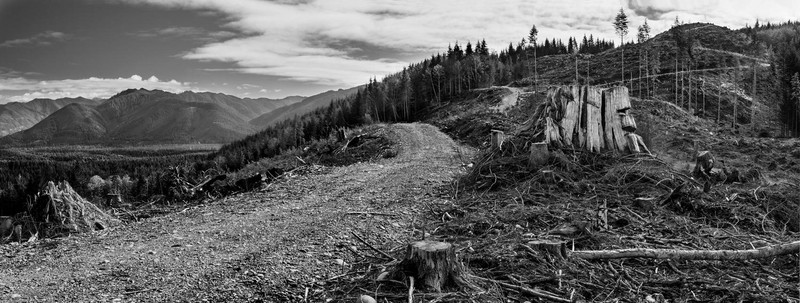
Clearcut hillside
Why companies use it:
- It is fast and efficient.
- It lowers labor and harvesting costs per unit of timber.
- Machinery can move easily when there are no trees left standing in the cut area.
One distinction students mix up all the time:
| Term | What it means |
|---|---|
| Clearcutting | A harvesting method. The forest may regrow naturally or be replanted. |
| Deforestation | Long-term loss of forest, often because the land is converted to farming, mining, roads, or cities. |
So clearcutting can lead to deforestation, but they are not the same thing. The core tradeoff in this topic is simple: economic efficiency comes with major ecological disturbance.
Forest Features That Are Removed
A forest is more than trees standing upright. When a stand is clear-cut, several protective structures disappear together.
Canopy
The canopy is the upper layer of branches and leaves.
- It intercepts rainfall before it hits the ground.
- It shades soil and nearby streams.
- It reduces solar heating.
- It provides habitat for many organisms.
Roots
Tree roots help hold the whole system together.
- They bind soil and reduce erosion.
- They help water infiltrate into the ground.
- They reduce slope instability.
Leaf litter and ground vegetation
This is the layer of fallen leaves, small plants, and ground cover.
- It protects soil from raindrop impact.
- It absorbs water and slows runoff.
- It helps maintain soil structure.
Living trees as biomass
Living trees are part of the carbon cycle and air quality.
- They store carbon dioxide as organic matter.
- They remove CO2 through photosynthesis.
- They absorb some pollutants and trap particulates from the air.
Environmental Effects of Clearcutting
Once those forest features are removed, the effects connect quickly.
Soil erosion
Soil erosion is one of the biggest impacts.
- Exposed soil gets hit directly by rain.
- Fewer roots and less leaf litter mean less protection and less stability.
- Machinery and logging roads can compact soil and channel runoff.
- Topsoil washes away more easily.
That sediment often enters streams, increasing turbidity and harming aquatic habitats.
Increased soil and stream temperatures
Without canopy shade, more sunlight reaches the ground and water.
- Soil heats up and loses moisture faster.
- Streams exposed to sunlight warm up too.
Warmer streams hold less dissolved oxygen, which can stress cold-water organisms.
Increased runoff and flooding
Forests normally slow water movement. Clearcutting removes that control.
- Less rainfall is intercepted by trees.
- Less transpiration means more water stays in the soil.
- Compacted or exposed soil often means less infiltration.
- More water runs over land into streams.
This raises storm peak discharge faster and increases downstream flood risk.
Carbon storage, carbon release, and air pollution
Forests are both carbon reservoirs and carbon sinks.
- Cutting trees removes future CO2 uptake.
- Burning trees or slash releases stored CO2 quickly.
- Decomposition of leftover roots and branches releases carbon more slowly.
- Fewer leaves also means less pollutant absorption and less trapping of airborne particles.
How the Effects Connect
This topic is often tested as a chain of cause and effect:
- Trees are removed for efficient timber harvest.
- Canopy, roots, and ground cover are lost.
- More sunlight reaches soil and streams, so temperatures rise.
- Less interception, transpiration, and infiltration cause faster runoff.
- Runoff erodes exposed soil and carries sediment into streams.
- Warmer water, sediment, and flashier flow reduce water quality and aquatic habitat.
- Burning or decomposition releases stored carbon, and fewer trees remain to absorb CO2.
- The result is short-term economic gain with broad ecosystem damage across the watershed.
The watershed diagram below ties several of those links together, especially the shift from forested upstream land to altered downstream water supply.
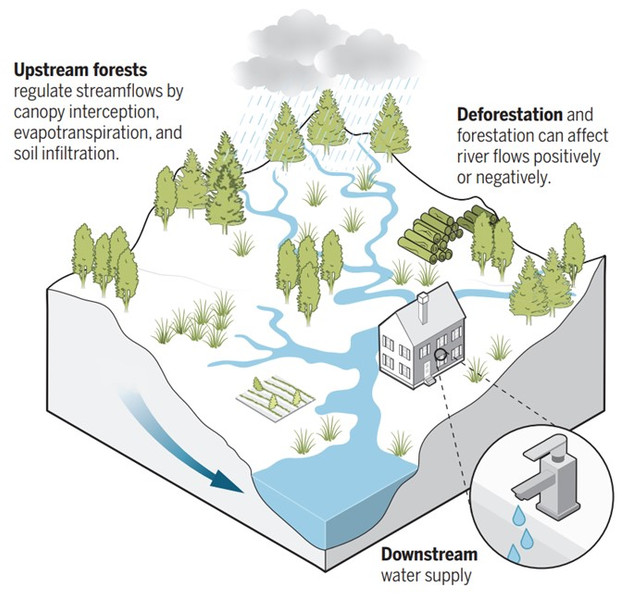
Forest cover and watershed flow
Why Clearcutting Matters
This topic shows a major APES idea. When humans use natural resources, they alter natural systems.
Forests provide key ecosystem services:
- carbon storage
- pollutant removal
- habitat
- erosion control
- water regulation
Even if the area regrows, those services drop right away after clearcutting. Regrowth is usually secondary succession because the soil remains, but a young replanted stand does not quickly replace a mature forest. Compared with selective cutting or leaving riparian buffer strips near streams, clearcutting causes more widespread disturbance even though it is cheaper and faster.
Key Takeaways
Clearcutting
A timber-harvesting method that removes all or nearly all trees in a stand at once; it can lower harvesting costs but increases erosion, soil and stream temperatures, runoff, flood risk, habitat loss, and atmospheric carbon dioxide while reducing pollutant absorption
Notes
Clearcutting
A timber-harvesting method that removes all or nearly all trees in a stand at once; it can lower harvesting costs but increases erosion, soil and stream temperatures, runoff, flood risk, habitat loss, and atmospheric carbon dioxide while reducing pollutant absorption
