Topic 7.4 Notes – Atmospheric CO₂ and Particulates
What Atmospheric CO₂ and Particulates Are
Atmospheric CO₂ is a gas. It is a normal part of the carbon cycle, which means carbon moves among the atmosphere, living things, soils, water, and rocks. A source releases carbon, and a sink absorbs more than it releases.
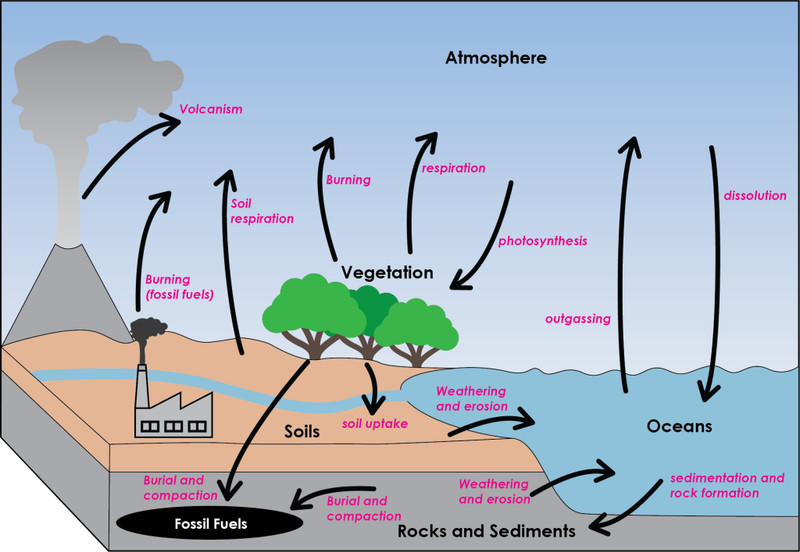
Carbon cycle diagram
Particulate matter is totally different. It is made of tiny solid particles or liquid droplets suspended in air.
A few distinctions matter a lot:
- Natural vs anthropogenic depends on the process that produced it, not the substance itself.
- CO₂ from respiration is natural.
- CO₂ from burning fossil fuels is anthropogenic.
- One event can release both.
- Volcanic eruptions release CO₂ gas and ash particles.
- Lightning-caused wildfires release CO₂, smoke, and ash.
- Atmospheric concentration is not the same as emission rate.
- A place can measure high pollution because of transport, poor mixing, or slow removal, even if the source is far away.
Natural Sources of Atmospheric CO₂
The main natural CO₂ sources you need here are respiration, decomposition, and volcanic activity.
Respiration
Cellular respiration happens in plants, animals, fungi, protists, and many microorganisms. In aerobic respiration, organisms use oxygen to break down organic molecules and release CO₂, water, and energy.
A common mistake is forgetting that plants also respire. They photosynthesize and respire. Whether an ecosystem is a net source or sink depends on the balance over time.
Decomposition
Decomposers, especially bacteria and fungi, break down dead organisms and wastes. Much of the CO₂ released during decomposition comes from the respiration of those decomposers.
- Aerobic decomposition releases CO₂.
- Anaerobic decomposition can release CO₂ and CH₄, especially in wetlands, waterlogged soils, and sediments.
- Warm, moist, oxygen-rich conditions usually speed decomposition.
Volcanic activity
CO₂ dissolved in magma escapes as pressure drops during eruptions or degassing. This carbon comes from geologic reservoirs, not recent biomass. Also, keep this straight on tests:
- Volcanic CO₂ = gas
- Volcanic ash = particulate matter
Other natural CO₂ sources
- Naturally ignited wildfires
- Surface waters and oceans releasing dissolved CO₂
- Soils releasing CO₂ from roots and microbes
Where Natural Particulates Come From
Particulate matter includes dust, ash, smoke, sea salt, pollen, spores, and liquid aerosols.
Size matters:
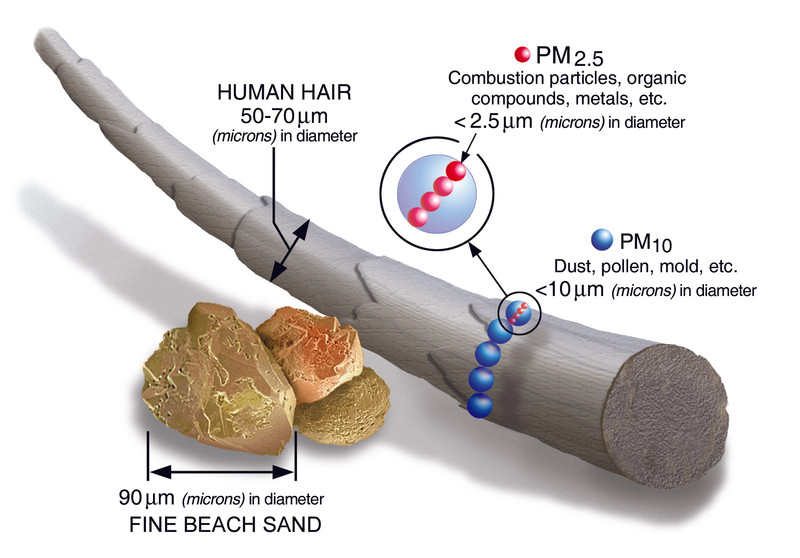
- PM₁₀ = particles micrometers or less
- PM₂.₅ = particles micrometers or less
Smaller particles stay suspended longer and travel farther. The size comparison below gives you a quick sense of how tiny PM₁₀ and PM₂.₅ are relative to a human hair and fine sand. Rain can remove particles from air.
Volcanic particles
Volcanoes release ash, pulverized rock, and droplets directly. They can also produce secondary particulates when sulfur dioxide forms sulfate aerosols.
- Primary PM = emitted directly
- Secondary PM = forms in the atmosphere
Windblown mineral dust
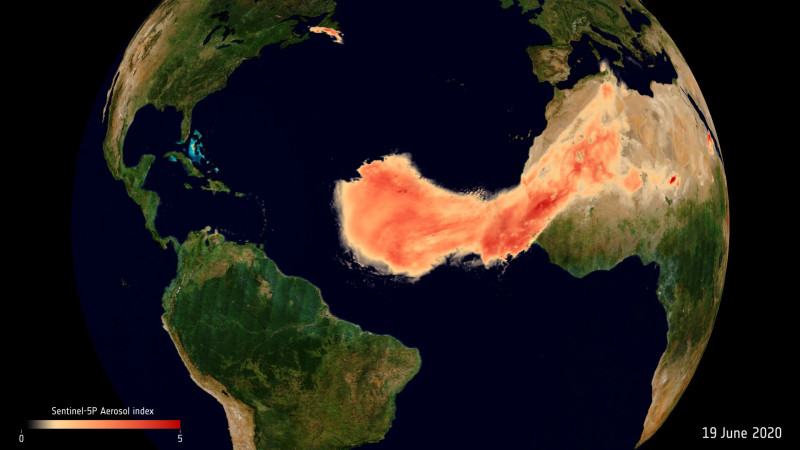
Strong winds lift dust from deserts, dry lake beds, beaches, and exposed soils. This is more likely when soils are dry and vegetation is sparse.
- Illustrative example: Saharan dust crossing the Atlantic Ocean
Wildfire smoke and ash
Naturally ignited wildfires release ash, soot, and fine smoke particles. The classification depends on what started the fire.
Sea spray
Breaking waves and bursting bubbles eject seawater droplets. These can stay liquid or evaporate and leave sea-salt particles behind.
Biological particles
Illustrative examples:
- Pollen grains
- Fungal spores
These often peak seasonally. Dry, windy weather helps dispersal, and rain temporarily removes them.
How These Sources Affect Air Measurements
Measured air concentration depends on more than emissions. It also depends on:
- transport by wind
- dispersion and atmospheric mixing
- topography
- precipitation
- particle size
That is why pollution can be measured far from its source, especially fine particles. Also, natural does not mean harmless, and the existence of natural emissions does not mean recent atmospheric changes are entirely natural.
How Scientists Measure CO₂ and Particulates
Measuring particulate matter
A common method is gravimetric sampling. Air is pulled through a pre-weighed filter, and the filter is weighed again.
Good design includes:
- size-selective inlets for PM₁₀ or PM₂.₅
- consistent flow rate and sampling time
- careful filter handling
- consistent sampling height
- blank filters to detect handling or humidity effects
Scientists may also use particle composition, wind direction, air-mass trajectories, and upwind vs downwind comparisons to identify sources.
Measuring CO₂ release from respiration or decomposition
A chamber is placed over soil or decomposing material, and scientists track CO₂ concentration over time.
- Upward slope on a CO₂ vs time graph = net CO₂ release
- Steeper slope = greater release rate
Strong design features include replicates, controls, calibrated sensors, equal sampling periods, and tracking temperature and soil moisture.
Key Takeaways
Carbon Source vs. Carbon Sink
A carbon source releases more carbon than it absorbs during a stated period; a carbon sink absorbs more than it releases
Cellular Respiration
In aerobic respiration, organisms use oxygen to extract energy from organic molecules and release their carbon as CO₂.
Decomposition
Breakdown of dead organisms, wastes, and other organic matter; aerobic decomposer respiration releases CO₂, while anaerobic decomposition can produce CO₂ and CH₄.
Volcanic Activity
Rising magma loses pressure and releases geological CO₂; volcanoes also eject particulate ash and emit SO₂ that can form sulfate aerosols
Ocean–Atmosphere CO₂ Exchange
Bidirectional transfer of CO₂ between surface water and air; water becomes a natural atmospheric source when it releases dissolved CO₂.
Soil Respiration
CO₂ released from soil by plant-root respiration and microbial respiration during decomposition
Particulate Matter (PM); Aerosols
Small solid particles or liquid droplets suspended in air, including dust, ash, smoke, sea salt, pollen, and spores; aerosol may also mean the entire suspension
Primary vs. Secondary Particulate Matter
Primary particles enter the atmosphere directly; secondary particles form there through reactions involving gaseous precursors
Windblown Mineral Dust
Soil and mineral particles lifted from dry, sparsely vegetated surfaces by strong winds and sometimes transported thousands of kilometers
Naturally Ignited Wildfires
Lightning-caused fires that release CO₂ through biomass combustion and particulate smoke, soot, organic particles, and ash
Sea Spray
Suspended seawater droplets and sea-salt particles produced when breaking waves and bursting bubbles eject seawater into the air
Bioaerosols
Airborne biological particles such as pollen, fungal spores, microorganisms, and fragments of plants or animals
PM₁₀
Inhalable particulate matter with an aerodynamic diameter of 10 micrometers or less
PM₂.₅
Fine particulate matter with an aerodynamic diameter of 2.5 micrometers or less
Notes
Carbon Source vs. Carbon Sink
A carbon source releases more carbon than it absorbs during a stated period; a carbon sink absorbs more than it releases
Cellular Respiration
In aerobic respiration, organisms use oxygen to extract energy from organic molecules and release their carbon as CO₂.
Decomposition
Breakdown of dead organisms, wastes, and other organic matter; aerobic decomposer respiration releases CO₂, while anaerobic decomposition can produce CO₂ and CH₄.
Volcanic Activity
Rising magma loses pressure and releases geological CO₂; volcanoes also eject particulate ash and emit SO₂ that can form sulfate aerosols
Ocean–Atmosphere CO₂ Exchange
Bidirectional transfer of CO₂ between surface water and air; water becomes a natural atmospheric source when it releases dissolved CO₂.
Soil Respiration
CO₂ released from soil by plant-root respiration and microbial respiration during decomposition
Particulate Matter (PM); Aerosols
Small solid particles or liquid droplets suspended in air, including dust, ash, smoke, sea salt, pollen, and spores; aerosol may also mean the entire suspension
Primary vs. Secondary Particulate Matter
Primary particles enter the atmosphere directly; secondary particles form there through reactions involving gaseous precursors
Windblown Mineral Dust
Soil and mineral particles lifted from dry, sparsely vegetated surfaces by strong winds and sometimes transported thousands of kilometers
Naturally Ignited Wildfires
Lightning-caused fires that release CO₂ through biomass combustion and particulate smoke, soot, organic particles, and ash
Sea Spray
Suspended seawater droplets and sea-salt particles produced when breaking waves and bursting bubbles eject seawater into the air
Bioaerosols
Airborne biological particles such as pollen, fungal spores, microorganisms, and fragments of plants or animals
PM₁₀
Inhalable particulate matter with an aerodynamic diameter of 10 micrometers or less
PM₂.₅
Fine particulate matter with an aerodynamic diameter of 2.5 micrometers or less
