Topic 7.5 Notes – Indoor Air Pollutants
What Indoor Air Pollutants Are
Indoor air pollutants are harmful gases, vapors, biological materials, or suspended particles inside enclosed spaces like homes, schools, and offices. Indoor exposure matters because pollutants can build up when ventilation is low, especially in tightly sealed buildings.
Indoor concentration depends on three things working together:
- Source strength: how much pollutant is released
- Building volume: how much air space it spreads through
- Air-exchange rate: how quickly indoor air is replaced
The course groups indoor pollutants by physical form:
- Gaseous pollutants include carbon monoxide, radon, nitrogen oxides, sulfur dioxide, and VOCs (volatile organic compounds, chemicals that evaporate easily).
- Particulate pollutants include asbestos, dust, and smoke.
- Biological pollutants include mold and biological material in dust.
The distinctions students mix up most:
- Carbon monoxide is an asphyxiant. It reduces oxygen delivery in the body.
- Radon is a radioactive gas linked to lung cancer.
- Asbestos is a fibrous particulate.
- Formaldehyde is a VOC.
Major Sources of Indoor Air Pollutants
The AP course uses three source groups.
Natural sources
- Radon-222 comes from the decay of uranium in some rocks and soils.
- It enters through foundation cracks, basement floors, gaps around pipes, crawl spaces, and sump openings.
- It can also come in through groundwater from private wells.
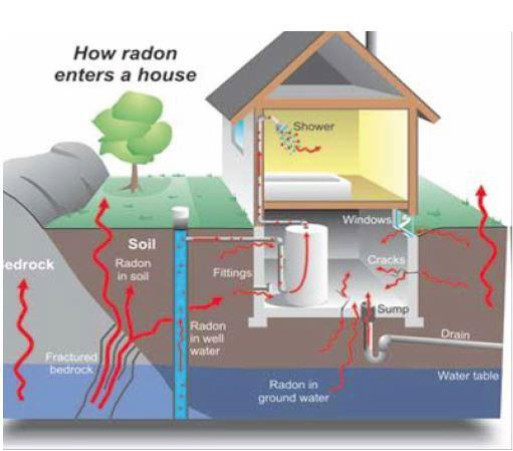
Radon entry pathways into a home
- Mold grows where moisture is present, such as leaks, flooding, condensation, or high humidity. It releases spores and fragments into the air.
- Dust is a particulate mixture that can include soil, pollen, fibers, skin cells, and biological material.
Human-made sources
- Insulation can be a source, especially in older materials.
- VOCs can off-gas from furniture, paneling, carpets, adhesives, cleaners, and pressed wood.
- Formaldehyde often comes from building materials, furniture, upholstery, and carpeting.
- Lead comes from old paints.
- Asbestos may be in older insulation, pipe coverings, ceiling materials, or floor materials.
A common test trap is lead. Lead does not usually evaporate into air. The main pathway is lead-containing dust or chips from deteriorating or disturbed paint.
Combustion sources
Common indoor combustion sources include furnaces, gas stoves, fireplaces, wood stoves, kerosene heaters, candles, generators, tobacco products, and attached garages with running vehicles.
These can release:
- Carbon monoxide
- Nitrogen oxides
- Sulfur dioxide
- Particulates
- Tobacco smoke
Key Pollutants and Their Health Effects
- Carbon monoxide is colorless and odorless and forms during incomplete combustion. Early symptoms include headache, dizziness, nausea, weakness, and confusion. Severe exposure can cause unconsciousness, brain injury, and death.
- Radon is inhaled, and its radioactive decay products damage lung tissue. It causes radon-induced lung cancer and is the second leading cause of lung cancer in America. Smoking plus radon raises risk a lot.
- Particulates such as asbestos, dust, and smoke can be inhaled. Smaller particles are more dangerous because they reach deeper into the lungs. Asbestos can cause asbestosis, lung cancer, and mesothelioma.
- VOCs and formaldehyde can irritate the eyes, nose, throat, and respiratory tract. They can also cause headaches, nausea, and sometimes cancer risk depending on the compound.
- Lead is a neurotoxin, especially dangerous for children because it harms brain development, learning, and behavior.
- Mold can trigger allergic reactions, coughing, wheezing, and asthma problems.
How Indoor Pollutants Build Up and How to Read Scenarios
A lot of AP questions are just asking you to trace a chain:
- Source
- Pollutant type
- Entry or release pathway
- Exposure
- Health effect
Common patterns:
- Uranium in soil → radon gas → foundation cracks or well water → inhalation → lung cancer risk
- Malfunctioning fuel-burning appliance → carbon monoxide → indoor buildup → inhalation → oxygen deprivation
- Damaged asbestos material → airborne fibers → inhalation → chronic lung disease
- New carpet, furniture, or paneling → VOC off-gassing → buildup in sealed building → irritation and headaches
Low ventilation increases accumulation. That idea connects to sick building syndrome, which means nonspecific symptoms like headache, irritation, dizziness, or fatigue that are tied to time spent in a building. Common causes include low ventilation plus VOCs, mold, dust, smoke, or office/building emissions.
Prevention and Control
Control works best when it matches the source or pathway.
- Increase controlled ventilation and filtration to reduce buildup.
- Maintain and properly vent combustion appliances.
- Use carbon monoxide detectors.
- Test homes for radon, especially at the lowest occupied level.
- Sub-slab depressurization is the main radon fix. Sealing cracks helps, but usually is not enough by itself.
- Fix moisture problems to control mold.
- Choose low-VOC materials and let new materials off-gas in ventilated conditions.
- Do not disturb asbestos. Use trained professionals for inspection or removal.
- Stabilize or safely remove lead paint and control dust during renovation.
- Remove tobacco smoke sources. Ordinary ventilation is much less effective.
Key Takeaways
Indoor Air Pollution
Harmful gases, vapors, biological materials, or suspended particles present inside enclosed structures
Particulate Indoor Pollutants
Small solid particles or liquid droplets suspended in indoor air, including asbestos fibers, dust, and smoke
Carbon Monoxide (CO)
Colorless, odorless asphyxiant gas from incomplete combustion that binds to hemoglobin, reducing oxygen transport and potentially causing unconsciousness or death
Asphyxiant
A substance that interferes with the body's delivery or use of oxygen; carbon monoxide is an example
Radon-222
Naturally occurring radioactive gas from uranium decay that can enter through foundations or well water and is the second leading U.S. cause of lung cancer
Mold
A common natural-source indoor pollutant consisting of moisture-dependent fungi that release spores, fragments, and allergens and can aggravate respiratory conditions
Dust
A particulate mixture that may contain soil, fibers, pollen, biological material, combustion particles, and particles from deteriorating materials
Asbestos
Heat-resistant fibrous minerals used in older building materials whose airborne fibers can cause asbestosis, lung cancer, and mesothelioma when inhaled
Volatile Organic Compounds (VOCs)
Carbon-containing chemicals that readily evaporate at indoor temperatures and may be emitted by paints, cleaners, furnishings, paneling, carpeting, and adhesives
Off-Gassing
The release of volatile chemicals from a material into the surrounding air
Formaldehyde
A common irritating VOC emitted by pressed wood, adhesives, building materials, furniture, upholstery, and carpeting
Nitrogen Oxides (NOx)
Respiratory-irritating gases produced by high-temperature combustion and released indoors by fuel-burning appliances
Sulfur Dioxide (SO2)
A respiratory-irritating gas produced when sulfur-containing fuels are burned
Tobacco Smoke
A combustion-generated mixture containing carbon monoxide, fine particles, VOCs, and carcinogens that damages respiratory and cardiovascular health
Secondhand Smoke
Exposure of nonsmokers to pollutants from burning tobacco and smoke exhaled by tobacco users
Sick Building Syndrome
Nonspecific symptoms associated with time in a building, often linked to inadequate ventilation or accumulated pollutants and relieved after leaving
Lead from Paint
Neurotoxic lead particles released as chips or dust when older lead-based paint deteriorates or is disturbed, especially hazardous to children
Notes
Indoor Air Pollution
Harmful gases, vapors, biological materials, or suspended particles present inside enclosed structures
Particulate Indoor Pollutants
Small solid particles or liquid droplets suspended in indoor air, including asbestos fibers, dust, and smoke
Carbon Monoxide (CO)
Colorless, odorless asphyxiant gas from incomplete combustion that binds to hemoglobin, reducing oxygen transport and potentially causing unconsciousness or death
Asphyxiant
A substance that interferes with the body's delivery or use of oxygen; carbon monoxide is an example
Radon-222
Naturally occurring radioactive gas from uranium decay that can enter through foundations or well water and is the second leading U.S. cause of lung cancer
Mold
A common natural-source indoor pollutant consisting of moisture-dependent fungi that release spores, fragments, and allergens and can aggravate respiratory conditions
Dust
A particulate mixture that may contain soil, fibers, pollen, biological material, combustion particles, and particles from deteriorating materials
Asbestos
Heat-resistant fibrous minerals used in older building materials whose airborne fibers can cause asbestosis, lung cancer, and mesothelioma when inhaled
Volatile Organic Compounds (VOCs)
Carbon-containing chemicals that readily evaporate at indoor temperatures and may be emitted by paints, cleaners, furnishings, paneling, carpeting, and adhesives
Off-Gassing
The release of volatile chemicals from a material into the surrounding air
Formaldehyde
A common irritating VOC emitted by pressed wood, adhesives, building materials, furniture, upholstery, and carpeting
Nitrogen Oxides (NOx)
Respiratory-irritating gases produced by high-temperature combustion and released indoors by fuel-burning appliances
Sulfur Dioxide (SO2)
A respiratory-irritating gas produced when sulfur-containing fuels are burned
Tobacco Smoke
A combustion-generated mixture containing carbon monoxide, fine particles, VOCs, and carcinogens that damages respiratory and cardiovascular health
Secondhand Smoke
Exposure of nonsmokers to pollutants from burning tobacco and smoke exhaled by tobacco users
Sick Building Syndrome
Nonspecific symptoms associated with time in a building, often linked to inadequate ventilation or accumulated pollutants and relieved after leaving
Lead from Paint
Neurotoxic lead particles released as chips or dust when older lead-based paint deteriorates or is disturbed, especially hazardous to children
