Topic 5.4 Notes – Impact of Agricultural Practices
How Farming Practices Damage Soil and Water
The pattern tying this topic together is simple. Farming practices can help crops now and harm the environment later. The damage usually begins when one of three things happens:
- Soil cover is removed so wind and rain can carry soil away.
- Soil is disturbed so its structure breaks down.
- Nutrients are added in excess and leave the field.
The three practices you need to know are:
- Tilling which turns and mixes soil
- Slash-and-burn farming which clears land by cutting and burning vegetation
- Fertilizer use which adds nutrients such as nitrogen, phosphorus, and potassium
A big APES idea here is that the impact does not stay on the farm. Soil, nutrients, smoke, and gases move into streams, lakes, groundwater, the atmosphere, and nearby habitats.
The Three Major Damaging Practices
Tilling
Tilling is mechanical turning or mixing of soil before or during planting.
Short-term benefits:
- Easier planting
- Weed control
- More air in the soil
- Temporary nutrient release as organic matter breaks down
The main environmental cost is erosion.
Why erosion increases after tilling:
- Less vegetation and crop residue protect the soil
- Soil aggregates break apart
- Loose particles are exposed to wind and water
What topsoil loss causes:
- Lower fertility
- Less organic matter
- Lower water-holding capacity
- Shallower rooting depth
- Fewer soil organisms
Off-site effects matter too:
- Sediment enters streams and lakes
- Turbidity rises, so less light reaches aquatic plants
- Sediment can bury habitats
Repeated tilling also speeds decomposition of soil organic matter, releases CO2, and can create compaction below the surface.
The Dust Bowl is the classic example. Plowed Great Plains soil, drought, and wind led to massive topsoil loss.
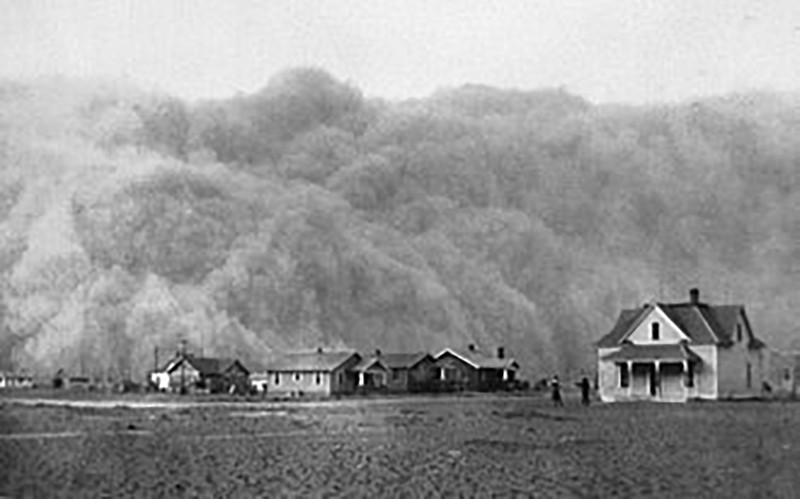
Dust Bowl dust storm
Slash-and-burn farming
In slash-and-burn farming, vegetation is cut, dried, and burned, then crops are planted.
Short-term benefits:
- Fast land clearing
- Less labor
- Ash gives a temporary nutrient pulse
- Ash can raise soil pH
That nutrient gain does not last. Nutrients are lost by:
- Runoff
- Leaching
- Harvest removal
- Volatilization during burning
This is especially damaging in tropical forests because many nutrients are stored in the biomass rather than deep soil. Once the forest is gone, the nutrient cycle breaks down fast.
Major effects:
- Deforestation
- Habitat fragmentation
- Biodiversity loss
- Erosion and runoff
- Loss of soil organic matter
- Reduced infiltration
- Smoke and particulate pollution
- CO2 release
- Lower long-term carbon storage
Shifting cultivation can be less damaging if fallow periods are long enough for forest recovery. Trouble starts when land is cleared faster than it can regenerate.
The key example is the Amazon Basin, where forest clearing and burning can leave smoke rising along the edge of newly deforested land.
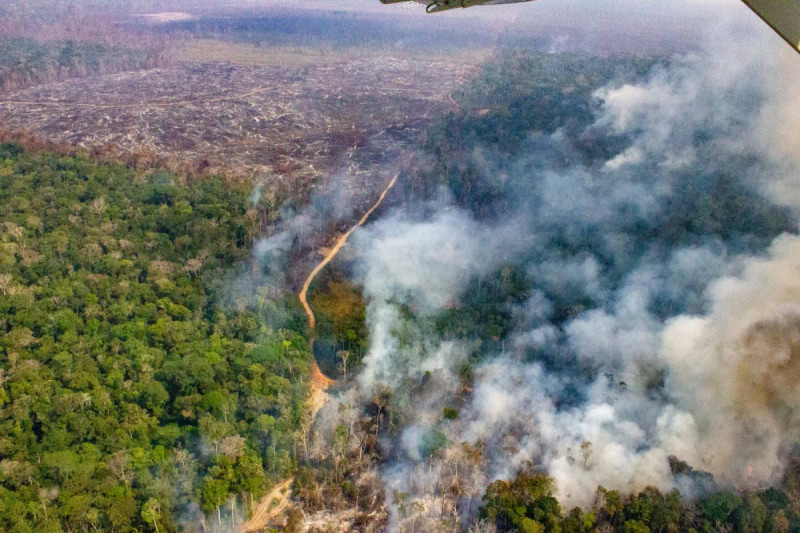
Slash-and-burn clearing in the Amazon
Fertilizer use
Fertilizers add nutrients, especially N-P-K or nitrogen, phosphorus, and potassium.
Both synthetic fertilizers and organic sources like manure or compost can pollute if too much is applied. The issue is not the source. The issue is excess nutrients leaving the field.
Main pathways:
- Runoff
- Erosion
- Leaching
- Atmospheric release
How Fertilizer Pollution Happens
This process often shows up in MCQs and FRQs as a cause-and-effect chain. The diagram below follows that sequence from nutrient runoff to oxygen depletion in the water.
- Fertilizer is applied to land.
- Crops do not absorb all of it.
- Nutrients leave the field.
- Runoff and erosion move nutrients into surface water.
- Leaching moves soluble nitrate into groundwater.
- Extra nitrogen and phosphorus reach lakes, rivers, or coasts.
- Algae and aquatic plants grow rapidly.
- They die.
- Decomposers break down the dead material and use oxygen.
- Dissolved oxygen drops.
- Hypoxia or a dead zone can form.
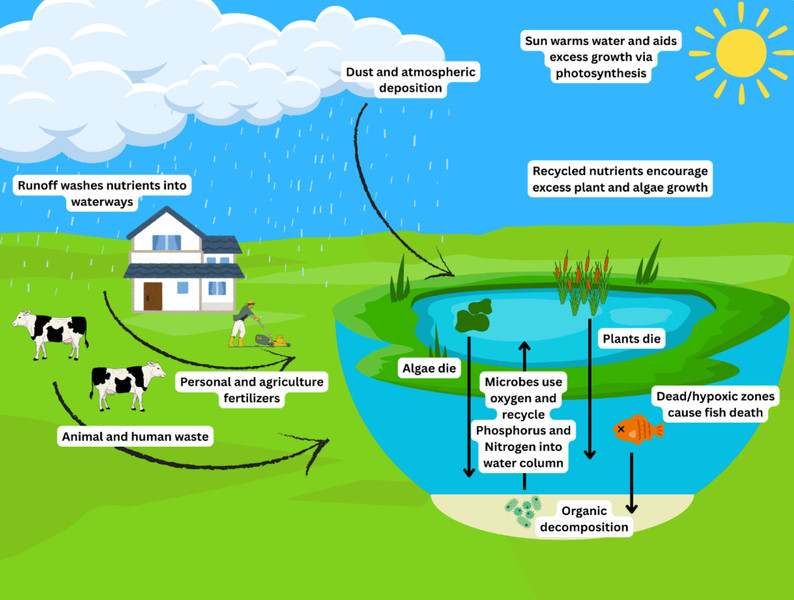
Eutrophication and dead zone formation
A common mistake is saying algae alone remove the oxygen. The oxygen drop happens mainly because decomposition uses it up.
Other fertilizer effects:
- Soil microbes can convert nitrogen fertilizer into nitrous oxide , a greenhouse gas.
- Ammonia can volatilize into the air.
- Repeated fertilization can acidify soil.
- Excess salts can damage roots.
The standard example is the Gulf of Mexico dead zone, fed by nutrients from the Mississippi River watershed.
Why These Practices Matter Together
These three practices work together by disrupting nutrient cycling and reducing the land’s ability to hold soil, water, and carbon.
A classic case looks like this:
- A field is tilled and left bare
- Fertilizer is added
- Heavy rain washes away topsoil and nutrients
That one storm can lead to:
- Declining soil quality
- Water pollution
- Hypoxia
- Habitat loss
- Biodiversity decline
- Air pollution
- Greenhouse gas emissions
On a test, you usually need to do three things clearly. Name the practice, give its short-term farming benefit, and explain the specific environmental damage it causes.
Key Takeaways
Tilling (Plowing)
Mechanical digging, turning, or mixing of soil that prepares fields but removes protective cover, breaks soil aggregates, and increases erosion and topsoil loss
Slash-and-Burn Farming
Clearing land by cutting, drying, and burning vegetation; ash briefly supplies nutrients, but clearing causes nutrient loss, erosion, habitat loss, and carbon emissions
Shifting Cultivation
Cultivating a cleared plot briefly and then leaving it fallow to recover; shortened fallow periods cause greater degradation and repeated deforestation
Fertilizer Use
Adding nutrients to increase crop growth; nutrients applied beyond crop uptake can pollute groundwater, surface water, soil, and the atmosphere
Leaching
Downward movement of dissolved substances through soil, which can carry highly soluble nitrate below roots and into groundwater
Cultural Eutrophication
Human-caused nutrient enrichment of water that increases algal or plant growth, whose decomposition consumes dissolved oxygen
Hypoxia
A condition of abnormally low dissolved oxygen, often produced when decomposers consume oxygen while breaking down nutrient-stimulated biomass
Dead Zone
An aquatic area where dissolved oxygen is too low to support many animals, often as a severe result of nutrient enrichment and decomposition
Notes
Tilling (Plowing)
Mechanical digging, turning, or mixing of soil that prepares fields but removes protective cover, breaks soil aggregates, and increases erosion and topsoil loss
Slash-and-Burn Farming
Clearing land by cutting, drying, and burning vegetation; ash briefly supplies nutrients, but clearing causes nutrient loss, erosion, habitat loss, and carbon emissions
Shifting Cultivation
Cultivating a cleared plot briefly and then leaving it fallow to recover; shortened fallow periods cause greater degradation and repeated deforestation
Fertilizer Use
Adding nutrients to increase crop growth; nutrients applied beyond crop uptake can pollute groundwater, surface water, soil, and the atmosphere
Leaching
Downward movement of dissolved substances through soil, which can carry highly soluble nitrate below roots and into groundwater
Cultural Eutrophication
Human-caused nutrient enrichment of water that increases algal or plant growth, whose decomposition consumes dissolved oxygen
Hypoxia
A condition of abnormally low dissolved oxygen, often produced when decomposers consume oxygen while breaking down nutrient-stimulated biomass
Dead Zone
An aquatic area where dissolved oxygen is too low to support many animals, often as a severe result of nutrient enrichment and decomposition
