Topic 8.4 Notes – Human Impacts on Wetlands and Mangroves
What Wetlands and Mangroves Are
A wetland is land where water covers the soil part or all of the time. It does not need standing water all year. Seasonal flooding still counts if the area stays wet long enough to create wetland conditions.
Those conditions usually include:
- the water table at or near the surface
- waterlogged soils
- low oxygen in the soil, because water fills the spaces where air would normally be
That low-oxygen soil is why wetlands have special plants and animals adapted to it. Wetlands also occur along a gradient from open water into drier upland areas, with different plant communities dominating different zones.
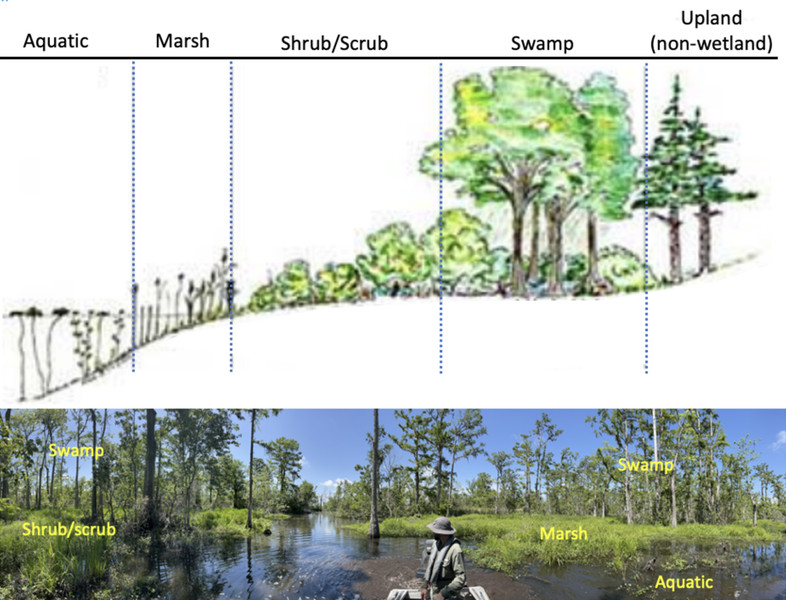
Wetland zones from aquatic habitat to upland
Marshes
Marshes are wetlands dominated by grasses and other nonwoody plants.
Swamps
Swamps are wetlands dominated by woody plants such as trees and shrubs.
Mangrove wetlands
Mangroves are coastal wetlands in tropical and subtropical intertidal zones. They have salt-tolerant trees and shrubs growing in soft, muddy, oxygen-poor, salty sediment. Their root systems help them anchor and get oxygen.
Hydrology matters here because the movement, timing, depth, and duration of water determine whether wetland conditions stay in place.
What Services Wetlands and Mangroves Provide
Wetlands matter because they provide water filtration and purification, flood protection, and habitat. Mangroves add major coastal benefits like shoreline stabilization and fishery support.
Water filtration and purification
As water moves through a wetland, it slows down.
- Filtration means sediment settles out and gets physically trapped.
- Pollutants attached to that sediment can also be trapped.
- Wetland plants take up nitrogen and phosphorus.
- Microorganisms can break down or transform some pollutants.
Purification is broader than filtration. It includes trapping plus biological and chemical processing.
Flood protection and water storage
Wetlands act like temporary sponges.
- They store water during storms or floods.
- They release it more slowly.
- This lowers and delays peak discharge downstream.
Mangroves also reduce wave energy and storm surge impacts.
Habitat and biodiversity support
Wetlands provide:
- feeding
- breeding
- spawning
- nursery
- resting
- shelter habitat
Amphibians, birds, fish, invertebrates, reptiles, and mammals use wetlands. Mangrove roots are especially important as nursery habitat for juvenile fish and crustaceans, which connects mangroves directly to commercial and subsistence fisheries.
Shoreline stabilization
Mangrove roots trap sediment and reduce coastal erosion.
Major Human Threats to Wetlands and Mangroves
Commercial development
Development often drains, fills, dredges, clears, or paves wetlands.
- direct habitat loss and fragmentation
- less water storage
- more runoff
- higher flooding risk
Mangroves are often cleared for resorts, ports, marinas, and aquaculture ponds.
Dam construction and altered hydrology
Dams change downstream flooding patterns, sediment delivery, and connectivity.
- wetlands may shrink or dry out
- plant communities may change
- fish migration can be disrupted
The Everglades are a classic example. Canals, levees, drainage, and water diversion changed the natural flow of water.
Overfishing
Overfishing removes organisms faster than they can recover. That disrupts food webs and weakens the mangrove nursery to fishery connection.
Agricultural pollution
This is usually nonpoint source pollution.
Runoff can carry:
- sediment
- fertilizers
- pesticides and herbicides
- animal waste
- pathogens
Sediment raises turbidity and can bury habitat. Excess nitrogen and phosphorus can cause algal growth and then low dissolved oxygen.
Industrial pollution
Industrial pollution can enter through discharge, spills, runoff, atmospheric deposition, or groundwater.
Possible contaminants include:
- acids
- petroleum
- solvents
- heavy metals
- other toxic chemicals
These can cause death, stress, reproductive failure, and long-term contaminated sediment.
How Wetland Loss Causes Environmental Damage
This gets tested as a cause-and-effect chain.
The diagram pulls both chains together, so use it to connect the steps for wetlands and mangroves.
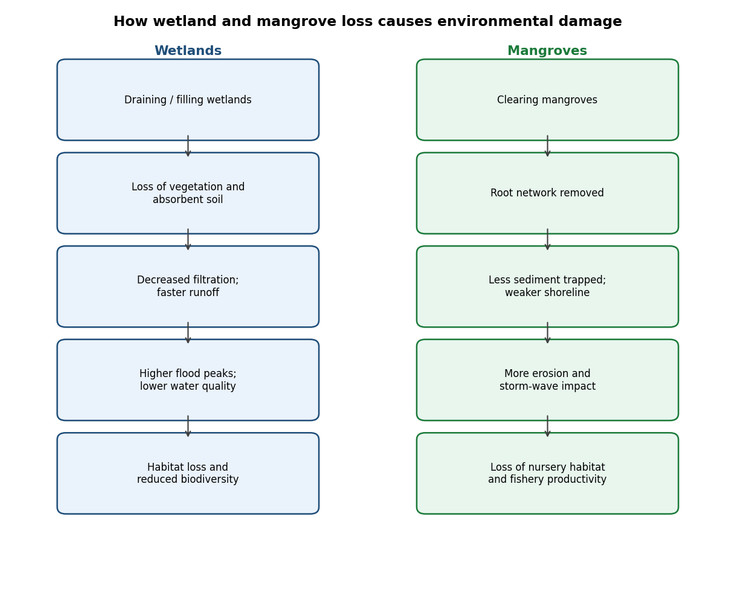
Wetland and mangrove loss cause-and-effect chains
When wetlands are drained or filled:
- Vegetation and absorbent soil are lost.
- Filtration and purification decrease.
- Runoff moves faster.
- Flood peaks downstream get higher.
- Habitat is lost and biodiversity drops.
When mangroves are cleared:
- The root network is removed.
- Less sediment is trapped.
- Shorelines erode more easily.
- Waves and storm impacts get stronger.
- Nursery habitat is lost.
- Fishery productivity falls.
Protecting and Restoring Wetlands and Mangroves
The best logic is avoid damage first, then minimize it, then restore.
Limiting direct destruction
Protection can include zoning, protected areas, setbacks, conservation easements, and rules on dredging, filling, and clearing.
Restoring hydrology and vegetation
Restoration may involve removing drainage structures, reconnecting floodplains, restoring tidal flow, and planting native vegetation. Fixing the water conditions first is usually the most important part.
Reducing pollution at the source
Agricultural BMPs include buffer strips, better fertilizer timing and rates, erosion control, and animal waste management. Industrial fixes include wastewater treatment, spill prevention, and discharge limits.
Constructed wetlands can help treat runoff or wastewater, but they do not replace natural wetlands.
Managing dams and fisheries
Managers can use environmental flow releases, limit withdrawals, or sometimes remove dams. Fisheries can be protected with catch limits, size limits, seasonal closures, protected nursery areas, and marine reserves.
Key Takeaways
Wetland
An area where water covers or saturates the soil for part or all of the time, producing waterlogged conditions that favor organisms adapted to low-oxygen soils
Mangroves
Salt-tolerant trees and shrubs adapted to sheltered tropical and subtropical coastal intertidal wetlands
Ecosystem Services
Ecological processes and resources that benefit ecosystems and people; wetland services include water filtration and purification, flood protection, habitat, and shoreline stabilization
Wetland Water Filtration
Physical trapping of suspended sediment and attached pollutants as vegetation, roots, and shallow ground slow water
Wetland Water Purification
Improvement of water quality through physical trapping, plant uptake of nutrients, and microbial transformation or breakdown of pollutants
Wetland Flood Protection
Temporary storage and gradual release of floodwater lowers peak discharge; coastal wetlands and mangroves also dissipate waves and storm surge and stabilize shorelines
Wetland Habitat
Feeding, breeding, spawning, nursery, resting, and sheltering habitat that supports biodiversity and aquatic food webs
Commercial Development of Wetlands
Draining, filling, dredging, clearing, or paving wetlands for construction, causing habitat loss, altered water flow, reduced filtration and storage, and greater flooding or erosion
Dam Construction and Wetlands
Dams alter the amount, timing, and distribution of water, sediment, nutrients, and organisms, causing downstream wetlands to shrink, dry, change communities, or lose connectivity
Overfishing in Wetlands and Mangroves
Harvesting organisms faster than they reproduce, reducing populations and disrupting predator–prey relationships, biodiversity, food webs, and fisheries
Agricultural Pollution of Wetlands
Nonpoint runoff of sediment, fertilizers, pesticides, animal waste, and pathogens that increases turbidity, toxicity, nutrient enrichment, oxygen depletion, and habitat degradation
Industrial Pollution of Wetlands
Industrial acids, petroleum, solvents, heavy metals, and other wastes that contaminate water and sediment, alter chemical conditions, and harm survival, growth, development, or reproduction
Notes
Wetland
An area where water covers or saturates the soil for part or all of the time, producing waterlogged conditions that favor organisms adapted to low-oxygen soils
Mangroves
Salt-tolerant trees and shrubs adapted to sheltered tropical and subtropical coastal intertidal wetlands
Ecosystem Services
Ecological processes and resources that benefit ecosystems and people; wetland services include water filtration and purification, flood protection, habitat, and shoreline stabilization
Wetland Water Filtration
Physical trapping of suspended sediment and attached pollutants as vegetation, roots, and shallow ground slow water
Wetland Water Purification
Improvement of water quality through physical trapping, plant uptake of nutrients, and microbial transformation or breakdown of pollutants
Wetland Flood Protection
Temporary storage and gradual release of floodwater lowers peak discharge; coastal wetlands and mangroves also dissipate waves and storm surge and stabilize shorelines
Wetland Habitat
Feeding, breeding, spawning, nursery, resting, and sheltering habitat that supports biodiversity and aquatic food webs
Commercial Development of Wetlands
Draining, filling, dredging, clearing, or paving wetlands for construction, causing habitat loss, altered water flow, reduced filtration and storage, and greater flooding or erosion
Dam Construction and Wetlands
Dams alter the amount, timing, and distribution of water, sediment, nutrients, and organisms, causing downstream wetlands to shrink, dry, change communities, or lose connectivity
Overfishing in Wetlands and Mangroves
Harvesting organisms faster than they reproduce, reducing populations and disrupting predator–prey relationships, biodiversity, food webs, and fisheries
Agricultural Pollution of Wetlands
Nonpoint runoff of sediment, fertilizers, pesticides, animal waste, and pathogens that increases turbidity, toxicity, nutrient enrichment, oxygen depletion, and habitat degradation
Industrial Pollution of Wetlands
Industrial acids, petroleum, solvents, heavy metals, and other wastes that contaminate water and sediment, alter chemical conditions, and harm survival, growth, development, or reproduction
