Topic 1.1 Notes – Contextualizing Period 1
What Period 1 Is About
This period begins in 1491, which matters because Native societies were already old, organized, and connected long before Columbus. It begins in 1492 only in the sense of sustained transatlantic contact, not the beginning of history in the Americas.
It ends in 1607 with Jamestown, the first permanent English colony. Spain had settled earlier, including St. Augustine (1565), but Jamestown starts enduring English colonization.
The core idea is simple. APUSH starts with the meeting of three developed worlds:
- Native American societies across North America
- European states expanding across the Atlantic
- African societies drawn into the Atlantic world
For now, focus on the first of those worlds. This map previews the major Native cultural regions and helps you see how much diversity existed in North America before sustained contact.
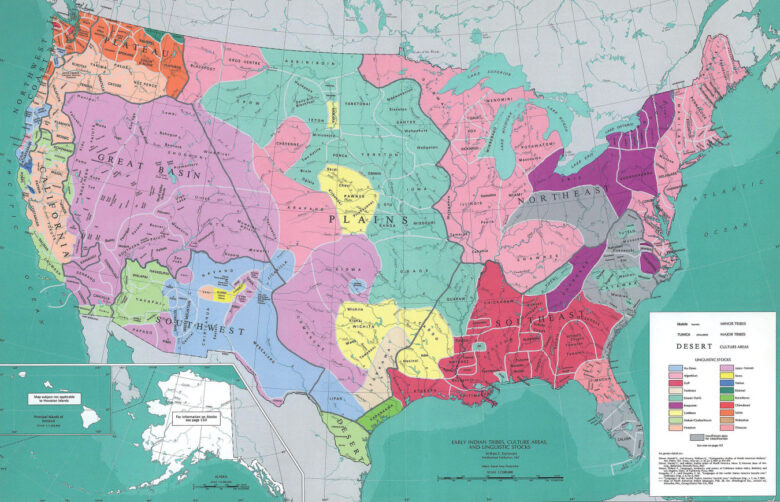
Native cultural regions in North America before sustained contact
Native Societies in North America Before Sustained Contact
North America was never one single Native culture. It held many peoples with different languages, economies, political systems, and religions. What ties them together is adaptation. Native societies used their environments actively through farming, irrigation, controlled burning, hunting, trade, and settlement building.
Maize was a major turning point. As it spread north from Mesoamerica, it supported bigger populations, permanent villages, specialized labor, and more complex leadership.
Regional patterns
- Southwest
Pueblo peoples built permanent settlements in dry lands. Irrigation and maize farming made life possible in an arid climate. - Great Basin and parts of the western Great Plains
Dry conditions and scattered resources encouraged more mobile lifestyles. - Northeast, Atlantic seaboard, and Mississippi River Valley
Many groups used mixed economies of farming, hunting, fishing, and gathering. Maize, beans, and squash were central crops. - Northwest Coast
Rich fish and forest resources supported settled communities and clear social hierarchies even without large-scale farming. - California
Diverse environments supported intensive hunting, fishing, and gathering.
Cahokia
A great example of Native complexity is Cahokia, a Mississippian urban center near present-day St. Louis. This reconstruction highlights the large central mound, broad plazas, defensive palisade, and dense surrounding settlement that made Cahokia one of the largest urban centers in pre-Columbian North America. It declined before 1491, which is the point. Native history in North America ran deep before Europeans arrived.
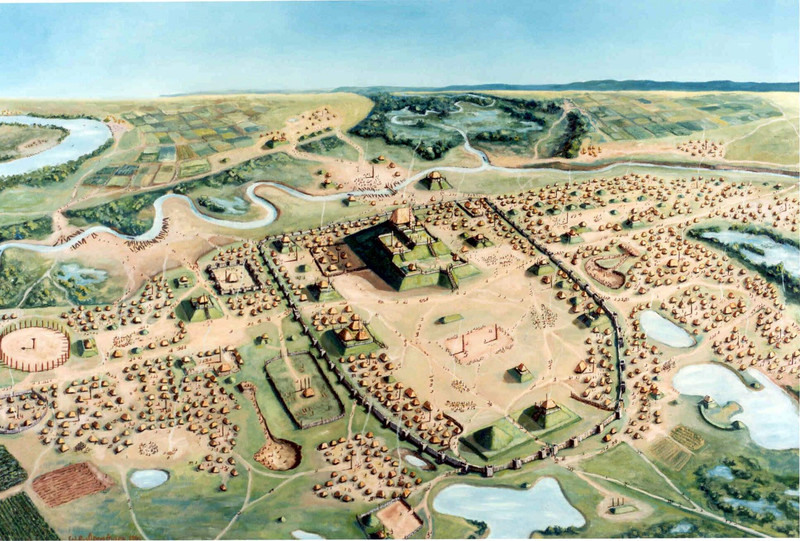
Reconstruction of Cahokia
Why Europeans Expanded into the Atlantic
Europeans crossed the Atlantic because several changes came together at once.
- Stronger monarchies could pay for voyages and claim land. Spain under Ferdinand and Isabella is the classic example.
- Political rivalry pushed states to compete. Portugal explored Africa first, then England, France, and the Netherlands challenged Iberian power. The Treaty of Tordesillas (1494) split claims between Spain and Portugal.
- Economic motives mattered a lot. Europeans wanted direct access to Asian goods like spices and silk. Growing capitalism encouraged investment for profit, and mercantilism linked colonies to state wealth and power.
- Religion mattered too. The Reconquista ended in 1492, strengthening Spain’s Christian mission mindset. After 1517, the Protestant Reformation sharpened religious rivalry.
- Technology made expansion possible. Know caravel, compass, astrolabe, improved maps, and knowledge of winds and currents.
Landmarks often grouped together on tests:
- Columbus, 1492
- John Cabot, 1497
- Roanoke, 1585 and 1587
- Jamestown, 1607
Africa and the Atlantic World Europeans Created
West and West-Central Africa already had states, cities, trade networks, and forms of slavery before major European involvement. Africa was not just a place Europeans took labor from.
Portugal’s coastal trade and Atlantic island sugar plantations helped create the plantation model. That system tied together export crops, investment, and coerced labor. As demand grew in American mines and plantations, Europeans expanded slavery’s scale and made it more racialized. Africans entered the Americas through forced migration, but they were part of the Atlantic world as people with their own societies and histories.
What Contact Changed Across the Atlantic
The Columbian Exchange connected all three regions.
| From the Americas | To the Americas |
|---|---|
| maize, potatoes, tomatoes, cacao, peppers, gold, silver | wheat, sugarcane, rice, horses, cattle, pigs, sheep, diseases |
The deadliest transfer was disease, especially smallpox, measles, and influenza.
Spain built the first major empire in the Americas. Cortés defeated the Aztec with Indigenous allies in 1519-1521. Pizarro conquered the Inca in 1532-1533. The encomienda system gave colonists the right to demand Native labor or tribute.
Colonial society became hierarchical:
- peninsulares = born in Spain
- creoles = Spanish ancestry, born in the Americas
- mestizos = mixed European and Native ancestry
- mulattoes = mixed European and African ancestry
Different ideas about land, religion, gender, and family shaped contact. Native peoples responded in many ways, including resistance, diplomacy, trade, alliance, and adaptation. Contact changed everyone, but the effects were unequal. Native populations faced catastrophe, and Africans were pulled in through coercion.
