Topic 1.6 Notes – Cultural Interactions Between Europeans, Native Americans, and Africans
How Europeans, Native Americans, and Africans Saw One Another
First contact brought curiosity and misunderstanding at the same time. None of these groups were uniform. “Europeans,” “Native Americans,” and “Africans” each included many different peoples with different languages, beliefs, and goals.
- Europeans often described Native peoples in opposite ways at once. They could be seen as possible converts, useful allies, or “uncivilized” obstacles to land and empire.
- Native peoples often treated Europeans as trading partners, military allies, or dangerous intruders inside existing Native rivalries.
- Africans entered this world through trade, coercion, and enslavement. Over time, Europeans tied African ancestry more and more closely to forced labor.
- The key pattern is ugly but important. Greater contact did not create equality. It often gave Europeans better knowledge to use for domination.
A classic example is the conquest of the Mexica Empire. Spain did not win by Spanish strength alone. Tlaxcalan allies helped Cortés because they had their own reasons to fight Mexica power. Malintzin also called Doña Marina or La Malinche made that conquest possible as an interpreter, adviser, and cultural broker.
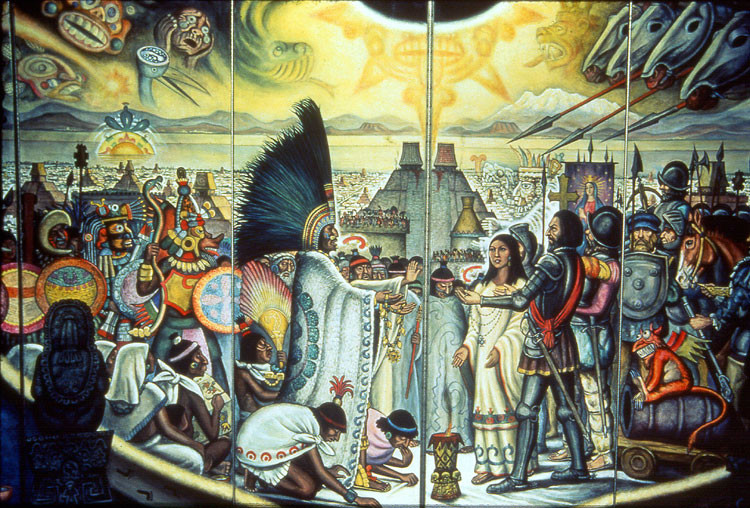
Conquest of the Mexica Empire
Divergent Worldviews
These groups kept running into conflict because they meant different things when they talked about faith, land, family, and power.
Religion
Europeans believed Christianity was the one true religion and pushed conversion through missions. Many Native religions tied spiritual life to nature, ancestors, ceremony, and sacred places, so Europeans often dismissed them as superstition.
Some Native people rejected Christianity. Others adopted parts of it and blended beliefs.
- Virgin of Guadalupe connects to this. Tradition says Mary appeared to Juan Diego in 1531 at Tepeyac. Guadalupe became a Catholic symbol with Indigenous meaning too.
- Africans also adapted Christianity while keeping parts of African spiritual traditions.
Land use and ownership
Europeans usually thought land should be owned privately, fenced, sold, and transferred permanently. Native peoples had territorial rights too, but often emphasized shared use, stewardship, and layered access.
That difference caused constant trouble. A European “purchase” might mean total ownership forever. A Native community might mean shared use or alliance. Settlers made conflict worse by farming permanently, fencing land, and letting livestock roam.
Gender roles and family organization
European society was mostly patriarchal, with male-headed households. Many Native societies relied on extended kin networks, and some were matrilineal.
- Among the Haudenosaunee, women and clan mothers had major power in agriculture, kinship, and choosing leaders.
Europeans often misread Native labor patterns and gender roles as disorder because they judged them by European standards.
Political authority
Europeans expected kings, hierarchy, and written law. Native political systems ranged from empires to village councils to confederacies. Many leaders ruled by consensus or limited authority, so Europeans often misunderstood what Native leaders could actually promise.
Trade, Cultural Exchange, and Cultural Brokers
Early cooperation usually came from mutual need. Native peoples adopted useful goods without accepting European rule.
- Native adoption included iron tools, kettles, cloth, firearms, horses, and selected Christian symbols.
- Europeans depended on Native maize, beans, squash, farming methods, medicinal knowledge, routes, and diplomacy.
Trade changed power. The fur trade tied Native groups to Atlantic markets and could deepen rivalries.
Cultural brokers made exchange possible:
- interpreters
- traders
- converts
- captives
- intermarried families
- mixed-ancestry communities
Malintzin is the clearest example. One AP trap here is thinking borrowing meant surrender. It usually meant selective adoption.
Native Resistance and European Justifications for Subjugation
As settlement grew, conflict grew over land, labor, religion, and sovereignty. Disease weakened Native communities and also encouraged Europeans to see conquest as God’s will.
Native responses worked in several forms at once:
- diplomacy
- strategic alliances
- selective accommodation
- migration and cultural preservation
- military resistance
Named examples include the Tlaxcalan alliance with Cortés and resistance to forced labor and mission systems.
Europeans justified domination with overlapping claims:
| Justification | What it meant |
|---|---|
| Christian conversion | conquest presented as saving souls |
| Doctrine of Discovery | Christian rulers could claim non-Christian lands |
| Requerimiento of 1513 | demanded submission to Spain and Christianity |
| “civilizing” mission | cultural difference used to rank peoples |
| economic need | labor and wealth excused coercion |
| racial ideas | Africans and Native peoples cast as naturally subordinate |
Debate Over How Non-Europeans Should Be Treated
Contact sparked arguments inside Europe and the Spanish Empire.
- Bartolomé de Las Casas condemned Spanish cruelty, argued Native peoples were rational humans with rights, supported peaceful conversion, and influenced the New Laws of 1542.
- Juan Ginés de Sepúlveda defended conquest. He argued Native peoples were inferior and used practices like human sacrifice to justify domination.
The Valladolid debate of 1550-1551 turned this into a direct argument over natural rights vs. justified conquest and voluntary conversion vs. forced subjugation.
Key Takeaways
European–Native Mutual Misunderstandings
Each side interpreted the other through its own assumptions, causing conflicting understandings of trade, treaties, religion, land, and political authority
European vs. Native Religious Worldviews
Europeans promoted exclusive Christianity and conversion, while diverse Native traditions often connected spiritual power to nature, ancestors, landscapes, and communal ceremonies
Spanish Missions
Catholic institutions intended to convert Native peoples and transform their ceremonies, family practices, labor, and community authority
Religious Syncretism
The blending or coexistence of beliefs and practices from different religious traditions, such as Indigenous traditions and Christianity
European vs. Native Land Use and Ownership
Europeans favored permanent, exclusive, transferable private property, while many Native systems emphasized layered use rights, communal obligations, seasonal access, and stewardship
European vs. Native Gender Roles and Family Organization
Europeans generally favored patriarchal nuclear households, while many Native societies relied on extended kinship networks in which women could hold substantial economic and political authority
Matrilineal Society
A society in which descent, clan identity, and certain inheritance or property rights pass through the mother's line
European vs. Native Political Authority
Europeans expected hierarchical territorial rule by powerful monarch-like leaders, while Native authority could depend on councils, kinship, consensus, persuasion, or confederation
Selective Cultural Exchange
Europeans, Native Americans, and Africans adopted useful goods, knowledge, and practices from one another without necessarily accepting the other's authority or entire culture
Cultural Brokers
Interpreters, traders, converts, captives, missionaries, or intermarried people who mediated languages, diplomacy, kinship expectations, religion, and political interests
Malintzin (Doña Marina or La Malinche)
Indigenous interpreter, diplomatic intermediary, and adviser whose linguistic and political knowledge helped Cortés build alliances during the conquest of Mexico
Hernán Cortés
Spanish conquistador whose small force conquered the Mexica Empire with crucial assistance from Malintzin and Indigenous allies such as the Tlaxcalans
Tlaxcalans
Indigenous enemies of Mexica power whose alliance and military assistance were crucial to Cortés's conquest of the Mexica Empire
Spanish Conquest of the Mexica (Aztec) Empire
Cortés and numerous Indigenous allies defeated the Mexica, after which Spain established a colonial order that subordinated Indigenous peoples
Native Strategies of Adaptation and Resistance
Diplomacy, strategic alliances, selective accommodation, migration, cultural preservation, and military resistance used to defend Native land, autonomy, religion, and social organization
Political Sovereignty
A people's right and ability to govern itself, which Native communities sought to preserve against European territorial, labor, and religious demands
African Diasporic Cultures
New cultures created as displaced Africans from diverse societies retained and blended religious, musical, linguistic, agricultural, and family traditions in the Americas
Racialized Slavery
The developing association of African ancestry and physical difference with permanent, inherited enslavement and supposed natural inferiority
European Justifications for Conquest and Subjugation
Conversion, discovery, Christian sovereignty, civilization, economic necessity, and racial hierarchy were used to legitimize conquest, coerced labor, and dispossession
Doctrine of Discovery
The claim that Christian rulers could assert sovereignty over lands inhabited by non-Christians, disregarding existing Native governments and territorial rights
Requerimiento
A 1513 Spanish declaration demanding acceptance of Christianity and Spanish rule and claiming that refusal justified war, enslavement, and property seizure
Bartolomé de Las Casas
Spanish Dominican friar who argued that Native peoples were rational, possessed natural rights, and should be converted peacefully rather than conquered or enslaved
New Laws of 1542
Spanish reforms influenced by Las Casas that restricted Native enslavement and encomiendas but were weakened by colonial resistance and poor enforcement
Juan Ginés de Sepúlveda
Spanish humanist and theologian who defended conquest by portraying Native peoples as inferior and war as a means to impose government and facilitate conversion
Valladolid Debate
The 1550–1551 dispute in which Las Casas defended Native rights and voluntary conversion while Sepúlveda justified Spanish conquest; it produced no clear winner and did not end conquest
Virgin of Guadalupe
Catholic devotion rooted in the tradition that Mary appeared to the Indigenous convert Juan Diego at Tepeyac in 1531, combining Catholic symbolism with strong Indigenous and later Mexican meanings
Notes
European–Native Mutual Misunderstandings
Each side interpreted the other through its own assumptions, causing conflicting understandings of trade, treaties, religion, land, and political authority
European vs. Native Religious Worldviews
Europeans promoted exclusive Christianity and conversion, while diverse Native traditions often connected spiritual power to nature, ancestors, landscapes, and communal ceremonies
Spanish Missions
Catholic institutions intended to convert Native peoples and transform their ceremonies, family practices, labor, and community authority
Religious Syncretism
The blending or coexistence of beliefs and practices from different religious traditions, such as Indigenous traditions and Christianity
European vs. Native Land Use and Ownership
Europeans favored permanent, exclusive, transferable private property, while many Native systems emphasized layered use rights, communal obligations, seasonal access, and stewardship
European vs. Native Gender Roles and Family Organization
Europeans generally favored patriarchal nuclear households, while many Native societies relied on extended kinship networks in which women could hold substantial economic and political authority
Matrilineal Society
A society in which descent, clan identity, and certain inheritance or property rights pass through the mother's line
European vs. Native Political Authority
Europeans expected hierarchical territorial rule by powerful monarch-like leaders, while Native authority could depend on councils, kinship, consensus, persuasion, or confederation
Selective Cultural Exchange
Europeans, Native Americans, and Africans adopted useful goods, knowledge, and practices from one another without necessarily accepting the other's authority or entire culture
Cultural Brokers
Interpreters, traders, converts, captives, missionaries, or intermarried people who mediated languages, diplomacy, kinship expectations, religion, and political interests
Malintzin (Doña Marina or La Malinche)
Indigenous interpreter, diplomatic intermediary, and adviser whose linguistic and political knowledge helped Cortés build alliances during the conquest of Mexico
Hernán Cortés
Spanish conquistador whose small force conquered the Mexica Empire with crucial assistance from Malintzin and Indigenous allies such as the Tlaxcalans
Tlaxcalans
Indigenous enemies of Mexica power whose alliance and military assistance were crucial to Cortés's conquest of the Mexica Empire
Spanish Conquest of the Mexica (Aztec) Empire
Cortés and numerous Indigenous allies defeated the Mexica, after which Spain established a colonial order that subordinated Indigenous peoples
Native Strategies of Adaptation and Resistance
Diplomacy, strategic alliances, selective accommodation, migration, cultural preservation, and military resistance used to defend Native land, autonomy, religion, and social organization
Political Sovereignty
A people's right and ability to govern itself, which Native communities sought to preserve against European territorial, labor, and religious demands
African Diasporic Cultures
New cultures created as displaced Africans from diverse societies retained and blended religious, musical, linguistic, agricultural, and family traditions in the Americas
Racialized Slavery
The developing association of African ancestry and physical difference with permanent, inherited enslavement and supposed natural inferiority
European Justifications for Conquest and Subjugation
Conversion, discovery, Christian sovereignty, civilization, economic necessity, and racial hierarchy were used to legitimize conquest, coerced labor, and dispossession
Doctrine of Discovery
The claim that Christian rulers could assert sovereignty over lands inhabited by non-Christians, disregarding existing Native governments and territorial rights
Requerimiento
A 1513 Spanish declaration demanding acceptance of Christianity and Spanish rule and claiming that refusal justified war, enslavement, and property seizure
Bartolomé de Las Casas
Spanish Dominican friar who argued that Native peoples were rational, possessed natural rights, and should be converted peacefully rather than conquered or enslaved
New Laws of 1542
Spanish reforms influenced by Las Casas that restricted Native enslavement and encomiendas but were weakened by colonial resistance and poor enforcement
Juan Ginés de Sepúlveda
Spanish humanist and theologian who defended conquest by portraying Native peoples as inferior and war as a means to impose government and facilitate conversion
Valladolid Debate
The 1550–1551 dispute in which Las Casas defended Native rights and voluntary conversion while Sepúlveda justified Spanish conquest; it produced no clear winner and did not end conquest
Virgin of Guadalupe
Catholic devotion rooted in the tradition that Mary appeared to the Indigenous convert Juan Diego at Tepeyac in 1531, combining Catholic symbolism with strong Indigenous and later Mexican meanings
