Topic 7.2 Notes – Imperialism: Debates
What Imperialism Meant in the 1890s
Imperialism meant extending national power over other lands and peoples. That could mean annexation, military occupation, naval bases, economic control, or political influence.
This felt new because the question was no longer just about moving across North America. The issue was whether the U.S. should hold distant overseas territories that might never become equal states.
There was still clear continuity with earlier expansion:
- Manifest Destiny had justified westward growth.
- The Louisiana Purchase, Indian removal, annexation of Texas, and the Mexican-American War all expanded U.S. power.
- The change was location and status. Hawaii, Puerto Rico, Guam, and the Philippines were far away and often treated as possessions, not future partners.
The debate became urgent in 1898:
- American-backed planters had overthrown Queen Liliʻuokalani in Hawaii in 1893; the U.S. annexed Hawaii in 1898.
- Pearl Harbor made Hawaii strategically valuable.
- The Spanish-American War raised the question of what to do with new territories.
Quick context that helps everything fit:
- huge industrial growth
- the Panic of 1893 and fear of overproduction
- rising competition among world powers
- the 1890 “closed frontier” announcement
Why Imperialists Supported Overseas Expansion
Imperialists usually mixed several arguments together.
Economic motives
They argued the U.S. needed:
- foreign markets for surplus factory goods and farm products
- raw materials and places to invest money
- stronger access to China trade
After the depression of 1893, expansion looked to many people like a way to restore prosperity.
Naval and strategic motives
Alfred Thayer Mahan, in The Influence of Sea Power upon History, argued that great nations needed:
- a strong steel navy
- a large merchant marine
- coaling stations and overseas bases
- strategic islands and a canal through Central America
That argument mattered a lot. It helps explain support from Theodore Roosevelt and Henry Cabot Lodge.
Competition, race, and nationalism
Imperialists feared the U.S. would fall behind European empires and Japan. Colonies and bases looked like proof of national greatness.
They also used racial and cultural claims:
- Anglo-Saxonism said English-speaking white Protestants were especially fit to rule.
- Social Darwinism treated world politics like a struggle where strong nations had to expand.
- Josiah Strong, in Our Country, pushed a Protestant missionary “civilizing mission.”
- Rudyard Kipling’s “The White Man’s Burden” presented empire as a duty.
A lot of this was paternalistic. Imperialists said they were spreading Christianity, order, and self-government, but they denied colonized people immediate self-rule.
Frontier thinking
Frederick Jackson Turner’s 1893 frontier thesis said the frontier had shaped American character. Once the frontier was “closed,” some expansionists saw overseas empire as a new outlet for energy, masculinity, and prestige. Roosevelt tied this to his ideal of the “strenuous life.”
Why Anti-Imperialists Opposed Empire
Anti-imperialists agreed on one thing more than anything else. Empire violated self-determination.
The coalition
The American Anti-Imperialist League included Carl Schurz, Andrew Carnegie, William James, Jane Addams, Moorfield Storey, Mark Twain, William Jennings Bryan, and Samuel Gompers. They did not all think alike.
Their main arguments
- Consent of the governed mattered. A republic born from anti-colonial revolution should not rule other peoples as subjects.
- Empire threatened republican government by encouraging militarism, standing armies, and stronger executive power.
- Mark Twain mocked the hypocrisy of calling conquest liberty.
- Andrew Carnegie opposed annexation and even backed Philippine independence.
- Some appealed to Washington’s Farewell Address and warned against long-term foreign entanglements.
- Many said colonies were expensive and mostly benefited corporations.
- Samuel Gompers feared competition from low-wage colonial labor.
- Some critics attacked imperial racism and linked it to segregation at home.
- Others opposed annexation because they did not want nonwhite peoples incorporated into the U.S.
That last point is a common trap. Anti-imperialism was not automatically egalitarian.
Similarities and Differences in the Debate
Both sides claimed to defend American exceptionalism:
- imperialists said America had a mission to spread civilization
- anti-imperialists said America was exceptional because it rejected empire
Both sides used economic, security, and even racial arguments. The biggest divide was this question: Can supposedly good results justify rule without consent?
In the short run, imperialists won. The U.S. annexed Hawaii and kept new overseas possessions. In the long run, this debate shaped later arguments about intervention, military bases, markets, democracy promotion, and self-determination.
Sources and Examples Most Likely to Show Up
Albert J. Beveridge, “The March of the Flag”
Combines markets, race, religion, nationalism, and destiny. Source it as an expansionist politician trying to persuade Americans during the Spanish-American War era.American Anti-Imperialist League platform
Stresses liberty, consent, and anti-militarism. Remember that the platform speaks for a coalition with mixed motives.Louis Dalrymple’s 1899 cartoon “School Begins”
Uncle Sam teaches the new territories like children. The cartoon captures paternalism and racial hierarchy, especially in the classroom scene and the blackboard defense of rule without consent.
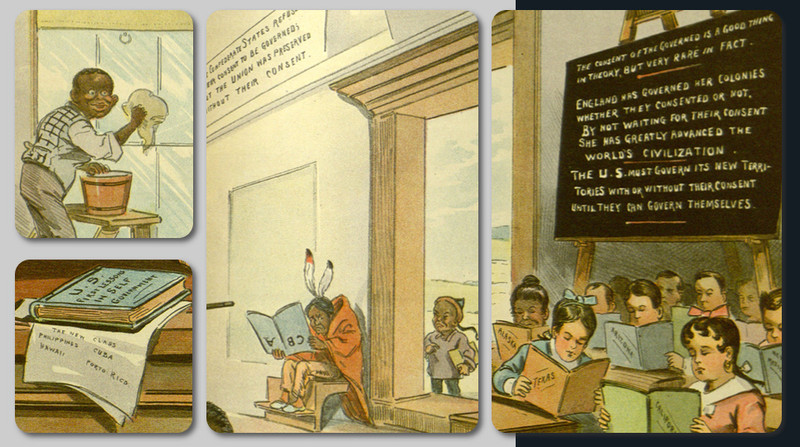
Louis Dalrymple, “School Begins” (1899)
Maps of Hawaii, Guam, Puerto Rico, Cuba, the Philippines, and Pacific trade routes
These make the strategic logic visible, but they also show the anti-imperialist problem of distant overseas rule.
Key Takeaways
Imperialism
Extending a nation’s power over other lands and peoples through annexation, colonial rule, military occupation, economic dominance, or political control
Alfred Thayer Mahan / The Influence of Sea Power upon History
Naval strategist who argued that national power required a modern navy, merchant marine, overseas bases, and control of major sea routes
Frederick Jackson Turner / Frontier Thesis
Historian who argued in 1893 that the frontier had shaped American democracy, individualism, and national character
Social Darwinism
The misapplication of evolutionary ideas to societies and nations, portraying imperial competition as a struggle in which conquest proved superior fitness
Anglo-Saxonism
The belief that English-speaking white Protestants were especially fit for self-government and destined to spread their institutions to other peoples
Josiah Strong / Our Country
Protestant minister who argued that Anglo-Saxon Americans had a providential mission to spread Christianity and their idea of civilization
Civilizing Mission
The imperialist claim that American rule would bring Christianity, education, technology, commerce, and orderly government to supposedly less civilized peoples
Paternalism
Treating domination as benevolent guardianship by claiming colonized peoples were not mature enough to govern themselves
Rudyard Kipling / “The White Man’s Burden”
Kipling’s 1899 poem portrayed colonial rule over supposedly less civilized peoples as a difficult moral duty of white imperial powers
Theodore Roosevelt
Expansionist leader who embraced naval preparedness, strategic bases, and the “strenuous life” as expressions of national strength and international influence
Albert J. Beveridge / “The March of the Flag”
In his 1898 speech, Beveridge defended expansion through new markets, racial and religious mission, nationalism, and competition with other empires
American Anti-Imperialist League
Organization founded in 1898 that opposed colonial rule as hostile to liberty, consent of the governed, and republican government
Self-Determination
The right of a people to choose its own political status and government rather than be ruled by an outside power
Consent of the Governed
The principle that legitimate government derives authority from the people it rules, used to argue that colonial government violated American founding ideals
Isolationism
A preference for avoiding permanent alliances, overseas power struggles, and extensive foreign military commitments—not complete withdrawal from trade or diplomacy
American Exceptionalism
Imperialists saw America’s special mission as spreading its institutions; anti-imperialists saw it as rejecting empire and preserving government by consent
Mark Twain
Prominent Anti-Imperialist League member who used satire to expose the contradiction between claims of benevolent civilization and the violence of conquest
Andrew Carnegie
Industrialist and anti-imperialist who opposed annexation and offered to help purchase Philippine independence
Samuel Gompers
American Federation of Labor leader who opposed annexation partly from fear that lower-paid colonial labor would undermine American workers
Imperialists
Supporters of overseas expansion who cited markets, naval security, imperial competition, racial theories, and the closed frontier
Anti-Imperialists
Opponents of colonial rule who invoked self-determination, isolationist tradition, economic costs, and both egalitarian and exclusionary racial arguments
Closed Frontier
The perception after 1890 that continental expansion was complete, used by imperialists to argue that the nation needed new overseas outlets
Manifest Destiny
The belief that American expansion was a natural or divinely favored mission, extended by imperialists from continental growth to overseas expansion
Notes
Imperialism
Extending a nation’s power over other lands and peoples through annexation, colonial rule, military occupation, economic dominance, or political control
Alfred Thayer Mahan / The Influence of Sea Power upon History
Naval strategist who argued that national power required a modern navy, merchant marine, overseas bases, and control of major sea routes
Frederick Jackson Turner / Frontier Thesis
Historian who argued in 1893 that the frontier had shaped American democracy, individualism, and national character
Social Darwinism
The misapplication of evolutionary ideas to societies and nations, portraying imperial competition as a struggle in which conquest proved superior fitness
Anglo-Saxonism
The belief that English-speaking white Protestants were especially fit for self-government and destined to spread their institutions to other peoples
Josiah Strong / Our Country
Protestant minister who argued that Anglo-Saxon Americans had a providential mission to spread Christianity and their idea of civilization
Civilizing Mission
The imperialist claim that American rule would bring Christianity, education, technology, commerce, and orderly government to supposedly less civilized peoples
Paternalism
Treating domination as benevolent guardianship by claiming colonized peoples were not mature enough to govern themselves
Rudyard Kipling / “The White Man’s Burden”
Kipling’s 1899 poem portrayed colonial rule over supposedly less civilized peoples as a difficult moral duty of white imperial powers
Theodore Roosevelt
Expansionist leader who embraced naval preparedness, strategic bases, and the “strenuous life” as expressions of national strength and international influence
Albert J. Beveridge / “The March of the Flag”
In his 1898 speech, Beveridge defended expansion through new markets, racial and religious mission, nationalism, and competition with other empires
American Anti-Imperialist League
Organization founded in 1898 that opposed colonial rule as hostile to liberty, consent of the governed, and republican government
Self-Determination
The right of a people to choose its own political status and government rather than be ruled by an outside power
Consent of the Governed
The principle that legitimate government derives authority from the people it rules, used to argue that colonial government violated American founding ideals
Isolationism
A preference for avoiding permanent alliances, overseas power struggles, and extensive foreign military commitments—not complete withdrawal from trade or diplomacy
American Exceptionalism
Imperialists saw America’s special mission as spreading its institutions; anti-imperialists saw it as rejecting empire and preserving government by consent
Mark Twain
Prominent Anti-Imperialist League member who used satire to expose the contradiction between claims of benevolent civilization and the violence of conquest
Andrew Carnegie
Industrialist and anti-imperialist who opposed annexation and offered to help purchase Philippine independence
Samuel Gompers
American Federation of Labor leader who opposed annexation partly from fear that lower-paid colonial labor would undermine American workers
Imperialists
Supporters of overseas expansion who cited markets, naval security, imperial competition, racial theories, and the closed frontier
Anti-Imperialists
Opponents of colonial rule who invoked self-determination, isolationist tradition, economic costs, and both egalitarian and exclusionary racial arguments
Closed Frontier
The perception after 1890 that continental expansion was complete, used by imperialists to argue that the nation needed new overseas outlets
Manifest Destiny
The belief that American expansion was a natural or divinely favored mission, extended by imperialists from continental growth to overseas expansion
