Topic 6.3 Notes – Westward Expansion: Social and Cultural Development
Why People Moved West and What They Built
The dream was self-sufficiency. A family could own land and avoid dependence on bosses. The reality was more complicated. Western settlement depended on federal land policy, railroad expansion, outside money, and national markets.
- Pull factors
- Homestead Act offered 160 acres to settlers who lived on and improved the land.
- Transcontinental railroad completed in 1869 helped move people, goods, and information west.
- Railroad land promotion advertised western land in the East and Europe.
- Mining strikes promised fast wealth.
- Cattle markets created jobs and profits.
- Farm opportunities attracted families to the Great Plains.
- Wage work existed in railroads, mining, ranching, and towns.
- Push factors
- poverty and debt
- lack of opportunity in the East or South
- racial violence and post-Reconstruction repression in the South
Different kinds of settlements grew from these motives:
- family farms and rural Great Plains communities
- railroad towns that connected western production to national markets
- mining camps and boomtowns that might grow into commercial centers or collapse into ghost towns
- ranching communities and cattle towns
The test loves this catch. The “independent” settler still needed banks, merchants, machinery, railroad shipping, land surveys, and army protection. A railroad map like this helps you see why western settlement was tied so closely to the rest of the country.
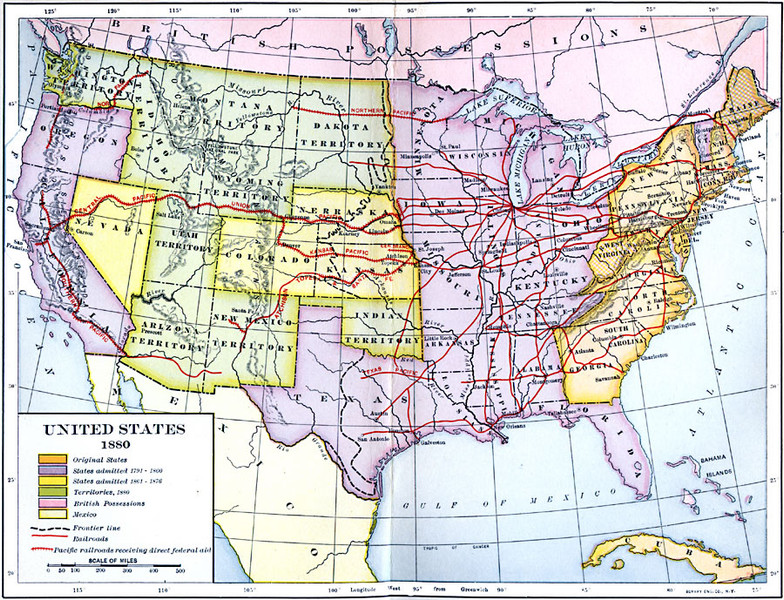
U.S. railroads and western settlement, 1880
Who Lived in the West
The West already held American Indian nations and long-established Mexican American communities. So settlement meant moving into a diverse region, not creating one from scratch.
- White migrants came from eastern states.
- European immigrants included Germans and Scandinavians on northern plains farms and Irish in construction, mining, and transportation.
- Chinese workers worked in railroad construction, mining, agriculture, and small businesses. They faced discrimination, mob violence, and exclusion from claims and jobs.
- African Americans worked as farmers, miners, ranchers, soldiers, and cowboys.
- Exodusters moved especially to Kansas.
- Benjamin “Pap” Singleton promoted that migration.
- Buffalo Soldiers in the 9th and 10th Cavalry served in western campaigns.
- Mexican Americans remained in the Southwest after the border shifted under the Treaty of Guadalupe Hidalgo.
- Women were homesteaders, teachers, business owners, and farm or ranch laborers. Some single women and widows filed claims themselves.
Western ranching borrowed heavily from Mexican vaquero traditions. That matters because the real West was racially mixed, even though later myth turned it into an all-white frontier.
Conflict Over Land, Resources, and Sovereignty
As more migrants arrived, competition sharpened over land, water, minerals, timber, and grazing.
- Conflict could mean farmers vs open-range ranchers.
- In the Johnson County War of 1892, small ranchers and homesteaders clashed with big cattle interests.
- Mexican Americans lost land through taxes, fraud, court costs, violence, squatting, and legal bias, despite treaty promises.
- Las Gorras Blancas in New Mexico resisted enclosure by cutting fences and attacking property.
The destruction of the bison made all this worse. Images like this famous pile of bison skulls capture the scale of the slaughter.
- Causes included commercial hunting, railroad access, sport killing, habitat disruption, and military encouragement.
- Effects were huge because bison provided food, shelter, trade goods, and religious meaning for Plains Indians.
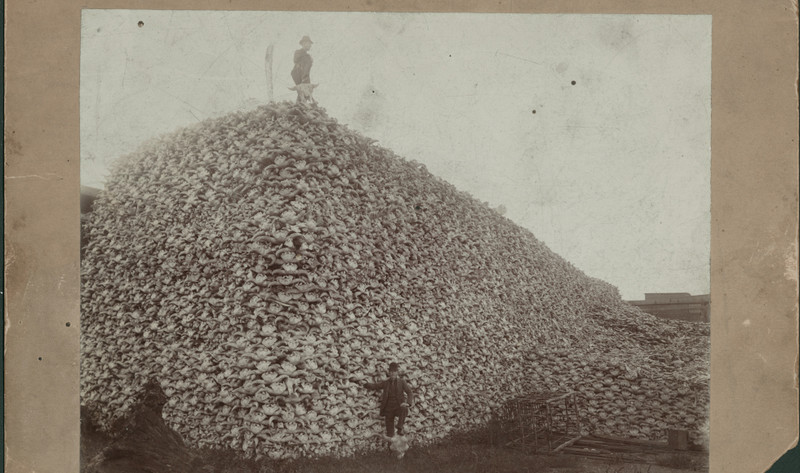
Pile of bison skulls, late 1800s
The federal government repeatedly violated treaties, backed settlers, and denied tribal sovereignty. In 1871, Congress ended recognition of tribes through new treaties.
How the U.S. Conquered Native Resistance and Reshaped Native Life
The pattern kept repeating. Treaty violation led to Native resistance. Resistance brought army suppression. Suppression ended in confinement to reservations.
Resistance and military conquest
- Great Sioux War, 1876-1877 began after gold was found in the Black Hills, violating the Fort Laramie Treaty of 1868.
- Battle of the Little Bighorn in 1876 brought a Native victory over Custer by Lakota, Northern Cheyenne, and Arapaho forces led by figures including Sitting Bull and Crazy Horse.
- Nez Perce War in 1877 is tied to Chief Joseph and the retreat toward Canada.
- Geronimo led Apache resistance until surrender in 1886.
- Wovoka’s Ghost Dance spread hope and fear. That fear helped produce the Wounded Knee Massacre in 1890 under Spotted Elk (Big Foot).
Reservations and assimilation
Reservations usually meant poor land, ration dependence, heavy federal control, and weaker sovereignty.
- Dawes Severalty Act of 1887 broke communal land into individual allotments and opened “surplus” land to white settlers.
- Carlisle Indian Industrial School, founded by Richard Henry Pratt in 1879, cut hair, banned Native languages, and imposed Christianity and Euro-American norms.
- Federal officials also restricted ceremonies like the Sun Dance.
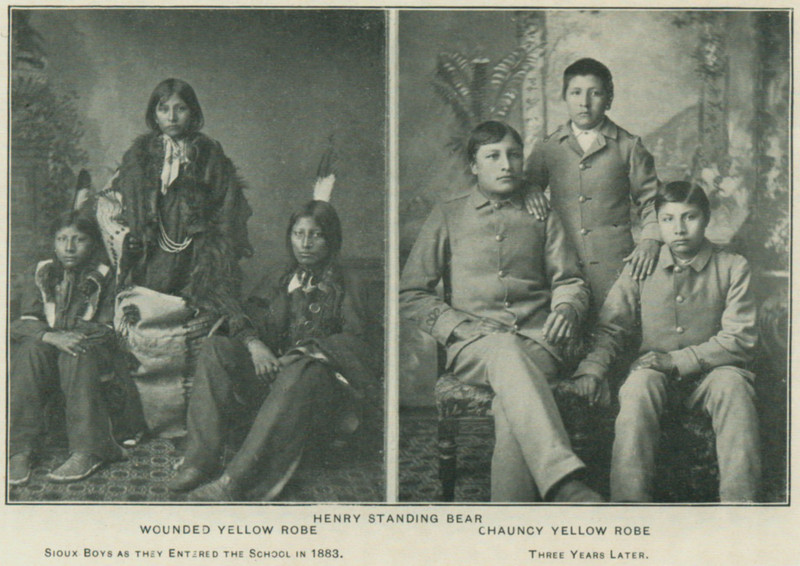
Carlisle Indian School before-and-after photograph
Photos like this Carlisle before-and-after image were used to present assimilation as a success. These policies caused land loss, weakened tribal governments, and attacked Native culture. Native peoples still preserved languages, religions, kinship ties, and ceremonies, and they adapted through farming, livestock, wage labor, trade, and crafts.
What Westward Expansion Meant
Western expansion created farms, towns, ranches, mining centers, and stronger market connections. It also transformed the environment and dispossessed American Indians and Mexican Americans through conquest, reservations, and assimilation policy.
The story people later told about the West hid a lot of that.
- In 1890, the Census declared the frontier line closed.
- In 1893, Frederick Jackson Turner’s Frontier Thesis argued that the frontier shaped democracy and individualism.
- Buffalo Bill Cody’s Wild West shows popularized a romantic, simplified version of the frontier.
The exam argument here is clear. Westward settlement created chances for migrants, but it also rested on federal power, racial conflict, conquest, and Native survival.
Key Takeaways
Homestead Act of 1862
Offered 160 acres of public land to settlers who occupied and improved it for five years, encouraging western farming and migration
Mining Boomtowns
Rapidly growing settlements near mineral discoveries that often declined into ghost towns unless they developed other economic activities
Chinese Workers in the West
Migrants who worked in railroads, mining, agriculture, and businesses while facing discriminatory laws, exclusion, and mob violence
Buffalo Soldiers
African American soldiers in segregated western Army regiments, including the 9th and 10th Cavalry, who participated in campaigns against Native nations
Exodusters
African Americans who migrated from the post-Reconstruction South, especially to Kansas beginning in 1879, to escape oppression and seek land and autonomy
Benjamin “Pap” Singleton
Promoter who encouraged Exodusters to migrate west to escape racial violence, political repression, debt, and the exploitative Southern agricultural system
Vaqueros
Mexican cattle workers whose herding techniques and vocabulary strongly shaped western cowboy culture
Women in the West
Women homesteaded, farmed, ran businesses, taught, and sustained households and communities despite unequal rights and gender restrictions
Treaty of Guadalupe Hidalgo
The 1848 treaty that transferred the Southwest from Mexico to the United States and promised property protections that Mexican Americans often did not receive
Mexican Americans in the Southwest
Long-established residents who often lost land through litigation, taxes, fraud, violence, and squatting but preserved language, religion, and regional traditions
Las Gorras Blancas (White Caps)
New Mexican resistance group that cut fences and destroyed large landholders' property to oppose enclosure of communal lands in the late 1880s and early 1890s
Destruction of the American Bison
Commercial hunting, railroads, habitat loss, and military encouragement reduced the bison to fewer than 1,000 by about 1890, devastating Plains Indian life
Johnson County War
An 1892 Wyoming conflict in which powerful ranching interests fought smaller ranchers and homesteaders accused of cattle theft
End of Federal Treaty-Making with Native Nations
In 1871 Congress ended new treaties with Native nations, signaling that Indian policy would be imposed unilaterally rather than negotiated between sovereign nations
Fort Laramie Treaty of 1868
Recognized the Great Sioux Reservation, including the sacred Black Hills, and protected additional Native hunting territory
Great Sioux War
The 1876–1877 war caused by U.S. violation of Lakota lands after gold was found in the Black Hills; it ended with greater federal control and Native land loss
George Armstrong Custer
Army officer whose 1874 Black Hills expedition confirmed gold reports and whose 7th Cavalry was defeated at Little Bighorn
Battle of the Little Bighorn
June 1876 Native victory in which Lakota, Northern Cheyenne, and Arapaho warriors defeated Custer's 7th Cavalry, provoking intensified U.S. retaliation
Sitting Bull
Hunkpapa Lakota spiritual and political leader associated with Native resistance during the Great Sioux War
Crazy Horse
Oglala Lakota war leader who played a major role in resistance to U.S. military conquest during the Great Sioux War
Nez Perce War
The 1877 conflict in which Nez Perce bands resisted confinement and retreated about 1,000 miles toward Canada before surrendering
Chief Joseph
Best-known Nez Perce spokesman associated with the 1877 retreat and surrender, although leadership was shared among several Native figures
Geronimo
Chiricahua Apache leader who used mobility and difficult terrain to resist U.S. and Mexican forces before surrendering in 1886
Reservation System
Federal system that confined Native peoples to restricted lands under extensive government control, freeing other territory for settlers and businesses
Tribal Sovereignty
The inherent authority of a Native nation to govern its members and territory, increasingly denied by unilateral federal control
Oklahoma Land Rush of 1889
Opening in which settlers entered lands made available by the federal government, continuing the transfer of territory from Native control to non-Native settlement
Native American Assimilation
Coercive federal policy intended to replace tribal identity, communal landholding, Native religions, and languages with private property, Christianity, English, and individual farming
Dawes Severalty Act (Dawes Act)
The 1887 law that divided communal reservation land into individual allotments and opened “surplus” land to outsiders, causing massive Native land loss
Indian Boarding Schools
Assimilation institutions that removed Native children from their families, suppressed their languages and religions, and imposed Euro-American education and customs
Carlisle Indian Industrial School
Influential Native boarding school founded in Pennsylvania in 1879 that became a model for coercive cultural assimilation
Richard Henry Pratt
Founder of the Carlisle Indian Industrial School who expressed its assimilation goal as “Kill the Indian in him, and save the man.”
Ghost Dance
The 1889–1890 Native religious movement promising renewal, the return of the dead and bison, and freedom from oppression; officials misread it as an uprising
Wovoka
Northern Paiute religious leader who founded the Ghost Dance movement and taught moral renewal and the restoration of Native life
Wounded Knee Massacre
The 1890 killing of approximately 150 to 300 Lakota, many women and children, by the 7th Cavalry during an attempted disarmament in South Dakota
Closing of the Frontier (1890 Census)
The Census Bureau's announcement that settlement was too widespread to identify a continuous frontier line, not that all western land was settled
Frontier Thesis
Theory that free land and repeated westward settlement shaped American democracy, individualism, innovation, and social mobility
Frederick Jackson Turner
Historian who presented the Frontier Thesis in 1893 while largely overlooking Native ownership, federal power, conquest, women, and nonwhite labor
Wild West Mythology
Popular portrayals that celebrated rugged white individualism and simplified cowboys, soldiers, outlaws, and Native peoples while obscuring government support, diversity, and conquest
Buffalo Bill Cody
Showman whose traveling Wild West performances dramatized and romanticized western conquest for American and international audiences
Allotment
Division of collectively held reservation land into individual parcels to weaken tribal life and open “surplus” land to outsiders
Native Cultural Persistence
Preservation of tribal identities, languages, religions, kinship, art, and ceremonies despite coercive federal assimilation policies
Native Economic Adaptation
Use of farming, livestock raising, wage labor, leasing, crafts, and trade to pursue self-support while retaining tribal identity
Notes
Homestead Act of 1862
Offered 160 acres of public land to settlers who occupied and improved it for five years, encouraging western farming and migration
Mining Boomtowns
Rapidly growing settlements near mineral discoveries that often declined into ghost towns unless they developed other economic activities
Chinese Workers in the West
Migrants who worked in railroads, mining, agriculture, and businesses while facing discriminatory laws, exclusion, and mob violence
Buffalo Soldiers
African American soldiers in segregated western Army regiments, including the 9th and 10th Cavalry, who participated in campaigns against Native nations
Exodusters
African Americans who migrated from the post-Reconstruction South, especially to Kansas beginning in 1879, to escape oppression and seek land and autonomy
Benjamin “Pap” Singleton
Promoter who encouraged Exodusters to migrate west to escape racial violence, political repression, debt, and the exploitative Southern agricultural system
Vaqueros
Mexican cattle workers whose herding techniques and vocabulary strongly shaped western cowboy culture
Women in the West
Women homesteaded, farmed, ran businesses, taught, and sustained households and communities despite unequal rights and gender restrictions
Treaty of Guadalupe Hidalgo
The 1848 treaty that transferred the Southwest from Mexico to the United States and promised property protections that Mexican Americans often did not receive
Mexican Americans in the Southwest
Long-established residents who often lost land through litigation, taxes, fraud, violence, and squatting but preserved language, religion, and regional traditions
Las Gorras Blancas (White Caps)
New Mexican resistance group that cut fences and destroyed large landholders' property to oppose enclosure of communal lands in the late 1880s and early 1890s
Destruction of the American Bison
Commercial hunting, railroads, habitat loss, and military encouragement reduced the bison to fewer than 1,000 by about 1890, devastating Plains Indian life
Johnson County War
An 1892 Wyoming conflict in which powerful ranching interests fought smaller ranchers and homesteaders accused of cattle theft
End of Federal Treaty-Making with Native Nations
In 1871 Congress ended new treaties with Native nations, signaling that Indian policy would be imposed unilaterally rather than negotiated between sovereign nations
Fort Laramie Treaty of 1868
Recognized the Great Sioux Reservation, including the sacred Black Hills, and protected additional Native hunting territory
Great Sioux War
The 1876–1877 war caused by U.S. violation of Lakota lands after gold was found in the Black Hills; it ended with greater federal control and Native land loss
George Armstrong Custer
Army officer whose 1874 Black Hills expedition confirmed gold reports and whose 7th Cavalry was defeated at Little Bighorn
Battle of the Little Bighorn
June 1876 Native victory in which Lakota, Northern Cheyenne, and Arapaho warriors defeated Custer's 7th Cavalry, provoking intensified U.S. retaliation
Sitting Bull
Hunkpapa Lakota spiritual and political leader associated with Native resistance during the Great Sioux War
Crazy Horse
Oglala Lakota war leader who played a major role in resistance to U.S. military conquest during the Great Sioux War
Nez Perce War
The 1877 conflict in which Nez Perce bands resisted confinement and retreated about 1,000 miles toward Canada before surrendering
Chief Joseph
Best-known Nez Perce spokesman associated with the 1877 retreat and surrender, although leadership was shared among several Native figures
Geronimo
Chiricahua Apache leader who used mobility and difficult terrain to resist U.S. and Mexican forces before surrendering in 1886
Reservation System
Federal system that confined Native peoples to restricted lands under extensive government control, freeing other territory for settlers and businesses
Tribal Sovereignty
The inherent authority of a Native nation to govern its members and territory, increasingly denied by unilateral federal control
Oklahoma Land Rush of 1889
Opening in which settlers entered lands made available by the federal government, continuing the transfer of territory from Native control to non-Native settlement
Native American Assimilation
Coercive federal policy intended to replace tribal identity, communal landholding, Native religions, and languages with private property, Christianity, English, and individual farming
Dawes Severalty Act (Dawes Act)
The 1887 law that divided communal reservation land into individual allotments and opened “surplus” land to outsiders, causing massive Native land loss
Indian Boarding Schools
Assimilation institutions that removed Native children from their families, suppressed their languages and religions, and imposed Euro-American education and customs
Carlisle Indian Industrial School
Influential Native boarding school founded in Pennsylvania in 1879 that became a model for coercive cultural assimilation
Richard Henry Pratt
Founder of the Carlisle Indian Industrial School who expressed its assimilation goal as “Kill the Indian in him, and save the man.”
Ghost Dance
The 1889–1890 Native religious movement promising renewal, the return of the dead and bison, and freedom from oppression; officials misread it as an uprising
Wovoka
Northern Paiute religious leader who founded the Ghost Dance movement and taught moral renewal and the restoration of Native life
Wounded Knee Massacre
The 1890 killing of approximately 150 to 300 Lakota, many women and children, by the 7th Cavalry during an attempted disarmament in South Dakota
Closing of the Frontier (1890 Census)
The Census Bureau's announcement that settlement was too widespread to identify a continuous frontier line, not that all western land was settled
Frontier Thesis
Theory that free land and repeated westward settlement shaped American democracy, individualism, innovation, and social mobility
Frederick Jackson Turner
Historian who presented the Frontier Thesis in 1893 while largely overlooking Native ownership, federal power, conquest, women, and nonwhite labor
Wild West Mythology
Popular portrayals that celebrated rugged white individualism and simplified cowboys, soldiers, outlaws, and Native peoples while obscuring government support, diversity, and conquest
Buffalo Bill Cody
Showman whose traveling Wild West performances dramatized and romanticized western conquest for American and international audiences
Allotment
Division of collectively held reservation land into individual parcels to weaken tribal life and open “surplus” land to outsiders
Native Cultural Persistence
Preservation of tribal identities, languages, religions, kinship, art, and ceremonies despite coercive federal assimilation policies
Native Economic Adaptation
Use of farming, livestock raising, wage labor, leasing, crafts, and trade to pursue self-support while retaining tribal identity
