Topic 2.7 Notes – Colonial Society and Culture
How Colonial Culture Became Both More British and More Distinct
This topic is built around a tension you need to keep straight. The colonies were becoming more British through Atlantic trade, British goods, English political ideas, and shared print culture. At the same time, they were becoming more distinct because of migration, religious diversity, regional differences, and practical self-rule.
- Before 1754, most colonists still saw themselves as loyal British subjects.
- They claimed the rights of Englishmen, especially property rights, jury trial, representative taxation, and rule of law.
- That matters because later resistance to Britain often used British ideas about liberty and lawful government against Britain itself.
Population Growth, Diversity, and Social Order
Movement across the Atlantic changed who lived in the colonies and how colonial society worked. This settlement map helps you see the broad regional patterns that shaped colonial life.
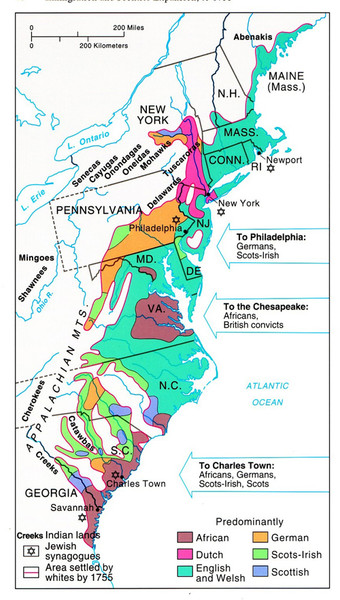
Ethnic settlement patterns in the British mainland colonies, c. 1755
Who lived where
- English settlers remained dominant in New England and much of the South.
- Germans clustered in Pennsylvania and nearby areas, keeping German-language churches, schools, and newspapers.
- Scots-Irish settled the Appalachian backcountry from Pennsylvania southward.
- Dutch influence stayed strong in New York and New Jersey.
- Smaller groups included French Huguenots, Swedes, Welsh, Scots, Irish Catholics, and Jews.
- Forced African migration brought languages, music, religious traditions, farming knowledge, and family practices that deeply shaped colonial culture.
Pluralism and hierarchy
Pluralism means many ethnic and religious groups lived together. It does not mean equality.
- New England was more English and Congregationalist.
- Middle colonies were the most ethnically and religiously diverse.
- Southern colonies were more Anglican and plantation-based.
Social order was unequal:
| Group | Typical position |
|---|---|
| Elites | merchants, large landowners, planters, officeholders |
| Middling groups | farmers, artisans, shopkeepers |
| Lower-status whites | laborers, tenants, indentured servants |
| Enslaved Africans | bottom of a hereditary racial system |
Colonial society was also patriarchal. Under coverture, a married woman’s legal identity was largely absorbed into her husband’s, even though women’s labor was essential. Political participation existed, but mainly for property-owning white men.
Religion, Enlightenment, and Print Culture
Religion still shaped daily life, but new religious and intellectual movements made authority easier to question.
Churches and toleration
- Congregational Church dominated New England.
- Anglican Church was established in most southern colonies and parts of the middle colonies.
- Quakers had major influence in Pennsylvania.
- Presbyterians, Baptists, Dutch Reformed, and Lutherans were growing.
- Catholics remained suspect.
- Jews were present in port cities such as New York and Newport.
- The Maryland Toleration Act of 1649 offered limited toleration for Christians, not full religious freedom.
First Great Awakening
The First Great Awakening of the 1730s and 1740s stressed personal conversion and emotional faith.
- Jonathan Edwards preached “Sinners in the Hands of an Angry God.”
- George Whitefield traveled colony to colony, gaining intercolonial fame.
- New Lights backed revivals. Old Lights defended traditional church authority.
- The movement helped Baptists and Presbyterians grow.
- It inspired new colleges such as the College of New Jersey (Princeton).
Images of George Whitefield preaching capture the scale and energy of these revival meetings.
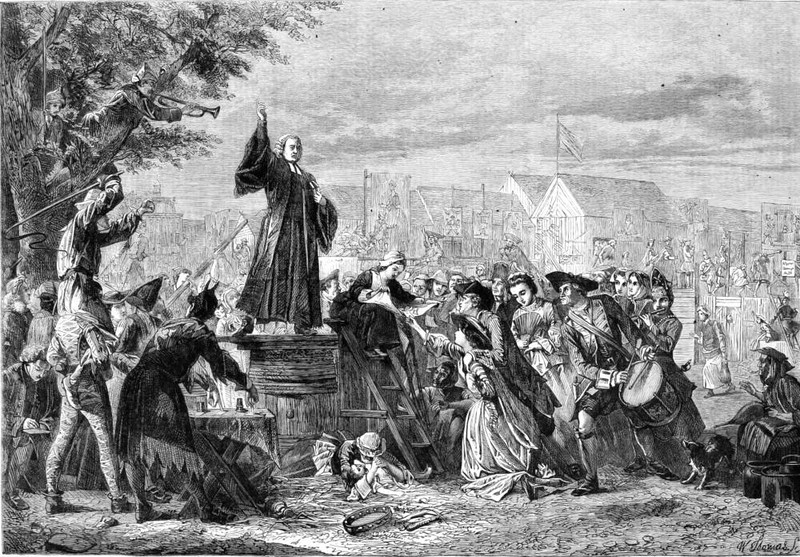
George Whitefield preaching during the First Great Awakening
Its biggest effect was that it challenged established authority and connected colonies through a shared religious experience.
Enlightenment and print
The Enlightenment emphasized reason, natural law, observation, and progress.
- John Locke argued for natural rights, consent of the governed, and the social contract.
- Benjamin Franklin represented colonial Enlightenment thinking through electricity experiments, the Library Company of Philadelphia, and the American Philosophical Society.
Print spread all of this. Harvard, William and Mary, and Yale trained elites and clergy. Literacy was strongest in New England. Newspapers, pamphlets, sermons, and almanacs tied the colonies into transatlantic debate. The John Peter Zenger trial in 1735 became a symbol of resistance to official power and support for a freer press.
Anglicization, Self-Government, and Growing Mistrust of Britain
As colonists bought British goods and copied British manners, they also built local political habits that made outside control harder.
- Anglicization meant adopting British consumer culture and political models. Colonists imported tea, clothing, books, ceramics, and furniture, and elites copied British gentility.
- Colonial governments followed English forms with a governor, council, and elected assembly.
But daily life gave colonists real autonomy:
- Salutary neglect let colonies run many of their own affairs.
- Assemblies often controlled taxation and even governors’ salaries.
- New England town meetings and southern county governments built local political experience.
- Intercolonial trade, postal routes, and print networks connected the colonies to one another, not just to Britain.
Tension grew where imperial and colonial interests split.
- Mercantilism and the Navigation Acts tried to direct colonial trade for Britain’s benefit.
- Smuggling and weak enforcement taught colonists to ignore distant rules.
- Western settlement and frontier defense caused conflict because colonists wanted land and protection on local terms.
- Bacon’s Rebellion showed backcountry anger over frontier defense and elite rule.
- The Dominion of New England under Sir Edmund Andros limited assemblies and town meetings and was overthrown after the Glorious Revolution.
By 1754, colonists were not calling for independence. They were learning to resist authority they saw as arbitrary through self-government, religious independence, Enlightenment ideas, and radical Whig fears of corruption.
Key Takeaways
Anglicization
Process by which colonists increasingly adopted British goods, culture, political models, and identity while remaining locally autonomous
Religious and Ethnic Pluralism
Coexistence of multiple religious, ethnic, linguistic, and cultural groups in the colonies, without implying equality or complete toleration
German Migrants
Immigrants concentrated in Pennsylvania and nearby areas who maintained German-language churches, schools, newspapers, and farming communities
Scots-Irish
Mostly Protestant migrants from Ulster who settled heavily in the Appalachian backcountry from Pennsylvania southward
Coverture
English legal doctrine under which a married woman’s legal identity and control of property were largely absorbed by her husband
Established Churches
Churches supported or preferred by colonial governments, especially Congregationalism in New England and Anglicanism in the South
Maryland Toleration Act / Act Concerning Religion
1649 Maryland law protecting Christians who accepted the divinity of Jesus, an early but limited form of religious toleration
First Great Awakening
Protestant revivals of the 1730s–1740s stressing personal conversion, challenging established clergy, and connecting colonists across regional boundaries
Jonathan Edwards
Great Awakening theologian whose 1741 sermon “Sinners in the Hands of an Angry God” urged repentance and personal conversion
George Whitefield
English itinerant revivalist whose colony-to-colony preaching and newspaper coverage made the Great Awakening an intercolonial experience
New Lights vs. Old Lights
New Lights supported revivalism and personal conversion; Old Lights defended established clergy, orderly worship, and traditional authority
Protestant Evangelicalism
Protestant movement emphasizing personal conversion and active preaching, spread across the colonies by revivals, itinerants, and print
Enlightenment
Intellectual movement emphasizing reason, observation, natural law, and human progress while questioning inherited authority
John Locke
English Enlightenment thinker who argued for natural rights, government by consent, and a social contract limiting rulers
Natural Rights
Rights people possess inherently and that legitimate governments exist to protect
Social Contract
Theory that government rests on the people’s consent and must protect their rights to remain legitimate
Benjamin Franklin
Colonial printer, scientist, inventor, and civic organizer who embodied Enlightenment reason, experimentation, and practical improvement
Transatlantic Print Culture
Circulation of newspapers, pamphlets, sermons, books, and ideas across the Atlantic and among colonies, creating a shared arena for debate
John Peter Zenger Trial
1735 acquittal of a New York printer prosecuted for criticizing Governor William Cosby; it became a symbol of resistance to official power but did not establish a legal right to press freedom
Rights of Englishmen
Claimed liberties of British subjects, including property protection, representative taxation, jury trials, and government under law
Salutary Neglect
Britain’s informal pattern of lax colonial supervision and uneven trade-law enforcement, which allowed habits of practical self-government to grow
Colonial Assemblies
Elected representative bodies that controlled taxation and appropriations and often used governors’ salaries to influence imperial officials
New England Town Meetings
Local assemblies in which eligible men directly decided community matters such as taxation, roads, and local government
Intercolonial Commercial Ties
Trade and information networks linking colonial ports and communities to one another as well as to the wider Atlantic economy
Mercantilism
Imperial economic system that regulated colonial trade to increase the wealth, power, and security of Britain
Navigation Acts
British laws requiring important colonial trade to use English or colonial ships and directing certain commodities through regulated markets
Dominion of New England
Imperial government created in 1686 that centralized northern colonies, restricted self-rule, and collapsed after colonists overthrew it in 1689
Sir Edmund Andros
Governor of the Dominion of New England who restricted town meetings, enforced trade laws, taxed without assemblies, and challenged land titles
Bacon’s Rebellion
1676 Virginia uprising led by Nathaniel Bacon against Governor William Berkeley that exposed conflict between frontier settlers and the coastal elite over defense, land, and Native policy
Country / Radical Whig Tradition
English opposition ideology warning that concentrated power, patronage, standing armies, and corruption threatened liberty
Patriarchy
Social system in which men held primary legal, political, and household authority, while women’s rights and opportunities were restricted
Nathaniel Bacon
Leader of the 1676 Virginia rebellion against Governor William Berkeley over frontier defense, western settlement, Native policy, and elite rule
William Berkeley
Virginia governor accused by Nathaniel Bacon’s supporters of neglecting frontier defense and restricting attacks on Native communities
Notes
Anglicization
Process by which colonists increasingly adopted British goods, culture, political models, and identity while remaining locally autonomous
Religious and Ethnic Pluralism
Coexistence of multiple religious, ethnic, linguistic, and cultural groups in the colonies, without implying equality or complete toleration
German Migrants
Immigrants concentrated in Pennsylvania and nearby areas who maintained German-language churches, schools, newspapers, and farming communities
Scots-Irish
Mostly Protestant migrants from Ulster who settled heavily in the Appalachian backcountry from Pennsylvania southward
Coverture
English legal doctrine under which a married woman’s legal identity and control of property were largely absorbed by her husband
Established Churches
Churches supported or preferred by colonial governments, especially Congregationalism in New England and Anglicanism in the South
Maryland Toleration Act / Act Concerning Religion
1649 Maryland law protecting Christians who accepted the divinity of Jesus, an early but limited form of religious toleration
First Great Awakening
Protestant revivals of the 1730s–1740s stressing personal conversion, challenging established clergy, and connecting colonists across regional boundaries
Jonathan Edwards
Great Awakening theologian whose 1741 sermon “Sinners in the Hands of an Angry God” urged repentance and personal conversion
George Whitefield
English itinerant revivalist whose colony-to-colony preaching and newspaper coverage made the Great Awakening an intercolonial experience
New Lights vs. Old Lights
New Lights supported revivalism and personal conversion; Old Lights defended established clergy, orderly worship, and traditional authority
Protestant Evangelicalism
Protestant movement emphasizing personal conversion and active preaching, spread across the colonies by revivals, itinerants, and print
Enlightenment
Intellectual movement emphasizing reason, observation, natural law, and human progress while questioning inherited authority
John Locke
English Enlightenment thinker who argued for natural rights, government by consent, and a social contract limiting rulers
Natural Rights
Rights people possess inherently and that legitimate governments exist to protect
Social Contract
Theory that government rests on the people’s consent and must protect their rights to remain legitimate
Benjamin Franklin
Colonial printer, scientist, inventor, and civic organizer who embodied Enlightenment reason, experimentation, and practical improvement
Transatlantic Print Culture
Circulation of newspapers, pamphlets, sermons, books, and ideas across the Atlantic and among colonies, creating a shared arena for debate
John Peter Zenger Trial
1735 acquittal of a New York printer prosecuted for criticizing Governor William Cosby; it became a symbol of resistance to official power but did not establish a legal right to press freedom
Rights of Englishmen
Claimed liberties of British subjects, including property protection, representative taxation, jury trials, and government under law
Salutary Neglect
Britain’s informal pattern of lax colonial supervision and uneven trade-law enforcement, which allowed habits of practical self-government to grow
Colonial Assemblies
Elected representative bodies that controlled taxation and appropriations and often used governors’ salaries to influence imperial officials
New England Town Meetings
Local assemblies in which eligible men directly decided community matters such as taxation, roads, and local government
Intercolonial Commercial Ties
Trade and information networks linking colonial ports and communities to one another as well as to the wider Atlantic economy
Mercantilism
Imperial economic system that regulated colonial trade to increase the wealth, power, and security of Britain
Navigation Acts
British laws requiring important colonial trade to use English or colonial ships and directing certain commodities through regulated markets
Dominion of New England
Imperial government created in 1686 that centralized northern colonies, restricted self-rule, and collapsed after colonists overthrew it in 1689
Sir Edmund Andros
Governor of the Dominion of New England who restricted town meetings, enforced trade laws, taxed without assemblies, and challenged land titles
Bacon’s Rebellion
1676 Virginia uprising led by Nathaniel Bacon against Governor William Berkeley that exposed conflict between frontier settlers and the coastal elite over defense, land, and Native policy
Country / Radical Whig Tradition
English opposition ideology warning that concentrated power, patronage, standing armies, and corruption threatened liberty
Patriarchy
Social system in which men held primary legal, political, and household authority, while women’s rights and opportunities were restricted
Nathaniel Bacon
Leader of the 1676 Virginia rebellion against Governor William Berkeley over frontier defense, western settlement, Native policy, and elite rule
William Berkeley
Virginia governor accused by Nathaniel Bacon’s supporters of neglecting frontier defense and restricting attacks on Native communities
