Topic 5.4 Notes – The Compromise of 1850
Why the Compromise of 1850 Happened
The Mexican Cession reopened the biggest question in U.S. politics. Would slavery expand west? The land taken from Mexico was not automatically covered by the Missouri Compromise, which had regulated slavery only in the Louisiana Purchase.
What made this explosive was political power more than plantation farming.
- Senate balance mattered because each new state got two senators.
- Territorial control mattered because today’s territory could become tomorrow’s state.
- Constitutional authority mattered because Americans disagreed over whether Congress could ban slavery in federal territories.
- The future of the Union mattered because both sections began treating the issue as a test of survival.
The first major flashpoint was the Wilmot Proviso. It proposed banning slavery in any territory won from Mexico. It passed the House, where the North had more people, and failed in the Senate, where free and slave states were balanced. That split showed sectional voting starting to matter more than party loyalty.
The Free Soil movement grew out of this fight.
- It opposed the expansion of slavery into the territories.
- It was not the same as abolitionism. Many free-soilers cared less about ending slavery where it already existed than about reserving western land for free white labor.
- The Free Soil Party in the election of 1848 showed that slavery expansion had become a major national political issue.
California turned a debate into a crisis. The Gold Rush caused a population boom, California wrote a constitution banning slavery in 1849, and it applied for admission as a free state. That threatened the exact 15 free / 15 slave state balance in the Senate.
Regional Positions and the Main Proposed Solutions
Both sections said they defended liberty, the Constitution, and the Union. They just meant very different things.
Northern positions
- Abolitionists attacked slavery as a moral evil.
- Free-soilers opposed expansion to protect free labor.
- Moderates wanted compromise to preserve political stability and the Union.
Southern positions
- Southerners defended slavery through property rights, equal access to the territories, and constitutional protections.
- Southern moderates would accept compromise if fugitive slave recovery was strengthened.
- Fire-eaters threatened secession. The Nashville Convention became the clearest example of that pressure.
Main proposals
- Wilmot Proviso
- Extend the Missouri Compromise line to the Pacific
- Popular sovereignty
- Immediate admission of California as a free state
- Stronger fugitive slave enforcement
- Secession as the extreme southern option
How Congress Built the Compromise
Henry Clay tried to solve the crisis with one big package in 1850. The debate was shaped by the Great Triumvirate:
- Henry Clay pushed compromise.
- John C. Calhoun argued the South was losing power and demanded guarantees for slavery.
- Daniel Webster backed compromise in his Seventh of March speech to save the Union, which angered many antislavery northerners.
William H. Seward rejected compromise with slavery and appealed to a “higher law.”
President Zachary Taylor preferred admitting California and New Mexico as states instead of supporting Clay’s full package. After Taylor died, Millard Fillmore supported compromise.
Clay’s omnibus bill failed. Stephen A. Douglas rescued it by splitting it into separate bills, so different coalitions could pass different parts.
The Five Parts of the Compromise of 1850
| Measure | What it did | Who benefited most |
|---|---|---|
| California | Admitted as a free state | North |
| Utah and New Mexico | Organized under popular sovereignty | South got no federal ban on slavery |
| Texas boundary | Texas gave up claims; got $10 million | Reduced conflict |
| Washington, D.C. | Slave trade abolished, slavery remained legal | North got symbolic win |
| Fugitive Slave Act | Stronger federal enforcement of recapture | South |
The Fugitive Slave Act is the piece students most often need to know in detail:
- no jury trial for the accused
- accused could not testify
- federal commissioners handled cases
- commissioners were paid more for returning alleged fugitives
- slavery became a national issue inside free states
What the Compromise Solved and What It Failed to Solve
It worked in the short term. It reduced secession talk, preserved the Union, and showed Congress could still make sectional bargains.
It failed in the long term because it settled immediate policies without settling the core conflict.
- It did not answer whether Congress could ban slavery in the territories.
- It did not resolve free labor vs. slave labor.
- It did not settle fights over federal power vs. state resistance.
- Popular sovereignty delayed the problem more than it solved it.
Northern backlash grew fast:
- personal liberty laws
- vigilance committees
- Underground Railroad
- Anthony Burns case in Boston
- Harriet Beecher Stowe’s Uncle Tom’s Cabin
The map below helps you connect those arguments to the territorial changes created by the Compromise, especially California’s admission as a free state and the organization of Utah and New Mexico without a final answer on slavery.
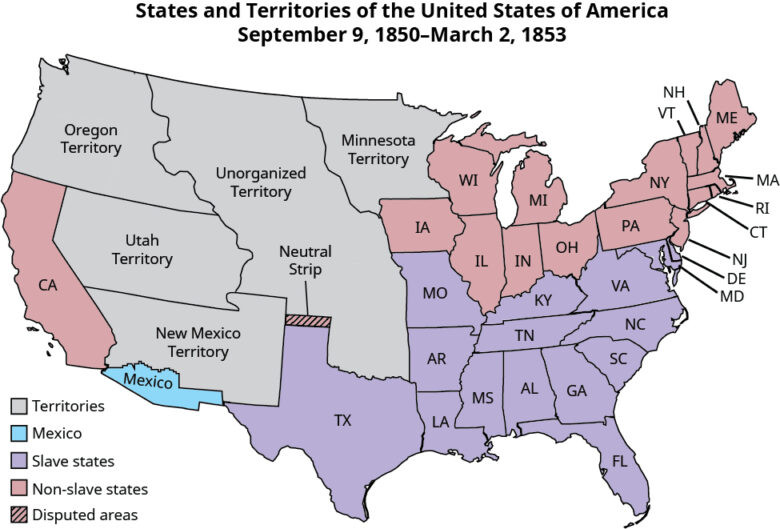
Map of the United States after the Compromise of 1850
The big pattern is this. Both regions wanted influence over federal policy. The North usually pushed to restrict slavery’s expansion. The South demanded protection for slavery and equal territorial rights. That difference kept growing, and Dred Scott v. Sandford later tried to settle the issue in court and made things worse.
Key Takeaways
Mexican Cession
Vast territory transferred by Mexico in 1848 whose acquisition sparked conflict over whether slavery could expand westward
Wilmot Proviso
David Wilmot’s unsuccessful proposal to prohibit slavery in all territory acquired from Mexico; sectional House support and Senate opposition revealed the growing North–South divide
Popular Sovereignty
Policy allowing territorial settlers to decide whether to permit slavery; used in Utah and New Mexico but left the timing and legality of slavery unsettled
Fire-Eaters
Radical southern defenders of slavery who threatened secession if the federal government denied what they considered southern constitutional rights
Nashville Convention
1850 meeting of delegates from several slave states to coordinate a southern response to restrictions on slavery and consider secession
Henry Clay
Kentucky senator who introduced the broad compromise plan of 1850 and attempted to pass its concessions together as an omnibus bill
John C. Calhoun
South Carolina senator who warned that northern power had destroyed sectional balance and demanded guarantees for southern rights to preserve the Union
Zachary Taylor
President who favored admitting California and New Mexico directly as states and opposed Texas’s claims but died before the compromise passed
Millard Fillmore
President who succeeded Zachary Taylor, supported the compromise, signed its separate measures into law, and enforced them
Stephen A. Douglas
Illinois senator who secured passage by dividing Clay’s failed omnibus bill into separate measures supported by shifting sectional coalitions
Compromise of 1850
Five-law sectional settlement admitting free California, using popular sovereignty in Utah and New Mexico, settling Texas’s boundary, ending Washington’s slave trade, and strengthening fugitive-slave enforcement
California’s Admission as a Free State
Northern gain in the Compromise of 1850 that created a 16-to-15 free-state Senate majority and increased southern fears of political decline
Utah and New Mexico Territories
Territories organized by the Compromise of 1850 without a federal ban on slavery, leaving their eventual decision to popular sovereignty
Texas–New Mexico Boundary Settlement
Texas surrendered its disputed western claims in exchange for $10 million, preventing armed conflict and permitting separate organization of New Mexico
Abolition of the Slave Trade in Washington, D.C.
Compromise measure ending the buying and selling of enslaved people in the capital while leaving slavery itself legal there
Fugitive Slave Act of 1850
Federal law strengthening the capture and return of alleged fugitives, denying them jury trials and testimony, allowing officials to compel assistance, and intensifying northern resistance
Personal Liberty Laws
Northern state laws providing legal protections to alleged fugitives or withholding state cooperation from federal fugitive-slave enforcement
Uncle Tom’s Cabin
Harriet Beecher Stowe’s 1852 antislavery novel, inspired partly by the Fugitive Slave Act, that expanded northern moral opposition to slavery
Free Soil Movement
Movement opposing slavery’s territorial expansion to preserve western land for free white labor; many supporters were not abolitionists
Free Soil Party
Political party whose 1848 presidential campaign made opposition to slavery’s expansion an independent political force
Daniel Webster
Massachusetts senator who supported the Compromise of 1850, including stronger fugitive-slave enforcement, to preserve the Union
Seventh of March Speech
Webster’s 1850 speech supporting sectional compromise as necessary to preserve the Union
William H. Seward
New York senator who opposed concessions to slavery and argued that moral law condemned the institution
Higher Law
Seward’s argument that a moral law above the Constitution condemned slavery and outweighed demands for compromise
Great Triumvirate
Henry Clay, Daniel Webster, and John C. Calhoun, the aging national leaders who represented competing positions in the Compromise of 1850 debate
Notes
Mexican Cession
Vast territory transferred by Mexico in 1848 whose acquisition sparked conflict over whether slavery could expand westward
Wilmot Proviso
David Wilmot’s unsuccessful proposal to prohibit slavery in all territory acquired from Mexico; sectional House support and Senate opposition revealed the growing North–South divide
Popular Sovereignty
Policy allowing territorial settlers to decide whether to permit slavery; used in Utah and New Mexico but left the timing and legality of slavery unsettled
Fire-Eaters
Radical southern defenders of slavery who threatened secession if the federal government denied what they considered southern constitutional rights
Nashville Convention
1850 meeting of delegates from several slave states to coordinate a southern response to restrictions on slavery and consider secession
Henry Clay
Kentucky senator who introduced the broad compromise plan of 1850 and attempted to pass its concessions together as an omnibus bill
John C. Calhoun
South Carolina senator who warned that northern power had destroyed sectional balance and demanded guarantees for southern rights to preserve the Union
Zachary Taylor
President who favored admitting California and New Mexico directly as states and opposed Texas’s claims but died before the compromise passed
Millard Fillmore
President who succeeded Zachary Taylor, supported the compromise, signed its separate measures into law, and enforced them
Stephen A. Douglas
Illinois senator who secured passage by dividing Clay’s failed omnibus bill into separate measures supported by shifting sectional coalitions
Compromise of 1850
Five-law sectional settlement admitting free California, using popular sovereignty in Utah and New Mexico, settling Texas’s boundary, ending Washington’s slave trade, and strengthening fugitive-slave enforcement
California’s Admission as a Free State
Northern gain in the Compromise of 1850 that created a 16-to-15 free-state Senate majority and increased southern fears of political decline
Utah and New Mexico Territories
Territories organized by the Compromise of 1850 without a federal ban on slavery, leaving their eventual decision to popular sovereignty
Texas–New Mexico Boundary Settlement
Texas surrendered its disputed western claims in exchange for $10 million, preventing armed conflict and permitting separate organization of New Mexico
Abolition of the Slave Trade in Washington, D.C.
Compromise measure ending the buying and selling of enslaved people in the capital while leaving slavery itself legal there
Fugitive Slave Act of 1850
Federal law strengthening the capture and return of alleged fugitives, denying them jury trials and testimony, allowing officials to compel assistance, and intensifying northern resistance
Personal Liberty Laws
Northern state laws providing legal protections to alleged fugitives or withholding state cooperation from federal fugitive-slave enforcement
Uncle Tom’s Cabin
Harriet Beecher Stowe’s 1852 antislavery novel, inspired partly by the Fugitive Slave Act, that expanded northern moral opposition to slavery
Free Soil Movement
Movement opposing slavery’s territorial expansion to preserve western land for free white labor; many supporters were not abolitionists
Free Soil Party
Political party whose 1848 presidential campaign made opposition to slavery’s expansion an independent political force
Daniel Webster
Massachusetts senator who supported the Compromise of 1850, including stronger fugitive-slave enforcement, to preserve the Union
Seventh of March Speech
Webster’s 1850 speech supporting sectional compromise as necessary to preserve the Union
William H. Seward
New York senator who opposed concessions to slavery and argued that moral law condemned the institution
Higher Law
Seward’s argument that a moral law above the Constitution condemned slavery and outweighed demands for compromise
Great Triumvirate
Henry Clay, Daniel Webster, and John C. Calhoun, the aging national leaders who represented competing positions in the Compromise of 1850 debate
