Topic 4.7 Notes – Expanding Democracy
How Democracy Expanded for White Men
The Constitution did not set one national voting rule. States controlled suffrage, so change happened unevenly and state by state.
Early on, many states tied voting to property because landowners were seen as “independent.” The idea was that a man who depended on an employer, landlord, or creditor might be too easily influenced.
By the 1830s, most states had shifted to white manhood suffrage, meaning most adult white men could vote whether or not they owned property. That made politics more participatory, but it did not make it equal.
- Included more fully: propertyless white men
- Still excluded: women, enslaved people, most free African Americans, and American Indians
That tension matters a lot on tests. Democracy expanded, but mainly inside the category of white manhood.
Why Suffrage Expanded
Revolutionary language helped push the change. If government rests on consent of the governed, then ordinary white men could argue that labor, taxpaying, militia service, and citizenship entitled them to a vote. At the same time, deference declined. People were less willing to accept rule by wealthy elites just because they had status.
Western settlement pushed this further. New western states often wrote broader voting rights for white men into their constitutions. Older eastern states looked more and more outdated if they kept property limits.
The market revolution also weakened the old landowner standard. In a more mobile, commercial society, wage earners, artisans, tenant farmers, and migrants mattered more, and many were clearly part of public life even without land.
Rhode Island and Dorr Rebellion
Rhode Island kept its old 1663 charter and property requirement long after that system looked obsolete.
- 1841: reformers wrote a People’s Constitution
- 1842: Thomas Dorr challenged the existing government
- The rebellion failed, but Rhode Island later expanded white male suffrage
This is a great example of democratic pressure outrunning an old political system.
Parties also wanted more voters. Expanded suffrage and party organization fed each other.
How Politics Became Mass Politics
Democracy changed more than who could vote. It also changed how politics worked.
Campaigning became louder and more organized, especially by the 1840 election, when parties used popular imagery like the log cabin and hard cider theme to sell candidates to ordinary voters.
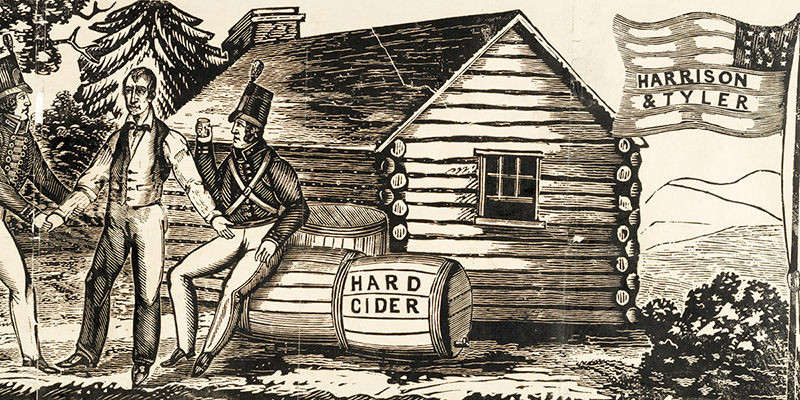
1840 Harrison campaign imagery
Many state legislatures had once chosen presidential electors directly. By 1832, only South Carolina still did that. Presidents now needed broad public support.
Candidate selection changed too:
- Old system: congressional caucuses, mocked as King Caucus
- New system: state conventions and national nominating conventions
- First national convention: Anti-Masonic Party in 1831
- Democrats and National Republicans followed in 1832
- Rallies, parades, barbecues, songs, slogans, symbols
- Partisan newspapers spread the party message
- Parties printed their own ballots or “tickets”
- Voting was often public, so pressure, intimidation, and fraud were common
The spoils system fit this new party world. Jacksonians defended rotation in office, but patronage often meant rewarding loyal supporters with jobs. William L. Marcy summed it up with “to the victor belong the spoils.”
The Elections That Show the Change
Election of 1824
- Candidates were Andrew Jackson, John Quincy Adams, William H. Crawford, Henry Clay
- Electoral vote was Jackson 99, Adams 84, Crawford 41, Clay 37
- No majority, so the House decided under the Twelfth Amendment
- Clay backed Adams
- Adams won, then named Clay secretary of state
- Jackson’s supporters cried “corrupt bargain”
The huge point here is that many voters thought Jackson should win because he led in popular and electoral votes, even without a constitutional majority.
Election of 1828
Jackson defeated Adams in a highly organized popular campaign. He was sold as the common man’s candidate, while Adams was painted as an elitist. Martin Van Buren helped build the disciplined Democratic Party behind Jackson. People call this the Revolution of 1828 because it confirmed mass democratic politics.
Campaign of 1840
The Whigs copied Democratic campaign methods.
- William Henry Harrison
- Log cabin and hard cider image
- Slogan: “Tippecanoe and Tyler Too”
- Turnout reached about 80 percent of eligible voters
What Expanded Democracy Changed and What It Did Not
Expanded democracy enlarged the electorate for white men and made popular support the main source of legitimacy. It also created the Second Party System and turned parties into the center of political life.
| Party | Leading figures | Main support |
|---|---|---|
| Democrats | Andrew Jackson, Martin Van Buren | farmers, frontier settlers, urban workers, many immigrants |
| Whigs | broad anti-Jackson coalition | merchants, manufacturers, professionals, many evangelical reformers, middle-class voters |
The limits are just as important as the gains.
- Free African Americans lost ground in many places. New York Constitution of 1821 kept a property requirement for Black men, North Carolina disfranchised free Black men in 1835, and Pennsylvania Constitution of 1838 limited suffrage to white men.
- Women stayed excluded. New Jersey’s 1807 law restricted voting to free white male citizens. Women remained politically active informally, and the Seneca Falls Convention in 1848 grew out of that exclusion.
- American Indians were excluded from citizenship and voting, and white democracy expanded alongside Native dispossession and removal.
Key Takeaways
Participatory Democracy
A political system characterized by broad voter involvement, competitive parties, popular campaigning, and direct participation in choosing leaders
Property Qualifications for Voting
State requirements that voters own a specified amount of property, based on the belief that property gave men independence and a stake in society
White Manhood Suffrage / Universal White Male Suffrage
Voting rights for nearly all adult white male citizens regardless of property ownership, while women and most nonwhite people remained excluded
Decline of Deference
The weakening expectation that ordinary citizens should accept rule by wealthy, educated, or socially prominent men
Market Revolution
Economic change that increased the importance of wage earners, artisans, tenants, and mobile workers, weakening the claim that only property owners were independent citizens
Dorr Rebellion
Thomas Dorr’s failed 1842 effort to install a government under Rhode Island’s People’s Constitution; it helped prompt broader, though still restricted, white male suffrage
Andrew Jackson
Military hero portrayed as the champion of the common man who led a mass Democratic coalition and won the presidency in 1828
Election of 1824
Jackson won pluralities of the recorded popular and electoral votes but no electoral majority; the House chose Adams, fueling the corrupt-bargain charge and Jacksonian mobilization
Twelfth Amendment
Required the House to choose the president from the top three electoral-vote recipients when no candidate won an Electoral College majority, with one vote per state delegation
Corrupt Bargain
Jacksonians’ charge that Henry Clay helped John Quincy Adams win the 1824 House election in exchange for appointment as secretary of state, though no explicit bargain was proven
John Quincy Adams
House-selected president in 1824 whose policies and limited use of patronage helped Jacksonians organize a disciplined opposition
Henry Clay
Fourth-place candidate and House Speaker in 1824 who supported Adams and was then appointed secretary of state, prompting the corrupt-bargain charge
Martin Van Buren
New York politician who organized Jackson’s supporters into a disciplined national coalition that became the Democratic Party
Democratic Party
Mass party formed around Jackson and Van Buren that appealed strongly to farmers, workers, immigrants, and frontier settlers while opposing concentrated privilege
Election of 1828 / Revolution of 1828
Jackson defeated Adams through a disciplined national campaign appealing directly to an enlarged white male electorate
Mass Political Parties
Permanent organizations that recruited candidates, published newspapers, distributed ballots, held rallies, and mobilized ordinary voters at every political level
Mass Campaigning
Mobilizing broad electorates through rallies, parades, barbecues, partisan newspapers, songs, slogans, symbols, and carefully constructed candidate images
Congressional Nominating Caucus / King Caucus
The early system in which members of Congress selected presidential candidates, criticized as unrepresentative and abandoned after 1824
National Nominating Convention
A party gathering of delegates from multiple states that selected presidential candidates and helped create national tickets, platforms, and campaign organizations
Anti-Masonic Party
Political party that held the first national presidential nominating convention in 1831
Party-Printed Ballots / Party Tickets
Recognizable ballots printed and distributed by parties that listed their candidates, encouraged straight-party voting, and permitted surveillance or intimidation
Second Party System
The national competition between Democrats and Whigs during the 1830s and 1840s, with both parties organizing and mobilizing ordinary white male voters
Whig Party
Broad anti-Jackson party that opposed arbitrary executive power and attracted many merchants, manufacturers, commercial farmers, professionals, reformers, and middle-class voters
Rotation in Office
Jacksonian principle that public positions should periodically change hands rather than become the permanent property of an entrenched officeholding class
Patronage / Spoils System
The practice of a victorious party rewarding loyal supporters with government offices, strengthening party organization while encouraging favoritism and corruption
Election of 1840
Whig William Henry Harrison defeated Martin Van Buren through log-cabin imagery, slogans, songs, rallies, and other mass-campaign methods as turnout reached about 80 percent
William Henry Harrison
Whig candidate portrayed as a log-cabin frontier soldier who defeated Martin Van Buren in the highly organized mass campaign of 1840
Popular Election of Presidential Electors
Shift from state legislatures appointing presidential electors to voters choosing them; by 1832, only South Carolina retained legislative selection
Notes
Participatory Democracy
A political system characterized by broad voter involvement, competitive parties, popular campaigning, and direct participation in choosing leaders
Property Qualifications for Voting
State requirements that voters own a specified amount of property, based on the belief that property gave men independence and a stake in society
White Manhood Suffrage / Universal White Male Suffrage
Voting rights for nearly all adult white male citizens regardless of property ownership, while women and most nonwhite people remained excluded
Decline of Deference
The weakening expectation that ordinary citizens should accept rule by wealthy, educated, or socially prominent men
Market Revolution
Economic change that increased the importance of wage earners, artisans, tenants, and mobile workers, weakening the claim that only property owners were independent citizens
Dorr Rebellion
Thomas Dorr’s failed 1842 effort to install a government under Rhode Island’s People’s Constitution; it helped prompt broader, though still restricted, white male suffrage
Andrew Jackson
Military hero portrayed as the champion of the common man who led a mass Democratic coalition and won the presidency in 1828
Election of 1824
Jackson won pluralities of the recorded popular and electoral votes but no electoral majority; the House chose Adams, fueling the corrupt-bargain charge and Jacksonian mobilization
Twelfth Amendment
Required the House to choose the president from the top three electoral-vote recipients when no candidate won an Electoral College majority, with one vote per state delegation
Corrupt Bargain
Jacksonians’ charge that Henry Clay helped John Quincy Adams win the 1824 House election in exchange for appointment as secretary of state, though no explicit bargain was proven
John Quincy Adams
House-selected president in 1824 whose policies and limited use of patronage helped Jacksonians organize a disciplined opposition
Henry Clay
Fourth-place candidate and House Speaker in 1824 who supported Adams and was then appointed secretary of state, prompting the corrupt-bargain charge
Martin Van Buren
New York politician who organized Jackson’s supporters into a disciplined national coalition that became the Democratic Party
Democratic Party
Mass party formed around Jackson and Van Buren that appealed strongly to farmers, workers, immigrants, and frontier settlers while opposing concentrated privilege
Election of 1828 / Revolution of 1828
Jackson defeated Adams through a disciplined national campaign appealing directly to an enlarged white male electorate
Mass Political Parties
Permanent organizations that recruited candidates, published newspapers, distributed ballots, held rallies, and mobilized ordinary voters at every political level
Mass Campaigning
Mobilizing broad electorates through rallies, parades, barbecues, partisan newspapers, songs, slogans, symbols, and carefully constructed candidate images
Congressional Nominating Caucus / King Caucus
The early system in which members of Congress selected presidential candidates, criticized as unrepresentative and abandoned after 1824
National Nominating Convention
A party gathering of delegates from multiple states that selected presidential candidates and helped create national tickets, platforms, and campaign organizations
Anti-Masonic Party
Political party that held the first national presidential nominating convention in 1831
Party-Printed Ballots / Party Tickets
Recognizable ballots printed and distributed by parties that listed their candidates, encouraged straight-party voting, and permitted surveillance or intimidation
Second Party System
The national competition between Democrats and Whigs during the 1830s and 1840s, with both parties organizing and mobilizing ordinary white male voters
Whig Party
Broad anti-Jackson party that opposed arbitrary executive power and attracted many merchants, manufacturers, commercial farmers, professionals, reformers, and middle-class voters
Rotation in Office
Jacksonian principle that public positions should periodically change hands rather than become the permanent property of an entrenched officeholding class
Patronage / Spoils System
The practice of a victorious party rewarding loyal supporters with government offices, strengthening party organization while encouraging favoritism and corruption
Election of 1840
Whig William Henry Harrison defeated Martin Van Buren through log-cabin imagery, slogans, songs, rallies, and other mass-campaign methods as turnout reached about 80 percent
William Henry Harrison
Whig candidate portrayed as a log-cabin frontier soldier who defeated Martin Van Buren in the highly organized mass campaign of 1840
Popular Election of Presidential Electors
Shift from state legislatures appointing presidential electors to voters choosing them; by 1832, only South Carolina retained legislative selection
