Topic 3.7 Notes – The Articles of Confederation
What the Articles of Confederation Were
Right after breaking from Britain, Americans tried to build governments that matched Revolutionary ideas. Popular sovereignty and representation mattered, but so did fear of centralized authority.
State governments showed that fear first:
- Legislatures held most power in many states because people distrusted governors who looked too much like royal officials.
- Property qualifications for voting and officeholding stayed in place. The Revolution expanded self-government, but it did not create full political equality.
- Virginia Declaration of Rights in 1776 became an influential model for rights protections.
- Pennsylvania Constitution of 1776 was a very democratic, legislature-dominated model with weak executive power.
- Massachusetts Constitution of 1780 took a different path. It had stronger separation of powers, a stronger governor, and it was written by a constitutional convention and ratified by the people.
The national version of that same fear became the Articles of Confederation. Drafted in 1776, approved in 1777, and ratified in 1781, they created a confederation, which means the states kept most sovereignty and joined in a “firm league of friendship.”
Ratification took so long because of western land claims. Maryland refused to approve the Articles until large-claim states like Virginia agreed to cede western lands to the national government.
How the Confederation Government Worked
The Confederation government could handle shared problems, but only by working through the states.
- Unicameral Congress means one house, not two.
- One state, one vote means Delaware and Virginia counted equally.
- There was no national executive to carry out laws.
- There was no permanent national judiciary to interpret laws.
- Major laws usually needed 9 of 13 states.
- Amendments required unanimous approval.
Congress still had real powers:
- declare war and make peace
- conduct diplomacy and make treaties
- send and receive ambassadors
- borrow money and issue currency
- establish a postal system
- regulate coinage
- settle some interstate disputes
- manage western lands
- request troops and money from states
That last word matters. Congress could request, not command. It acted on states, not directly on citizens.
Why the Articles Struggled
The weaknesses were built into the structure.
Money and debt
- Congress could not levy taxes. It asked states for money, and states often ignored those requests.
- War debts to domestic creditors, foreign governments, and soldiers piled up unpaid.
- Continental currency lost value through inflation.
- Attempts to create an import duty failed because unanimity was required. Rhode Island blocked one plan, and New York blocked another.
Commerce and foreign policy
- Congress could not regulate interstate or foreign trade.
- States set their own tariffs and currencies, which hurt a national market.
- Britain kept forts in the Northwest and limited American trade, saying the U.S. had violated treaty terms.
- Spain closed the Mississippi River in 1784, which hurt western farmers who depended on it.
Enforcement
Without an executive or judiciary, laws and treaties were hard to enforce uniformly. That is why the core problem was structural, not just weak leadership.
What the Confederation Actually Accomplished in the West
The biggest success of the Articles was western policy. Congress turned ceded western lands into future equal states, not colonies.
The map shows the Northwest Territory in relation to present-day state boundaries. This is the region organized by the ordinances below.
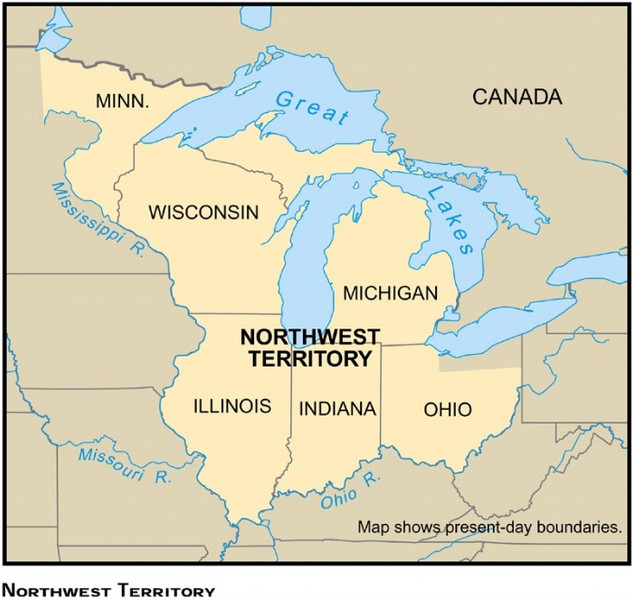
Northwest Territory
Land Ordinance of 1785
To make western land easier to organize and sell, Congress set up a grid-based survey system like the one shown here.
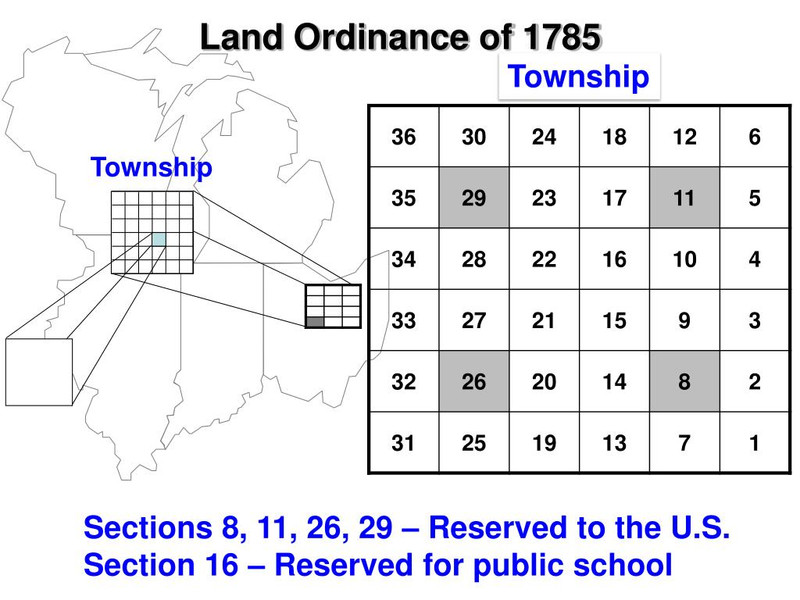
Land Ordinance of 1785 township grid
- Created the rectangular survey system
- Divided land into townships and 36 sections
- Reserved section 16 for schools
- Made land easier to identify, sell, and govern
- Raised revenue through land sales
- Also favored speculators and ignored Native land claims
Northwest Ordinance of 1787
This law created a step-by-step path to statehood:
- Congress appointed a governor, secretary, and judges.
- At 5,000 free adult males, settlers could elect a legislature.
- At 60,000 free inhabitants, the territory could apply for statehood.
It also protected religious freedom, trial by jury, habeas corpus, private property, and contracts, encouraged public education, and banned slavery in the Northwest Territory. Still, it required the return of fugitive enslaved people. The Ohio River started to matter as an early sectional boundary.
Why the Articles Were Replaced
Postwar hardship brought the weaknesses into the open. Debt, high taxes, trade problems, and lack of hard currency created fights between debtors who wanted relief and creditors who wanted repayment.
Shays’ Rebellion in 1786 to 1787 made that crisis visible. Western Massachusetts farmers, many led symbolically by Daniel Shays, shut down courts to stop foreclosures and tried to seize the Springfield arsenal. Massachusetts had to use a privately funded militia because the national government lacked money and troops.
That convinced many elites that liberty without order threatened property and stability. George Washington, Alexander Hamilton, and James Madison pushed for a stronger central government. The Annapolis Convention in 1786 called for broader reform, and the Confederation Congress approved the Philadelphia Convention in 1787.
The Articles mattered because they unified the states and solved western land issues. They also exposed the central problem of the early republic. Americans had to find a government strong enough to govern without destroying liberty.
Key Takeaways
Republicanism
Government based on popular sovereignty and representative institutions rather than hereditary monarchy
Popular Sovereignty
The principle that legitimate government derives its authority from the people
New State Constitutions
Postindependence governing documents that affirmed popular sovereignty, often protected rights, and generally concentrated power in frequently elected legislatures while weakening governors
Property Qualifications
Requirements that voters or citizens own property, with some states also requiring property ownership or taxpaying for officeholding
Pennsylvania Constitution of 1776
A democratic, legislature-centered constitution with a unicameral legislature, plural executive council, frequent elections, and a relatively broad franchise
Massachusetts Constitution of 1780
A constitution ratified by voters after a special convention that created a stronger elected governor and clearer separation of powers
Articles of Confederation
The first written U.S. constitution, effective in 1781, which created a loose confederation in which sovereign states granted limited powers to a national government
Confederation Congress
The unicameral national legislature under the Articles, with one vote per state and limited powers over war, diplomacy, borrowing, western lands, and other common affairs
Structural Limitations of the Articles of Confederation
Congress could not tax or regulate commerce, lacked executive and judicial branches and reliable enforcement, needed nine states for major laws, and required unanimity for amendments
Western Land Cessions
Surrenders of state western claims to the national government that secured Maryland's ratification of the Articles and created nationally administered territory
Debtors vs. Creditors
Farmers and artisans often favored paper money, easier credit, and debt relief, while merchants and creditors favored hard money and full repayment
Land Ordinance of 1785
Law that surveyed western land into six-mile-square townships of 36 sections, reserved section 16 for schools, and organized land sales to raise revenue
Shays' Rebellion
A 1786–1787 Massachusetts farmers' uprising against taxes, debts, and foreclosures that exposed national military and financial weakness and accelerated demands for reform
Daniel Shays
Revolutionary War veteran and best-known leader of the Massachusetts resistance that became Shays' Rebellion
Annapolis Convention of 1786
Poorly attended meeting on interstate commerce whose delegates called for a broader convention to strengthen the national government
Northwest Ordinance of 1787
Law that governed the Northwest Territory, created a path to equal statehood, protected rights and property, promoted education, and prohibited slavery except as punishment for crime
Nationalists
Leaders such as George Washington, Alexander Hamilton, and James Madison who argued that the United States needed a stronger central government
Notes
Republicanism
Government based on popular sovereignty and representative institutions rather than hereditary monarchy
Popular Sovereignty
The principle that legitimate government derives its authority from the people
New State Constitutions
Postindependence governing documents that affirmed popular sovereignty, often protected rights, and generally concentrated power in frequently elected legislatures while weakening governors
Property Qualifications
Requirements that voters or citizens own property, with some states also requiring property ownership or taxpaying for officeholding
Pennsylvania Constitution of 1776
A democratic, legislature-centered constitution with a unicameral legislature, plural executive council, frequent elections, and a relatively broad franchise
Massachusetts Constitution of 1780
A constitution ratified by voters after a special convention that created a stronger elected governor and clearer separation of powers
Articles of Confederation
The first written U.S. constitution, effective in 1781, which created a loose confederation in which sovereign states granted limited powers to a national government
Confederation Congress
The unicameral national legislature under the Articles, with one vote per state and limited powers over war, diplomacy, borrowing, western lands, and other common affairs
Structural Limitations of the Articles of Confederation
Congress could not tax or regulate commerce, lacked executive and judicial branches and reliable enforcement, needed nine states for major laws, and required unanimity for amendments
Western Land Cessions
Surrenders of state western claims to the national government that secured Maryland's ratification of the Articles and created nationally administered territory
Debtors vs. Creditors
Farmers and artisans often favored paper money, easier credit, and debt relief, while merchants and creditors favored hard money and full repayment
Land Ordinance of 1785
Law that surveyed western land into six-mile-square townships of 36 sections, reserved section 16 for schools, and organized land sales to raise revenue
Shays' Rebellion
A 1786–1787 Massachusetts farmers' uprising against taxes, debts, and foreclosures that exposed national military and financial weakness and accelerated demands for reform
Daniel Shays
Revolutionary War veteran and best-known leader of the Massachusetts resistance that became Shays' Rebellion
Annapolis Convention of 1786
Poorly attended meeting on interstate commerce whose delegates called for a broader convention to strengthen the national government
Northwest Ordinance of 1787
Law that governed the Northwest Territory, created a path to equal statehood, protected rights and property, promoted education, and prohibited slavery except as punishment for crime
Nationalists
Leaders such as George Washington, Alexander Hamilton, and James Madison who argued that the United States needed a stronger central government
