Topic 8.6 Notes – Early Steps in the Civil Rights Movement (1940s and 1950s)
How the Early Civil Rights Movement Grew After World War II
This movement was about making the 14th Amendment and 15th Amendment mean something in everyday life. Equal protection and voting rights had existed on paper since Reconstruction, but Jim Crow laws, disfranchisement, and racial violence kept Black Americans from full citizenship.
- In the South, segregation was de jure. Law required it.
- In the North and West, discrimination was often de facto. Custom, housing patterns, and job discrimination kept inequality going without the same set of segregation laws.
World War II sharpened the contradiction. The U.S. said it was fighting fascism and racism abroad, yet tolerated racism at home. The Black press answered with the Double V campaign. Victory overseas had to be matched by victory against white supremacy in America.
Black veterans came home expecting full rights. The 1946 beating and blinding of veteran Isaac Woodard helped push Truman toward civil rights action. Pressure had already worked once. In 1941, A. Philip Randolph threatened a March on Washington over discrimination in defense jobs and the military. FDR responded with Executive Order 8802, banning discrimination in defense industries, and created the Fair Employment Practice Committee.
Broader changes gave the movement strength:
- Great Migration gave Black Americans more voting power and stronger city communities.
- Black churches, NAACP branches, women’s groups, and labor networks gave organizers money, space, leadership, and communication.
- The Cold War and decolonization mattered because segregation hurt America’s image in the “free world,” though Black demands had existed long before that.
The pattern to remember is legal action + grassroots pressure + federal response.
The Federal Government’s First Steps
The three branches all mattered, but not in the same way.
Harry Truman
Truman made civil rights a national issue. His President’s Committee on Civil Rights published To Secure These Rights in 1947. It called for anti-lynching laws, voting-rights protection, an end to poll taxes, fair employment, and military desegregation.
He then used executive power:
- Executive Order 9980 ended discrimination in the federal civilian workforce.
- Executive Order 9981 desegregated the armed forces.
The Korean War sped up military integration because the armed services needed manpower and efficiency.
Limits showed up fast. Southern Democrats revolted as Dixiecrats in 1948, led by Strom Thurmond, and blocked broader civil rights laws in Congress.
Congress under Eisenhower
Congress finally passed civil rights laws again, but they were weak.
- Civil Rights Act of 1957
- first civil rights law since Reconstruction
- created the U.S. Commission on Civil Rights
- created the Civil Rights Division in the Justice Department
- had weak enforcement of voting rights
- Civil Rights Act of 1960
- required preservation of voting records
- allowed federal referees when local officials blocked registration
These mattered more as a sign that the federal government was returning to civil rights than as immediate solutions.
The NAACP’s Legal Attack on Segregation
The NAACP and NAACP Legal Defense Fund tried to destroy Plessy v. Ferguson and its “separate but equal” doctrine by using the 14th Amendment.
Leaders and strategy
Charles Hamilton Houston and Thurgood Marshall used an incremental strategy. They first attacked obviously unequal graduate and professional schools, where states had a hard time pretending separate systems were equal.
Key cases before Brown:
- Smith v. Allwright (1944) ended the white primary.
- Morgan v. Virginia (1946) ended segregation on interstate buses.
- Shelley v. Kraemer (1948) stopped courts from enforcing restrictive housing covenants.
- Sweatt v. Painter (1950) said the separate Black law school in Texas was unequal.
- McLaurin v. Oklahoma State Regents (1950) said isolating a Black graduate student within a white school was unconstitutional.
Brown v. Board of Education 1954
Oliver Brown sued for his daughter Linda Brown.
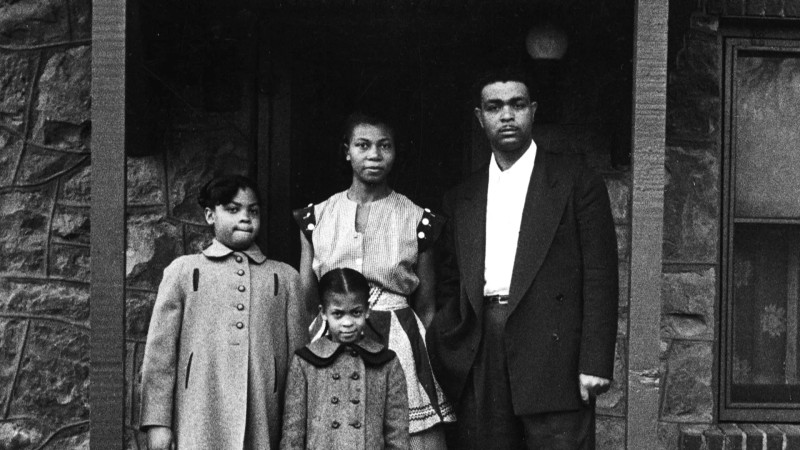
Oliver Brown and family
The case combined school cases from Kansas, South Carolina, Virginia, and Delaware, plus the related D.C. case Bolling v. Sharpe. Chief Justice Earl Warren wrote a unanimous decision saying “separate educational facilities are inherently unequal.” Social science, including Kenneth and Mamie Clark’s doll studies, supported the argument that segregation harmed children.
Brown II in 1955 ordered desegregation with “all deliberate speed,” which sounds strong but gave segregationists room to delay.
Grassroots Protest, Nonviolence, and White Resistance
Brown triggered massive white backlash.
- Massive resistance became the Southern strategy.
- The Southern Manifesto in 1956 denounced Brown.
- States used pupil-placement laws, token integration, school closures, and segregation academies.
- White Citizens’ Councils used economic pressure, while the KKK used terror.
Little Rock crisis 1957
That backlash was on full display at Little Rock Central High School, where federal troops escorted Black students into the building.
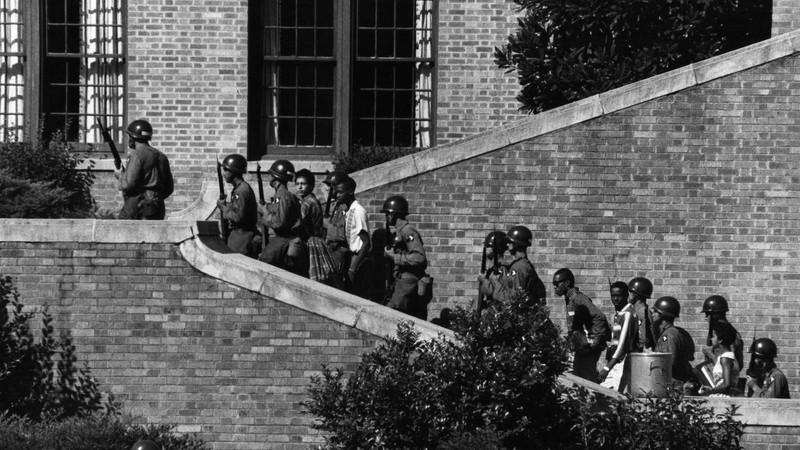
Little Rock school desegregation, 1957
Governor Orval Faubus used the Arkansas National Guard to block the Little Rock Nine. Eisenhower responded by federalizing the Guard and sending the 101st Airborne. In Cooper v. Aaron (1958), the Court said states had to obey Supreme Court rulings.
Racial violence as a mobilizer
The 1955 murder of Emmett Till shocked the nation. Mamie Till-Mobley insisted on an open-casket funeral, and Jet magazine’s photographs made the violence visible. An all-white jury acquitted the killers.
Montgomery Bus Boycott
Another famous image from this early phase of the movement shows Rosa Parks being fingerprinted after her arrest.
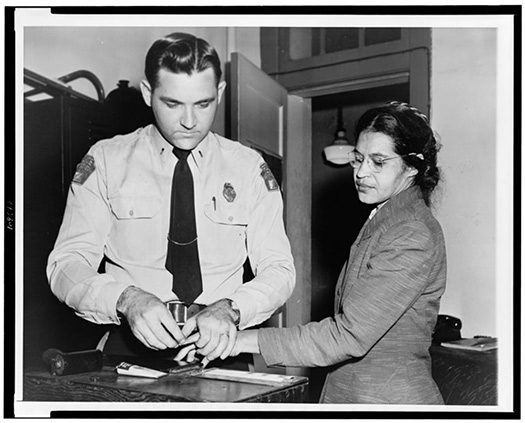
Rosa Parks after her arrest, 1955
The boycott began after Rosa Parks was arrested, but it rested on years of local organizing by Jo Ann Robinson, the Women’s Political Council, E. D. Nixon, and earlier resister Claudette Colvin. The Montgomery Improvement Association led a 381-day boycott using carpools, churches, and economic pressure. Martin Luther King Jr. emerged as a national leader. Browder v. Gayle desegregated the buses.
Organized nonviolence
King tied together Christianity, democratic ideals, and Gandhi’s methods. The SCLC formed in 1957 to coordinate church-based activism. CORE, founded in 1942, had already tested nonviolence in the Journey of Reconciliation in 1947. The Green Book showed how segregation shaped ordinary travel. The Greensboro sit-ins in 1960 led to SNCC, connecting this early phase to the larger 1960s movement.
What Changed by 1960 and What Had Not
By 1960, the movement had won major gains. The military was desegregated. Brown struck at legal segregation. Little Rock showed federal enforcement could matter. Congress had resumed civil rights legislation. The Montgomery model proved that mass nonviolent protest could work. SCLC and student activism had appeared.
But most Southern schools were still segregated. Black voting was still heavily suppressed. Housing and job discrimination continued across the country.
Key Takeaways
Jim Crow Laws
State and local laws enforcing racial segregation and Black political and economic subordination, especially in the South
De Jure Segregation vs. De Facto Segregation
De jure segregation was imposed by law; de facto segregation resulted from customs, private discrimination, housing patterns, and economic practices
Fourteenth Amendment’s Equal Protection Clause
Constitutional guarantee that states provide equal protection of the laws; the principal basis for legal challenges to state-enforced segregation
Double V Campaign
Black press campaign during World War II demanding victory over fascism abroad and racism at home
A. Philip Randolph
Black labor leader whose threatened 1941 March on Washington pressured Roosevelt to prohibit discrimination in defense employment
Executive Order 8802
Roosevelt’s 1941 order banning racial discrimination in defense industries and creating the Fair Employment Practice Committee
Harry Truman
President who elevated civil rights nationally, created a civil rights committee, barred discrimination in federal employment, and ordered military desegregation
Executive Order 9980
Truman’s 1948 order prohibiting racial discrimination in the federal civilian workforce
Executive Order 9981
Truman’s 1948 order requiring equal treatment and opportunity in the armed forces, leading to gradual military desegregation
Dixiecrats
Segregationist southern Democrats who opposed the 1948 Democratic civil rights plank and nominated Strom Thurmond for president
NAACP
Civil rights organization that used carefully selected lawsuits to make the Equal Protection Clause effective against state-enforced segregation
Plessy v. Ferguson / “Separate but Equal” Doctrine
1896 ruling permitting state-enforced racial separation when facilities were supposedly equal; the main constitutional obstacle attacked by the NAACP.
Charles Hamilton Houston
NAACP lawyer who developed the incremental strategy of challenging unequal segregated facilities and building precedents against segregation
Thurgood Marshall
NAACP attorney who led the legal campaign against school segregation and argued Brown before the Supreme Court
Smith v. Allwright
1944 Supreme Court decision invalidating the white primary used to exclude Black voters from decisive southern elections
Morgan v. Virginia
1946 Supreme Court decision striking down state-required segregation on interstate buses as a burden on interstate commerce
Shelley v. Kraemer
1948 Supreme Court decision holding that courts could not enforce racially restrictive housing covenants
Sweatt v. Painter
1950 ruling requiring the University of Texas Law School to admit Heman Sweatt because its separate Black law school was unequal in tangible and intangible qualities
McLaurin v. Oklahoma State Regents
1950 ruling that Oklahoma could not admit George McLaurin to graduate school while isolating him from white students
Brown v. Board of Education
Unanimous 1954 decision declaring state-mandated public-school segregation unconstitutional because separate educational facilities are inherently unequal
Earl Warren
Chief justice who wrote Brown’s unanimous opinion and worked to prevent a dissent that could encourage resistance
Bolling v. Sharpe
1954 companion to Brown that invalidated school segregation in Washington, D.C., where the Fourteenth Amendment did not directly apply
Brown II
1955 decision directing federal district courts to oversee school desegregation “with all deliberate speed,” language that permitted extensive delay
Massive Resistance
Organized southern campaign to obstruct school desegregation through delay, token plans, school closings, private academies, economic pressure, and violence
Southern Manifesto
1956 declaration by 101 southern members of Congress condemning Brown and pledging resistance to school desegregation
White Citizens’ Councils
White supremacist organizations that used economic retaliation, including firings, denied loans, and business boycotts, against civil rights activists
Little Rock Crisis / Little Rock Nine
1957 confrontation in which nine Black students entered Central High School under federal military protection after Arkansas resisted integration
Orval Faubus
Arkansas governor who used the National Guard to block the Little Rock Nine from entering Central High School
Dwight Eisenhower
President who federalized the Arkansas National Guard and sent the 101st Airborne Division to enforce integration at Little Rock
Cooper v. Aaron
1958 unanimous ruling that state officials were bound by the Supreme Court’s constitutional interpretation and could not nullify Brown
Civil Rights Act of 1957
First federal civil rights law since Reconstruction; created the U.S. Commission on Civil Rights and the Justice Department’s Civil Rights Division and authorized voting-rights injunctions
Civil Rights Act of 1960
Law requiring preservation of voting records and allowing federal court-appointed referees to assist qualified citizens denied registration
Emmett Till
Fourteen-year-old Black Chicagoan whose brutal 1955 murder in Mississippi and his killers’ acquittal exposed the violence sustaining Jim Crow
Mamie Till-Mobley
Emmett Till’s mother, whose decision to hold an open-casket funeral publicized the brutality of her son’s murder
Rosa Parks
Experienced NAACP activist whose December 1955 refusal to surrender her bus seat triggered the Montgomery Bus Boycott
Montgomery Bus Boycott
381-day nonviolent boycott that combined grassroots organizing, economic pressure, and litigation and ended with Montgomery’s buses desegregated
Jo Ann Robinson
Women’s Political Council leader who rapidly circulated notices launching the Montgomery bus boycott and helped organize it
Montgomery Improvement Association
Organization created to direct the Montgomery Bus Boycott, with Martin Luther King Jr. selected as its president
Browder v. Gayle
Federal case holding Alabama’s bus-segregation laws unconstitutional, leading to the desegregation of Montgomery’s buses in 1956
Martin Luther King Jr.
Montgomery leader who became the leading national advocate of disciplined nonviolent resistance grounded in Christianity, democratic ideals, and Gandhian methods
Nonviolent Direct Action
Disciplined boycotts, demonstrations, and civil disobedience that disrupted injustice, exposed repression, and created pressure for government action
Southern Christian Leadership Conference (SCLC)
Organization founded by King and other ministers in 1957 to use Black churches to coordinate, train, and publicize southern civil rights campaigns
Congress of Racial Equality (CORE)
Civil rights organization founded in 1942 that applied Gandhian nonviolent methods to racial discrimination
Journey of Reconciliation
CORE-led 1947 interracial bus trip through the upper South testing the ruling against segregation in interstate travel
Greensboro Sit-Ins
1960 protest begun by four Black college students at a whites-only Woolworth lunch counter that spread to other cities
Student Nonviolent Coordinating Committee (SNCC)
Student-led civil rights organization formed in 1960 out of the expanding sit-in movement, marking a new phase of nonviolent direct action
President’s Committee on Civil Rights
Committee established by Truman in 1946 that recommended stronger federal protection of civil rights
To Secure These Rights
The committee’s 1947 report calling for voting protections, fair employment, an end to lynching and poll taxes, and desegregation
Fifteenth Amendment
Reconstruction amendment prohibiting racial discrimination in voting, a promise civil rights activists sought to enforce
Women’s Political Council
Black women’s organization whose leader Jo Ann Robinson helped launch and organize the Montgomery Bus Boycott
Notes
Jim Crow Laws
State and local laws enforcing racial segregation and Black political and economic subordination, especially in the South
De Jure Segregation vs. De Facto Segregation
De jure segregation was imposed by law; de facto segregation resulted from customs, private discrimination, housing patterns, and economic practices
Fourteenth Amendment’s Equal Protection Clause
Constitutional guarantee that states provide equal protection of the laws; the principal basis for legal challenges to state-enforced segregation
Double V Campaign
Black press campaign during World War II demanding victory over fascism abroad and racism at home
A. Philip Randolph
Black labor leader whose threatened 1941 March on Washington pressured Roosevelt to prohibit discrimination in defense employment
Executive Order 8802
Roosevelt’s 1941 order banning racial discrimination in defense industries and creating the Fair Employment Practice Committee
Harry Truman
President who elevated civil rights nationally, created a civil rights committee, barred discrimination in federal employment, and ordered military desegregation
Executive Order 9980
Truman’s 1948 order prohibiting racial discrimination in the federal civilian workforce
Executive Order 9981
Truman’s 1948 order requiring equal treatment and opportunity in the armed forces, leading to gradual military desegregation
Dixiecrats
Segregationist southern Democrats who opposed the 1948 Democratic civil rights plank and nominated Strom Thurmond for president
NAACP
Civil rights organization that used carefully selected lawsuits to make the Equal Protection Clause effective against state-enforced segregation
Plessy v. Ferguson / “Separate but Equal” Doctrine
1896 ruling permitting state-enforced racial separation when facilities were supposedly equal; the main constitutional obstacle attacked by the NAACP.
Charles Hamilton Houston
NAACP lawyer who developed the incremental strategy of challenging unequal segregated facilities and building precedents against segregation
Thurgood Marshall
NAACP attorney who led the legal campaign against school segregation and argued Brown before the Supreme Court
Smith v. Allwright
1944 Supreme Court decision invalidating the white primary used to exclude Black voters from decisive southern elections
Morgan v. Virginia
1946 Supreme Court decision striking down state-required segregation on interstate buses as a burden on interstate commerce
Shelley v. Kraemer
1948 Supreme Court decision holding that courts could not enforce racially restrictive housing covenants
Sweatt v. Painter
1950 ruling requiring the University of Texas Law School to admit Heman Sweatt because its separate Black law school was unequal in tangible and intangible qualities
McLaurin v. Oklahoma State Regents
1950 ruling that Oklahoma could not admit George McLaurin to graduate school while isolating him from white students
Brown v. Board of Education
Unanimous 1954 decision declaring state-mandated public-school segregation unconstitutional because separate educational facilities are inherently unequal
Earl Warren
Chief justice who wrote Brown’s unanimous opinion and worked to prevent a dissent that could encourage resistance
Bolling v. Sharpe
1954 companion to Brown that invalidated school segregation in Washington, D.C., where the Fourteenth Amendment did not directly apply
Brown II
1955 decision directing federal district courts to oversee school desegregation “with all deliberate speed,” language that permitted extensive delay
Massive Resistance
Organized southern campaign to obstruct school desegregation through delay, token plans, school closings, private academies, economic pressure, and violence
Southern Manifesto
1956 declaration by 101 southern members of Congress condemning Brown and pledging resistance to school desegregation
White Citizens’ Councils
White supremacist organizations that used economic retaliation, including firings, denied loans, and business boycotts, against civil rights activists
Little Rock Crisis / Little Rock Nine
1957 confrontation in which nine Black students entered Central High School under federal military protection after Arkansas resisted integration
Orval Faubus
Arkansas governor who used the National Guard to block the Little Rock Nine from entering Central High School
Dwight Eisenhower
President who federalized the Arkansas National Guard and sent the 101st Airborne Division to enforce integration at Little Rock
Cooper v. Aaron
1958 unanimous ruling that state officials were bound by the Supreme Court’s constitutional interpretation and could not nullify Brown
Civil Rights Act of 1957
First federal civil rights law since Reconstruction; created the U.S. Commission on Civil Rights and the Justice Department’s Civil Rights Division and authorized voting-rights injunctions
Civil Rights Act of 1960
Law requiring preservation of voting records and allowing federal court-appointed referees to assist qualified citizens denied registration
Emmett Till
Fourteen-year-old Black Chicagoan whose brutal 1955 murder in Mississippi and his killers’ acquittal exposed the violence sustaining Jim Crow
Mamie Till-Mobley
Emmett Till’s mother, whose decision to hold an open-casket funeral publicized the brutality of her son’s murder
Rosa Parks
Experienced NAACP activist whose December 1955 refusal to surrender her bus seat triggered the Montgomery Bus Boycott
Montgomery Bus Boycott
381-day nonviolent boycott that combined grassroots organizing, economic pressure, and litigation and ended with Montgomery’s buses desegregated
Jo Ann Robinson
Women’s Political Council leader who rapidly circulated notices launching the Montgomery bus boycott and helped organize it
Montgomery Improvement Association
Organization created to direct the Montgomery Bus Boycott, with Martin Luther King Jr. selected as its president
Browder v. Gayle
Federal case holding Alabama’s bus-segregation laws unconstitutional, leading to the desegregation of Montgomery’s buses in 1956
Martin Luther King Jr.
Montgomery leader who became the leading national advocate of disciplined nonviolent resistance grounded in Christianity, democratic ideals, and Gandhian methods
Nonviolent Direct Action
Disciplined boycotts, demonstrations, and civil disobedience that disrupted injustice, exposed repression, and created pressure for government action
Southern Christian Leadership Conference (SCLC)
Organization founded by King and other ministers in 1957 to use Black churches to coordinate, train, and publicize southern civil rights campaigns
Congress of Racial Equality (CORE)
Civil rights organization founded in 1942 that applied Gandhian nonviolent methods to racial discrimination
Journey of Reconciliation
CORE-led 1947 interracial bus trip through the upper South testing the ruling against segregation in interstate travel
Greensboro Sit-Ins
1960 protest begun by four Black college students at a whites-only Woolworth lunch counter that spread to other cities
Student Nonviolent Coordinating Committee (SNCC)
Student-led civil rights organization formed in 1960 out of the expanding sit-in movement, marking a new phase of nonviolent direct action
President’s Committee on Civil Rights
Committee established by Truman in 1946 that recommended stronger federal protection of civil rights
To Secure These Rights
The committee’s 1947 report calling for voting protections, fair employment, an end to lynching and poll taxes, and desegregation
Fifteenth Amendment
Reconstruction amendment prohibiting racial discrimination in voting, a promise civil rights activists sought to enforce
Women’s Political Council
Black women’s organization whose leader Jo Ann Robinson helped launch and organize the Montgomery Bus Boycott
