Topic 1.7 Notes – Causation in Period 1
How Sustained Transatlantic Voyages Changed the Atlantic World
By 1491, the Americas already held diverse Native societies shaped by local environments. Europeans did not arrive to one single “Native culture.” They met farming towns, trading networks, empires, and mobile societies, and those differences shaped who traded, resisted, allied, or moved.
After 1492, improved ships and navigation, plus competition among European states, turned contact into a durable Atlantic system. That system is often summarized through the Columbian Exchange shown here.
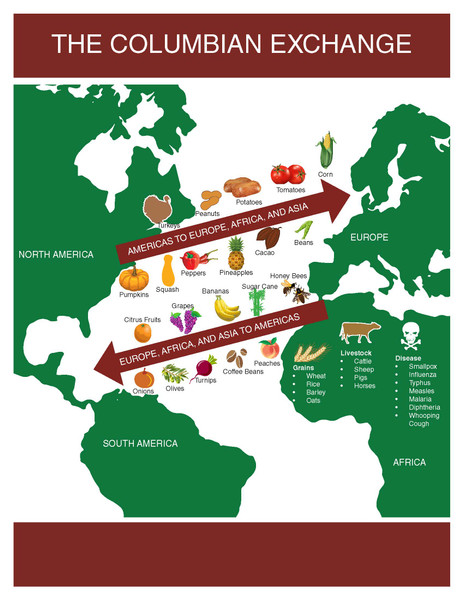
The Columbian Exchange
- Better maritime travel and imperial rivalry led to repeated voyages.
- Repeated voyages made sustained contact possible.
- Sustained contact produced the Columbian Exchange, conquest, colonization, forced migration, and environmental change.
The strongest causal answer explains how one thing led to another. Example: voyages did not just “happen before” conquest. Voyages carried pathogens, soldiers, settlers, missionaries, and goods across the ocean over and over, which made conquest and colonization possible.
The Major Effects of Contact in the Americas
Demographic collapse from disease
The most immediate effect in the Americas was epidemic disease.
- Old World diseases such as smallpox, measles, and influenza spread among Native peoples who lacked prior exposure.
- Disease often moved through Native trade networks faster than Europeans traveled.
- Mass death weakened leadership, disrupted farming, reduced military strength, and made conquest easier.
The standard example is smallpox during Cortés’s invasion. In 1520, smallpox struck the Aztec capital Tenochtitlán. The city fell in 1521. Disease did not act alone, but it helped break Aztec resistance.
The Columbian Exchange
This was the transfer of plants, animals, diseases, people, and ideas across the Atlantic.
| Americas to Europe/Africa | Europe/Africa to Americas |
|---|---|
| maize | wheat |
| potatoes | sugarcane |
| tomatoes | horses |
| cacao | cattle |
| tobacco | pigs |
| sheep | |
| diseases | |
| enslaved Africans | |
| settlers |
Potatoes and maize especially helped population growth in Europe. In the Americas, animals changed land use. Horses later transformed Plains societies, though that mattered more after 1607.
Environmental change
European colonists cleared land, expanded grazing, redirected water, and organized production around mining and export crops. Livestock trampled Native fields and encouraged large land claims.
Spanish Conquest and Colonial Systems
Spanish conquest worked because several causes came together, not because Europeans had better weapons and won automatically.
- Epidemic disease weakened Native societies.
- Steel weapons, firearms, armor, and horses gave advantages.
- Native allies supplied crucial manpower.
- Political divisions inside Indigenous empires made them vulnerable.
- Spanish motives included wealth, status, and Christian conversion.
Hernán Cortés conquered the Aztec Empire in 1521, and Tlaxcalan allies were crucial. Francisco Pizarro conquered the Inca after exploiting civil war and capturing Atahualpa in 1532.
The encomienda system gave colonists the right to demand Native labor or tribute. Brutal labor and disease shrank Native populations further, so colonists increasingly turned to the forced migration of enslaved Africans.
The Spanish casta system ranked people by ancestry:
- peninsulares: born in Spain
- creoles: Spanish ancestry, born in the Americas
- mestizos: mixed Spanish and Native ancestry
- mulattoes: mixed Spanish and African ancestry
- Native Americans and Africans usually held lower status
Cultural Conflict, Debate, and Native Agency
Europeans and Native peoples clashed over religion, land, gender roles, family, and power.
- Missionaries pushed Christian conversion. Native peoples resisted, adapted, or blended beliefs.
- Europeans treated land as owned property with boundaries. Many Native groups used land collectively or seasonally through kinship patterns.
- Many Native societies gave women major economic or political roles. Europeans often tried to impose patriarchal norms.
Native peoples were never passive. They shaped events through diplomacy, trade, alliances, migration, and armed resistance.
The Valladolid debate showed Europeans arguing over conquest itself. Bartolomé de las Casas condemned Spanish abuse of Native peoples. Juan Ginés de Sepúlveda defended domination.
Effects in Europe and the Best Big-Picture Argument
Europe changed too. American silver and new crops increased wealth, commerce, and population. Rivalry grew among Spain, Portugal, France, England, and the Netherlands. Atlantic expansion also encouraged capitalism, long-distance trade, and joint-stock investment. The endpoint example is Jamestown, founded by the Virginia Company in 1607.
The best full claim is that transatlantic voyages caused Native population decline, Spanish imperial expansion, coerced labor systems, Atlantic trade, and long-term ecological and cultural change.
