Topic 9.4 Notes – A Changing Economy
What the Changing Economy Was
The core shift here is postindustrialization. The U.S. did not stop making things, but fewer Americans worked in factories. More of the economy revolved around services, data, finance, and technology.
- Continuity stayed strong. The U.S. was still a capitalist, consumer economy driven mostly by private enterprise.
- Change came in what mattered most. Information networks, finance, and global supply chains became more central than mass industrial employment.
- The chain you need to know is digital technology + globalization + automation. That combination led to:
- fewer manufacturing jobs
- more service and tech jobs
- weaker unions
- wage stagnation for many workers
- greater inequality
How Digital Technology Reshaped the Economy and Daily Life
Productivity means getting more output from the same labor or resources. Computers and digital communication boosted productivity by making design, shipping, accounting, finance, and production faster and cheaper.
Key developments
- Microprocessor made computers smaller and cheaper.
- Personal computers spread through homes and workplaces in the 1980s and 1990s.
- Computer-aided design and computerized machinery improved precision and reduced labor needs.
- Bar codes and digital records made retail and shipping more efficient.
- The internet grew out of government and university networks.
- Tim Berners-Lee made the World Wide Web public in 1991, which made the internet much easier to use.
- Email and digital communication lowered transaction costs and let firms coordinate work across long distances.
By the 1980s and 1990s, that shift was visible in everyday office life as personal computers became standard workplace tools.
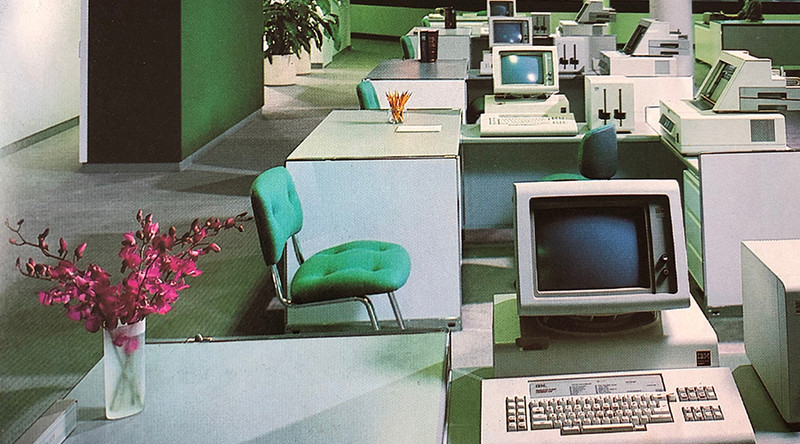
Personal computers in the workplace
Major firms and symbols of the new economy
- Microsoft and Apple became major personal computing companies.
- Silicon Valley became the leading tech and investment hub.
- Amazon (1994) helped expand e-commerce.
- Google (1998) transformed how people found information online.
- Facebook (2004) became a major social media platform.
- Apple’s iPhone (2007) symbolized the smartphone era.
Effects on daily life
Digital technology changed daily life as much as work.
- People gained easier access to information through online news, archives, and search engines.
- Communication shifted from letters and landlines to email, texting, video calls, and social media.
- Shopping, entertainment, and relationships moved online through e-commerce, streaming, remote communication, and digital networks.
- New problems came with it:
- misinformation
- privacy concerns
- surveillance and corporate data collection
- the digital divide, with unequal access by income, age, education, and geography
How Globalization and Deindustrialization Changed Work
Globalization means economies becoming more connected through trade, investment, production, finance, transportation, and communication. Digital tools made that much easier.
Why globalization sped up
- Digital communication let companies manage far-flung operations.
- Container shipping cut transportation costs.
- Multinational corporations built global supply chains.
- Government policy supported trade integration.
Key policy examples
| Policy | What it did |
|---|---|
| NAFTA (1994) | Lowered trade barriers among the U.S., Canada, and Mexico |
| World Trade Organization (1995) | Set trade rules and handled disputes |
| China joins WTO (2001) | Increased import competition, especially for U.S. manufacturing |
Deindustrialization means manufacturing made up a smaller share of employment and many factories closed or moved.
- Automation means machines or software replace labor.
- Offshoring means production moves abroad.
- Those are different causes, and APUSH likes that distinction.
Regional effects hit hard in the Rust Belt, especially Detroit, Cleveland, Pittsburgh, Buffalo, and Gary. The map shows how this old industrial region stretched across parts of the Great Lakes and Northeast. Factory closings damaged jobs, tax bases, and local businesses. Some cities reinvented themselves. Pittsburgh shifted toward healthcare, education, finance, and technology. Growth increasingly favored parts of the South and West.
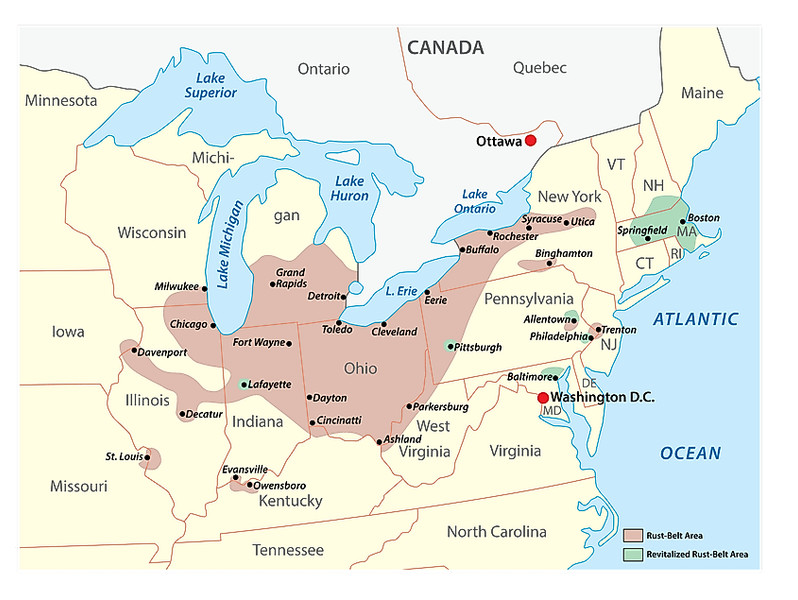
Rust Belt map
How Work, Wages, and Inequality Changed
Service jobs replaced many factory jobs, but the service sector was split.
- Higher-paid work included software engineers, physicians, financial analysts, and attorneys.
- Lower-paid work included retail, food service, hospitality, home healthcare, and personal care.
- That created labor-market polarization. Growth happened at the top and bottom, while many middle-income routine jobs declined.
Union membership also fell.
- Manufacturing shrank.
- Service work was harder to organize.
- Employers pushed back.
- Right-to-work laws weakened unions.
- Private-sector unions declined more than public-sector unions.
A real wage is a wage adjusted for inflation. After the 1970s, productivity kept rising, but many working- and middle-class wages did not. Minimum wage often lost buying power when Congress did not raise it. At the same time, pensions became less common, healthcare and college got more expensive, and jobs felt less secure.
Finance and the Great Recession
As finance grew, risk grew too. Subprime mortgages and mortgage-backed securities tied more of the economy to housing. When the housing bubble burst, the 2007-2008 financial crisis hit. Lehman Brothers failed in 2008. The Great Recession brought layoffs, foreclosures, and bailouts. Recovery brought asset values back faster than it restored worker security, which deepened inequality.
Key Takeaways
Postindustrial Economy
An economy increasingly based on services, information, finance, advanced technology, and global supply chains rather than mass industrial employment
Economic Productivity
The output produced from a given amount of labor and resources; computers, automation, and digital communication increased it
Microprocessor
A compact computer processor that made smaller, cheaper personal computers and computerized machinery possible
Personal Computers
Computers that spread through homes and workplaces in the 1980s and 1990s, transforming communication, data processing, design, and production
Internet
A global digital network that expanded rapidly in the 1990s, lowering communication costs and transforming information, commerce, work, and social interaction
Electronic Commerce (E-Commerce)
The buying and selling of goods and services online, pioneered on a large scale by firms such as Amazon
Smartphones
Portable devices combining internet access, communication, photography, navigation, and entertainment; the 2007 iPhone accelerated their mass adoption
Social Media
Online platforms such as Facebook that let users publish content, create identities, organize, and maintain social networks
Digital Divide
Unequal access to reliable internet service, digital devices, and digital skills based on income, education, age, or geography
Silicon Valley
The California region that became a major center of computer technology, entrepreneurship, investment, and concentrated wealth
Globalization
The increasing integration of national economies through trade, investment, production, finance, transportation, and communication
Global Supply Chains
Production systems in which research, components, assembly, marketing, and distribution occur in different countries
North American Free Trade Agreement (NAFTA)
A 1994 agreement that gradually removed most trade barriers among the United States, Canada, and Mexico, expanding trade while increasing competitive pressure on some workers
World Trade Organization (WTO)
An organization established in 1995 to oversee international trade rules and settle disputes; China’s 2001 entry intensified global competition
Automation vs. Offshoring
Automation replaces or changes tasks with machinery or software; offshoring moves production to another country
Deindustrialization
The decline of manufacturing’s share of employment and the closing or relocation of industrial facilities, even while manufacturing output remained substantial
Rust Belt
Older manufacturing areas of the Northeast and Midwest that suffered factory closings, job and population losses, and fiscal decline
Service Economy (Service Sector)
An economy with growing employment in fields such as healthcare, education, finance, retail, hospitality, entertainment, and information technology
Labor-Market Polarization
Growth of high-skill, high-wage jobs and low-wage in-person service jobs while many routine middle-income jobs declined
Declining Union Membership
The shrinking unionized share of the workforce as manufacturing declined and service work, employer resistance, relocation, subcontracting, and right-to-work laws hindered organizing, weakening worker bargaining power
Stagnant Real Wages
Inflation-adjusted wages for many working- and middle-class Americans grew slowly after the 1970s even as productivity continued rising
Economic Inequality
The unequal distribution of income and wealth, which increased as gains became concentrated among highly skilled workers and owners of appreciating assets
Income vs. Wealth
Income is earnings and other receipts over time; wealth is the value of accumulated assets minus debts
Great Recession
The severe downturn triggered in 2007–2008 when the housing bubble collapsed, mortgage-backed securities lost value, credit froze, and millions lost jobs or homes
World Wide Web
A system made publicly available in 1991 that made the internet easier for ordinary users to navigate
Tim Berners-Lee
Developed the World Wide Web and made it publicly available in 1991
Notes
Postindustrial Economy
An economy increasingly based on services, information, finance, advanced technology, and global supply chains rather than mass industrial employment
Economic Productivity
The output produced from a given amount of labor and resources; computers, automation, and digital communication increased it
Microprocessor
A compact computer processor that made smaller, cheaper personal computers and computerized machinery possible
Personal Computers
Computers that spread through homes and workplaces in the 1980s and 1990s, transforming communication, data processing, design, and production
Internet
A global digital network that expanded rapidly in the 1990s, lowering communication costs and transforming information, commerce, work, and social interaction
Electronic Commerce (E-Commerce)
The buying and selling of goods and services online, pioneered on a large scale by firms such as Amazon
Smartphones
Portable devices combining internet access, communication, photography, navigation, and entertainment; the 2007 iPhone accelerated their mass adoption
Social Media
Online platforms such as Facebook that let users publish content, create identities, organize, and maintain social networks
Digital Divide
Unequal access to reliable internet service, digital devices, and digital skills based on income, education, age, or geography
Silicon Valley
The California region that became a major center of computer technology, entrepreneurship, investment, and concentrated wealth
Globalization
The increasing integration of national economies through trade, investment, production, finance, transportation, and communication
Global Supply Chains
Production systems in which research, components, assembly, marketing, and distribution occur in different countries
North American Free Trade Agreement (NAFTA)
A 1994 agreement that gradually removed most trade barriers among the United States, Canada, and Mexico, expanding trade while increasing competitive pressure on some workers
World Trade Organization (WTO)
An organization established in 1995 to oversee international trade rules and settle disputes; China’s 2001 entry intensified global competition
Automation vs. Offshoring
Automation replaces or changes tasks with machinery or software; offshoring moves production to another country
Deindustrialization
The decline of manufacturing’s share of employment and the closing or relocation of industrial facilities, even while manufacturing output remained substantial
Rust Belt
Older manufacturing areas of the Northeast and Midwest that suffered factory closings, job and population losses, and fiscal decline
Service Economy (Service Sector)
An economy with growing employment in fields such as healthcare, education, finance, retail, hospitality, entertainment, and information technology
Labor-Market Polarization
Growth of high-skill, high-wage jobs and low-wage in-person service jobs while many routine middle-income jobs declined
Declining Union Membership
The shrinking unionized share of the workforce as manufacturing declined and service work, employer resistance, relocation, subcontracting, and right-to-work laws hindered organizing, weakening worker bargaining power
Stagnant Real Wages
Inflation-adjusted wages for many working- and middle-class Americans grew slowly after the 1970s even as productivity continued rising
Economic Inequality
The unequal distribution of income and wealth, which increased as gains became concentrated among highly skilled workers and owners of appreciating assets
Income vs. Wealth
Income is earnings and other receipts over time; wealth is the value of accumulated assets minus debts
Great Recession
The severe downturn triggered in 2007–2008 when the housing bubble collapsed, mortgage-backed securities lost value, credit froze, and millions lost jobs or homes
World Wide Web
A system made publicly available in 1991 that made the internet easier for ordinary users to navigate
Tim Berners-Lee
Developed the World Wide Web and made it publicly available in 1991
