Topic 6.12 Notes – Controversies over the Role of Government in the Gilded Age
What the Government’s Economic Role Was in the Gilded Age
The main debate was not government versus no government. Government already shaped the economy. The question was whether it should mostly protect business and property or also regulate corporations and help people in hard times.
- Laissez-faire meant government should interfere as little as possible with wages, prices, production, contracts, and competition.
- Supporters said competition would reward efficient businesses and create long-term growth.
- They believed downturns would fix themselves without federal relief.
- They argued regulation distorted markets and threatened property rights.
- They said direct aid created dependency and went beyond proper constitutional powers.
Ideas behind limited government
- Social Darwinism used Herbert Spencer’s ideas to claim inequality was natural. Wealth showed “fitness,” so helping the poor or regulating the successful seemed like interfering with nature.
- Gospel of Wealth came from Andrew Carnegie. He said the rich had a duty to give back through private philanthropy, but he still preferred charity from individuals over redistribution by government.
That sounds hands-off, but there’s an important continuity here. Government had long used tariffs, land policy, patents, and courts to shape the economy. So “laissez-faire” often meant selective help for business, not true neutrality.
Why Laissez-Faire Was Contradictory in Practice
In practice, government actively helped industrial capitalism.
- Railroad land grants gave companies huge amounts of western land to finance track building.
- Protective tariffs shielded U.S. manufacturers from foreign competition.
- Patent and contract protections helped inventors, investors, and corporations.
- Legal support for corporations and limited liability made large-scale investment safer.
- Hard-money policy favored creditors and eastern business interests.
- Government also transferred western land and resources into private hands.
Labor conflicts make the contradiction obvious. Officials often refused to regulate business or aid workers, but they used force to protect property and commerce.
- Great Railroad Strike of 1877: federal troops helped restore order and rail service.
- Pullman Strike of 1894: President Grover Cleveland sent troops; federal injunctions targeted union leaders; Eugene V. Debs was jailed.
- In re Debs (1895) upheld federal intervention.
That pattern shows up on AP questions all the time. Government often stayed passive toward business abuses but acted strongly against labor unrest.
Economic Crises and Demands for a Bigger Federal Role
The Panics of 1873 and 1893 exposed how little federal help existed during depressions. There was no modern welfare state and no federal economic stabilization policy.
- Hardship was expected to be handled by families, charities, and local governments.
- Cleveland’s Texas Seed Bill veto (1887) said federal charity was unconstitutional and morally harmful.
Hard times pushed some Americans to demand more action.
- Coxey’s Army (1894) marched for federal public works jobs and expanded paper currency.
Money policy was part of this same fight.
- Hard money and the gold standard were favored by creditors and eastern business interests because they protected the value of money.
- Greenbacks and free silver were favored by farmers, miners, and debtors because inflation made debts easier to repay.
- The Coinage Act of 1873, called the “Crime of 1873,” angered silver supporters.
| Region | Typical position |
|---|---|
| Northeast | high tariffs, hard money |
| South and West | lower tariffs, inflation, regulation |
How Railroads and Trusts Pushed the Federal Government Toward Regulation
Railroads were the first major target because they were essential and often abused their power.
- Rebates gave secret discounts to big shippers.
- Discriminatory rates charged different customers different prices.
- Rate pools let railroads cooperate instead of compete.
- Long-haul short-haul discrimination often charged more for shorter trips where customers had fewer options.
| Law or case | What it did |
|---|---|
| Munn v. Illinois (1877) | states could regulate businesses “affected with a public interest” |
| Wabash v. Illinois (1886) | states could not regulate interstate railroad traffic |
| Interstate Commerce Act (1887) | required “reasonable and just” rates; created the ICC, first permanent federal regulatory commission |
| Sherman Antitrust Act (1890) | banned restraints of trade and monopolization |
| United States v. E. C. Knight Co. (1895) | weakened Sherman by saying manufacturing was not interstate commerce |
Big business also consolidated through horizontal integration, vertical integration, trusts, holding companies, and mergers. Critics said concentrated wealth controlled politics as well as markets. That criticism shows up clearly in this famous cartoon of giant trust leaders looming over the Senate.
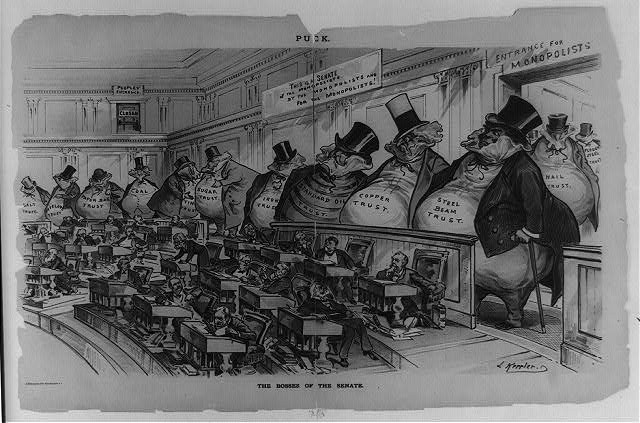
“The Bosses of the Senate” political cartoon
Even though early enforcement was weak, the ICC and Sherman Act mattered because they established the principle that corporations could be regulated by the federal government.
Government, Markets, and Expansion Abroad
As industry grew, policymakers tied prosperity to overseas markets, raw materials, and trade routes.
- In Latin America, James G. Blaine promoted trade ties through the First International Conference of American States (1889-1890), an early form of Pan-Americanism.
- In the Pacific, the Reciprocity Treaty with Hawaii (1875) tied Hawaiian sugar to the U.S. market.
- The Bayonet Constitution (1887) increased planter power and gave the U.S. access to Pearl Harbor.
- American interests helped overthrow Queen Liliʻuokalani (1893).
- The U.S. annexed Hawaii in 1898.
- The Open Door notes (1899-1900) continued this push by seeking equal access to markets in China.
Key Takeaways
Laissez-Faire
Belief that competition and private contracts should govern the economy with minimal regulation or public relief
Social Darwinism
Application of competitive evolution to society that portrayed inequality as natural and defended limited government
Herbert Spencer
Writer who applied a simplified theory of biological competition to society and influenced Social Darwinism
Gospel of Wealth
Andrew Carnegie's belief that the wealthy should use fortunes for public purposes through private philanthropy, not redistribution
Andrew Carnegie
Industrialist associated with the Gospel of Wealth and the use of private philanthropy to benefit society
Freedom of Contract
Legal doctrine treating private economic agreements as protected from government interference
Fourteenth Amendment Due Process Protections for Corporations
Judicial extension of due process protections to corporate property, strengthening corporate challenges to regulation
Railroad Land Grants
Federal grants of public land that railroads sold to finance construction and connect western resources to national markets
Protective Tariffs
High duties that shielded American manufacturers from foreign competition but raised prices and troubled agricultural exporters
Great Railroad Strike of 1877
Nationwide railroad conflict in which federal troops suppressed disorder and restored rail service
Pullman Strike of 1894
Rail strike broken when President Cleveland used federal troops and an injunction to protect interstate commerce and the mail
Grover Cleveland
President who opposed federal relief in the Texas Seed Bill and sent troops against the Pullman Strike
Eugene V. Debs
Labor leader imprisoned for violating the federal injunction issued during the Pullman Strike
Federal Labor Injunctions
Court orders used to halt strikes or boycotts that interfered with interstate transportation, commerce, or the mail
In re Debs (1895)
Supreme Court decision upholding federal intervention and the injunction used against the Pullman Strike
Panic of 1873
Financial panic followed by bank failures, business collapse, unemployment, and depression without a federal safety net
Panic of 1893
Severe financial panic and depression that intensified demands for federal relief, monetary expansion, and public works
Texas Seed Bill Veto (1887)
Cleveland vetoed drought relief for Texas farmers, arguing that federal charity was unconstitutional and weakened self-reliance
Coinage Act of 1873 / Crime of 1873
Law ending standard silver-dollar coinage, denounced by silver advocates as the Crime of 1873
Granger Laws
State laws promoted by agrarian groups to regulate railroad and grain-elevator rates
State Police Power vs. Federal Commerce Power
States regulated local health, safety, and welfare, while Congress controlled commerce crossing state lines
Munn v. Illinois (1877)
Supreme Court decision allowing states to regulate private property affected with a public interest
Wabash, St. Louis & Pacific Railway Co. v. Illinois (1886)
Supreme Court decision barring state regulation of interstate railroad rates and indicating that regulation must come from Congress
Interstate Commerce Act of 1887
Law requiring just interstate railroad rates, restricting discrimination and pools, and creating the ICC.
Interstate Commerce Commission (ICC)
First permanent federal regulatory commission, created to oversee interstate railroads but initially weakened by limited resources and courts
Trust
Combination placing several companies' stock under common trustees, allowing formally separate firms to operate as one
Sherman Antitrust Act of 1890
Federal law outlawing restraints of interstate trade and monopolization, though early enforcement against corporations was weak
United States v. E. C. Knight Co. (1895)
Decision distinguishing local manufacturing from interstate commerce and preventing use of the Sherman Act against a dominant sugar refiner
James G. Blaine
Secretary of state who promoted closer Latin American trade and influence through the First International Conference of American States
First International Conference of American States (1889–1890)
Washington meeting promoted by Blaine to expand hemispheric trade and influence, helping begin the Pan-American movement
Reciprocity Treaty of 1875
Treaty giving Hawaiian sugar favorable access to the U.S. market and increasing American planters' influence in Hawaii
Bayonet Constitution (1887)
Constitution forced on King Kalākaua that reduced royal authority and strengthened wealthy property owners, including American planters
Overthrow of Queen Liliʻuokalani (1893)
American planters helped remove Hawaii's queen while seeking a government favorable to their commercial and political interests
Annexation of Hawaii (1898)
U.S. acquisition of Hawaii after years of growing American commercial influence and strategic interest in Pacific access
Open Door Notes (1899–1900)
American policy calling for equal commercial access to China rather than exclusive European spheres of influence
Jacob Coxey
Reformer who advocated federally funded public works and additional paper currency to aid the unemployed during the depression of the 1890s
Coxey's Army
1894 march of unemployed workers to Washington demanding federal public works; the proposal was rejected and Coxey was arrested
Hard Money
Currency tied especially to gold, favored by creditors and business interests because it preserved value and limited inflation
Greenbacks
Paper currency whose expansion was supported by many farmers and debtors seeking inflation, higher prices, and easier debt repayment
Free Silver
Free coinage of silver to expand the money supply and cause inflation, supported by many farmers, miners, and debtors
Notes
Laissez-Faire
Belief that competition and private contracts should govern the economy with minimal regulation or public relief
Social Darwinism
Application of competitive evolution to society that portrayed inequality as natural and defended limited government
Herbert Spencer
Writer who applied a simplified theory of biological competition to society and influenced Social Darwinism
Gospel of Wealth
Andrew Carnegie's belief that the wealthy should use fortunes for public purposes through private philanthropy, not redistribution
Andrew Carnegie
Industrialist associated with the Gospel of Wealth and the use of private philanthropy to benefit society
Freedom of Contract
Legal doctrine treating private economic agreements as protected from government interference
Fourteenth Amendment Due Process Protections for Corporations
Judicial extension of due process protections to corporate property, strengthening corporate challenges to regulation
Railroad Land Grants
Federal grants of public land that railroads sold to finance construction and connect western resources to national markets
Protective Tariffs
High duties that shielded American manufacturers from foreign competition but raised prices and troubled agricultural exporters
Great Railroad Strike of 1877
Nationwide railroad conflict in which federal troops suppressed disorder and restored rail service
Pullman Strike of 1894
Rail strike broken when President Cleveland used federal troops and an injunction to protect interstate commerce and the mail
Grover Cleveland
President who opposed federal relief in the Texas Seed Bill and sent troops against the Pullman Strike
Eugene V. Debs
Labor leader imprisoned for violating the federal injunction issued during the Pullman Strike
Federal Labor Injunctions
Court orders used to halt strikes or boycotts that interfered with interstate transportation, commerce, or the mail
In re Debs (1895)
Supreme Court decision upholding federal intervention and the injunction used against the Pullman Strike
Panic of 1873
Financial panic followed by bank failures, business collapse, unemployment, and depression without a federal safety net
Panic of 1893
Severe financial panic and depression that intensified demands for federal relief, monetary expansion, and public works
Texas Seed Bill Veto (1887)
Cleveland vetoed drought relief for Texas farmers, arguing that federal charity was unconstitutional and weakened self-reliance
Coinage Act of 1873 / Crime of 1873
Law ending standard silver-dollar coinage, denounced by silver advocates as the Crime of 1873
Granger Laws
State laws promoted by agrarian groups to regulate railroad and grain-elevator rates
State Police Power vs. Federal Commerce Power
States regulated local health, safety, and welfare, while Congress controlled commerce crossing state lines
Munn v. Illinois (1877)
Supreme Court decision allowing states to regulate private property affected with a public interest
Wabash, St. Louis & Pacific Railway Co. v. Illinois (1886)
Supreme Court decision barring state regulation of interstate railroad rates and indicating that regulation must come from Congress
Interstate Commerce Act of 1887
Law requiring just interstate railroad rates, restricting discrimination and pools, and creating the ICC.
Interstate Commerce Commission (ICC)
First permanent federal regulatory commission, created to oversee interstate railroads but initially weakened by limited resources and courts
Trust
Combination placing several companies' stock under common trustees, allowing formally separate firms to operate as one
Sherman Antitrust Act of 1890
Federal law outlawing restraints of interstate trade and monopolization, though early enforcement against corporations was weak
United States v. E. C. Knight Co. (1895)
Decision distinguishing local manufacturing from interstate commerce and preventing use of the Sherman Act against a dominant sugar refiner
James G. Blaine
Secretary of state who promoted closer Latin American trade and influence through the First International Conference of American States
First International Conference of American States (1889–1890)
Washington meeting promoted by Blaine to expand hemispheric trade and influence, helping begin the Pan-American movement
Reciprocity Treaty of 1875
Treaty giving Hawaiian sugar favorable access to the U.S. market and increasing American planters' influence in Hawaii
Bayonet Constitution (1887)
Constitution forced on King Kalākaua that reduced royal authority and strengthened wealthy property owners, including American planters
Overthrow of Queen Liliʻuokalani (1893)
American planters helped remove Hawaii's queen while seeking a government favorable to their commercial and political interests
Annexation of Hawaii (1898)
U.S. acquisition of Hawaii after years of growing American commercial influence and strategic interest in Pacific access
Open Door Notes (1899–1900)
American policy calling for equal commercial access to China rather than exclusive European spheres of influence
Jacob Coxey
Reformer who advocated federally funded public works and additional paper currency to aid the unemployed during the depression of the 1890s
Coxey's Army
1894 march of unemployed workers to Washington demanding federal public works; the proposal was rejected and Coxey was arrested
Hard Money
Currency tied especially to gold, favored by creditors and business interests because it preserved value and limited inflation
Greenbacks
Paper currency whose expansion was supported by many farmers and debtors seeking inflation, higher prices, and easier debt repayment
Free Silver
Free coinage of silver to expand the money supply and cause inflation, supported by many farmers, miners, and debtors
