Topic 6.13 Notes – Politics in the Gilded Age
What Gilded Age Politics Were
Mark Twain and Charles Dudley Warner gave the era its name in The Gilded Age. “Gilded” means coated in gold, so the point is that America looked rich and modern, but underneath were poverty, corruption, and repeated economic panics.
Politics stayed intensely active. Voter turnout among eligible male voters was high, party loyalty was fierce, and elections were often very close. That happened in a country being reshaped by industrialization, cities, immigration, western settlement, and economic crises.
The core pattern was competitive democracy with unequal power:
- Women were still largely excluded from voting.
- African Americans in the South were pushed out of politics through violence, intimidation, poll taxes, literacy tests, and fraud.
- Wealthy business interests had far more influence than ordinary citizens.
- Both parties relied on patronage, party machines, and regional or cultural loyalties.
The issues were real, even if both parties accepted industrial capitalism. The biggest ones were tariffs, currency, veterans’ pensions, civil service reform, and limited regulation of railroads and trusts.
Republicans and Democrats in the Gilded Age
The parties were closely matched, so small shifts mattered a lot. You want to see them side by side because APUSH often asks for both differences and similarities.
| Party | Strongholds | Main supporters | Main positions |
|---|---|---|---|
| Republicans | North and much of the West | Union veterans, many northern Black voters, business interests, many farmers, middle-class evangelical Protestants | High tariffs, gold or limited currency, Union pensions, stronger national government, temperance/prohibition |
| Democrats | Solid South and northern immigrant city districts | White southern Democrats, Irish Catholics, other immigrants, many urban workers | Lower tariffs, limited federal government, states’ rights, less Protestant moral reform |
Republicans
Republicans often “waved the bloody shirt,” meaning they kept Civil War memories alive and linked Democrats to secession. That helped hold together a coalition built on Union victory, business growth, and Protestant reform.
Democrats
Democrats were strongest where resentment of federal power was strongest. In the South that meant white supremacy and “home rule.” In northern cities it meant immigrant communities that disliked prohibition and Protestant attempts to regulate personal behavior.
- Bourbon Democrats like Grover Cleveland backed gold and fiscal restraint.
- Southern and western Democrats moved toward free silver.
What they shared and how they differed
Both parties used patronage, accepted capitalism, received business support, and were touched by corruption. Their differences were still meaningful, especially on region, religion, ethnicity, tariffs, and federal power. Neither party did much at first for indebted farmers or industrial workers.
Patronage, Corruption, and Urban Machines
The spoils system gave government jobs to loyal party workers. That built party loyalty, but it also encouraged bribery and incompetence.
Republicans split over patronage:
- Stalwarts led by Roscoe Conkling defended it.
- Half-Breeds around James G. Blaine leaned toward reform.
- Mugwumps broke with Blaine in 1884 and backed Democrat Grover Cleveland.
Garfield’s assassination by Charles J. Guiteau in 1881 made patronage look dangerous and absurd. The Pendleton Civil Service Act of 1883 created the Civil Service Commission, used competitive exams, and made merit matter more than party loyalty. It cut one kind of corruption but pushed parties to depend more on corporate donors.
Scandals and reform examples you need to know:
- Crédit Mobilier: railroad insiders profited through a shady construction company.
- Whiskey Ring: liquor-tax fraud involving distillers and officials.
- Cleveland’s vetoes: blocked fraudulent pension bills and recovered public land.
Cities ran on political machines because poor people and immigrants often needed help the government did not provide.
- Machines offered jobs, food, housing help, legal aid, and political access.
- They also used graft, bribery, ballot fraud, and kickbacks.
Tammany Hall and Boss Tweed are the classic example. This cartoon presents Tweed as a toppled political boss after the fall of the Tammany Ring. Thomas Nast’s cartoons and New York Times reporting helped expose the Tweed Ring.
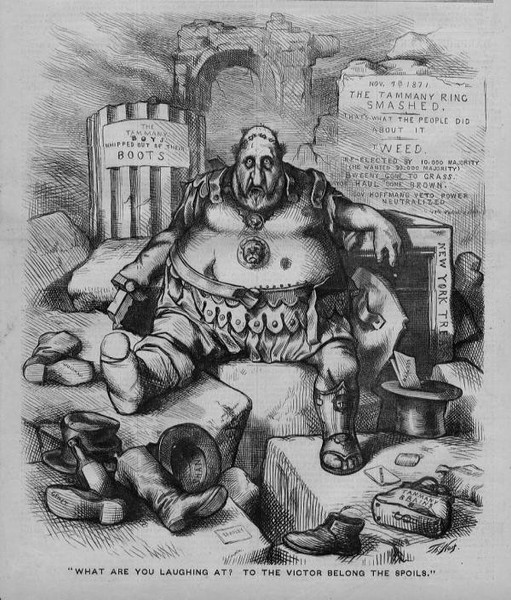
Thomas Nast cartoon of Boss Tweed and Tammany Hall
Tariffs, Currency, and the Rise of the Populists
Economic issues divided the parties more than students sometimes expect.
- Tariffs: Republicans wanted high protective tariffs. Democrats wanted lower tariffs. Key examples are Cleveland’s 1887 tariff message, Harrison’s 1888 win, and the McKinley Tariff of 1890.
- Currency: Creditors liked the gold standard because it kept money stable and scarce. Debtors, especially farmers, wanted more money in circulation because inflation made debts easier to repay.
Background terms that show up a lot:
- Greenbacks and the Greenback Party
- Bimetallism
- Coinage Act of 1873, attacked as the “Crime of ’73”
- Bland-Allison Act 1878
- Sherman Silver Purchase Act 1890, repealed during the Panic of 1893
The federal government also began weak regulation:
- Interstate Commerce Act 1887 created the ICC
- Sherman Antitrust Act 1890 targeted trusts
Both were weak at first, but they mattered because they set the precedent that government could regulate big business.
Populism and the Election of 1896
Farmers faced falling crop prices, debt, high railroad rates, storage costs, and dependence on distant markets. That frustration grew through the Grange and Farmers’ Alliances into the People’s Party.
The Omaha Platform of 1892 called for:
- free silver at 16 to 1
- graduated income tax
- government control or ownership of railroads, telegraph, and telephone
- subtreasury plan
- direct election of senators
- initiative and referendum
- eight-hour workday
James B. Weaver won over 1 million votes and 22 electoral votes in 1892.
The Panic of 1893 made things worse. Cleveland defended gold, accepted the J. P. Morgan bond deal, and refused broad relief. Coxey’s Army demanded federal public-works jobs.
In 1896, William Jennings Bryan gave the “Cross of Gold” speech and fused Populist and Democratic support behind free silver. William McKinley, backed by gold, high tariffs, and Mark Hanna’s business fundraising, won the industrial and urban states.
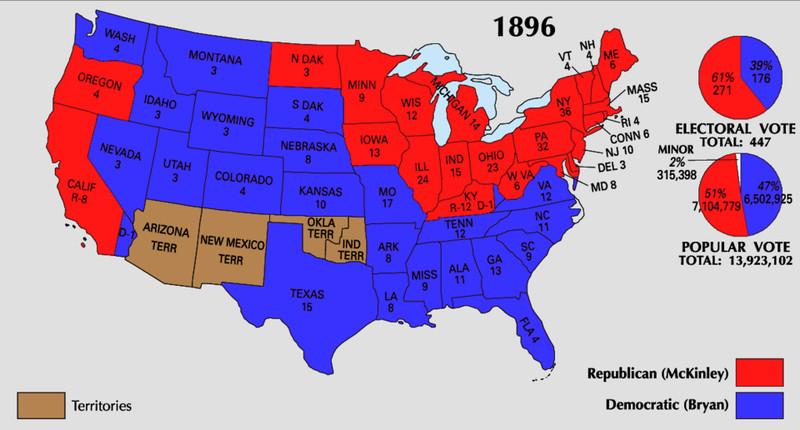
1896 presidential election map
On the map, McKinley’s strength is concentrated in the Northeast, Midwest, and Pacific Coast, while Bryan carried much of the South and West. That result crushed the Populists as an independent party, but many of their ideas came back later in the Progressive Era, especially the income tax and direct election of senators.
Key Takeaways
Gilded Age
Late-19th-century era of surface prosperity but underlying inequality, corruption, economic crises, and intense party competition
Republican Party in the Gilded Age
Northern, Union-veteran, business, and Protestant coalition favoring protective tariffs, sound money, pensions, moral reform, and stronger national authority
Democratic Party in the Gilded Age
Coalition of the white South, urban immigrants, and workers generally favoring lower tariffs, states’ rights, limited government, and less moral regulation
Solid South
Former Confederate states dominated by white Democrats after Reconstruction through disfranchisement, violence, and appeals to home rule and white supremacy
Waving the Bloody Shirt
Republican campaign tactic invoking Civil War memories and associating Democrats with secession and the Confederacy
Bourbon Democrats
Conservative Democrats, including Grover Cleveland, who favored the gold standard, fiscal restraint, and limited government
Patronage / Spoils System
Practice of awarding government jobs to loyal party supporters, strengthening party organizations but encouraging favoritism and corruption
Stalwarts
Republican faction associated with Roscoe Conkling that defended the traditional patronage system
Half-Breeds
Republican rivals of the Stalwarts, associated with James G. Blaine, who gave qualified support to civil service reform
Mugwumps
Reform Republicans who rejected James G. Blaine as corrupt and supported Democrat Grover Cleveland in 1884
Assassination of James A. Garfield
Garfield was shot in 1881 by disappointed office seeker Charles Guiteau, dramatizing the abuses of patronage and encouraging civil service reform
Pendleton Civil Service Act
1883 law creating merit-based examinations for some federal jobs and barring required political contributions from covered employees
Urban Political Machines
Hierarchical party organizations that traded jobs, aid, and services for votes while often practicing graft, fraud, and favoritism
Tammany Hall
New York City Democratic political machine that mobilized immigrants and distributed services while engaging in extensive corruption
Thomas Nast
Harper’s Weekly cartoonist whose attacks on Boss Tweed portrayed Tammany Hall as corrupt and helped bring down the Tweed Ring
Protective Tariff
Tax on imports intended to protect American producers; Republicans favored high rates, while Democrats argued they raised consumer prices
McKinley Tariff
1890 Republican law that raised import duties to historically high levels, provoking consumer opposition and Democratic electoral gains
Greenbacks
Civil War paper money not immediately redeemable in specie whose continued circulation was favored by advocates of an expanded money supply
Greenback Party
1870s third party of farmers and some workers that sought continued paper currency and an expanded money supply
Inflation vs. Deflation
Inflation makes fixed debts easier to repay but reduces purchasing power; deflation makes dollars and debts more valuable, benefiting creditors
Gold Standard
Currency system limiting money to gold-backed value, favored by creditors, conservative Democrats, and Republicans as a source of stability
Bimetallism
Monetary system in which both gold and silver support the currency, expanding the money supply beyond gold alone
Free Silver
Demand for unlimited silver coinage, usually at 16 ounces of silver to 1 of gold, to expand currency and ease debt
Coinage Act of 1873 / Crime of ’73
Law ending standard silver-dollar coinage, later condemned by silver advocates as the “Crime of ’73.”
Bland-Allison Act
1878 law requiring limited monthly federal silver purchases, expanding coinage but falling short of free silver
Sherman Silver Purchase Act
1890 law increasing federal silver purchases; pressure on gold reserves led Cleveland to secure its repeal during the Panic of 1893
Interstate Commerce Act
1887 law creating the Interstate Commerce Commission, the first sustained federal attempt to regulate railroads, though initially weak
Sherman Antitrust Act
1890 law outlawing combinations restraining interstate trade, initially weakened by narrow enforcement and sometimes used against unions
The Grange
Farm organization promoting cooperation, education, and political action against railroad costs and other agricultural grievances
Farmers’ Alliances
Agrarian organizations advocating cooperation, railroad regulation, currency expansion, and the subtreasury plan
Subtreasury Plan
Proposal for federal crop storage and low-interest loans so farmers could delay sales instead of accepting low market prices
People’s Party / Populist Party
Agrarian third party seeking stronger government regulation, currency expansion, political democratization, and relief for farmers and workers
Omaha Platform
Populists’ 1892 program calling for free silver, an income tax, railroad control, a subtreasury, direct democracy, and other reforms
James B. Weaver
Populist presidential candidate who won over one million popular votes and 22 electoral votes in 1892
Panic of 1893
Severe depression marked by railroad and bank failures, business collapse, unemployment, and intensified demands for federal action
Grover Cleveland
Conservative Democratic president who promoted tariff reduction and civil service reform while defending fiscal restraint, limited government, and the gold standard and rejecting large-scale federal relief
William Jennings Bryan
Democratic presidential nominee in 1896 who championed free silver and appealed to farmers and debtors against creditor interests
Cross of Gold Speech
Bryan’s 1896 speech condemning the gold standard and demanding that ordinary producers not be sacrificed to creditor interests
William McKinley
Republican victor in 1896 who supported the gold standard, protective tariffs, and economic stability
Mark Hanna
McKinley’s campaign manager who raised large business contributions and built an extensive, carefully organized Republican campaign in 1896
Populist-Democratic Fusion
Populists endorsed Democrat William Jennings Bryan in 1896 to unite the silver vote while naming their own vice-presidential candidate
Election of 1896
McKinley defeated Bryan, preserving the gold standard and weakening Populism as an independent party while leaving its reform agenda alive
Civil Service Reform
Effort to replace patronage appointments with merit-based government hiring and professional administration
Benjamin Harrison
Republican who defeated Cleveland in 1888 despite losing the popular vote and supported protective tariffs as president
James G. Blaine
Half-Breed Republican leader and 1884 presidential nominee rejected as corrupt by the Mugwumps
Roscoe Conkling
New York senator and Stalwart leader who defended patronage and built power through control of federal appointments
William M. “Boss” Tweed
Tammany Hall boss who used control of New York City offices and inflated public contracts to obtain kickbacks; convicted in 1873
Tweed Ring
Boss Tweed and his associates, who stole city funds through inflated bills and kickbacks on public projects
Jacob Coxey
Reformer who led unemployed marchers to Washington in 1894 and proposed paper-money-funded federal road construction
Coxey’s Army
Unemployed marchers who went to Washington in 1894 seeking a federally funded road-building jobs program; Congress refused
Notes
Gilded Age
Late-19th-century era of surface prosperity but underlying inequality, corruption, economic crises, and intense party competition
Republican Party in the Gilded Age
Northern, Union-veteran, business, and Protestant coalition favoring protective tariffs, sound money, pensions, moral reform, and stronger national authority
Democratic Party in the Gilded Age
Coalition of the white South, urban immigrants, and workers generally favoring lower tariffs, states’ rights, limited government, and less moral regulation
Solid South
Former Confederate states dominated by white Democrats after Reconstruction through disfranchisement, violence, and appeals to home rule and white supremacy
Waving the Bloody Shirt
Republican campaign tactic invoking Civil War memories and associating Democrats with secession and the Confederacy
Bourbon Democrats
Conservative Democrats, including Grover Cleveland, who favored the gold standard, fiscal restraint, and limited government
Patronage / Spoils System
Practice of awarding government jobs to loyal party supporters, strengthening party organizations but encouraging favoritism and corruption
Stalwarts
Republican faction associated with Roscoe Conkling that defended the traditional patronage system
Half-Breeds
Republican rivals of the Stalwarts, associated with James G. Blaine, who gave qualified support to civil service reform
Mugwumps
Reform Republicans who rejected James G. Blaine as corrupt and supported Democrat Grover Cleveland in 1884
Assassination of James A. Garfield
Garfield was shot in 1881 by disappointed office seeker Charles Guiteau, dramatizing the abuses of patronage and encouraging civil service reform
Pendleton Civil Service Act
1883 law creating merit-based examinations for some federal jobs and barring required political contributions from covered employees
Urban Political Machines
Hierarchical party organizations that traded jobs, aid, and services for votes while often practicing graft, fraud, and favoritism
Tammany Hall
New York City Democratic political machine that mobilized immigrants and distributed services while engaging in extensive corruption
Thomas Nast
Harper’s Weekly cartoonist whose attacks on Boss Tweed portrayed Tammany Hall as corrupt and helped bring down the Tweed Ring
Protective Tariff
Tax on imports intended to protect American producers; Republicans favored high rates, while Democrats argued they raised consumer prices
McKinley Tariff
1890 Republican law that raised import duties to historically high levels, provoking consumer opposition and Democratic electoral gains
Greenbacks
Civil War paper money not immediately redeemable in specie whose continued circulation was favored by advocates of an expanded money supply
Greenback Party
1870s third party of farmers and some workers that sought continued paper currency and an expanded money supply
Inflation vs. Deflation
Inflation makes fixed debts easier to repay but reduces purchasing power; deflation makes dollars and debts more valuable, benefiting creditors
Gold Standard
Currency system limiting money to gold-backed value, favored by creditors, conservative Democrats, and Republicans as a source of stability
Bimetallism
Monetary system in which both gold and silver support the currency, expanding the money supply beyond gold alone
Free Silver
Demand for unlimited silver coinage, usually at 16 ounces of silver to 1 of gold, to expand currency and ease debt
Coinage Act of 1873 / Crime of ’73
Law ending standard silver-dollar coinage, later condemned by silver advocates as the “Crime of ’73.”
Bland-Allison Act
1878 law requiring limited monthly federal silver purchases, expanding coinage but falling short of free silver
Sherman Silver Purchase Act
1890 law increasing federal silver purchases; pressure on gold reserves led Cleveland to secure its repeal during the Panic of 1893
Interstate Commerce Act
1887 law creating the Interstate Commerce Commission, the first sustained federal attempt to regulate railroads, though initially weak
Sherman Antitrust Act
1890 law outlawing combinations restraining interstate trade, initially weakened by narrow enforcement and sometimes used against unions
The Grange
Farm organization promoting cooperation, education, and political action against railroad costs and other agricultural grievances
Farmers’ Alliances
Agrarian organizations advocating cooperation, railroad regulation, currency expansion, and the subtreasury plan
Subtreasury Plan
Proposal for federal crop storage and low-interest loans so farmers could delay sales instead of accepting low market prices
People’s Party / Populist Party
Agrarian third party seeking stronger government regulation, currency expansion, political democratization, and relief for farmers and workers
Omaha Platform
Populists’ 1892 program calling for free silver, an income tax, railroad control, a subtreasury, direct democracy, and other reforms
James B. Weaver
Populist presidential candidate who won over one million popular votes and 22 electoral votes in 1892
Panic of 1893
Severe depression marked by railroad and bank failures, business collapse, unemployment, and intensified demands for federal action
Grover Cleveland
Conservative Democratic president who promoted tariff reduction and civil service reform while defending fiscal restraint, limited government, and the gold standard and rejecting large-scale federal relief
William Jennings Bryan
Democratic presidential nominee in 1896 who championed free silver and appealed to farmers and debtors against creditor interests
Cross of Gold Speech
Bryan’s 1896 speech condemning the gold standard and demanding that ordinary producers not be sacrificed to creditor interests
William McKinley
Republican victor in 1896 who supported the gold standard, protective tariffs, and economic stability
Mark Hanna
McKinley’s campaign manager who raised large business contributions and built an extensive, carefully organized Republican campaign in 1896
Populist-Democratic Fusion
Populists endorsed Democrat William Jennings Bryan in 1896 to unite the silver vote while naming their own vice-presidential candidate
Election of 1896
McKinley defeated Bryan, preserving the gold standard and weakening Populism as an independent party while leaving its reform agenda alive
Civil Service Reform
Effort to replace patronage appointments with merit-based government hiring and professional administration
Benjamin Harrison
Republican who defeated Cleveland in 1888 despite losing the popular vote and supported protective tariffs as president
James G. Blaine
Half-Breed Republican leader and 1884 presidential nominee rejected as corrupt by the Mugwumps
Roscoe Conkling
New York senator and Stalwart leader who defended patronage and built power through control of federal appointments
William M. “Boss” Tweed
Tammany Hall boss who used control of New York City offices and inflated public contracts to obtain kickbacks; convicted in 1873
Tweed Ring
Boss Tweed and his associates, who stole city funds through inflated bills and kickbacks on public projects
Jacob Coxey
Reformer who led unemployed marchers to Washington in 1894 and proposed paper-money-funded federal road construction
Coxey’s Army
Unemployed marchers who went to Washington in 1894 seeking a federally funded road-building jobs program; Congress refused
