Topic 5.3 Notes – The Mexican–American War
How the Mexican-American War Happened
This war grew out of Manifest Destiny, the belief that the United States was meant to spread across North America. That idea mixed patriotism, economic ambition, and racial assumptions that treated Mexicans and Native peoples as obstacles to expansion.
That expansion is easier to picture on a map because the crisis over Texas turned into a much larger shift in control of the Southwest.
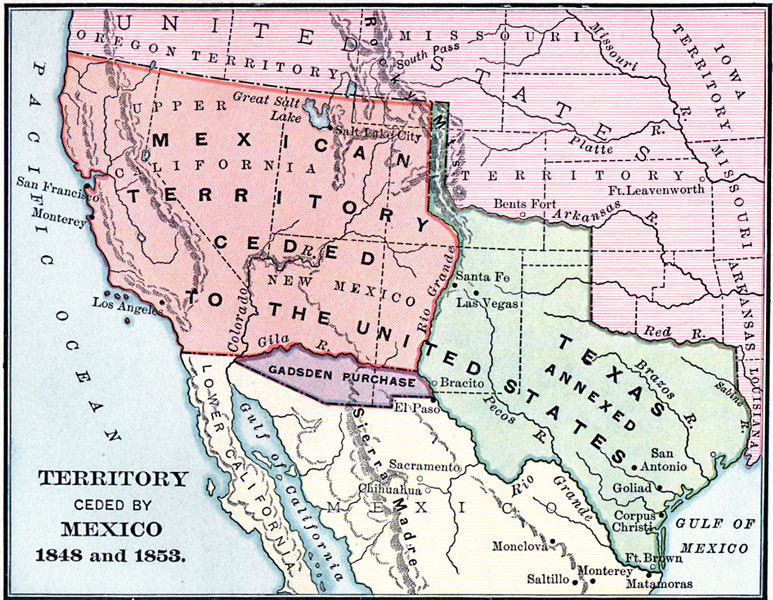
Mexican Cession, Texas annexation, and the Gadsden Purchase
After Mexico won independence from Spain in 1821, it controlled Texas, New Mexico, and California. Mexico let U.S. settlers move into Texas, but tensions rose fast over slavery, immigration, religion, and how much authority Mexico could enforce.
Texas Revolution
In 1835-1836, Texans rebelled against Mexico.
- Alamo: Mexican forces defeated the defenders, which became a rallying cry.
- Goliad: Mexican troops executed captured Texans, deepening anti-Mexican anger.
- San Jacinto: Sam Houston’s forces won a quick surprise victory.
- Santa Anna captured: Antonio López de Santa Anna, Mexico’s leader, was taken prisoner.
Mexico never fully accepted Texas independence. So when the U.S. annexed Texas in 1845, it created an immediate crisis.
President James K. Polk wanted more than Texas. He wanted:
- Texas securely annexed
- California and New Mexico
- Pacific ports that could expand trade with Asia
Polk sent John Slidell to negotiate, but Mexico refused even to receive him. That failure made war more likely.
The border dispute pushed things over the edge. The map highlights the key claim the United States made at the time. The U.S. said the Rio Grande was Texas’s border. Mexico claimed the Nueces River. The land between them was disputed, and Polk sent troops there. In April 1846, the Thornton Affair broke out when Mexican troops attacked an American patrol. Polk used this to tell Congress that Mexico had “shed American blood upon American soil.”
Lock in the causes as a set:
- Texas annexation
- border dispute
- Polk’s desire for California and New Mexico
- Manifest Destiny
- Pacific trade and economic motives
- racial and cultural assumptions
Support and Opposition to the War
The war divided Americans because it was never just about one skirmish on the border. It raised questions about presidential power, expansion, and slavery.
Supporters, mostly Democrats and expansionists, said the war defended national honor and fulfilled Manifest Destiny. Many volunteers enlisted.
Opponents, especially Whigs and antislavery Northerners, argued Polk had provoked it.
- Abraham Lincoln’s Spot Resolutions challenged Polk to name the exact “spot” where blood had been shed.
- Frederick Douglass called the war immoral and proslavery.
- Henry David Thoreau protested the war and slavery by refusing to pay a poll tax. That experience led to Civil Disobedience.
How the United States Won the War
The U.S. had major advantages: a stronger economy, better artillery, naval superiority, and a more stable government. The overall pattern matters more than memorizing every battle. The U.S. attacked from several directions, seized the North and West, then captured Mexico City.
- Zachary Taylor fought in northern Mexico and won Buena Vista.
- Stephen Kearny moved into New Mexico and toward California.
- In California, the Bear Flag Revolt, John C. Frémont, and U.S. naval support helped secure the region.
- Winfield Scott launched an amphibious landing at Veracruz and marched inland to Mexico City.
The war lasted 1846-1848.
A detail teachers love to ask about is that many later Civil War leaders served here, including Ulysses S. Grant, Robert E. Lee, Stonewall Jackson, George McClellan, and Jefferson Davis. Grant later said the war was unjust.
What the Treaty of Guadalupe Hidalgo Changed
The Treaty of Guadalupe Hidalgo ended the war in 1848.
| Term | What it did |
|---|---|
| Texas border | Mexico recognized the Rio Grande |
| Mexican Cession | U.S. gained California and New Mexico |
| Land included | Present-day California, Nevada, Utah, most of Arizona and New Mexico, and parts of Colorado and Wyoming |
| Payment | U.S. paid $15 million and assumed certain claims |
The later Gadsden Purchase in 1853 added southern land for a possible railroad route.
The biggest political effect was slavery. The Wilmot Proviso tried to ban slavery in land taken from Mexico. It passed the House, failed in the Senate, and never became law, but it exposed growing sectional voting.
Key positions:
- Free-soil: no slavery in western territories
- Southern proslavery expansion: slavery could expand west
- Popular sovereignty: settlers decide
- Abolitionism: slavery should end entirely
The treaty promised citizenship and property rights to Mexicans who stayed, but those promises were often weakened. Tejanos, Californios, and Hispanos lost land through courts, taxes, fraud, squatting, and violence. The California Land Act of 1851 made many prove old land claims in U.S. courts.
This land was also home to Comanche, Apache, Navajo, Pueblo, and others. U.S. expansion brought forts, settlers, conflict, dispossession, and growing pressure toward reservation systems.
Key Takeaways
Mexican–American War
1846–1848 war provoked by annexation, expansionism, and the disputed Texas border; U.S. victory produced the Mexican Cession and intensified conflict over slavery and western peoples
James K. Polk
Expansionist Democratic president who supported Texas annexation, sought California and New Mexico, sent troops into the disputed borderland, and led the United States into war with Mexico
Manifest Destiny
Belief that the United States was destined or divinely authorized to expand across North America, often justified by racial and cultural claims of American superiority
Texas Annexation
The United States admitted Texas as a slave state in 1845 despite Mexico’s continued claim to it, creating a diplomatic crisis and sectional controversy
John Slidell Mission
Polk’s failed 1845 effort to settle claims, gain recognition of the Rio Grande border, and purchase California and New Mexico from Mexico
Rio Grande–Nueces Border Dispute
Texas and the United States claimed the Rio Grande as Texas’s boundary, while Mexico claimed the Nueces River, leaving the land between them disputed
Thornton Clash
April 25, 1846 attack by Mexican troops on Captain Seth Thornton’s patrol in the disputed borderland, used by Polk as the immediate justification for war
Polk’s War Message
Polk’s May 1846 claim that Mexico had invaded U.S. territory and shed American blood on American soil, leading Congress to authorize war
Frederick Douglass
Abolitionist who condemned the Mexican–American War as an immoral expansion of slavery and American imperial power
Zachary Taylor
General who advanced into northern Mexico and became a national hero after victories including Buena Vista, helping him win the presidency in 1848
Stephen Kearny
U.S. general who occupied New Mexico and continued west toward California during the war
Bear Flag Revolt
1846 uprising by American settlers in California that accompanied U.S. naval and military efforts to seize the region from Mexico
John C. Frémont
American leader who participated in the takeover of California during the Mexican–American War
Winfield Scott
General who landed at Veracruz, marched inland, and captured Mexico City in 1847, forcing Mexico toward a peace settlement
Treaty of Guadalupe Hidalgo
1848 treaty ending the war: Mexico recognized the Rio Grande border, ceded California and New Mexico, and received $15 million, while Mexican residents were promised citizenship and property protections
Mexican Cession
Approximately 525,000 square miles transferred by Mexico in 1848, including California and New Mexico; it expanded the United States to the Pacific and reopened the slavery question
Gadsden Purchase
1853 U.S. purchase from Mexico of land in present-day southern Arizona and southwestern New Mexico for $10 million, partly for a southern railroad route
Wilmot Proviso
David Wilmot’s unsuccessful 1846 proposal to prohibit slavery in any territory acquired from Mexico; it exposed growing sectional voting and conflict
Free-Soil Position
Position that slavery should not expand into western territories, often to reserve western land for free labor rather than to establish racial equality
Popular Sovereignty
Proposal that settlers in each territory should decide whether slavery would be permitted there
California Land Act of 1851
Law requiring holders of Spanish and Mexican land grants to seek federal validation of their titles, with costs and delays contributing to Mexican American land loss
Abraham Lincoln
Whig congressman who challenged Polk to prove that the war’s first bloodshed occurred on United States soil
Spot Resolutions
Lincoln’s 1847 resolutions demanding that Polk identify the exact spot of the first bloodshed and prove it belonged to the United States
Henry David Thoreau
Writer who refused to pay a poll tax in protest against slavery and the Mexican–American War
Civil Disobedience
Thoreau’s essay defending individual resistance to an unjust government, inspired by his opposition to slavery and the war
David Wilmot
Pennsylvania Democratic representative who introduced the Wilmot Proviso to bar slavery from territory acquired from Mexico
Notes
Mexican–American War
1846–1848 war provoked by annexation, expansionism, and the disputed Texas border; U.S. victory produced the Mexican Cession and intensified conflict over slavery and western peoples
James K. Polk
Expansionist Democratic president who supported Texas annexation, sought California and New Mexico, sent troops into the disputed borderland, and led the United States into war with Mexico
Manifest Destiny
Belief that the United States was destined or divinely authorized to expand across North America, often justified by racial and cultural claims of American superiority
Texas Annexation
The United States admitted Texas as a slave state in 1845 despite Mexico’s continued claim to it, creating a diplomatic crisis and sectional controversy
John Slidell Mission
Polk’s failed 1845 effort to settle claims, gain recognition of the Rio Grande border, and purchase California and New Mexico from Mexico
Rio Grande–Nueces Border Dispute
Texas and the United States claimed the Rio Grande as Texas’s boundary, while Mexico claimed the Nueces River, leaving the land between them disputed
Thornton Clash
April 25, 1846 attack by Mexican troops on Captain Seth Thornton’s patrol in the disputed borderland, used by Polk as the immediate justification for war
Polk’s War Message
Polk’s May 1846 claim that Mexico had invaded U.S. territory and shed American blood on American soil, leading Congress to authorize war
Frederick Douglass
Abolitionist who condemned the Mexican–American War as an immoral expansion of slavery and American imperial power
Zachary Taylor
General who advanced into northern Mexico and became a national hero after victories including Buena Vista, helping him win the presidency in 1848
Stephen Kearny
U.S. general who occupied New Mexico and continued west toward California during the war
Bear Flag Revolt
1846 uprising by American settlers in California that accompanied U.S. naval and military efforts to seize the region from Mexico
John C. Frémont
American leader who participated in the takeover of California during the Mexican–American War
Winfield Scott
General who landed at Veracruz, marched inland, and captured Mexico City in 1847, forcing Mexico toward a peace settlement
Treaty of Guadalupe Hidalgo
1848 treaty ending the war: Mexico recognized the Rio Grande border, ceded California and New Mexico, and received $15 million, while Mexican residents were promised citizenship and property protections
Mexican Cession
Approximately 525,000 square miles transferred by Mexico in 1848, including California and New Mexico; it expanded the United States to the Pacific and reopened the slavery question
Gadsden Purchase
1853 U.S. purchase from Mexico of land in present-day southern Arizona and southwestern New Mexico for $10 million, partly for a southern railroad route
Wilmot Proviso
David Wilmot’s unsuccessful 1846 proposal to prohibit slavery in any territory acquired from Mexico; it exposed growing sectional voting and conflict
Free-Soil Position
Position that slavery should not expand into western territories, often to reserve western land for free labor rather than to establish racial equality
Popular Sovereignty
Proposal that settlers in each territory should decide whether slavery would be permitted there
California Land Act of 1851
Law requiring holders of Spanish and Mexican land grants to seek federal validation of their titles, with costs and delays contributing to Mexican American land loss
Abraham Lincoln
Whig congressman who challenged Polk to prove that the war’s first bloodshed occurred on United States soil
Spot Resolutions
Lincoln’s 1847 resolutions demanding that Polk identify the exact spot of the first bloodshed and prove it belonged to the United States
Henry David Thoreau
Writer who refused to pay a poll tax in protest against slavery and the Mexican–American War
Civil Disobedience
Thoreau’s essay defending individual resistance to an unjust government, inspired by his opposition to slavery and the war
David Wilmot
Pennsylvania Democratic representative who introduced the Wilmot Proviso to bar slavery from territory acquired from Mexico
