Topic 7.13 Notes – World War II: Military
How the United States and the Allies Won World War II
Pearl Harbor brought the U.S. fully into the war on December 7, 1941. In his “date which will live in infamy” speech, FDR framed the attack as a direct assault on the nation. Within days, Germany and Italy declared war on the U.S., turning it into a true two-front war.
Americans increasingly saw the war as a fight for freedom and democracy against fascism and militarism. That idea mattered because it unified public support, and later it seemed even more justified when Allied troops uncovered Nazi camps and learned more about Japanese atrocities.
The best causation answer is never “D-Day won the war” or “the atomic bomb won the war.” Victory came from connected causes:
- U.S. productive power supplied ships, planes, tanks, food, and weapons on a huge scale.
- Soviet sacrifice on the eastern front destroyed much of Germany’s army.
- British survival gave the Allies a base for bombing and invading Europe.
- Coordinated Allied strategy kept these strengths working together.
- Axis weaknesses mattered too. Germany and Japan expanded too far, coordinated poorly, and could not match Allied resources.
The Main Reasons Allied Victory Was Possible
Allied cooperation and grand strategy
The major Allies were the United States, Great Britain, Soviet Union, and China. The Big Three were Franklin Roosevelt, Winston Churchill, and Joseph Stalin.
Even after Pearl Harbor, the Allies chose Germany first because Germany was the greater overall threat.
| Conference | What it did |
|---|---|
| Casablanca (1943) | demanded unconditional surrender |
| Tehran (1943) | committed to a cross-Channel invasion |
| Yalta (1945) | planned occupation zones in Germany, Soviet entry vs. Japan, and the United Nations |
| Potsdam (1945) | Truman, Stalin, Attlee met; issued Potsdam Declaration to Japan |
Industrial and geographic advantages
The U.S. became the arsenal of democracy. The Allies had bigger populations, more raw materials, more oil, and more ability to replace losses. Geography helped too:
- U.S. protected by oceans
- Britain served as a staging base
- Soviet Union absorbed massive German attacks
Technology and intelligence
Key tools included radar, sonar, codebreaking, aircraft carriers, long-range bombers, landing craft, submarines, proximity fuse, and penicillin. Codebreaking helped at Midway and against German communications. The point is not just invention. The Allies could mass-produce and deploy these tools. Britain’s role as a staging base also made major operations like the Normandy invasion possible.
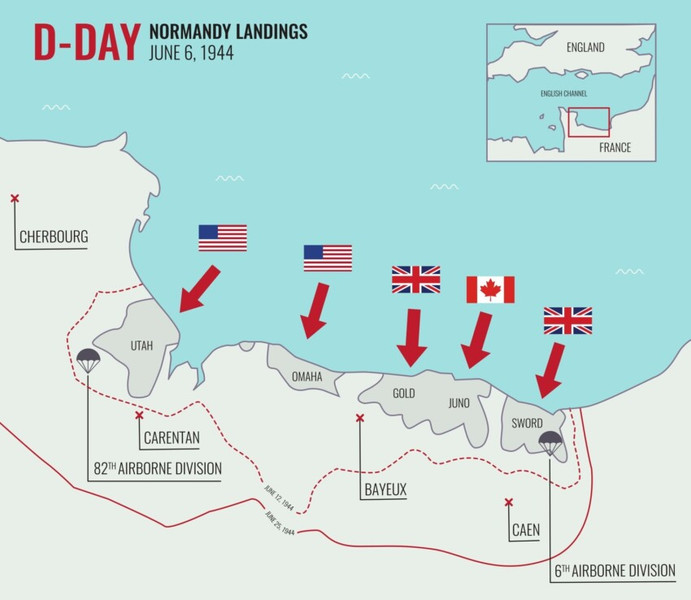
D-Day landings in Normandy, June 6, 1944
Soviet and Axis roles
The Soviet victory at Stalingrad was indispensable. Germany made defeat more likely by invading the USSR and declaring war on the U.S. Japan also failed to destroy U.S. carriers at Pearl Harbor, which left America able to fight a long naval war.
The Campaigns That Broke the Axis
Europe and the Atlantic
- Operation Torch put Allied troops in North Africa; Axis forces there surrendered in 1943.
- The Allies invaded Sicily and Italy. Mussolini fell, but fighting continued.
- The Battle of the Atlantic secured supply lines through convoys, escorts, radar, sonar, and codebreaking.
- Strategic bombing hit Germany hard. Firebombing of Hamburg and Dresden raised moral questions.
D-Day, June 6, 1944, was Operation Overlord under Dwight D. Eisenhower:
- Allies used deception so Germany expected Pas-de-Calais.
- Airborne troops dropped behind German lines.
- Troops landed at Utah, Omaha, Gold, Juno, and Sword.
- They established a beachhead.
- Paris was liberated in August 1944.
Germany’s last major western attack was the Battle of the Bulge. Hitler committed suicide, Germany surrendered on May 7, 1945, and V-E Day was May 8.
Pacific War
In the Pacific, the war began with rapid Japanese victories, then shifted as the U.S. fought its way back across the ocean.
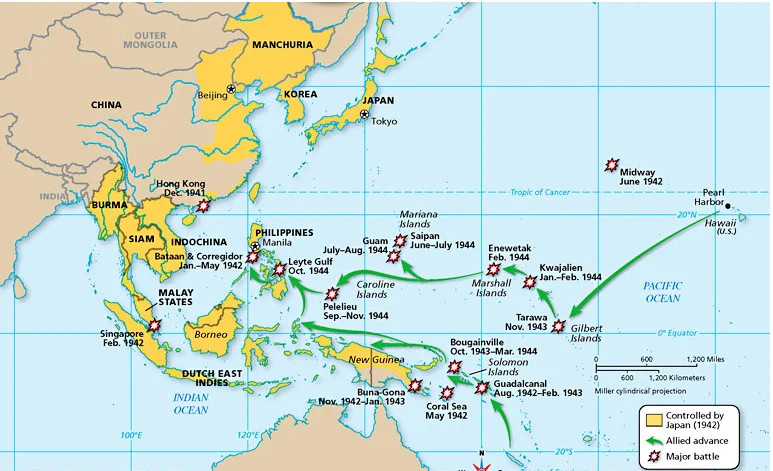
Pacific island-hopping campaigns
Japan won early in the Philippines, Bataan, and Corregidor. The Bataan Death March became a symbol of Japanese brutality.
The tide turned in 1942:
- Coral Sea checked Japanese expansion.
- Midway destroyed four Japanese carriers.
The U.S. used island-hopping, shown on the map as advances across the central Pacific and through New Guinea and the Philippines:
- Capture key islands
- Bypass others
- Advance along two routes under Chester Nimitz and Douglas MacArthur
Key campaigns were Guadalcanal, Gilbert and Marshall Islands, Marianas, Leyte Gulf, Philippines, Iwo Jima, and Okinawa. Submarines and bombing cut Japan off from resources. Kamikaze attacks and Okinawa showed how costly invasion would be.
Atomic Bombs, Atrocities, and the Meaning of Victory
The Manhattan Project brought together Leslie Groves, J. Robert Oppenheimer, Los Alamos, Oak Ridge, and Hanford. The Trinity test happened on July 16, 1945.
- Hiroshima on August 6 with Little Boy
- Soviet entry against Japan on August 8
- Nagasaki on August 9 with Fat Man
- Japan surrendered on August 15
- Formal surrender on September 2, or V-J Day
The debate still matters. Supporters said the bombs avoided invasion and shortened the war. Critics said Japan was already weakening, Soviet entry mattered, and the civilian destruction was morally unacceptable.
Atrocities reinforced Allied war aims:
- Holocaust
- liberation of camps such as Buchenwald and Dachau
- Nanjing Massacre
- Bataan Death March
About 16 million Americans served. Military service opened opportunities but also exposed inequality:
- Women served in WAC, WAVES, WASPs, and as nurses, mechanics, and radio operators.
- African Americans included the Tuskegee Airmen, 761st Tank Battalion, Doris Miller, and the Double V campaign.
- Japanese Americans served in the 442nd Regimental Combat Team.
- Native Americans included the Navajo Code Talkers.
Victory destroyed Axis regimes, revealed mass atrocities, began the nuclear age, and left the U.S. as a major global military power.
Key Takeaways
Axis Powers
Germany, Italy, and Japan—the principal wartime coalition defeated by the Allies
Allied Powers
Coalition led by the United States, Great Britain, Soviet Union, and China that defeated the Axis
Attack on Pearl Harbor
Japan’s December 7, 1941 attack on Hawaii that killed over 2,400 Americans and brought the United States into World War II.
Franklin D. Roosevelt
President during most of World War II who led U.S. entry and Allied cooperation and called Pearl Harbor a date of infamy
Fascism
Authoritarian, intensely nationalistic ideology that suppresses opposition and subordinates individual rights to the state
Japanese Militarism
Ideology emphasizing military authority, obedience to the emperor, and imperial expansion
Big Three
Roosevelt, British prime minister Winston Churchill, and Soviet leader Joseph Stalin, the principal Allied wartime leaders
Winston Churchill
British prime minister and Big Three leader who favored early Mediterranean operations before a cross-Channel invasion
Joseph Stalin
Soviet dictator and Big Three leader who demanded a western second front while Soviet forces fought Germany in the east
Germany First Strategy
Allied policy of prioritizing Germany’s defeat while containing and gradually rolling back Japan
Casablanca Conference
1943 Roosevelt-Churchill meeting that continued Mediterranean operations and announced the demand for unconditional Axis surrender
Tehran Conference
1943 first Big Three meeting where the Western Allies committed to invading France and Stalin promised continued offensives
Yalta Conference
February 1945 Big Three meeting coordinating final operations, Soviet entry against Japan, German occupation zones, and the United Nations
Potsdam Conference
July–August 1945 meeting where Truman, Stalin, and British leaders managed defeated Germany and addressed Japan’s surrender
Arsenal of Democracy
Description of the United States as the immense producer and supplier of weapons, vehicles, food, and matériel for the Allies
Battle of Stalingrad
1942–1943 Soviet victory that destroyed a major German army and began sustained Soviet advances westward
Operation Torch
November 1942 Allied invasion of French North Africa that brought American ground forces into combat against the Axis
Battle of the Atlantic
Long struggle in which convoys, escorts, aircraft, sonar, radar, and codebreaking protected Allied shipping from German U-boats
Operation Overlord (D-Day)
June 6, 1944 Allied invasion of Normandy that established a western front and began the liberation of France
Dwight D. Eisenhower
American general who served as supreme commander of the multinational D-Day invasion force
Battle of the Bulge
Germany’s unsuccessful final major western counteroffensive in the Ardennes during December 1944 and January 1945
V-E Day
May 8, 1945, celebrated as Victory in Europe Day after Germany’s unconditional surrender
Holocaust (Shoah)
Nazi Germany’s systematic persecution and murder of about six million European Jews, alongside Roma, people with disabilities, and other targeted groups
War Refugee Board
Agency Roosevelt created in 1944 to assist rescue efforts for people threatened by Nazi persecution and murder
Nanjing Massacre
1937 mass killing and rape committed by Japanese forces after their capture of Nanjing, China
Bataan Death March
Forced 1942 march of surrendered American and Filipino prisoners during which thousands died from murder, abuse, disease, and exhaustion
Douglas MacArthur
American general who commanded the southwest Pacific advance and fulfilled his promise to return to the Philippines in 1944
Battle of Midway
June 1942 carrier battle in which American aircraft sank four Japanese carriers, halting expansion and shifting the strategic initiative
Island-Hopping (Leapfrogging)
Strategy of capturing selected Pacific islands for bases and airfields while bypassing and isolating heavily fortified Japanese positions
Chester Nimitz
American admiral who led the central Pacific island-hopping drive toward Japan
Battle of Leyte Gulf
October 1944 naval battle that crippled much of Japan’s remaining fleet and aided the liberation of the Philippines
Kamikazes
Japanese pilots who deliberately crashed explosive-laden aircraft into Allied ships as American forces approached Japan
Battle of Iwo Jima
Costly 1945 American capture of a fortified island near Japan, demonstrating the likely human cost of invading the home islands
Battle of Okinawa
Largest Pacific amphibious operation, whose heavy 1945 casualties secured a base near Japan and intensified fears about invasion
Radar
Technology using radio waves to detect aircraft and ships, improving Allied air and naval defense
Sonar
Underwater detection technology used with antisubmarine weapons to locate and attack German U-boats
Allied Codebreaking
Decryption of Axis communications that aided victory at Midway and operations against Germany
Penicillin
Antibiotic used widely by Allied forces to reduce deaths from infected wounds
Manhattan Project
Secret American military-scientific program that developed the first atomic bombs during World War II.
Leslie Groves
Army general who directed the Manhattan Project’s military administration, construction, and production
J. Robert Oppenheimer
Physicist who led the Manhattan Project’s atomic weapons laboratory at Los Alamos
Trinity Test
First successful atomic-bomb test, conducted near Alamogordo, New Mexico, on July 16, 1945
Harry S. Truman
President after Roosevelt’s death who authorized the atomic bombings of Hiroshima and Nagasaki
Potsdam Declaration
July 26, 1945 Allied demand for Japan’s unconditional surrender, warning of prompt and utter destruction
V-J Day
August 15, 1945 celebration of Victory over Japan; formal surrender followed aboard the USS Missouri on September 2
Women’s Army Corps (WAC)
Army organization in which women performed noncombat work such as communications, administration, mechanics, and technical service
WAVES
Women Accepted for Volunteer Emergency Service, the Navy organization employing women in military support and technical roles
Women Airforce Service Pilots (WASP)
Women pilots who ferried aircraft and performed other noncombat flight duties for the U.S. military
Tuskegee Airmen
African American military pilots trained in Alabama who flew combat and bomber-escort missions in Europe
761st Tank Battalion
Segregated African American tank unit that fought with distinction in the European theater
Doris Miller
Black Navy mess attendant who fired an antiaircraft gun at Pearl Harbor and received the Navy Cross
Double V Campaign
African American campaign demanding victory over fascism abroad and racism and segregation at home
442nd Regimental Combat Team
Segregated Japanese American unit composed largely of Nisei soldiers that became one of the most highly decorated units for its size and length of service
Navajo Code Talkers
Native American servicemen who used a specially developed Navajo-based code for secure, rapid Pacific battlefield communications
Atomic Bombings of Hiroshima and Nagasaki
U.S. atomic attacks on Hiroshima (Little Boy, August 6) and Nagasaki (Fat Man, August 9) hastened Japan’s surrender and sparked enduring debate over mass civilian death
Strategic Bombing
Allied campaign against Axis industry, transportation, military facilities, and cities that weakened production but inflicted extensive civilian casualties
Firebombing
Incendiary bombing of German and Japanese cities that caused massive fires, widespread destruction, and heavy civilian casualties
Battle of the Coral Sea
May 1942 carrier battle that checked Japan’s advance toward Port Moresby before the more decisive American victory at Midway
Italian Campaign
Allied invasions of Sicily and mainland Italy that toppled Mussolini and forced Italy’s surrender, though German resistance prolonged the fighting
Notes
Axis Powers
Germany, Italy, and Japan—the principal wartime coalition defeated by the Allies
Allied Powers
Coalition led by the United States, Great Britain, Soviet Union, and China that defeated the Axis
Attack on Pearl Harbor
Japan’s December 7, 1941 attack on Hawaii that killed over 2,400 Americans and brought the United States into World War II.
Franklin D. Roosevelt
President during most of World War II who led U.S. entry and Allied cooperation and called Pearl Harbor a date of infamy
Fascism
Authoritarian, intensely nationalistic ideology that suppresses opposition and subordinates individual rights to the state
Japanese Militarism
Ideology emphasizing military authority, obedience to the emperor, and imperial expansion
Big Three
Roosevelt, British prime minister Winston Churchill, and Soviet leader Joseph Stalin, the principal Allied wartime leaders
Winston Churchill
British prime minister and Big Three leader who favored early Mediterranean operations before a cross-Channel invasion
Joseph Stalin
Soviet dictator and Big Three leader who demanded a western second front while Soviet forces fought Germany in the east
Germany First Strategy
Allied policy of prioritizing Germany’s defeat while containing and gradually rolling back Japan
Casablanca Conference
1943 Roosevelt-Churchill meeting that continued Mediterranean operations and announced the demand for unconditional Axis surrender
Tehran Conference
1943 first Big Three meeting where the Western Allies committed to invading France and Stalin promised continued offensives
Yalta Conference
February 1945 Big Three meeting coordinating final operations, Soviet entry against Japan, German occupation zones, and the United Nations
Potsdam Conference
July–August 1945 meeting where Truman, Stalin, and British leaders managed defeated Germany and addressed Japan’s surrender
Arsenal of Democracy
Description of the United States as the immense producer and supplier of weapons, vehicles, food, and matériel for the Allies
Battle of Stalingrad
1942–1943 Soviet victory that destroyed a major German army and began sustained Soviet advances westward
Operation Torch
November 1942 Allied invasion of French North Africa that brought American ground forces into combat against the Axis
Battle of the Atlantic
Long struggle in which convoys, escorts, aircraft, sonar, radar, and codebreaking protected Allied shipping from German U-boats
Operation Overlord (D-Day)
June 6, 1944 Allied invasion of Normandy that established a western front and began the liberation of France
Dwight D. Eisenhower
American general who served as supreme commander of the multinational D-Day invasion force
Battle of the Bulge
Germany’s unsuccessful final major western counteroffensive in the Ardennes during December 1944 and January 1945
V-E Day
May 8, 1945, celebrated as Victory in Europe Day after Germany’s unconditional surrender
Holocaust (Shoah)
Nazi Germany’s systematic persecution and murder of about six million European Jews, alongside Roma, people with disabilities, and other targeted groups
War Refugee Board
Agency Roosevelt created in 1944 to assist rescue efforts for people threatened by Nazi persecution and murder
Nanjing Massacre
1937 mass killing and rape committed by Japanese forces after their capture of Nanjing, China
Bataan Death March
Forced 1942 march of surrendered American and Filipino prisoners during which thousands died from murder, abuse, disease, and exhaustion
Douglas MacArthur
American general who commanded the southwest Pacific advance and fulfilled his promise to return to the Philippines in 1944
Battle of Midway
June 1942 carrier battle in which American aircraft sank four Japanese carriers, halting expansion and shifting the strategic initiative
Island-Hopping (Leapfrogging)
Strategy of capturing selected Pacific islands for bases and airfields while bypassing and isolating heavily fortified Japanese positions
Chester Nimitz
American admiral who led the central Pacific island-hopping drive toward Japan
Battle of Leyte Gulf
October 1944 naval battle that crippled much of Japan’s remaining fleet and aided the liberation of the Philippines
Kamikazes
Japanese pilots who deliberately crashed explosive-laden aircraft into Allied ships as American forces approached Japan
Battle of Iwo Jima
Costly 1945 American capture of a fortified island near Japan, demonstrating the likely human cost of invading the home islands
Battle of Okinawa
Largest Pacific amphibious operation, whose heavy 1945 casualties secured a base near Japan and intensified fears about invasion
Radar
Technology using radio waves to detect aircraft and ships, improving Allied air and naval defense
Sonar
Underwater detection technology used with antisubmarine weapons to locate and attack German U-boats
Allied Codebreaking
Decryption of Axis communications that aided victory at Midway and operations against Germany
Penicillin
Antibiotic used widely by Allied forces to reduce deaths from infected wounds
Manhattan Project
Secret American military-scientific program that developed the first atomic bombs during World War II.
Leslie Groves
Army general who directed the Manhattan Project’s military administration, construction, and production
J. Robert Oppenheimer
Physicist who led the Manhattan Project’s atomic weapons laboratory at Los Alamos
Trinity Test
First successful atomic-bomb test, conducted near Alamogordo, New Mexico, on July 16, 1945
Harry S. Truman
President after Roosevelt’s death who authorized the atomic bombings of Hiroshima and Nagasaki
Potsdam Declaration
July 26, 1945 Allied demand for Japan’s unconditional surrender, warning of prompt and utter destruction
V-J Day
August 15, 1945 celebration of Victory over Japan; formal surrender followed aboard the USS Missouri on September 2
Women’s Army Corps (WAC)
Army organization in which women performed noncombat work such as communications, administration, mechanics, and technical service
WAVES
Women Accepted for Volunteer Emergency Service, the Navy organization employing women in military support and technical roles
Women Airforce Service Pilots (WASP)
Women pilots who ferried aircraft and performed other noncombat flight duties for the U.S. military
Tuskegee Airmen
African American military pilots trained in Alabama who flew combat and bomber-escort missions in Europe
761st Tank Battalion
Segregated African American tank unit that fought with distinction in the European theater
Doris Miller
Black Navy mess attendant who fired an antiaircraft gun at Pearl Harbor and received the Navy Cross
Double V Campaign
African American campaign demanding victory over fascism abroad and racism and segregation at home
442nd Regimental Combat Team
Segregated Japanese American unit composed largely of Nisei soldiers that became one of the most highly decorated units for its size and length of service
Navajo Code Talkers
Native American servicemen who used a specially developed Navajo-based code for secure, rapid Pacific battlefield communications
Atomic Bombings of Hiroshima and Nagasaki
U.S. atomic attacks on Hiroshima (Little Boy, August 6) and Nagasaki (Fat Man, August 9) hastened Japan’s surrender and sparked enduring debate over mass civilian death
Strategic Bombing
Allied campaign against Axis industry, transportation, military facilities, and cities that weakened production but inflicted extensive civilian casualties
Firebombing
Incendiary bombing of German and Japanese cities that caused massive fires, widespread destruction, and heavy civilian casualties
Battle of the Coral Sea
May 1942 carrier battle that checked Japan’s advance toward Port Moresby before the more decisive American victory at Midway
Italian Campaign
Allied invasions of Sicily and mainland Italy that toppled Mussolini and forced Italy’s surrender, though German resistance prolonged the fighting
