Topic 7.3 Notes – The Spanish–American War
What the Spanish-American War Changed
This war mattered less for the fighting itself than for what came after. It pushed the U.S. from a mostly continental power into an overseas empire.
- The U.S. intervened in Cuba’s revolt against Spain.
- The U.S. defeated Spain in both the Caribbean and the Pacific.
- The Treaty of Paris redistributed Spain’s colonies.
- The U.S. controlled Cuba indirectly and crushed nationalism in the Philippines.
- The U.S. gained strategic reach in the Caribbean and Asia.
Effects to know cold
- Cuba was freed from Spain, but it was not fully sovereign because the U.S. kept major influence there.
- Puerto Rico and Guam became U.S. possessions.
- The Philippines was annexed by the United States.
- The U.S. became more involved in Asia, especially China.
- The war exposed a contradiction between American ideals and imperial rule.
The map helps you see the key shift APUSH cares about. After 1898, U.S. power reached across both the Caribbean and the Pacific.
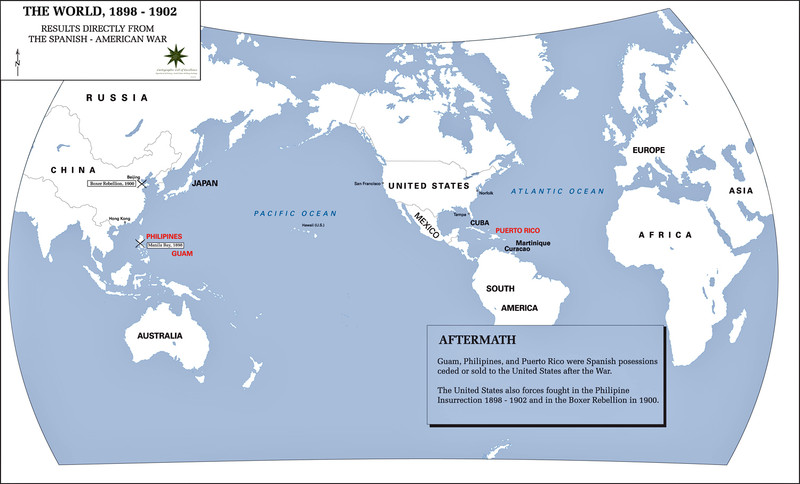
U.S. expansion after the Spanish-American War
Why the United States Went to War
The crisis started in Cuba, where a new war for independence began in 1895. José Martí helped inspire Cuban nationalism. Spain sent General Valeriano Weyler, whose reconcentration policy forced civilians into camps. Disease, hunger, and death created real humanitarian outrage in the U.S.
American motives came together all at once:
- sympathy for Cuban independence
- protection of U.S. investments in sugar and trade
- Cuba’s strategic location near Florida and future canal routes
- nationalism and political pressure at home
Yellow journalism
Newspapers helped turn Cuban suffering into a national cause. William Randolph Hearst’s New York Journal and Joseph Pulitzer’s New York World used sensational stories and dramatic images to stir anger at Spain.
The key AP point is that yellow journalism influenced public opinion, but it did not cause the war by itself.
Immediate catalysts
- The de Lôme letter insulted President McKinley and inflamed opinion.
- The USS Maine exploded in Havana Harbor in 1898.
- “Remember the Maine” became the rallying cry.
- McKinley tried diplomacy first, then asked for intervention.
- The Teller Amendment said the U.S. would not annex Cuba.
How the War Was Fought and Won
The war lasted from April to August 1898. John Hay later called it “a splendid little war,” but that phrase hides how messy it was.
Pacific theater
- Commodore George Dewey destroyed the Spanish fleet at the Battle of Manila Bay.
- Emilio Aguinaldo cooperated with the U.S. because he expected Philippine independence.
Caribbean theater
- Main fighting in Cuba centered near Santiago.
- Important battles included Las Guasimas, El Caney, and San Juan Heights.
- Theodore Roosevelt and the Rough Riders got the headlines.
- Buffalo Soldiers and other African American regulars were crucial in the fighting.
- The Spanish fleet was destroyed at Santiago Harbor.
- The U.S. also occupied Puerto Rico.
That celebrity side of the war shows up in the famous Rough Riders group photo below, but remember that Roosevelt's unit was only part of the larger U.S. campaign in Cuba.
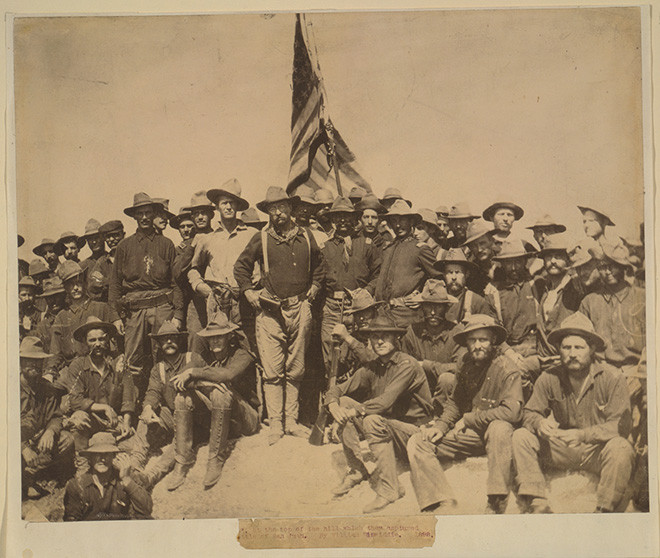
Theodore Roosevelt and the Rough Riders
A common test qualification is that more Americans died from yellow fever, malaria, and typhoid than from combat. Fast victory does not mean easy or well-run victory.
The Treaty of Paris and the New American Empire
The Treaty of Paris in 1898 ended the war and reshaped U.S. power.
| Territory | Result |
|---|---|
| Cuba | Released from Spanish control |
| Puerto Rico | Ceded to the U.S. |
| Guam | Ceded to the U.S. |
| Philippines | Ceded to the U.S. for $20 million |
Hawaii was annexed in 1898 too, but it was not taken from Spain and was not part of the treaty.
Cuba shows the biggest gap between words and reality. The U.S. occupied it until 1902, then forced in the Platt Amendment, which let the U.S. intervene in Cuban affairs and keep Guantánamo Bay.
Memorize this contrast: Teller Amendment = no annexation. Platt Amendment = indirect control.
The treaty barely passed the Senate. Critics said empire violated self-government. The Insular Cases beginning in 1901 said new lands could be unincorporated territories, where full constitutional rights did not automatically apply.
The Philippines and Expanded U.S. Involvement in Asia
Filipinos expected independence after Spain lost. Aguinaldo declared it in 1898. When the U.S. annexed the islands instead, the Philippine-American War began in 1899.
- the war shifted from regular fighting to guerrilla warfare
- U.S. suppression included reconcentration, harsh reprisals, and civilian suffering
- McKinley’s “Benevolent Assimilation” claimed U.S. rule would help Filipinos
- in practice, the U.S. suppressed a Filipino nationalist movement
These Pacific possessions also pulled the U.S. further into Asia:
- Guam and the Philippines became stepping-stones to Asian markets
- John Hay’s Open Door Policy pushed for equal trade access in China
- the U.S. joined the international force during the Boxer Rebellion
This was the turning point. Spain’s empire in the Americas mostly ended, and the U.S. emerged as a clearer world power with island possessions across the Caribbean and Pacific.
Key Takeaways
Spanish–American War
1898 war in which the United States defeated Spain, gained Puerto Rico, Guam, and the Philippines, and brought Cuba under strong U.S. influence
Cuban War of Independence
Cuban nationalist revolt against Spanish rule beginning in 1895 that prompted U.S. intervention and the Spanish–American War
José Martí
Cuban nationalist writer and organizer who helped inspire and organize the 1895 revolt against Spain before being killed in the fighting
Valeriano Weyler
Spanish general who tried to suppress Cuba’s revolt through reconcentration, producing widespread civilian suffering and stronger American support for intervention
Reconcentration Policy
Weyler’s policy of forcing rural Cubans into guarded towns and camps to separate civilians from insurgents, causing extensive suffering and death
Yellow Journalism
Sensationalized reporting that emphasized Spanish atrocities and Cuban suffering, shaping public opinion and increasing political pressure for intervention
De Lôme Letter
Private 1898 letter by Spanish ambassador Enrique Dupuy de Lôme insulting President McKinley; its publication heightened tensions with Spain
USS Maine
American battleship destroyed in Havana Harbor in February 1898; although Spain’s responsibility was unproved, its sinking became a rallying cry for war
William McKinley
President who initially pursued diplomacy, then requested intervention in Cuba and defended subsequent American control of the Philippines
Teller Amendment
1898 declaration that the United States would not annex Cuba and would leave the island to its people after restoring peace
George Dewey
American commodore whose Asiatic Squadron destroyed Spain’s Pacific fleet at Manila Bay, opening the way for U.S. control of the Philippines
Battle of Manila Bay
May 1898 American naval victory that destroyed Spain’s Pacific fleet and made control of the Philippines central to the peace settlement
Emilio Aguinaldo
Filipino nationalist leader who fought Spain, declared Philippine independence, and then led resistance to American colonial rule
Theodore Roosevelt
Assistant secretary of the navy who promoted Pacific preparedness, then gained fame fighting in Cuba with the Rough Riders
Buffalo Soldiers
African American regular army troops who played important roles in the Cuban campaign, including the fighting at the San Juan Heights
Battle of San Juan Hill
Major American victory near Santiago involving attacks on San Juan and Kettle Hills that helped collapse Spain’s position in Cuba
Treaty of Paris of 1898
Treaty ending the war: Spain relinquished Cuba, ceded Puerto Rico and Guam to the United States, and ceded the Philippines for $20 million
Platt Amendment
1901 measure limiting Cuban sovereignty, authorizing U.S. intervention, and requiring land for naval bases, including Guantánamo Bay
Philippine–American War
1899–1902 war in which the United States defeated Filipino nationalists seeking independence and established American colonial rule
Benevolent Assimilation
McKinley’s proclamation portraying American rule in the Philippines as protective and beneficial while treating Filipino consent as secondary
John Hay
Secretary of state who called the conflict a “splendid little war” and issued the Open Door notes seeking equal commercial access in China
Open Door Policy
John Hay’s policy asking foreign powers to preserve equal commercial access to China and respect China’s territorial integrity
Boxer Rebellion
Chinese uprising against foreign influence and Christian missions that the United States helped an international expedition suppress in 1900
Insular Cases
Supreme Court decisions holding that full constitutional rights did not automatically extend to all residents of newly acquired U.S. territories
William Randolph Hearst
Publisher of the New York Journal, which used sensational coverage of Cuba to attract readers and increase pressure for intervention
Joseph Pulitzer
Publisher of the New York World, which competed with Hearst's Journal through sensational coverage of the Cuban conflict
Rough Riders / First United States Volunteer Cavalry
Volunteer cavalry regiment associated with Theodore Roosevelt and publicized for its role in the fighting at the San Juan Heights
Notes
Spanish–American War
1898 war in which the United States defeated Spain, gained Puerto Rico, Guam, and the Philippines, and brought Cuba under strong U.S. influence
Cuban War of Independence
Cuban nationalist revolt against Spanish rule beginning in 1895 that prompted U.S. intervention and the Spanish–American War
José Martí
Cuban nationalist writer and organizer who helped inspire and organize the 1895 revolt against Spain before being killed in the fighting
Valeriano Weyler
Spanish general who tried to suppress Cuba’s revolt through reconcentration, producing widespread civilian suffering and stronger American support for intervention
Reconcentration Policy
Weyler’s policy of forcing rural Cubans into guarded towns and camps to separate civilians from insurgents, causing extensive suffering and death
Yellow Journalism
Sensationalized reporting that emphasized Spanish atrocities and Cuban suffering, shaping public opinion and increasing political pressure for intervention
De Lôme Letter
Private 1898 letter by Spanish ambassador Enrique Dupuy de Lôme insulting President McKinley; its publication heightened tensions with Spain
USS Maine
American battleship destroyed in Havana Harbor in February 1898; although Spain’s responsibility was unproved, its sinking became a rallying cry for war
William McKinley
President who initially pursued diplomacy, then requested intervention in Cuba and defended subsequent American control of the Philippines
Teller Amendment
1898 declaration that the United States would not annex Cuba and would leave the island to its people after restoring peace
George Dewey
American commodore whose Asiatic Squadron destroyed Spain’s Pacific fleet at Manila Bay, opening the way for U.S. control of the Philippines
Battle of Manila Bay
May 1898 American naval victory that destroyed Spain’s Pacific fleet and made control of the Philippines central to the peace settlement
Emilio Aguinaldo
Filipino nationalist leader who fought Spain, declared Philippine independence, and then led resistance to American colonial rule
Theodore Roosevelt
Assistant secretary of the navy who promoted Pacific preparedness, then gained fame fighting in Cuba with the Rough Riders
Buffalo Soldiers
African American regular army troops who played important roles in the Cuban campaign, including the fighting at the San Juan Heights
Battle of San Juan Hill
Major American victory near Santiago involving attacks on San Juan and Kettle Hills that helped collapse Spain’s position in Cuba
Treaty of Paris of 1898
Treaty ending the war: Spain relinquished Cuba, ceded Puerto Rico and Guam to the United States, and ceded the Philippines for $20 million
Platt Amendment
1901 measure limiting Cuban sovereignty, authorizing U.S. intervention, and requiring land for naval bases, including Guantánamo Bay
Philippine–American War
1899–1902 war in which the United States defeated Filipino nationalists seeking independence and established American colonial rule
Benevolent Assimilation
McKinley’s proclamation portraying American rule in the Philippines as protective and beneficial while treating Filipino consent as secondary
John Hay
Secretary of state who called the conflict a “splendid little war” and issued the Open Door notes seeking equal commercial access in China
Open Door Policy
John Hay’s policy asking foreign powers to preserve equal commercial access to China and respect China’s territorial integrity
Boxer Rebellion
Chinese uprising against foreign influence and Christian missions that the United States helped an international expedition suppress in 1900
Insular Cases
Supreme Court decisions holding that full constitutional rights did not automatically extend to all residents of newly acquired U.S. territories
William Randolph Hearst
Publisher of the New York Journal, which used sensational coverage of Cuba to attract readers and increase pressure for intervention
Joseph Pulitzer
Publisher of the New York World, which competed with Hearst's Journal through sensational coverage of the Cuban conflict
Rough Riders / First United States Volunteer Cavalry
Volunteer cavalry regiment associated with Theodore Roosevelt and publicized for its role in the fighting at the San Juan Heights
