Topic 3.10 Notes – Shaping a New Republic
How the New Republic Actually Worked
The Constitution gave a framework. Washington and Adams had to make it real. Washington mattered so much because people trusted him, and that trust helped the new federal government look legitimate instead of fragile.
- Cabinet system took shape under Washington. His main advisers were Alexander Hamilton at Treasury, Thomas Jefferson at State, Henry Knox at War, and Edmund Randolph as attorney general.
- Judiciary Act of 1789 created lower federal courts and organized the Supreme Court, so the national government actually had a court system below the top.
- Bill of Rights was ratified in 1791, partly to calm fears that the new Constitution gave too much power to the center.
- Washington strengthened executive power through diplomacy, enforcing federal law, and claiming the power to remove executive officers.
- He rejected royal style and stopped after two terms, creating the precedent later written into law much later.
Under all of this were the arguments that shaped the decade:
- Strict vs. broad construction
- National power vs. states’ rights
- Liberty vs. order
- Agrarian republic vs. commercial republic
- How to survive among Britain, France, Spain, and Native nations
Hamilton’s Program and the Rise of Parties
Hamilton wanted a stronger national economy because he thought weak finances could kill the republic.
- Funding the debt at full value built confidence in the government’s promises.
- Assumption meant the federal government would take on state Revolutionary War debts, tying creditors to national success.
- Tariff of 1789 and excise taxes brought in revenue.
- First Bank of the United States held federal money and expanded credit.
The Compromise of 1790 got assumption passed and placed the permanent capital on the Potomac, which led to Washington, D.C.
The Bank fight became a Constitution fight. Hamilton used loose construction and the necessary and proper clause. Jefferson answered with strict construction, saying Congress only had powers specifically listed.
The Whiskey Rebellion tested whether federal power meant anything. Western farmers resisted the whiskey excise tax. Washington sent militia forces to stop the rebellion. That was a huge contrast with Shays’ Rebellion, when the Articles government could barely respond.
These debates created the first party system:
| Party | Leaders | Favored |
|---|---|---|
| Federalists | Hamilton, Adams | strong central government, commerce, manufacturing, order, generally pro-British neutrality |
| Democratic-Republicans | Jefferson, Madison | limited federal power, agrarianism, states’ rights, sympathy for France |
Party identity also spread through newspapers, political clubs, and congressional alliances.
Foreign Policy and Western Conflict in the 1790s
The U.S. needed peace because it was too weak for a major war, but expansion kept dragging it into conflict.
The biggest western issue was Native land. The map below highlights the Ohio Country fighting that led to the Treaty of Greenville.
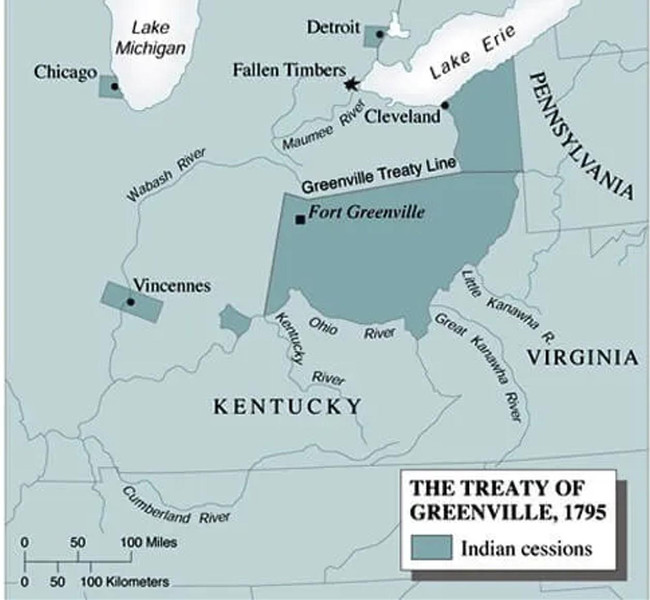
Treaty of Greenville, 1795
The U.S. claimed territory Britain had given up, but Native nations had never agreed to that transfer.
- Trade and Intercourse Act of 1790 said only the federal government could approve Native land sales.
- In the Ohio Valley, a Native confederacy including Shawnee, Miami, and Delaware resisted U.S. expansion.
- Britain still held forts and supported Native resistance.
- Anthony Wayne defeated Native forces at Fallen Timbers in 1794.
- Treaty of Greenville in 1795 forced large land cessions in Ohio.
Spain mattered too because western farmers needed the Mississippi River.
- Pinckney’s Treaty or Treaty of San Lorenzo in 1795
- set the 31st parallel as Florida’s boundary
- gave free navigation of the Mississippi
- gave the right of deposit at New Orleans
Spain was also expanding in California through missions, presidios, and settlements beginning with San Diego in 1769. Missions relied on bonded/coerced Native labor, but this frontier also created cultural blending and some social mobility for soldiers and mixed-ancestry people.
European war made neutrality a crisis. Washington issued the Proclamation of Neutrality in 1793, and Congress passed the Neutrality Act of 1794. The Citizen Genêt affair showed that the president, not a foreign minister, controlled U.S. diplomacy.
With Britain, problems included forts in the Northwest, impressment, ship seizures, and trade limits. Jay’s Treaty in 1794-1795 got British evacuation of forts and some settlement commissions, but only limited trade gains. Democratic-Republicans hated it.
Washington’s Farewell Address warned against sectionalism, political factions, and permanent foreign alliances. He supported neutrality, not total isolation.
Adams, Civil Liberties, and the Election of 1800
Under Adams, foreign tension turned into a civil liberties fight at home.
- XYZ Affair happened when French agents demanded a bribe before negotiations, which caused anti-French outrage.
- The Quasi-War with France from 1798 to 1800 was an undeclared naval conflict.
- Adams resisted full war and ended the crisis with the Convention of 1800, which also ended the 1778 alliance.
The Alien and Sedition Acts in 1798 included:
- Naturalization Act
- Alien Friends Act
- Alien Enemies Act
- Sedition Act
These were used mainly against Democratic-Republican critics, including Matthew Lyon.
Jefferson and Madison answered with the Virginia and Kentucky Resolutions. They argued states could judge unconstitutional federal laws through interposition and nullification.
The Election of 1800 ended in a tie between Jefferson and Aaron Burr, so the House chose Jefferson after 36 ballots. The significance is huge. It was a peaceful transfer of power between rival parties, which proved the Constitution could survive intense partisan conflict. It later led to the Twelfth Amendment, which separated electoral votes for president and vice president.
Key Takeaways
George Washington
First president; established cabinet, executive, neutrality, law-enforcement, and two-term precedents that legitimized the new federal government
Presidential Cabinet
Washington’s advisory body of executive department heads, including Thomas Jefferson at State and Alexander Hamilton at Treasury
Judiciary Act of 1789
Created federal district and circuit courts beneath the Supreme Court and initially set the Supreme Court at six justices
Bill of Rights
The first ten amendments, principally drafted by James Madison and ratified in 1791 to protect individual liberties
Alexander Hamilton
Washington’s treasury secretary and Federalist leader who promoted public credit, a national bank, commerce, manufacturing, and broad federal power
Hamilton’s Financial Program
Plan to fund federal debt, assume state debts, raise revenue, and establish a national bank to build credit and strengthen the federal government
Funding at Par
Hamilton’s policy of paying federal securities at full face value to establish public credit, despite criticism that it rewarded speculators
Federal Assumption of State Debts
Hamilton’s plan for the federal government to take over remaining state Revolutionary War debts, strengthening national authority and binding creditors to it
Compromise of 1790
Jefferson and Madison accepted assumption of state debts while Hamilton’s allies supported locating the permanent national capital on the Potomac
First Bank of the United States
Federally chartered bank created in 1791 to hold deposits, transfer funds, issue notes, and provide credit
Strict Construction vs. Loose Construction
Jefferson limited federal power to what the Constitution expressly authorized; Hamilton allowed implied powers through the necessary and proper clause
Whiskey Rebellion
Western Pennsylvania resistance to the whiskey excise that Washington suppressed with militia in 1794, demonstrating federal power to enforce laws
Trade and Intercourse Act of 1790
Federal law requiring federal approval for purchases of Native land, even as settlers and states frequently ignored its restrictions
Northwest Indian Confederacy
Alliance including Shawnee, Miami, Delaware, and other Native nations that resisted U.S. settlement north of the Ohio River
Anthony Wayne
U.S. general whose army defeated the Northwest Indian Confederacy at the Battle of Fallen Timbers in 1794
Battle of Fallen Timbers
Anthony Wayne’s 1794 victory over the Northwest Indian Confederacy, after which nearby British troops refused to intervene
Treaty of Greenville
1795 treaty forcing Native nations to cede most of present-day Ohio and other strategic lands after their defeat at Fallen Timbers
Pinckney’s Treaty (Treaty of San Lorenzo)
1795 agreement with Spain setting Florida’s border at the 31st parallel and granting U.S. navigation of the Mississippi and deposit rights at New Orleans
Spanish California Missions
Settlements that expanded Spanish control through coerced Native labor and conversion while promoting cultural blending and some frontier social mobility
Thomas Jefferson
Washington’s secretary of state and Democratic-Republican leader who favored strict construction, an agrarian republic, France, and limited federal power
James Madison
Principal drafter of the Bill of Rights and Democratic-Republican leader who opposed Hamilton’s program and wrote the Virginia Resolutions
Proclamation of Neutrality
Washington’s 1793 declaration that the United States would remain impartial in the war between revolutionary France and its enemies
Citizen Genêt Affair
French minister Edmond-Charles Genêt recruited American privateers and appealed to the public against neutrality, leading Washington to demand his recall
Jay’s Treaty
1794 agreement securing British evacuation of western forts and avoiding war but failing to end impressment or fully protect neutral shipping
First Party System
The 1790s competition between Federalists and Democratic-Republicans over federal power, economic policy, foreign affairs, liberty, and public order
Federalist Party
Party led by Hamilton and Adams favoring strong national power, loose construction, commerce, manufacturing, public order, and stable relations with Britain
Democratic-Republican Party
Party led by Jefferson and Madison favoring limited federal power, strict construction, an agrarian republic, popular participation, and sympathy for France
Washington’s Farewell Address
Washington’s 1796 defense of national unity and warning against sectionalism, political factions, and permanent foreign alliances
John Adams
Second president and Federalist who faced the XYZ Affair and Quasi-War, signed the Alien and Sedition Acts, and avoided full war with France
XYZ Affair
1797–1798 scandal in which French intermediaries demanded a bribe and loan before negotiating with U.S. diplomats, provoking anti-French anger
Quasi-War
Undeclared naval conflict between the United States and France from 1798 to 1800 following French seizures of American ships and the XYZ Affair
Convention of 1800
Agreement that ended the Quasi-War and terminated the Franco-American alliance created by the treaties of 1778
Alien and Sedition Acts
Four 1798 Federalist laws that lengthened naturalization, authorized action against certain noncitizens, and restricted opposition speech
Sedition Act
1798 law criminalizing false, scandalous, and malicious statements intended to defame the federal government, Congress, or president, chiefly enforced against Democratic-Republicans
Virginia and Kentucky Resolutions
1798 responses by Madison and Jefferson arguing through compact theory that states could oppose unconstitutional federal laws
Compact Theory
Theory that the states formed the federal government and could judge whether it had exceeded its delegated constitutional powers
Nullification vs. Interposition
Kentucky declared unconstitutional federal measures void through nullification, while Virginia more cautiously urged state interposition against them
Election of 1800
Jefferson defeated Adams after the House resolved his electoral tie with Aaron Burr, producing a peaceful transfer between opposing parties
Twelfth Amendment
Amendment requiring electors to cast separate votes for president and vice president after the Jefferson-Burr tie of 1800
French Revolution
Revolution in France that led to European war and divided Americans between sympathy for France and support for neutrality and British trade
Impressment
British seizure of sailors claimed as British subjects, including men aboard American ships; an issue Jay’s Treaty failed to resolve
Notes
George Washington
First president; established cabinet, executive, neutrality, law-enforcement, and two-term precedents that legitimized the new federal government
Presidential Cabinet
Washington’s advisory body of executive department heads, including Thomas Jefferson at State and Alexander Hamilton at Treasury
Judiciary Act of 1789
Created federal district and circuit courts beneath the Supreme Court and initially set the Supreme Court at six justices
Bill of Rights
The first ten amendments, principally drafted by James Madison and ratified in 1791 to protect individual liberties
Alexander Hamilton
Washington’s treasury secretary and Federalist leader who promoted public credit, a national bank, commerce, manufacturing, and broad federal power
Hamilton’s Financial Program
Plan to fund federal debt, assume state debts, raise revenue, and establish a national bank to build credit and strengthen the federal government
Funding at Par
Hamilton’s policy of paying federal securities at full face value to establish public credit, despite criticism that it rewarded speculators
Federal Assumption of State Debts
Hamilton’s plan for the federal government to take over remaining state Revolutionary War debts, strengthening national authority and binding creditors to it
Compromise of 1790
Jefferson and Madison accepted assumption of state debts while Hamilton’s allies supported locating the permanent national capital on the Potomac
First Bank of the United States
Federally chartered bank created in 1791 to hold deposits, transfer funds, issue notes, and provide credit
Strict Construction vs. Loose Construction
Jefferson limited federal power to what the Constitution expressly authorized; Hamilton allowed implied powers through the necessary and proper clause
Whiskey Rebellion
Western Pennsylvania resistance to the whiskey excise that Washington suppressed with militia in 1794, demonstrating federal power to enforce laws
Trade and Intercourse Act of 1790
Federal law requiring federal approval for purchases of Native land, even as settlers and states frequently ignored its restrictions
Northwest Indian Confederacy
Alliance including Shawnee, Miami, Delaware, and other Native nations that resisted U.S. settlement north of the Ohio River
Anthony Wayne
U.S. general whose army defeated the Northwest Indian Confederacy at the Battle of Fallen Timbers in 1794
Battle of Fallen Timbers
Anthony Wayne’s 1794 victory over the Northwest Indian Confederacy, after which nearby British troops refused to intervene
Treaty of Greenville
1795 treaty forcing Native nations to cede most of present-day Ohio and other strategic lands after their defeat at Fallen Timbers
Pinckney’s Treaty (Treaty of San Lorenzo)
1795 agreement with Spain setting Florida’s border at the 31st parallel and granting U.S. navigation of the Mississippi and deposit rights at New Orleans
Spanish California Missions
Settlements that expanded Spanish control through coerced Native labor and conversion while promoting cultural blending and some frontier social mobility
Thomas Jefferson
Washington’s secretary of state and Democratic-Republican leader who favored strict construction, an agrarian republic, France, and limited federal power
James Madison
Principal drafter of the Bill of Rights and Democratic-Republican leader who opposed Hamilton’s program and wrote the Virginia Resolutions
Proclamation of Neutrality
Washington’s 1793 declaration that the United States would remain impartial in the war between revolutionary France and its enemies
Citizen Genêt Affair
French minister Edmond-Charles Genêt recruited American privateers and appealed to the public against neutrality, leading Washington to demand his recall
Jay’s Treaty
1794 agreement securing British evacuation of western forts and avoiding war but failing to end impressment or fully protect neutral shipping
First Party System
The 1790s competition between Federalists and Democratic-Republicans over federal power, economic policy, foreign affairs, liberty, and public order
Federalist Party
Party led by Hamilton and Adams favoring strong national power, loose construction, commerce, manufacturing, public order, and stable relations with Britain
Democratic-Republican Party
Party led by Jefferson and Madison favoring limited federal power, strict construction, an agrarian republic, popular participation, and sympathy for France
Washington’s Farewell Address
Washington’s 1796 defense of national unity and warning against sectionalism, political factions, and permanent foreign alliances
John Adams
Second president and Federalist who faced the XYZ Affair and Quasi-War, signed the Alien and Sedition Acts, and avoided full war with France
XYZ Affair
1797–1798 scandal in which French intermediaries demanded a bribe and loan before negotiating with U.S. diplomats, provoking anti-French anger
Quasi-War
Undeclared naval conflict between the United States and France from 1798 to 1800 following French seizures of American ships and the XYZ Affair
Convention of 1800
Agreement that ended the Quasi-War and terminated the Franco-American alliance created by the treaties of 1778
Alien and Sedition Acts
Four 1798 Federalist laws that lengthened naturalization, authorized action against certain noncitizens, and restricted opposition speech
Sedition Act
1798 law criminalizing false, scandalous, and malicious statements intended to defame the federal government, Congress, or president, chiefly enforced against Democratic-Republicans
Virginia and Kentucky Resolutions
1798 responses by Madison and Jefferson arguing through compact theory that states could oppose unconstitutional federal laws
Compact Theory
Theory that the states formed the federal government and could judge whether it had exceeded its delegated constitutional powers
Nullification vs. Interposition
Kentucky declared unconstitutional federal measures void through nullification, while Virginia more cautiously urged state interposition against them
Election of 1800
Jefferson defeated Adams after the House resolved his electoral tie with Aaron Burr, producing a peaceful transfer between opposing parties
Twelfth Amendment
Amendment requiring electors to cast separate votes for president and vice president after the Jefferson-Burr tie of 1800
French Revolution
Revolution in France that led to European war and divided Americans between sympathy for France and support for neutrality and British trade
Impressment
British seizure of sailors claimed as British subjects, including men aboard American ships; an issue Jay’s Treaty failed to resolve
