Topic 4.12 Notes – African Americans in the Early Republic
How African American life changed and stayed the same from 1800 to 1848
This whole topic is a continuity-and-change question. You’re tracking what got worse, what improved, and what stayed stubbornly in place.
- Continuity stayed strongest in slavery and white supremacy. Most African Americans were still enslaved, and racism shaped law, politics, voting, work, and daily life.
- Change showed up in two big ways:
- slavery expanded geographically and numerically
- the free Black population and Black activism grew, especially in the North
- The core contradiction of the early republic was simple. The nation celebrated liberty and expanded voting rights for white men, but shut African Americans out of equal citizenship.
Numbers to know
| Year | Enslaved population | Free Black population |
|---|---|---|
| 1800 | about 893,000 | about 108,000 |
| 1840 | about 2.49 million | about 386,000 |
How slavery expanded and how enslaved people lived under it
Cotton drove this expansion. The cotton gin made short-staple cotton profitable, and planters pushed onto seized Indigenous land in Alabama, Mississippi, Louisiana, Arkansas, and eastern Texas.
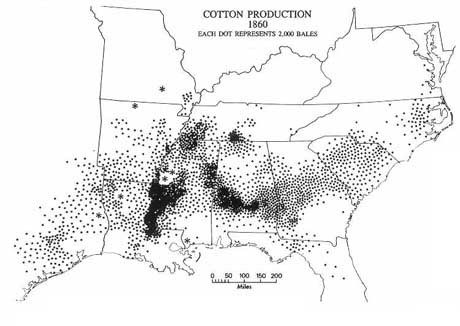
Cotton production in 1860
This map shows how heavily cotton production concentrated in the Deep South by 1860.
The 1808 end of the legal international slave trade did not slow slavery much. Growth continued through natural increase and the domestic slave trade.
- Second Middle Passage = forced sale and movement of enslaved people from the Upper South to the Deep South. This shattered families and made sale a constant threat.
- Chattel slavery meant people were legally property. Status followed the mother, and marriages or parental rights had no secure legal protection.
Labor systems
- Gang system on cotton and sugar plantations meant tightly supervised group labor, usually under overseers, with a brutal pace.
- Task system on rice plantations assigned daily jobs. Finishing early could leave some time, but enslavers still controlled the workload.
- Non-field labor included domestic servants, blacksmiths, carpenters, dockworkers, and hired-out urban workers.
Enslavers held control through slave codes, patrols, passes, surveillance, punishment, sale, literacy bans, and limits on movement and assembly.
How African Americans protected family, community, and dignity
Even under slavery, African Americans built lives that slavery could not fully erase.
- Families gave emotional support and a way to resist dehumanization, even when sale split people apart.
- Broad kinship networks mattered because unrelated adults often became surrogate parents, aunts, uncles, and grandparents.
- Christianity was reshaped through Black experience. Exodus, deliverance, and equality before God had special power.
- The invisible institution was unsupervised religious life led by enslaved people themselves.
- Culture also carried resistance and survival through spirituals, storytelling, music, dance, foodways, burial practices, and healing traditions.
- Literacy offered autonomy through reading the Bible, writing passes, communicating, and later testifying against slavery.
Everyday resistance
- slow work, feigned illness, tool-breaking, theft of necessities
- preserving family ties and forbidden cultural practices
- learning to read secretly
- temporary or permanent escape
Runaway ads are a favorite source angle. They reveal skills, planning, literacy, family ties, and determination, even though enslavers wrote them.
Escape, rebellion, and organized resistance
Escape was both personal freedom and a challenge to slaveholders’ property claims.
- The Underground Railroad was a loose network, not one system. Free Black communities, vigilance committees, sailors, wagon drivers, and abolitionists all helped.
- The Fugitive Slave Act of 1793 allowed recapture across state lines and put free Black people at risk of kidnapping.
- Escape stayed limited by patrols, distance, lack of resources, and recapture.
Open revolt happened less often because repression was so strong.
- Gabriel’s conspiracy (1800) planned to seize Richmond. It was inspired by Revolutionary ideals and was uncovered before it happened.
- Denmark Vesey’s alleged conspiracy (1822) led to executions in Charleston, destruction of a Black church, and tighter controls.
- Nat Turner’s rebellion (1831) killed about 55 whites, making it the deadliest slave revolt in U.S. history. Southern states answered with even harsher slave laws.
Free Black communities and Black political activism
Gradual emancipation increased free Black communities, but freedom did not mean equality.
- discrimination included disfranchisement, segregated schools and churches, unequal courts, job exclusion, violence, and kidnapping
- white male democracy often expanded by becoming more racially exclusive
- New York constitution of 1821 gave white men easier voting access but required Black men to own $250 in property
- Pennsylvania constitution of 1838 restricted voting to white men
Independent institutions and activism
- Free African Society (1787) founded by Richard Allen and Absalom Jones
- African Methodist Episcopal Church (1816) led by Richard Allen and gave Black Christians independent leadership
- Maria Stewart called for education, moral reform, and racial uplift
- Freedom’s Journal (1827) by Samuel Cornish and John Russwurm declared, “we wish to plead our own cause”
- Negro Convention movement began in 1830 in Philadelphia
- David Walker’s Appeal (1829) attacked slavery and racism using Christianity and the Declaration of Independence
- Frederick Douglass escaped in 1838, published Narrative in 1845, and started The North Star in 1847
- activists worked with the American Anti-Slavery Society (1833) but also clashed over leadership and racism within reform movements
The American Colonization Society (1816) backed migration to Liberia, but most free Black leaders rejected this. At the 1817 Philadelphia meeting, they insisted the United States was their homeland and demanded citizenship there.
Key Takeaways
Racialized Chattel Slavery
A system in which enslaved people were legally treated as inheritable property that could be bought, sold, leased, mortgaged, or transferred
Domestic Slave Trade / Second Middle Passage
The forced sale and migration of enslaved people from the Upper South to the expanding cotton regions of the Deep South, often separating families
Gang System vs. Task System
Gang labor kept workers under continuous group supervision, while task labor assigned daily work that could leave limited time after completion
Slave Codes
Southern laws controlling enslaved people through restrictions on movement, assembly, literacy, legal rights, and other activities
Spirituals
African American religious songs expressing faith, suffering, hope, community, and sometimes concealed ideas of liberation
Invisible Institution
The independent religious world enslaved African Americans created within or beyond white-controlled churches, emphasizing equality, justice, and deliverance
Everyday Resistance
Actions such as slowing work, feigning illness, damaging tools, learning secretly, preserving culture, negotiating privileges, or escaping to limit an enslaver’s control
Underground Railroad
A loose network of routes, safe places, free Black communities, abolitionists, and vigilance committees that assisted some freedom seekers
Fugitive Slave Act of 1793
Federal law authorizing interstate recovery of alleged fugitives, endangering both escaped enslaved people and free African Americans vulnerable to kidnapping
Gabriel’s Conspiracy
Gabriel, an enslaved Virginia blacksmith, planned an 1800 seizure of Richmond inspired by revolutionary ideals, but informants exposed it and he was executed
Denmark Vesey’s Alleged Conspiracy
An alleged 1822 Charleston uprising that authorities accused free Black carpenter Denmark Vesey of organizing; officials executed Vesey and 34 others and tightened restrictions on Black life
Nat Turner’s Rebellion
The deadliest U.S. revolt by enslaved people, led by enslaved preacher Nat Turner in Virginia in 1831; it killed about 55 white people and prompted violent reprisals and tighter controls on Black preaching, assembly, movement, and literacy
Gradual Emancipation
Northern policies that ended slavery slowly, often freeing children born after a set date only after lengthy periods of service
Free African Americans
African Americans legally free from individual enslavers but generally denied equal voting, educational, occupational, legal, and civil rights
Free African Society
A mutual-aid organization founded in Philadelphia in 1787 by Richard Allen and Absalom Jones to support the independent Black community
Richard Allen
Black religious leader who helped found the Free African Society, established Bethel Church, and became the AME Church’s first bishop
African Methodist Episcopal Church / AME Church
Independent Black denomination organized in 1816 with Richard Allen as its first bishop, supporting worship, education, relief, abolition, and community organizing
Mutual-Aid Societies
Black community organizations that assisted members during illness, funded burials, supported widows and orphans, and sustained schools
Maria Stewart
Black activist who publicly advocated education, economic independence, moral reform, and resistance to racial subordination in the early 1830s
African American Abolitionism
Black-led activism using speeches, petitions, publications, conventions, boycotts, testimony, and aid to fugitives to pursue abolition and equal citizenship
Freedom’s Journal
The first African American–owned and operated U.S. newspaper, founded in 1827 by Samuel Cornish and John Russwurm to let Black Americans plead their own cause
National Negro Convention Movement
An interstate Black political movement begun in Philadelphia in 1830 to address abolition, education, employment, migration, civil rights, and collective advancement
David Walker
Black abolitionist who wrote the 1829 Appeal, invoking Christianity and the Declaration of Independence to condemn slavery, assert Black equality, and warn of resistance
Appeal to the Coloured Citizens of the World
David Walker’s 1829 pamphlet denouncing slavery and racism, asserting Black equality, and warning that continued oppression would provoke resistance
Frederick Douglass
Formerly enslaved abolitionist who escaped in 1838 and became a leading lecturer, author, and newspaper publisher for abolition and equal rights
Narrative of the Life of Frederick Douglass, an American Slave
Douglass’s 1845 autobiography exposing slavery’s violence, family separation, deprivation, and suppression of literacy while refuting racist claims
The North Star
Frederick Douglass’s newspaper, begun in 1847, that provided an independent Black platform for abolition and equal rights
American Colonization Society
Organization founded in 1816 that promoted removing free African Americans to Africa and helped establish Liberia
Colonization
The proposal to resettle free African Americans outside the United States, rejected by most Black leaders as a denial of their American citizenship
The Confessions of Nat Turner
Thomas R. Gray’s account based on jail interviews with Nat Turner, providing evidence of Turner’s religious motives but mediated through a white editor
Notes
Racialized Chattel Slavery
A system in which enslaved people were legally treated as inheritable property that could be bought, sold, leased, mortgaged, or transferred
Domestic Slave Trade / Second Middle Passage
The forced sale and migration of enslaved people from the Upper South to the expanding cotton regions of the Deep South, often separating families
Gang System vs. Task System
Gang labor kept workers under continuous group supervision, while task labor assigned daily work that could leave limited time after completion
Slave Codes
Southern laws controlling enslaved people through restrictions on movement, assembly, literacy, legal rights, and other activities
Spirituals
African American religious songs expressing faith, suffering, hope, community, and sometimes concealed ideas of liberation
Invisible Institution
The independent religious world enslaved African Americans created within or beyond white-controlled churches, emphasizing equality, justice, and deliverance
Everyday Resistance
Actions such as slowing work, feigning illness, damaging tools, learning secretly, preserving culture, negotiating privileges, or escaping to limit an enslaver’s control
Underground Railroad
A loose network of routes, safe places, free Black communities, abolitionists, and vigilance committees that assisted some freedom seekers
Fugitive Slave Act of 1793
Federal law authorizing interstate recovery of alleged fugitives, endangering both escaped enslaved people and free African Americans vulnerable to kidnapping
Gabriel’s Conspiracy
Gabriel, an enslaved Virginia blacksmith, planned an 1800 seizure of Richmond inspired by revolutionary ideals, but informants exposed it and he was executed
Denmark Vesey’s Alleged Conspiracy
An alleged 1822 Charleston uprising that authorities accused free Black carpenter Denmark Vesey of organizing; officials executed Vesey and 34 others and tightened restrictions on Black life
Nat Turner’s Rebellion
The deadliest U.S. revolt by enslaved people, led by enslaved preacher Nat Turner in Virginia in 1831; it killed about 55 white people and prompted violent reprisals and tighter controls on Black preaching, assembly, movement, and literacy
Gradual Emancipation
Northern policies that ended slavery slowly, often freeing children born after a set date only after lengthy periods of service
Free African Americans
African Americans legally free from individual enslavers but generally denied equal voting, educational, occupational, legal, and civil rights
Free African Society
A mutual-aid organization founded in Philadelphia in 1787 by Richard Allen and Absalom Jones to support the independent Black community
Richard Allen
Black religious leader who helped found the Free African Society, established Bethel Church, and became the AME Church’s first bishop
African Methodist Episcopal Church / AME Church
Independent Black denomination organized in 1816 with Richard Allen as its first bishop, supporting worship, education, relief, abolition, and community organizing
Mutual-Aid Societies
Black community organizations that assisted members during illness, funded burials, supported widows and orphans, and sustained schools
Maria Stewart
Black activist who publicly advocated education, economic independence, moral reform, and resistance to racial subordination in the early 1830s
African American Abolitionism
Black-led activism using speeches, petitions, publications, conventions, boycotts, testimony, and aid to fugitives to pursue abolition and equal citizenship
Freedom’s Journal
The first African American–owned and operated U.S. newspaper, founded in 1827 by Samuel Cornish and John Russwurm to let Black Americans plead their own cause
National Negro Convention Movement
An interstate Black political movement begun in Philadelphia in 1830 to address abolition, education, employment, migration, civil rights, and collective advancement
David Walker
Black abolitionist who wrote the 1829 Appeal, invoking Christianity and the Declaration of Independence to condemn slavery, assert Black equality, and warn of resistance
Appeal to the Coloured Citizens of the World
David Walker’s 1829 pamphlet denouncing slavery and racism, asserting Black equality, and warning that continued oppression would provoke resistance
Frederick Douglass
Formerly enslaved abolitionist who escaped in 1838 and became a leading lecturer, author, and newspaper publisher for abolition and equal rights
Narrative of the Life of Frederick Douglass, an American Slave
Douglass’s 1845 autobiography exposing slavery’s violence, family separation, deprivation, and suppression of literacy while refuting racist claims
The North Star
Frederick Douglass’s newspaper, begun in 1847, that provided an independent Black platform for abolition and equal rights
American Colonization Society
Organization founded in 1816 that promoted removing free African Americans to Africa and helped establish Liberia
Colonization
The proposal to resettle free African Americans outside the United States, rejected by most Black leaders as a denial of their American citizenship
The Confessions of Nat Turner
Thomas R. Gray’s account based on jail interviews with Nat Turner, providing evidence of Turner’s religious motives but mediated through a white editor
