Topic 6.1 Notes – Contextualizing Period 6
What Industrial Capitalism Was in Period 6
Period 6 sits in the years 1865 to 1898. The U.S. had been mostly rural and agricultural, but after the Civil War it became much more urban, industrial, and connected.
Industrial capitalism means an economy built on:
- private ownership of businesses and property
- profit-seeking investment
- wage labor instead of family labor or slavery
- mechanized production
- corporations large enough to raise huge amounts of money
- national markets where goods were sold far from where they were made
This did not appear out of nowhere. It grew from the Market Revolution and sped up during the Civil War, when wartime production and Republican economic policies strengthened railroads, banking, and industry.
The Second Industrial Revolution pushed this change further with steel, petroleum, electricity, chemicals, mechanized food processing, and mass production. The core idea of the period is that rapid growth and deep instability happened at the same time. Corporations grew, cities exploded, the West was pulled into the national economy, and the U.S. became more tied to world markets.
Why Industrial Capitalism Grew So Fast
Industrial growth came from several causes working together:
- Natural resources gave industry raw materials such as coal, iron ore, timber, copper, and petroleum.
- Immigration and internal migration supplied workers and also created more consumers.
- Capital came from banks, securities markets, and both domestic and foreign investors.
- Government policy usually helped business expand.
- Transportation and communication linked the whole country.
- Domestic and overseas markets gave firms more places to sell.
Government support and infrastructure
People talked about laissez-faire, but the government was very active in helping business.
- Protective tariffs helped U.S. manufacturers by making imported goods cost more.
- The national banking system made finance more stable and available.
- Patents, contract enforcement, and property rights protected investment.
- Federal land grants and loans to railroads promoted expansion.
- The Pacific Railway Acts helped build transcontinental rail lines.
- In 1869, the first transcontinental railroad was completed at Promontory Summit, Utah.
Railroads and communication
Railroads were the backbone of the new economy because they connected mines, farms, factories, and cities. They also pushed the country toward a more uniform system of timekeeping.
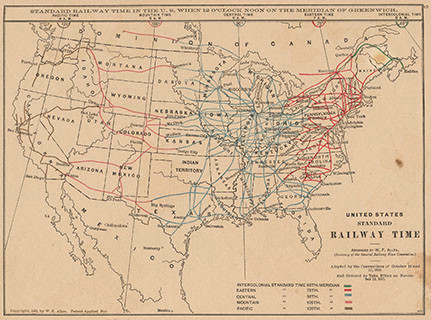
Railroad network and standardized railway time, 1883
- Standardized time was created because railroad schedules needed uniform time zones.
- The telegraph and transatlantic cable let businesses coordinate across long distances.
- Major centers included New York, Chicago, Pittsburgh, and Cleveland.
How Big Business and Agriculture Changed
As production got larger, businesses tried to control competition.
- Corporations could raise huge sums and hire professional managers.
- Vertical integration meant controlling many stages of production. Andrew Carnegie did this in steel.
- Horizontal integration meant buying competitors at the same stage of an industry to dominate that market. John D. Rockefeller used this in Standard Oil refining.
- Trusts and holding companies helped businesses consolidate.
- Debate words matter here. A captain of industry built growth and efficiency. A robber baron used unfair power and exploited others.
Farming also became part of industrial capitalism.
- Mechanization and railroads increased farm output.
- Farmers now produced for distant national markets.
- They depended on railroads, banks, wholesalers, and world prices.
- Falling crop prices, debt, and high shipping rates hurt many farmers.
- Farmers responded with cooperatives, regional alliances, and demands for railroad regulation and currency reform.
Western expansion tied all this together. Migrants went west for farming, ranching, mining, and railroad jobs, but western growth depended heavily on corporations and federal policy. It also brought violent conflict through bison destruction, treaty violations, military force, reservations, assimilation pressure, and land loss and discrimination for Mexican Americans.
How Industrialization Reshaped Society
Industrial jobs pulled people into cities. Immigrants came from Asia and increasingly from southern and eastern Europe, while internal migrants left farms and the South for cities and the West.
- Ethnic neighborhoods, churches, newspapers, and mutual-aid societies helped people keep parts of their culture while adapting.
- Cities also had overcrowding, disease, poor sanitation, pollution, and crime.
- Political machines traded services for votes. Tammany Hall is the classic example.
Industrialization created a sharper class structure:
- wealthy industrialists and financiers
- a growing middle class of managers, engineers, clerical workers, and salespeople
- a large working class facing long hours, dangerous jobs, and low security
Women and children were major parts of the workforce too.
The New South and continuity
Southerners talked about a “New South” with railroads and manufacturing, but the region stayed mostly agricultural.
- Sharecropping, tenant farming, and crop-lien debt kept many farmers trapped.
- After Reconstruction, white supremacy hardened through disfranchisement and segregation.
- Plessy v. Ferguson (1896) upheld “separate but equal.”
Why the Gilded Age Produced Conflict and Debate
The Panics of 1873 and 1893 exposed how unstable industrial capitalism could be. Unemployment rose, wages were cut, and strikes spread. Workers demanded higher wages, shorter hours, safer conditions, and collective bargaining. Employers answered with lockouts, injunctions, replacement workers, private security, and government help.
Different ideas tried to explain this new world:
- Social Darwinism defended inequality as the result of natural competition.
- Carnegie’s Gospel of Wealth said the rich should use their wealth for public good through philanthropy.
- The Social Gospel used Christian ethics to attack poverty and inequality.
- Socialists, utopian thinkers, labor organizers, and agrarian critics challenged concentrated wealth.
- Jane Addams used settlement-house reform to help immigrants and push social reform.
- Mark Twain and Charles Dudley Warner gave the era its name, the “Gilded Age,” meaning glitter on the surface hiding corruption underneath.
Politics reflected these fights.
- Major debates centered on tariffs and gold vs. silver currency.
- People attacked corruption, patronage, and corporate influence.
- The Interstate Commerce Act (1887) tried to regulate railroads.
- The Sherman Antitrust Act (1890) targeted monopolies, though early enforcement was weak.
- The People’s Party, or Populists, demanded stronger government action for farmers and ordinary producers.
