Topic 9.1 Notes – Contextualizing Period 9
How Period 9 Took Shape After 1980
Period 9 did not begin as a clean break. The U.S. entered it with a large federal government shaped by the New Deal and Great Society, a huge Cold War national security system, and an economy already feeling deindustrialization.
Four developments stay tied together through the whole period:
- Conservative ascendancy reshaped political debate around taxes, regulation, welfare, and social values.
- Globalization and technology connected the economy more tightly to the world and changed how people worked and communicated.
- Demographic shifts and migration moved power toward the South and West and made the population more diverse.
- Foreign policy after the Cold War and after 9/11 forced the U.S. to redefine its role in the world.
The roots were in the 1960s and 1970s:
- Backlash against civil rights, feminism, gay rights, environmentalism, and the counterculture helped fuel conservatism.
- Vietnam, the Pentagon Papers, and Watergate weakened trust in government.
- Stagflation plus the oil shocks of 1973 to 1974 and 1979 made the economy look hard to manage.
- The Sun Belt grew as the Rust Belt lost jobs and people.
That’s the frame the AP exam wants. Later changes make more sense when you show they came from these earlier disruptions.
The Rise of Modern Conservatism
Ronald Reagan’s 1980 election was the breakthrough, but the movement had been building for years.
Conservative ideas
- Lower taxes and deregulation were supposed to free businesses and encourage growth.
- Reduced federal responsibility for welfare fit the belief that government had grown too large.
- Free enterprise meant trust in markets over federal planning.
- A strong military appealed to anticommunists.
- Traditional social values drove fights over abortion, school prayer, gender roles, sexuality, and family structure.
The coalition
- Business conservatives wanted lower taxes and fewer regulations.
- Fiscal conservatives attacked deficits and domestic spending.
- Social conservatives included evangelical Protestants, conservative Catholics, and groups like the Moral Majority led by Jerry Falwell.
- Foreign-policy conservatives wanted a tougher stand against the Soviet Union.
Support came especially from white southern voters moving Republican, suburban voters, anticommunists, and people angry about taxes and regulation. Reagan became the public face of that coalition.
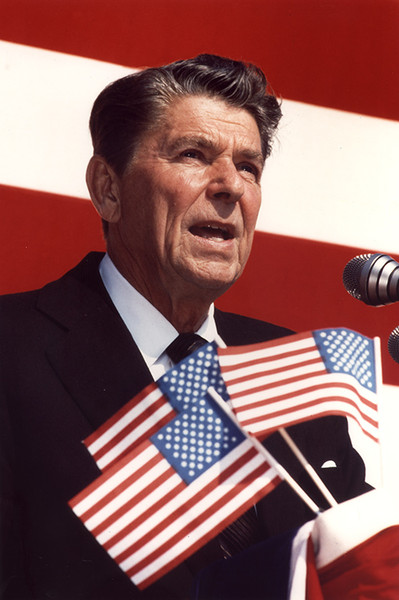
Ronald Reagan during the conservative resurgence
Reagan-era examples show both power and limits:
- Reaganomics or supply-side economics argued tax cuts would increase investment and growth.
- The Economic Recovery Tax Act of 1981 cut taxes significantly.
- Reagan’s response to the PATCO strike signaled a tougher stance toward organized labor and helped weaken unions.
- Conservatives changed debate more than they dismantled Social Security or Medicare.
That influence lasted. Bill Clinton’s “New Democrat” politics accepted parts of the conservative shift, including NAFTA and the Personal Responsibility and Work Opportunity Reconciliation Act of 1996. Polarization kept growing over abortion, affirmative action, immigration, LGBTQ+ rights, health care, taxes, and the safety net.
Globalization, Technology, and the Restructured Economy
Globalization means more movement of goods, capital, production, and information across borders. That helped grow the economy, but the gains were uneven.
- NAFTA in 1994 tied the U.S., Canada, and Mexico more closely together.
- The economy shifted toward service, finance, health care, education, retail, and technology.
- Manufacturing shrank as a share of employment because of deindustrialization, outsourcing, and automation.
- Union membership kept falling.
Supporters pointed to lower prices and larger markets. Critics pointed to job loss, wage stagnation, and inequality, especially for workers without advanced education. A lot of the gains went to highly educated workers, investors, and the tech and finance sectors.
Digital change made this even bigger:
- Personal computers
- Internet expansion in the 1990s
- Smartphones, e-commerce, social media, cloud computing
These changed work, communication, activism, news, privacy, and misinformation.
The 2007 to 2008 financial crisis and Great Recession exposed the risks of this economy and sparked fights over regulation, bailouts, foreclosures, and inequality.
Demographic Change and the New Geography of Power
Population kept moving to the Sun Belt, especially Florida, Texas, Arizona, California, and Nevada.
The migration map here shows the big shift of people and political influence toward the South and West.
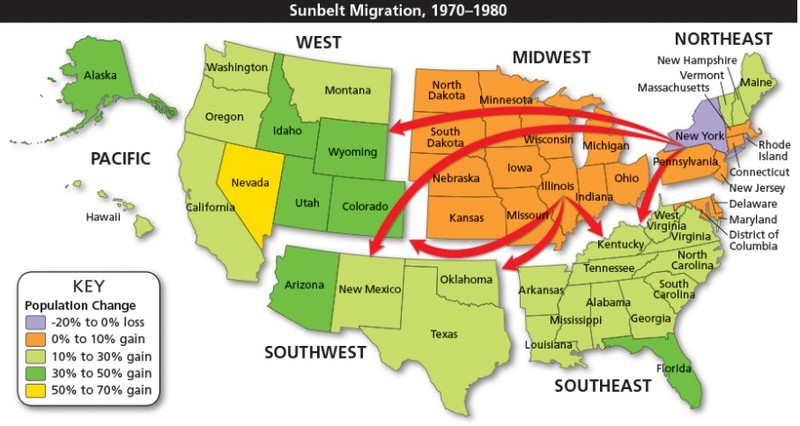
Sun Belt migration, 1970s
Why those states grew:
- Air conditioning
- Defense spending
- Suburban development
- Lower labor costs
- New industries
That growth meant more House seats and Electoral College votes for the South and West, which often strengthened conservative politics.
Immigration also changed the country. Since the Immigration and Nationality Act of 1965, immigration from Latin America and Asia grew sharply. Immigrants supplied labor in agriculture, construction, service work, medicine, education, and technology. They also increased racial and ethnic diversity and expanded Latino and Asian American communities.
These changes kept fueling debates over undocumented immigration, border enforcement, bilingual education, public services, citizenship, assimilation, and national identity.
Foreign Policy After the Cold War and After 9/11
Reagan kept a hard line in the Cold War through a military buildup, support for anticommunist movements abroad, and diplomacy with Mikhail Gorbachev.
The Cold War ended because several things came together:
- Soviet economic weakness
- Arms-race pressure
- Gorbachev’s reforms
- The fall of Eastern European communist governments in 1989
- German reunification in 1990
- Soviet dissolution in 1991
That left a unipolar moment with the U.S. as the top power. It still intervened through sanctions, alliances, air power, covert action, and troop deployments. Key examples were the Persian Gulf War, the Balkans, and NATO expansion.
Then 9/11 became the new turning point. Al-Qaeda attacked the World Trade Center, Pentagon, and a plane crashed in Pennsylvania. The U.S. launched the War on Terror, including the Afghanistan War in 2001 and the Iraq War in 2003. The Iraq invasion stayed controversial because the claimed weapons of mass destruction were not found.
At home, the War on Terror brought the Department of Homeland Security, expanded surveillance, and debates over civil liberties, detention, torture, executive power, and privacy. By the end of the period, the U.S. still faced terrorism, Middle East instability, Russia’s renewed assertiveness, China’s rise, and conflicts over energy dependence and climate change.
