Topic 2.6 Notes – Slavery in the British Colonies
How Slavery Became the Dominant Labor System in the British Colonies
The basic problem for colonists was simple. They had lots of land, not enough workers, and growing European demand for profitable crops. That combination pushed colonists to search for a labor system that was large, controllable, and permanent.
- Cash crops drove the demand for labor:
- Tobacco in the Chesapeake
- Rice and indigo in the Lowcountry
- Sugar in the West Indies
- Early on, colonists relied heavily on indentured servants, especially in Virginia and Maryland. These were workers who agreed to labor for a set term, usually in exchange for passage to America.
- Indentured servitude became less appealing to planters because:
- conditions in England improved, so fewer people wanted to come as servants
- colonial death rates dropped, so buying an enslaved person for life looked more profitable
- freed servants wanted land and competed with wealthy planters
In 1619, Africans arrived at Point Comfort, Virginia. That did not mean the full slave system existed immediately, but it marked the start of a permanent African presence in English mainland colonies.
Bacon’s Rebellion in 1676 pushed elites further toward slavery. The rebellion showed how dangerous a large population of angry servants and poor settlers could be. Planters increasingly preferred enslaved laborers, who could be controlled through law and denied the chance to become land-owning competitors.
The key term here is chattel slavery. Enslaved people were legally treated as property. They could be bought, sold, inherited, and held for life, and their children could inherit that status too.
Over time, that labor system became part of a much larger Atlantic network. This map is useful for keeping scale in mind. British mainland colonies were involved, but the biggest flows of enslaved Africans went to the Caribbean and Brazil.
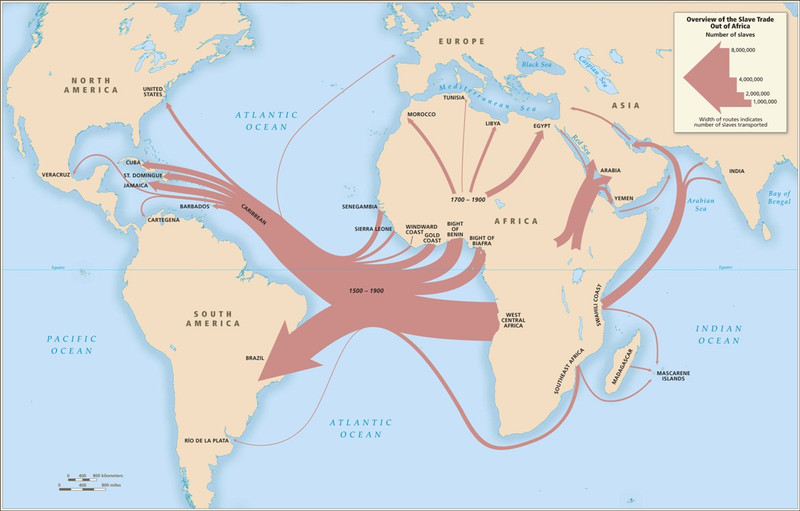
Atlantic slave trade routes out of Africa
Slavery Across the British Atlantic and in Each Colonial Region
All British colonies were tied to slavery, even if they did not all have giant plantations. Some used enslaved labor directly. Others made money from shipping, trade, and slave-produced goods.
The Atlantic slave trade brought captives mainly from West and West Central Africa. The Middle Passage was the forced ocean crossing marked by crowding, disease, abuse, and high death rates. A detail students miss a lot is that most enslaved Africans in the British Atlantic went to the West Indies, not mainland North America.
New England
- Rocky soil, short growing seasons, and small farms limited plantation slavery.
- Slavery still existed in households, workshops, docks, shipyards, and maritime trades.
- Boston and Newport were major port examples.
- On tests, the trap is saying slavery was absent here. It was smaller in scale, not absent.
Middle colonies
- Slavery existed in New York, New Jersey, Pennsylvania, and Delaware.
- Enslaved people worked in cities and countryside as domestic servants, artisans, dockworkers, and farm laborers.
- Key cities were New York City and Philadelphia.
Chesapeake
- Virginia and Maryland built a tobacco economy.
- By the early 1700s, slavery replaced indentured servitude on larger plantations.
- Wealth and political power concentrated in a planter elite.
- The enslaved population increasingly grew through natural increase.
Southern Atlantic colonies and the Lowcountry
- South Carolina and Georgia depended on rice and indigo.
- Enslaved Africans often formed a large share or majority of the population.
- African knowledge of rice cultivation was crucial.
- The task system assigned a daily task rather than nonstop gang labor.
- Gullah Geechee culture grew from strong African cultural retention.
- Georgia first banned slavery, then legalized it in 1750.
British West Indies
- Barbados and Jamaica were the harshest plantation colonies.
- Sugar created huge profits and brutal labor demands.
- Mainland colonies traded with and benefited from Caribbean slavery.
How Colonial Law Turned Slavery into a Racial System
Slavery became fully racial and hereditary through law over time, not all at once.
- John Punch case, 1640: two European runaways got extra service, but Punch, an African, was sentenced to lifelong servitude. This showed harsher treatment based on ancestry.
- Virginia law of 1662 established partus sequitur ventrem. A child inherited the status of the mother, which made slavery hereditary.
- Virginia law of 1691 banned interracial marriage.
- Virginia slave code of 1705 pulled these trends together and hardened racial slavery.
The effects matter more than memorizing the Latin phrase:
| Legal change | What it did |
|---|---|
| Hereditary status | Made slavery permanent across generations |
| African ancestry tied to enslavement | Turned race into legal status |
| Bans on interracial marriage | Hardened social boundaries |
| Privileges for whites | Gave poor Europeans legal advantages and weakened cross-racial unity |
How Enslaved People Resisted and Preserved Community
Enslaved people fought slavery openly and quietly.
- Open resistance included arson, attacks, conspiracies, escape, and maroon communities.
- The best-known uprising was the Stono Rebellion in 1739 in South Carolina. Rebels hoped to reach Spanish Florida, where some fugitives could gain freedom.
- The response was the Negro Act of 1740, which tightened controls.
Most resistance was everyday resistance:
- work slowdowns
- feigning illness
- breaking tools
- theft
- temporary escape
- negotiating tasks
Families had no legal protection. Husbands, wives, and children could be separated by sale or inheritance. Even so, enslaved people built extended kin networks and fictive kin ties that helped preserve community.
Culture also survived through adaptation:
- music, dance, storytelling, naming, foodways, medicine, burial practices
- Gullah Geechee as a major example
- African beliefs blended with Christianity, often stressing deliverance and spiritual equality
- gardens, fishing, hunting, crafts, and informal trade gave limited autonomy
Why Slavery Mattered to Colonial Society
Slavery shaped the whole colonial economy, not just the South. Tobacco, rice, indigo, and sugar generated wealth across the empire, and northern merchants and ports profited too.
It also shaped power. Large slaveholders gained more land, wealth, and political influence, especially in southern colonies. Regional demographics mattered too. New England had fewer enslaved people, the Chesapeake had many, and parts of South Carolina and the Caribbean had enslaved majorities.
The deepest point is this. White freedom expanded alongside Black enslavement. Colonial society built liberty for some people by denying it to others. That is why APUSH treats slavery as both an economic system and a racial social order.
Key Takeaways
Indentured Servitude
Temporary labor under a fixed contract, usually four to seven years, exchanged for passage and support; its declining supply helped slavery expand
Point Comfort, 1619
Site and year of the first recorded Africans’ arrival in English Virginia, beginning a permanent African presence in the mainland colonies
Bacon’s Rebellion
Virginia’s 1676 uprising that exposed planter fears of landless former servants and accelerated the shift toward enslaved African labor and white privilege
Chattel Slavery
A lifelong, hereditary system in which enslaved people were legally treated as property that could be bought, sold, or inherited
Atlantic Slave Trade
The forced Atlantic transportation and sale of African captives that supplied colonial labor; all British colonies participated, though most captives went to the Caribbean
Middle Passage
The brutal Atlantic voyage of enslaved Africans to the Americas, marked by confinement, abuse, disease, inadequate provisions, and high mortality
Slavery in New England
Limited on small farms but significant in households, workshops, maritime trades, and ports such as Boston and Newport
Slavery in the Middle Colonies
Urban and rural slavery supporting ports, artisan work, farms, and estates, but less dominant than in southern plantation regions
Slavery in the Chesapeake
Tobacco-based plantation slavery that replaced indentured labor and increasingly grew through natural increase, supporting multigenerational communities
Slavery in the Lowcountry
South Carolina and Georgia’s rice-and-indigo plantation system, with large enslaved populations, continued African imports, and harsh disease environments
Task System
Lowcountry labor arrangement assigning specific daily tasks, sometimes leaving workers limited time for gardens, crafts, households, or trade
Gullah Geechee Culture
Distinct Lowcountry culture blending multiple African traditions with European and American influences, aided by African concentration and plantation isolation
Slavery in the British West Indies
The most intensive British plantation slavery, driven by sugar and characterized by enslaved majorities, brutal labor, and continued imports
Partus Sequitur Ventrem
Virginia’s 1662 rule that a child inherited the mother’s status, making the children of enslaved women enslaved for life
Slave Codes
Colonial laws that made slavery permanent and racial while restricting enslaved people’s movement, assembly, weapons, testimony, education, and economic activity
Racial Slavery
A labor, property, legal, and social system that tied African ancestry to permanent enslavement while granting privileges to people classified as white
Overt vs. Covert Resistance
Overt resistance openly challenged slavery through rebellion, violence, or escape; covert resistance quietly reduced enslavers’ control through everyday actions
Stono Rebellion
A 1739 South Carolina uprising in which enslaved people seized weapons and marched toward Spanish Florida before militia suppression
Negro Act of 1740
South Carolina law passed after the Stono Rebellion that tightened restrictions on enslaved people’s movement, assembly, education, and economic activity
Maroon Communities
Settlements created by fugitives in swamps, forests, and other hard-to-control areas beyond slaveholders’ immediate authority
Everyday Resistance
Covert actions such as slowing work, feigning illness, breaking tools, damaging crops, stealing provisions, negotiating tasks, or leaving temporarily
Family and Kinship Under Slavery
Enslaved people formed partnerships, families, extended networks, and fictive kin to provide care and defend community despite sale and forced separation
Religious Syncretism
The blending of African spiritual traditions and Christianity into new religious beliefs and practices under slavery
Natural Increase
Population growth through births rather than continued importation, which increasingly sustained the Chesapeake’s enslaved population
Notes
Indentured Servitude
Temporary labor under a fixed contract, usually four to seven years, exchanged for passage and support; its declining supply helped slavery expand
Point Comfort, 1619
Site and year of the first recorded Africans’ arrival in English Virginia, beginning a permanent African presence in the mainland colonies
Bacon’s Rebellion
Virginia’s 1676 uprising that exposed planter fears of landless former servants and accelerated the shift toward enslaved African labor and white privilege
Chattel Slavery
A lifelong, hereditary system in which enslaved people were legally treated as property that could be bought, sold, or inherited
Atlantic Slave Trade
The forced Atlantic transportation and sale of African captives that supplied colonial labor; all British colonies participated, though most captives went to the Caribbean
Middle Passage
The brutal Atlantic voyage of enslaved Africans to the Americas, marked by confinement, abuse, disease, inadequate provisions, and high mortality
Slavery in New England
Limited on small farms but significant in households, workshops, maritime trades, and ports such as Boston and Newport
Slavery in the Middle Colonies
Urban and rural slavery supporting ports, artisan work, farms, and estates, but less dominant than in southern plantation regions
Slavery in the Chesapeake
Tobacco-based plantation slavery that replaced indentured labor and increasingly grew through natural increase, supporting multigenerational communities
Slavery in the Lowcountry
South Carolina and Georgia’s rice-and-indigo plantation system, with large enslaved populations, continued African imports, and harsh disease environments
Task System
Lowcountry labor arrangement assigning specific daily tasks, sometimes leaving workers limited time for gardens, crafts, households, or trade
Gullah Geechee Culture
Distinct Lowcountry culture blending multiple African traditions with European and American influences, aided by African concentration and plantation isolation
Slavery in the British West Indies
The most intensive British plantation slavery, driven by sugar and characterized by enslaved majorities, brutal labor, and continued imports
Partus Sequitur Ventrem
Virginia’s 1662 rule that a child inherited the mother’s status, making the children of enslaved women enslaved for life
Slave Codes
Colonial laws that made slavery permanent and racial while restricting enslaved people’s movement, assembly, weapons, testimony, education, and economic activity
Racial Slavery
A labor, property, legal, and social system that tied African ancestry to permanent enslavement while granting privileges to people classified as white
Overt vs. Covert Resistance
Overt resistance openly challenged slavery through rebellion, violence, or escape; covert resistance quietly reduced enslavers’ control through everyday actions
Stono Rebellion
A 1739 South Carolina uprising in which enslaved people seized weapons and marched toward Spanish Florida before militia suppression
Negro Act of 1740
South Carolina law passed after the Stono Rebellion that tightened restrictions on enslaved people’s movement, assembly, education, and economic activity
Maroon Communities
Settlements created by fugitives in swamps, forests, and other hard-to-control areas beyond slaveholders’ immediate authority
Everyday Resistance
Covert actions such as slowing work, feigning illness, breaking tools, damaging crops, stealing provisions, negotiating tasks, or leaving temporarily
Family and Kinship Under Slavery
Enslaved people formed partnerships, families, extended networks, and fictive kin to provide care and defend community despite sale and forced separation
Religious Syncretism
The blending of African spiritual traditions and Christianity into new religious beliefs and practices under slavery
Natural Increase
Population growth through births rather than continued importation, which increasingly sustained the Chesapeake’s enslaved population
