Topic 4.13 Notes – The Society of the South in the Early Republic
How Geography Shaped the Southern Economy
The South’s physical environment made large-scale cash-crop farming make sense. Warm weather, a long growing season, fertile soil, navigable rivers, and easy access to Atlantic and Gulf ports all favored agriculture aimed at distant markets. That kept alive a colonial pattern of commercial agriculture instead of pushing the region toward heavy manufacturing.
Different staples fit different places, and the map below shows how those crop regions were spread across the South by 1860:
- Tobacco grew in Virginia, Maryland, Kentucky, and parts of North Carolina and Tennessee.
- Rice thrived in the low country of South Carolina and Georgia.
- Sugar became important in southern Louisiana.
- Cotton spread across the expanding Deep South.
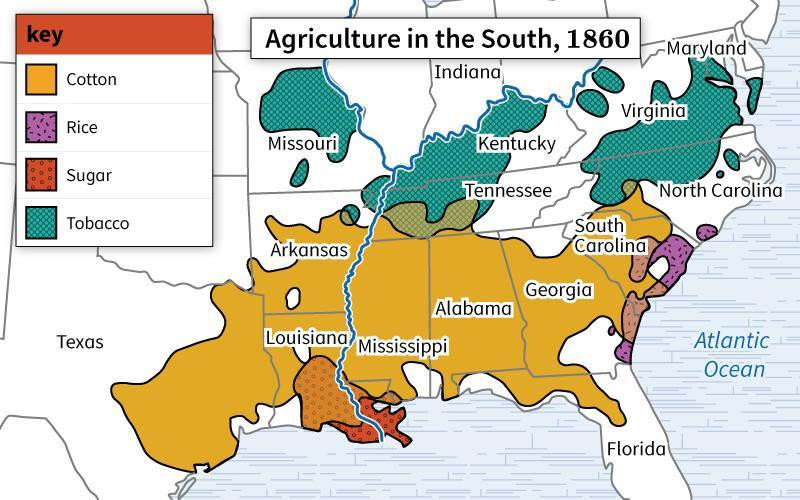
Southern staple-crop regions, 1860
Plantations were concentrated in fertile coastal plains, river valleys, and lowlands. That matters because the plantation South was powerful, but it was not every acre of the South. Upland and mountain areas had more yeoman farms, livestock raising, subsistence farming, and mixed agriculture.
A map question often tests this pattern. The Black Belt first meant dark, fertile soil. Later it also referred to areas with large African American populations because slavery and cotton concentrated there.
Cotton, King Cotton, and the Southern Export Economy
Cotton became the crop that best shows how geography and markets worked together. Long-staple cotton was valuable but grew mainly in limited coastal areas. Short-staple cotton could grow across the interior South, but removing its seeds by hand took forever.
Eli Whitney’s cotton gin
Whitney invented the cotton gin in 1793 and patented it in 1794. It could clean about 50 pounds a day instead of about 1 pound by hand. That made short-staple cotton highly profitable across a huge inland region.
The key exam point is that the gin did not reduce the need for enslaved labor. Enslaved workers still had to clear land, plant, hoe, and pick cotton by hand.
British textile mills and northeastern U.S. factories wanted more and more raw cotton. That tied the South to northern merchants, banks, insurers, shippers, and manufacturers, plus Atlantic markets overseas. Cotton output rose from a few thousand bales in 1790 to about 1.35 million by 1840, and by 1840 it made up about two-thirds of all U.S. export value.
“King Cotton” meant Southerners believed cotton gave them enormous economic power. It also had limits. The whole system depended on unstable prices, heavy borrowing, and credit, and it discouraged investment in factories, cities, and a more diverse economy.
Soil Exhaustion, Westward Expansion, and the Spread of Slavery
Plantation agriculture damaged the land. Repeated tobacco and cotton planting wore out soil, and deforestation led to erosion and watershed changes. Older farming regions in Virginia, the Carolinas, and Georgia were hit especially hard.
Many slaveholders responded by moving west of the Appalachians into Alabama, Mississippi, Louisiana, Arkansas, and Texas instead of restoring old land. Alabama and Mississippi became classic cotton frontier states. Speculators and migrants bought land, cleared forests, built plantations near rivers, and shipped cotton through Mobile and New Orleans.
This expansion depended on federal land acquisition, warfare, treaties, and Indian removal, which opened Indigenous land to white settlement.
The spread of cotton also spread slavery:
- The international slave trade legally ended in 1808, but slavery kept expanding.
- The domestic slave trade grew from the Upper South to the Deep South.
- Enslaved people were forcibly moved from Virginia and Maryland to Alabama, Mississippi, Louisiana, and beyond.
- They were transported in coffles or by coastal shipping.
- New Orleans became a major slave-trade center.
Southern Society and the Defense of Slavery
Southern society was ordered by race and class, with a small planter elite controlling much of the wealth, politics, and courts.
| Group | Place in society |
|---|---|
| Planter elite | Usually owned 20+ enslaved people; some owned hundreds |
| Small slaveholders | Owned fewer enslaved workers; often hoped to rise |
| Most white Southerners | Owned no enslaved people; many were yeoman farmers, tenants, or poor laborers |
| Free African Americans | Lived under growing legal restrictions |
Many nonslaveholding whites still backed slavery because it gave them racial status above Black people, tied them to plantation markets, held out the hope of future slaveholding, and became part of white political identity.
Planter culture valued patriarchal households, honor, reputation, and mastery. Southern leaders praised rural plantation life and attacked northern cities, factories, immigration, and reform. Protestant churches mattered too, especially Methodists and Baptists, and sectional church splits came in 1844 and 1845.
By the 1830s, proslavery thought hardened from slavery as a “necessary evil” to a “positive good.” John C. Calhoun’s 1837 Senate speech captured that shift. Defenses of slavery used paternalism, biblical arguments, property rights, states’ rights, and white supremacy. That is the core idea of the topic. Most white Southerners did not own enslaved people, but Southern leaders convinced many of them that slavery was part of the Southern way of life.
Key Takeaways
Staple Crops
Crops grown mainly for sale or export; Southern staples included tobacco, rice, sugar, and especially cotton
Plantation System
System of producing staple crops on large estates with enslaved labor that concentrated wealth and political power among planters
Long-Staple Cotton vs. Short-Staple Cotton
Long-staple cotton grew only in limited coastal areas, while short-staple cotton grew widely inland but required difficult seed removal
Cotton Gin
Machine that rapidly removed seeds from short-staple cotton, making its cultivation profitable across the interior South
Eli Whitney
Inventor who created the cotton gin in 1793, greatly increasing the profitability of short-staple cotton
King Cotton
Expression describing cotton’s economic dominance and Southerners’ belief that foreign and Northern dependence gave the South great influence
Cotton Belt
Broad region from Georgia through the Deep South into Arkansas and eastern Texas dominated by cotton plantations
Black Belt
Cotton Belt area named first for its dark, fertile soil and later for its large African American population
Soil Depletion
Loss of soil fertility from repeated tobacco or cotton cultivation, encouraging planters to seek fresh western lands
Domestic Slave Trade
Forced sale and movement of enslaved people from the Upper South to expanding cotton plantations in the Deep South
Planter Elite
Small, wealthy class generally owning twenty or more enslaved people that dominated Southern politics, courts, and commerce
Yeoman Farmers
Independent white farmers who owned and worked small farms and usually owned no enslaved people
Free African Americans
Black Southerners who were not enslaved but faced increasing restrictions on movement, work, education, assembly, and legal rights
Patriarchal Social Order
System claiming authority for elite white men over households, property, dependents, and enslaved laborers
Southern Honor Culture
Elite ideal emphasizing male reputation, independence, mastery, and public respect, sometimes defended through violence or dueling
Paternalism
Proslavery claim that enslavers were protective guardians caring for dependent enslaved people, concealing the system’s coercion and violence
Slavery as a “Positive Good”
By the 1830s, the argument that slavery was beneficial and superior to Northern wage labor rather than merely a necessary evil
John C. Calhoun
Southern senator who prominently declared slavery “a positive good” in an 1837 Senate speech
Proslavery Ideology
Defense of slavery through paternalism, property and states’ rights, biblical claims, white supremacy, and attacks on Northern wage labor
Factors
Commercial agents who arranged plantation crops’ storage and shipment, extended credit, and purchased supplies for planters
Subsistence Agriculture
Farming mainly to support the farmer’s household rather than to produce staples for distant markets, especially common in poorer upland areas
Notes
Staple Crops
Crops grown mainly for sale or export; Southern staples included tobacco, rice, sugar, and especially cotton
Plantation System
System of producing staple crops on large estates with enslaved labor that concentrated wealth and political power among planters
Long-Staple Cotton vs. Short-Staple Cotton
Long-staple cotton grew only in limited coastal areas, while short-staple cotton grew widely inland but required difficult seed removal
Cotton Gin
Machine that rapidly removed seeds from short-staple cotton, making its cultivation profitable across the interior South
Eli Whitney
Inventor who created the cotton gin in 1793, greatly increasing the profitability of short-staple cotton
King Cotton
Expression describing cotton’s economic dominance and Southerners’ belief that foreign and Northern dependence gave the South great influence
Cotton Belt
Broad region from Georgia through the Deep South into Arkansas and eastern Texas dominated by cotton plantations
Black Belt
Cotton Belt area named first for its dark, fertile soil and later for its large African American population
Soil Depletion
Loss of soil fertility from repeated tobacco or cotton cultivation, encouraging planters to seek fresh western lands
Domestic Slave Trade
Forced sale and movement of enslaved people from the Upper South to expanding cotton plantations in the Deep South
Planter Elite
Small, wealthy class generally owning twenty or more enslaved people that dominated Southern politics, courts, and commerce
Yeoman Farmers
Independent white farmers who owned and worked small farms and usually owned no enslaved people
Free African Americans
Black Southerners who were not enslaved but faced increasing restrictions on movement, work, education, assembly, and legal rights
Patriarchal Social Order
System claiming authority for elite white men over households, property, dependents, and enslaved laborers
Southern Honor Culture
Elite ideal emphasizing male reputation, independence, mastery, and public respect, sometimes defended through violence or dueling
Paternalism
Proslavery claim that enslavers were protective guardians caring for dependent enslaved people, concealing the system’s coercion and violence
Slavery as a “Positive Good”
By the 1830s, the argument that slavery was beneficial and superior to Northern wage labor rather than merely a necessary evil
John C. Calhoun
Southern senator who prominently declared slavery “a positive good” in an 1837 Senate speech
Proslavery Ideology
Defense of slavery through paternalism, property and states’ rights, biblical claims, white supremacy, and attacks on Northern wage labor
Factors
Commercial agents who arranged plantation crops’ storage and shipment, extended credit, and purchased supplies for planters
Subsistence Agriculture
Farming mainly to support the farmer’s household rather than to produce staples for distant markets, especially common in poorer upland areas
