Topic 9.2 Notes – Reagan and Conservatism
What Reagan Conservatism Was
By 1980, many voters were ready to try a different direction. Conservatives argued that the federal government had grown too large, too expensive, and too involved in everyday life. Reagan captured that idea in his famous line that government was “not the solution to our problem; government is the problem.”
This movement came from several strands joining together:
- Fiscal and business conservatives wanted lower taxes, less regulation, and weaker unions.
- Social conservatives and the religious right pushed abortion restrictions, school prayer, family values, and a bigger public role for religion.
- Anticommunists and neoconservatives wanted a tougher foreign policy.
- Reagan Democrats were white working- and middle-class voters who liked Reagan’s message on taxes, patriotism, crime, and social issues.
The movement had been building for years. Key precursors included:
- Barry Goldwater and the 1964 campaign, which helped define modern conservatism.
- Reagan’s “A Time for Choosing” speech, which made him a national conservative star.
- Phyllis Schlafly and STOP ERA, which mobilized opposition to feminism and the Equal Rights Amendment.
- Jerry Falwell and the Moral Majority, which brought evangelicals into politics.
- The Heritage Foundation, a major conservative think tank.
- California Proposition 13 in 1978, which showed how powerful anti-tax politics could be.
The breakthrough came in 1980. Reagan beat Jimmy Carter after asking, “Are you better off than you were four years ago?” He won 489 electoral votes to Carter’s 49. Republicans also took the Senate, though Democrats kept the House. That matters because Reagan had real governing power, but not a blank check.
His 1981 inauguration symbolized how fully this conservative coalition had moved from opposition into national power.
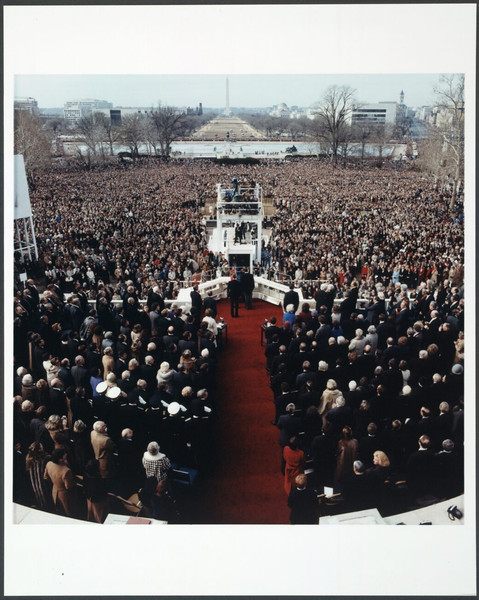
Ronald Reagan’s 1981 inauguration
Reagan’s Economic Program and Its Results
Reagan’s program, often called Reaganomics, included supply-side economics, tax cuts, deregulation, slower domestic spending growth, New Federalism through block grants, and an anti-union stance.
Supply-side economics
The core claim was that lower marginal tax rates would increase work, investment, and growth. That differed from Keynesian demand-side policy, which used government spending and taxation to manage consumer demand. Critics called Reagan’s approach “trickle-down economics.”
Key laws:
- Economic Recovery Tax Act of 1981 reduced taxes sharply.
- Tax Reform Act of 1986 simplified the tax code and lowered rates further.
Inflation, recession, recovery, and deficits
A lot of the inflation fight came from Paul Volcker at the Federal Reserve, who used tight money and high interest rates. That helped trigger the harsh 1981-1982 recession, with unemployment hitting 10.8 percent.
Recovery followed, and Reagan sold it with the “Morning in America” message. He crushed Walter Mondale in 1984. Still, the debate never ended:
- supporters pointed to lower inflation and strong growth
- critics pointed to huge budget deficits, rising national debt, and more income inequality
Deregulation and labor
Reagan continued and expanded Carter-era deregulation in finance, energy, telecommunications, and weaker environmental and workplace oversight. The clearest labor moment was the PATCO strike in 1981. Reagan fired over 11,000 air traffic controllers, which signaled that the federal government would back management more than labor.
That weakened unions, and the savings-and-loan crisis warned that deregulation could bring serious risks. Later debates kept circling back through Gramm-Leach-Bliley Act (1999), the financial crisis of 2007-2009, Dodd-Frank Act (2010), and the Consumer Financial Protection Bureau.
Why Government Did Not Shrink as Much as Conservatives Wanted
Conservatives said liberal programs created dependency and slowed growth. But popular programs were hard to cut.
- Social Security and Medicare stayed popular.
- The 1983 Social Security reform rescued the program through bipartisan compromise.
- The Department of Education survived.
- Civil rights and environmental programs endured.
- Reagan signed the 1982 Voting Rights Act extension.
- Reagan signed Martin Luther King Jr. Day into law in 1983.
So the key idea is this: conservatism redirected federal power more than it eliminated it.
Liberals answered with a different vision. In Mario Cuomo’s 1984 “family” speech, government was a protector of opportunity, rights, and vulnerable people. Even Democrats later borrowed conservative language about fiscal restraint, markets, and work-based policy.
The Culture Wars and Continuing Policy Debates
After 1980, fights over government were also fights over values. The big issues included abortion, school prayer, feminism, family values, religion in public life, LGBTQ rights, affirmative action, crime, drugs, and immigration.
Abortion and the judiciary
Roe v. Wade became the central dividing line. Reagan appointed Sandra Day O’Connor, Antonin Scalia, Anthony Kennedy, and elevated William Rehnquist to chief justice. The Senate rejected Robert Bork. Conservatives pushed originalism and judicial restraint.
Race, crime, drugs, and AIDS
- Regents of the University of California v. Bakke kept affirmative action alive but limited quotas.
- The War on Drugs and Nancy Reagan’s “Just Say No” campaign expanded punitive drug policy.
- Anti-Drug Abuse Acts of 1986 and 1988 created the infamous 100-to-1 crack/powder sentencing disparity.
- The AIDS crisis brought a slow Reagan response, while ACT UP demanded action.
Immigration, free trade, and the safety net
- Immigration Reform and Control Act of 1986 combined legalization with employer sanctions.
- NAFTA and the World Trade Organization became free-trade flashpoints.
- Personal Responsibility and Work Opportunity Reconciliation Act of 1996 created TANF and reshaped welfare.
- The Affordable Care Act kept the health care debate alive.
Key Takeaways
Ronald Reagan
Conservative Republican president elected in 1980 who promoted tax cuts, deregulation, reduced domestic spending, traditional values, and a stronger military
Conservative Ascendancy / Reagan Revolution
The post-1980 rise of conservatism that shifted national policy toward lower taxes, deregulation, market solutions, and traditional social values
Neoconservatives
Former liberals who became critical of Great Society programs and favored a more forceful foreign policy
Reagan Democrats
Traditionally Democratic working- and middle-class voters attracted to Reagan by taxes, crime, patriotism, and social issues
Barry Goldwater
The 1964 Republican nominee whose campaign opposed expanding federal power and trained activists who later reshaped the Republican Party
Stagflation
The 1970s combination of high inflation, weak economic growth, and elevated unemployment that weakened confidence in liberal economic management
Proposition 13
A 1978 California ballot measure that sharply limited property taxes and demonstrated the electoral strength of the tax revolt
Election of 1980
Reagan defeated Jimmy Carter amid economic and foreign-policy troubles, giving conservatives the presidency and enough support to enact major policy changes
The Great Communicator
Nickname for Reagan reflecting his optimistic style and effectiveness at presenting conservative ideas through television
Reaganomics
Reagan's economic program of tax reduction, deregulation, slower domestic-spending growth, and tight control of inflation
Supply-Side Economics / Trickle-Down Economics
Theory that lower marginal tax rates encourage work, saving, investment, and production; critics argued its benefits flowed mainly to the wealthy
Economic Recovery Tax Act of 1981
Law that cut individual income tax rates about 25 percent over three years and created incentives for business investment
Tax Reform Act of 1986
Bipartisan law that broadened the tax base, removed deductions, and lowered top individual and corporate tax rates
New Federalism
Reagan's effort to transfer domestic responsibilities and decision-making from the federal government to the states, often through block grants
Block Grants vs. Categorical Grants
Block grants give states flexibility over broad policy areas; categorical grants fund narrowly defined federal purposes
Paul Volcker
Federal Reserve chair who restricted the money supply and allowed high interest rates, helping break inflation but contributing to the 1981–1982 recession
Morning in America
Reagan's 1984 reelection theme portraying declining inflation and economic recovery as a return to prosperity and confidence
Deregulation
Reduction of federal rules and enforcement to promote competition and market decisions, with possible costs to environmental, workplace, consumer, and financial safety
Savings-and-Loan Crisis
1980s wave of financial-institution failures caused by loose rules and inadequate supervision, leading to a costly federal rescue
Gramm-Leach-Bliley Act
A 1999 law that removed major Glass-Steagall barriers separating commercial banking, investment banking, and insurance
Dodd-Frank Act
A 2010 response to the financial crisis that increased financial regulation and created the Consumer Financial Protection Bureau
PATCO Strike
In 1981 Reagan fired more than 11,000 striking federal air traffic controllers, encouraging employers to confront unions more aggressively
Institutional Inertia
The tendency of established policies to persist because they have administrators, beneficiaries, legal protections, and organized political support
Social Security Reform of 1983
Bipartisan reform that raised payroll taxes, gradually increased retirement age, and taxed some benefits to strengthen Social Security's finances
New Right
Conservative movement that made abortion, religion, schools, sexuality, family structure, and public morality central political issues
Culture Wars
Intense conflicts over the moral values public institutions should recognize, including abortion, religion, gender, sexuality, education, and family structure
Roe v. Wade
The 1973 decision protecting abortion rights that became a central target of social conservatives and a lasting partisan dividing line
Sandra Day O'Connor
Reagan's 1981 Supreme Court appointee and the first woman to serve on the Court
Robert Bork Nomination
Reagan's rejected 1987 Supreme Court nomination that produced a bitter debate over privacy, civil rights, and constitutional interpretation
Originalism
The approach of interpreting constitutional provisions according to their original public meaning
Judicial Restraint
The principle that courts should hesitate to create rights or policies not clearly grounded in constitutional text or history
Affirmative Action
Policies considering race to address inequality; conservatives emphasized color-blind merit, while supporters argued neutral rules could preserve past discrimination
War on Drugs
Expanded federal enforcement against illegal drugs that emphasized punishment and contributed to mass incarceration and racial disparities
Anti-Drug Abuse Act of 1986
Law imposing severe mandatory minimums and a 100-to-1 powder-to-crack cocaine quantity disparity that worsened racial inequalities in incarceration
AIDS Crisis
Epidemic first recognized in 1981 whose slow federal response exposed conflicts over sexuality, stigma, public health, and government responsibility
ACT UP
AIDS activist organization that used protest to demand research, faster drug approval, treatment access, and an end to discrimination
Immigration Reform and Control Act of 1986
Law that legalized about three million qualifying undocumented immigrants while penalizing employers who knowingly hired unauthorized workers and strengthening enforcement
Personal Responsibility and Work Opportunity Reconciliation Act
The 1996 welfare law that replaced AFDC with state-run TANF block grants and imposed work requirements and time limits
Free Trade
Removal of trade barriers to increase competition and growth, opposed by those concerned about job losses, wages, labor standards, and local industries
North American Free Trade Agreement (NAFTA)
The 1994 agreement reducing trade barriers among the United States, Canada, and Mexico, praised for growth and criticized for encouraging job relocation
World Trade Organization (WTO)
International trade organization created in 1995 that promoted global economic integration and intensified disputes over globalization's gains and losses
Defense of Marriage Act (DOMA)
A 1996 law defining federal marriage as between one man and one woman and permitting states to reject same-sex marriages from elsewhere
Obergefell v. Hodges
The 2015 Supreme Court decision recognizing a nationwide constitutional right to same-sex marriage
Social Safety Net
Government programs providing economic and health security, with broad support for Social Security and Medicare but greater vulnerability for means-tested aid
Affordable Care Act (ACA)
A 2010 law expanding health coverage through subsidies, insurance rules, Medicaid expansion, and initially an individual mandate
Phyllis Schlafly
Conservative activist who led the campaign against ratification of the Equal Rights Amendment
STOP ERA
Movement led by Phyllis Schlafly that helped prevent ratification of the Equal Rights Amendment before its 1982 deadline
Jerry Falwell
Evangelical leader who founded the Moral Majority and mobilized religious conservatives in Republican politics
Moral Majority
Organization founded in 1979 that mobilized religious conservatives around abortion, school prayer, and traditional family values
Equal Rights Amendment (ERA)
Proposed constitutional guarantee of equal rights regardless of sex that fell short of ratification after conservative opposition
Religious Right
Evangelical and other religious conservatives mobilized around abortion, school prayer, LGBTQ rights, and traditional family values
Nancy Reagan
First lady associated with the Just Say No campaign against illegal drug use
Just Say No
Nancy Reagan’s campaign encouraging young people to reject illegal drug use
George H. W. Bush
Republican president who accepted tax increases in a 1990 budget despite his campaign pledge against new taxes
“Read My Lips: No New Taxes”
George H. W. Bush’s 1988 campaign pledge, broken when he accepted tax increases in the 1990 budget agreement
Bill Clinton
Democratic president who adopted some market-oriented conservative ideas while defending a limited social safety net
New Democrat
Centrist Democratic approach that accepted some market-oriented and fiscally conservative policies while retaining a limited safety net
Newt Gingrich
Republican leader who promoted the Contract with America and helped the GOP win control of Congress in 1994
Contract with America
The 1994 Republican campaign program calling for lower spending, welfare reform, and smaller government
Notes
Ronald Reagan
Conservative Republican president elected in 1980 who promoted tax cuts, deregulation, reduced domestic spending, traditional values, and a stronger military
Conservative Ascendancy / Reagan Revolution
The post-1980 rise of conservatism that shifted national policy toward lower taxes, deregulation, market solutions, and traditional social values
Neoconservatives
Former liberals who became critical of Great Society programs and favored a more forceful foreign policy
Reagan Democrats
Traditionally Democratic working- and middle-class voters attracted to Reagan by taxes, crime, patriotism, and social issues
Barry Goldwater
The 1964 Republican nominee whose campaign opposed expanding federal power and trained activists who later reshaped the Republican Party
Stagflation
The 1970s combination of high inflation, weak economic growth, and elevated unemployment that weakened confidence in liberal economic management
Proposition 13
A 1978 California ballot measure that sharply limited property taxes and demonstrated the electoral strength of the tax revolt
Election of 1980
Reagan defeated Jimmy Carter amid economic and foreign-policy troubles, giving conservatives the presidency and enough support to enact major policy changes
The Great Communicator
Nickname for Reagan reflecting his optimistic style and effectiveness at presenting conservative ideas through television
Reaganomics
Reagan's economic program of tax reduction, deregulation, slower domestic-spending growth, and tight control of inflation
Supply-Side Economics / Trickle-Down Economics
Theory that lower marginal tax rates encourage work, saving, investment, and production; critics argued its benefits flowed mainly to the wealthy
Economic Recovery Tax Act of 1981
Law that cut individual income tax rates about 25 percent over three years and created incentives for business investment
Tax Reform Act of 1986
Bipartisan law that broadened the tax base, removed deductions, and lowered top individual and corporate tax rates
New Federalism
Reagan's effort to transfer domestic responsibilities and decision-making from the federal government to the states, often through block grants
Block Grants vs. Categorical Grants
Block grants give states flexibility over broad policy areas; categorical grants fund narrowly defined federal purposes
Paul Volcker
Federal Reserve chair who restricted the money supply and allowed high interest rates, helping break inflation but contributing to the 1981–1982 recession
Morning in America
Reagan's 1984 reelection theme portraying declining inflation and economic recovery as a return to prosperity and confidence
Deregulation
Reduction of federal rules and enforcement to promote competition and market decisions, with possible costs to environmental, workplace, consumer, and financial safety
Savings-and-Loan Crisis
1980s wave of financial-institution failures caused by loose rules and inadequate supervision, leading to a costly federal rescue
Gramm-Leach-Bliley Act
A 1999 law that removed major Glass-Steagall barriers separating commercial banking, investment banking, and insurance
Dodd-Frank Act
A 2010 response to the financial crisis that increased financial regulation and created the Consumer Financial Protection Bureau
PATCO Strike
In 1981 Reagan fired more than 11,000 striking federal air traffic controllers, encouraging employers to confront unions more aggressively
Institutional Inertia
The tendency of established policies to persist because they have administrators, beneficiaries, legal protections, and organized political support
Social Security Reform of 1983
Bipartisan reform that raised payroll taxes, gradually increased retirement age, and taxed some benefits to strengthen Social Security's finances
New Right
Conservative movement that made abortion, religion, schools, sexuality, family structure, and public morality central political issues
Culture Wars
Intense conflicts over the moral values public institutions should recognize, including abortion, religion, gender, sexuality, education, and family structure
Roe v. Wade
The 1973 decision protecting abortion rights that became a central target of social conservatives and a lasting partisan dividing line
Sandra Day O'Connor
Reagan's 1981 Supreme Court appointee and the first woman to serve on the Court
Robert Bork Nomination
Reagan's rejected 1987 Supreme Court nomination that produced a bitter debate over privacy, civil rights, and constitutional interpretation
Originalism
The approach of interpreting constitutional provisions according to their original public meaning
Judicial Restraint
The principle that courts should hesitate to create rights or policies not clearly grounded in constitutional text or history
Affirmative Action
Policies considering race to address inequality; conservatives emphasized color-blind merit, while supporters argued neutral rules could preserve past discrimination
War on Drugs
Expanded federal enforcement against illegal drugs that emphasized punishment and contributed to mass incarceration and racial disparities
Anti-Drug Abuse Act of 1986
Law imposing severe mandatory minimums and a 100-to-1 powder-to-crack cocaine quantity disparity that worsened racial inequalities in incarceration
AIDS Crisis
Epidemic first recognized in 1981 whose slow federal response exposed conflicts over sexuality, stigma, public health, and government responsibility
ACT UP
AIDS activist organization that used protest to demand research, faster drug approval, treatment access, and an end to discrimination
Immigration Reform and Control Act of 1986
Law that legalized about three million qualifying undocumented immigrants while penalizing employers who knowingly hired unauthorized workers and strengthening enforcement
Personal Responsibility and Work Opportunity Reconciliation Act
The 1996 welfare law that replaced AFDC with state-run TANF block grants and imposed work requirements and time limits
Free Trade
Removal of trade barriers to increase competition and growth, opposed by those concerned about job losses, wages, labor standards, and local industries
North American Free Trade Agreement (NAFTA)
The 1994 agreement reducing trade barriers among the United States, Canada, and Mexico, praised for growth and criticized for encouraging job relocation
World Trade Organization (WTO)
International trade organization created in 1995 that promoted global economic integration and intensified disputes over globalization's gains and losses
Defense of Marriage Act (DOMA)
A 1996 law defining federal marriage as between one man and one woman and permitting states to reject same-sex marriages from elsewhere
Obergefell v. Hodges
The 2015 Supreme Court decision recognizing a nationwide constitutional right to same-sex marriage
Social Safety Net
Government programs providing economic and health security, with broad support for Social Security and Medicare but greater vulnerability for means-tested aid
Affordable Care Act (ACA)
A 2010 law expanding health coverage through subsidies, insurance rules, Medicaid expansion, and initially an individual mandate
Phyllis Schlafly
Conservative activist who led the campaign against ratification of the Equal Rights Amendment
STOP ERA
Movement led by Phyllis Schlafly that helped prevent ratification of the Equal Rights Amendment before its 1982 deadline
Jerry Falwell
Evangelical leader who founded the Moral Majority and mobilized religious conservatives in Republican politics
Moral Majority
Organization founded in 1979 that mobilized religious conservatives around abortion, school prayer, and traditional family values
Equal Rights Amendment (ERA)
Proposed constitutional guarantee of equal rights regardless of sex that fell short of ratification after conservative opposition
Religious Right
Evangelical and other religious conservatives mobilized around abortion, school prayer, LGBTQ rights, and traditional family values
Nancy Reagan
First lady associated with the Just Say No campaign against illegal drug use
Just Say No
Nancy Reagan’s campaign encouraging young people to reject illegal drug use
George H. W. Bush
Republican president who accepted tax increases in a 1990 budget despite his campaign pledge against new taxes
“Read My Lips: No New Taxes”
George H. W. Bush’s 1988 campaign pledge, broken when he accepted tax increases in the 1990 budget agreement
Bill Clinton
Democratic president who adopted some market-oriented conservative ideas while defending a limited social safety net
New Democrat
Centrist Democratic approach that accepted some market-oriented and fiscally conservative policies while retaining a limited safety net
Newt Gingrich
Republican leader who promoted the Contract with America and helped the GOP win control of Congress in 1994
Contract with America
The 1994 Republican campaign program calling for lower spending, welfare reform, and smaller government
