Topic 6.6 Notes – The Rise of Industrial Capitalism
What Industrial Capitalism Was After the Civil War
Industrial capitalism meant privately owned firms using wage labor, machines, lots of capital, and large business organizations to make goods for profit. That system already existed before 1865, but after the Civil War it exploded in scale.
It grew out of earlier Market Revolution foundations like railroads, telegraphs, factories, corporations, and commercial farming. After 1865, several conditions came together at once:
- Natural resources fueled industry. Coal, iron ore, timber, petroleum, and western minerals gave businesses raw materials.
- Population growth and urbanization created both workers and customers.
- Railroads and telegraphs tied the country into one market, and the 1866 transatlantic cable linked U.S. business to overseas information and trade.
- Government policy helped growth through tariffs, land grants, subsidies, patents, incorporation laws, and court protection of contracts and property.
- Capital came through stocks, bonds, and investment banks.
The continuity is easy to miss on tests. Private property, profit-seeking, wage labor, and corporations were not new. The change was scale. Markets became national, production became mass production, management became professional, and wealth became far more concentrated.
How Big Business Worked
Large firms needed a legal and managerial form that could outgrow one owner. That was the corporation.
- A corporation was legally separate from its owners. It could own property, make contracts, and keep existing even if owners changed.
- Stockholders supplied money, and limited liability made investing safer because they risked only what they invested.
- Ownership and management separated. Salaried executives, department managers, accounting, budgets, and statistical reports became normal.
Big firms also benefited from economies of scale. Producing more goods lowered per-unit costs through bulk buying, specialized machinery, lower shipping costs, and spreading fixed costs over more products. The downside was overproduction, debt, and instability.
Railroads as the first big businesses
Railroads were the first giant corporations, and they taught the rest of the economy how to operate on a national scale. This map helps you see why they mattered so much by 1880. Rail lines were spreading across the country, with especially dense networks in the Northeast and Midwest and several transcontinental connections tying western territories to eastern markets.
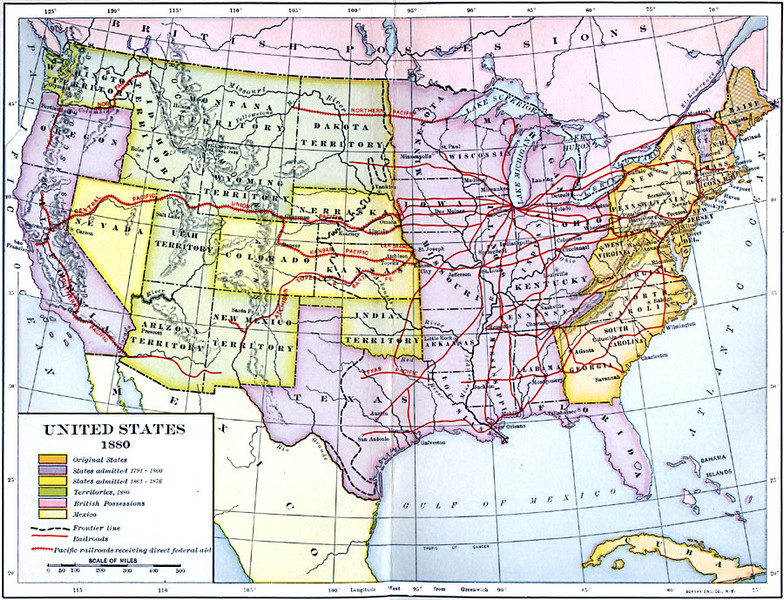
U.S. rail network, c. 1880
- First transcontinental railroad, 1869 connected farms, mines, factories, ports, and cities.
- Railroads created huge demand for steel, coal, timber, and locomotives.
- They used standard-gauge track, telegraph coordination, refrigerated cars, and helped create time zones in 1883.
- Cornelius Vanderbilt became famous for consolidating lines.
- Problems included pools (rate-sharing deals), rebates (discounts to big shippers), and stock watering (inflating stock value).
Production and marketing
Factories used interchangeable parts, specialized tasks, mechanization, and a growing wage labor force. Frederick Winslow Taylor pushed early scientific management, which measured work to increase efficiency.
Selling all those goods required mass marketing:
- Brand names, trademarks, national ads, traveling salesmen
- Montgomery Ward and Sears, Roebuck mail-order catalogs
- Department stores for city consumers
How Corporations Consolidated Power
To beat competition, corporations combined into larger units.
- Vertical integration meant controlling different stages of production and distribution.
- Horizontal integration meant buying or combining with competitors at the same stage.
- A firm could do both.
Carnegie and steel
Andrew Carnegie is the classic vertical integration example.
- New steelmaking methods like the Bessemer process and open-hearth made steel cheaper and stronger.
- Carnegie controlled iron ore, coke, transportation, mills, and distribution.
- His system emphasized efficiency, reinvestment, continuous production, and cost cutting.
- In 1901, J. P. Morgan combined Carnegie Steel into U.S. Steel.
Rockefeller and oil
Edwin Drake’s 1859 oil well launched the petroleum industry. John D. Rockefeller founded Standard Oil in 1870.
- He used horizontal integration by buying competing refineries.
- He also got railroad rebates and drawbacks, then expanded into pipelines, storage, tank cars, and marketing.
- The Standard Oil Trust formed in 1882.
- By about 1880, Standard controlled about 90 percent of refining.
Common forms
| Form | What it means |
|---|---|
| Trust | separate firms placed under central trustees |
| Holding company | parent corporation owns stock in others |
| Merger | firms combine into one |
| Acquisition | one firm buys another |
| Pool | firms cooperate without merging |
| Monopoly | one firm dominates a market |
| Oligopoly | a few firms dominate a market |
Other nationally organized industries included Gustavus Swift and Philip Armour in meatpacking, McCormick in farm machinery, Singer sewing machines, American Tobacco, American Sugar Refining Company, and J. P. Morgan as a major financier and railroad reorganizer.
Why Government and Foreign Markets Mattered
Government usually promoted business more than it restrained it.
- Land grants and loans aided railroads.
- Tariffs protected U.S. manufacturers.
- Patents, incorporation laws, and courts supported business growth.
- So even though people said laissez-faire, the government actively helped capitalism grow.
Regulation came slowly:
- Interstate Commerce Act (1887) tried to regulate railroads.
- Sherman Antitrust Act (1890) targeted monopolies.
- Both mattered more as warning signs than as strong early enforcement.
As industry outgrew the home market, businesses looked abroad for customers, raw materials, shipping routes, and investments. Key regions were Latin America, the Caribbean, the Pacific, Asia, and China. Exports and investments included kerosene, sewing machines, farm machinery, mining, agriculture, and transportation. Hawaii shows the link between business and expansion, especially through sugar planters.
How Industrial Capitalism Changed Society and the Economy
By the late 1800s, the U.S. became the world’s leading industrial economy. Mass production, consumer goods, national distribution, and international business all expanded.
This also created more middle-class jobs such as managers, engineers, accountants, clerks, and salesmen. At the same time, wealth and power became much more unequal.
That debate shows up constantly:
- Robber barons emphasizes monopoly, labor exploitation, political influence, and manipulation.
- Captains of industry emphasizes efficiency, innovation, lower prices, and economic growth.
Keep one limit in mind. Agriculture, family farms, small businesses, and local markets still mattered, and industrialization was strongest in the Northeast and Great Lakes, not everywhere.
Key Takeaways
Industrial Capitalism
Economic system in which privately owned firms use wage labor, machinery, concentrated capital, and large business organizations to produce and distribute goods for profit
Corporation
Business legally separate from its owners that can raise capital by selling stock and bonds, normally provides limited liability, and continues despite changes in ownership
Investment Bank
Financial institution that sells corporate securities, arranges mergers, and reorganizes companies to help large businesses raise capital and consolidate
J. P. Morgan
Powerful investment banker who reorganized indebted railroads, arranged mergers, and concentrated financial influence over major industries
Economies of Scale
Lower per-unit costs achieved by spreading fixed expenses across mass production, buying in bulk, and using specialized machinery and labor
Railroads as the First Big Businesses
Railroads pioneered large-scale finance, professional management, accounting, and national operations while connecting resources, factories, and consumers
Cornelius Vanderbilt
Railroad leader who consolidated shorter lines into large systems such as the New York Central, improving regional and national service
Railroad Pool
Agreement among nominally independent railroads to divide traffic or revenue and maintain rates without formally merging
Stock Watering
Issuing or selling corporate securities for more than the company’s assets justified, enriching promoters while often leaving the company indebted
Mass Marketing
Use of brand names, standardized packaging, trademarks, national advertising, sales networks, and catalogs to create demand for mass-produced goods
Vertical Integration
One company controls successive stages of production and distribution, from raw materials and transportation to manufacturing and sales
Horizontal Integration
One company absorbs or controls competitors operating at the same stage of an industry to increase market share and reduce competition
Trust
Arrangement in which shareholders transfer voting stock to trustees who centrally direct several nominally separate corporations and distribute combined profits
Holding Company
Parent corporation created mainly to own controlling stock in other corporations, achieving centralized control without using a formal trust
Monopoly
Market condition in which one seller controls all or nearly all of an industry, limiting effective competition
Protective Tariff
Tax that raises the price of imported manufactured goods, shielding domestic producers from foreign competition
Robber Barons vs. Captains of Industry
Competing interpretations portraying industrialists either as monopolistic exploiters or as efficient innovators who created jobs, growth, and lower prices
Frederick Winslow Taylor
Industrial engineer who developed scientific management by studying tasks to find the quickest and most efficient way to perform them
Scientific Management / Taylorism
System of studying and standardizing individual tasks to increase efficiency and managerial control over production
Andrew Carnegie
Steel industrialist who used vertical integration, modern machinery, and close cost control to build the dominant U.S. steel enterprise
Carnegie Steel
Vertically integrated steel company that controlled key supplies and transportation, lowered costs, and dominated U.S. steel production in the 1890s
John D. Rockefeller
Oil industrialist who built Standard Oil through horizontal integration, railroad rebates, and later vertical integration
Standard Oil
Oil corporation that absorbed competing refineries and expanded into pipelines, storage, transportation, and marketing, controlling roughly 90 percent of U.S. refining by the early 1880s
Laissez-Faire
Policy approach favoring limited direct government regulation of private business
Pro-Growth Government Policies
Government support for business through protective tariffs, land grants, subsidies, patent and contract enforcement, and permissive incorporation laws
Mass Production
Large-scale manufacture of standardized goods using machinery, specialized labor, and coordinated production to increase output and lower costs
Notes
Industrial Capitalism
Economic system in which privately owned firms use wage labor, machinery, concentrated capital, and large business organizations to produce and distribute goods for profit
Corporation
Business legally separate from its owners that can raise capital by selling stock and bonds, normally provides limited liability, and continues despite changes in ownership
Investment Bank
Financial institution that sells corporate securities, arranges mergers, and reorganizes companies to help large businesses raise capital and consolidate
J. P. Morgan
Powerful investment banker who reorganized indebted railroads, arranged mergers, and concentrated financial influence over major industries
Economies of Scale
Lower per-unit costs achieved by spreading fixed expenses across mass production, buying in bulk, and using specialized machinery and labor
Railroads as the First Big Businesses
Railroads pioneered large-scale finance, professional management, accounting, and national operations while connecting resources, factories, and consumers
Cornelius Vanderbilt
Railroad leader who consolidated shorter lines into large systems such as the New York Central, improving regional and national service
Railroad Pool
Agreement among nominally independent railroads to divide traffic or revenue and maintain rates without formally merging
Stock Watering
Issuing or selling corporate securities for more than the company’s assets justified, enriching promoters while often leaving the company indebted
Mass Marketing
Use of brand names, standardized packaging, trademarks, national advertising, sales networks, and catalogs to create demand for mass-produced goods
Vertical Integration
One company controls successive stages of production and distribution, from raw materials and transportation to manufacturing and sales
Horizontal Integration
One company absorbs or controls competitors operating at the same stage of an industry to increase market share and reduce competition
Trust
Arrangement in which shareholders transfer voting stock to trustees who centrally direct several nominally separate corporations and distribute combined profits
Holding Company
Parent corporation created mainly to own controlling stock in other corporations, achieving centralized control without using a formal trust
Monopoly
Market condition in which one seller controls all or nearly all of an industry, limiting effective competition
Protective Tariff
Tax that raises the price of imported manufactured goods, shielding domestic producers from foreign competition
Robber Barons vs. Captains of Industry
Competing interpretations portraying industrialists either as monopolistic exploiters or as efficient innovators who created jobs, growth, and lower prices
Frederick Winslow Taylor
Industrial engineer who developed scientific management by studying tasks to find the quickest and most efficient way to perform them
Scientific Management / Taylorism
System of studying and standardizing individual tasks to increase efficiency and managerial control over production
Andrew Carnegie
Steel industrialist who used vertical integration, modern machinery, and close cost control to build the dominant U.S. steel enterprise
Carnegie Steel
Vertically integrated steel company that controlled key supplies and transportation, lowered costs, and dominated U.S. steel production in the 1890s
John D. Rockefeller
Oil industrialist who built Standard Oil through horizontal integration, railroad rebates, and later vertical integration
Standard Oil
Oil corporation that absorbed competing refineries and expanded into pipelines, storage, transportation, and marketing, controlling roughly 90 percent of U.S. refining by the early 1880s
Laissez-Faire
Policy approach favoring limited direct government regulation of private business
Pro-Growth Government Policies
Government support for business through protective tariffs, land grants, subsidies, patent and contract enforcement, and permissive incorporation laws
Mass Production
Large-scale manufacture of standardized goods using machinery, specialized labor, and coordinated production to increase output and lower costs
