Topic 5.5 Notes – Sectional Conflict: Regional Differences
How Regional Differences Deepened Sectional Conflict
By the 1840s and 1850s, Americans were not just living in different places. They were building different kinds of societies, and slavery made those differences explosive.
- The North was becoming more urban and industrial. It had factories, railroads, wage labor, and large immigrant populations.
- The South stayed more rural and agricultural. Its economy and elite power rested on plantation slavery.
- The West was the battleground. People argued over who would control land, what kind of labor system would spread there, and who counted as full citizens.
This 1854 map helps you see that divide taking shape, especially in the western territories where the expansion of slavery was most contested.
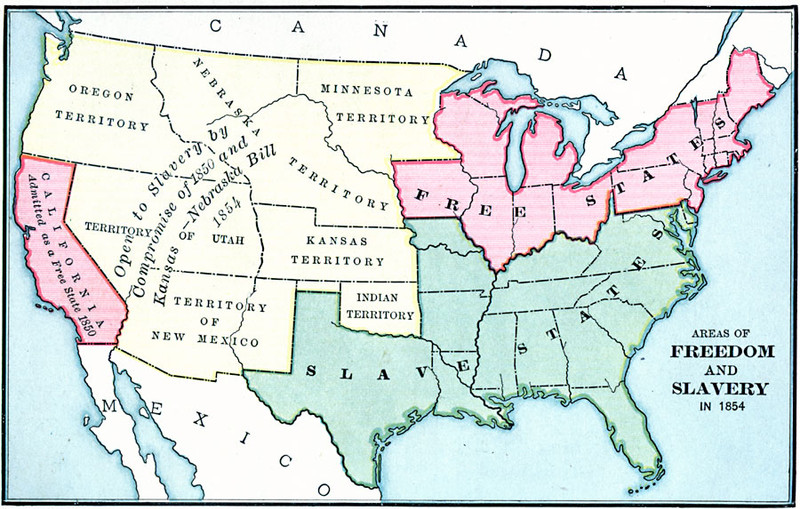
Areas of freedom and slavery, 1854
This conflict was bigger than “different lifestyles.” It was about competing ideas of labor, opportunity, property, and citizenship. Topic 5.5 is the social and economic setup. The actual compromises and political collapse come in Topic 5.6.
Immigration and Nativism in the North and West
Immigration changed the North and West far more than the South, which made the sections feel even less alike.
Main immigrant groups
- Irish immigrants came largely because of the Great Famine beginning in 1845. Many settled in eastern cities such as New York and Boston, worked as unskilled laborers, and built communities around Catholic parishes. Many Irish women worked in domestic service. They faced harsh anti-Irish and anti-Catholic prejudice.
- German immigrants came because of economic hardship and the Revolutions of 1848. They included Forty-Eighters, farmers, artisans, and skilled workers. Many settled in Wisconsin, Missouri, Ohio, and Illinois and preserved German-language newspapers, schools, churches, and customs.
- Chinese immigrants came mainly after the California Gold Rush. They worked in mining, agriculture, commerce, and service jobs, formed distinct communities in California and the Far West, and faced foreign miners’ taxes, racial violence, and exclusion.
Immigrants supplied labor and reshaped city neighborhoods, religion, and politics. Many assimilated gradually while still keeping their language and customs. Since few settled in the South, immigration widened sectional differences.
Nativism and anti-Catholicism
Many native-born Protestants feared immigrants would take jobs, lower wages, and weaken republican government. Catholics drew the most hostility.
- Know-Nothing Party or American Party
Anti-immigrant, anti-Catholic movement that wanted longer naturalization periods and less immigrant political power. It mattered politically in the 1850s, before slavery pushed nativism into the background.
The Sectional Economies and Free Labor vs Enslaved Labor
The North and South were connected economically, but they ran on different labor systems.
- Northern economy included manufacturing, commerce, canals, railroads, wage labor, and family farming. Still, the North was tied to slavery through textile mills, shipping, banking, and the cotton trade.
- Southern economy centered on cotton, plus tobacco, rice, and sugar. Wealth and political power were concentrated among slaveholders, even though most white Southerners did not own slaves.
Free labor and free soil
Free labor ideology said people should own their labor, earn wages, buy property, and move up socially. Many Northerners opposed slavery because they thought it threatened free white labor, not because they believed in racial equality.
Free-soilers opposed slavery’s expansion into the territories. They feared slaveholders would grab western land and block independent white farmers and workers. Their slogan was “free soil, free speech, free labor, and free men.”
A common trap on tests is mixing up free-soilers and abolitionists. Free-soilers often wanted to stop expansion, not end slavery everywhere.
Abolitionism and the Southern Defense of Slavery
As slavery expanded, the argument turned moral and intense.
Abolitionism
A minority in the North made slavery impossible to ignore.
- William Lloyd Garrison published The Liberator and demanded immediate emancipation.
- Frederick Douglass published Narrative of the Life of Frederick Douglass and later the North Star. His life and writing directly challenged racist claims.
- Harriet Beecher Stowe wrote Uncle Tom’s Cabin, which helped many Northerners picture slavery’s human cost.
- The Underground Railroad was a loose network, not a literal railroad.
- Harriet Tubman was its best-known conductor.
- John Brown accepted violence and became famous in Bleeding Kansas and at Harpers Ferry.
Southern defense of slavery
Southern leaders answered criticism by defending slavery as a positive good.
- John C. Calhoun argued slavery created stability.
- Racial doctrines and pseudoscience claimed Black people were naturally inferior.
- Paternalism said enslavers cared for enslaved people.
- Religious defenses argued the Bible allowed slavery.
- Constitutional arguments stressed property rights, fugitive slave protections, and states’ rights.
- Suppression of dissent included the gag rule, censorship of abolitionist literature, restrictions on Black literacy, and opposition to Hinton Rowan Helper’s The Impending Crisis of the South.
Why Compromise Became Harder
Regional positions were never totally uniform, but they were moving farther apart.
- In the North, views ranged from abolitionism to racism to free-soil antislavery.
- In the South, planter leadership shaped politics, but many nonslaveholding whites still supported the slave system.
- Enslaved and free African Americans were active agents through resistance, escape, community-building, and antislavery activism.
The key exam idea is this. Slavery’s expansion turned regional differences into a sectional crisis because Americans increasingly saw free labor and slave labor as incompatible futures for the nation. Immigration mattered, but by the mid-1850s slavery had become the dominant national divide.
Key Takeaways
Ethnic Communities
Immigrant settlements that preserved languages, religions, institutions, foods, and customs while gradually incorporating residents into American life
Irish Immigration
Great Famine migration of mostly poor Catholics who settled near eastern cities, supplied low-wage labor, built parish communities, and gained influence through the Democratic Party
German Immigration
Migration driven by economic hardship and political unrest that created diverse German farming and urban communities, especially in the Midwest
Forty-Eighters
German liberal and nationalist refugees who immigrated after the failed European revolutions of 1848
Chinese Immigration
Migration to California and the Far West accelerated by the Gold Rush, supplying labor while provoking discriminatory taxes, legal restrictions, and racial violence
Nativism
The belief that native-born white Protestant interests and culture should be protected against immigrants and their political influence
Anti-Catholicism
Prejudice claiming that Catholic loyalty to priests and the pope made Catholic immigrants unfit for independent republican citizenship
American Party / Know-Nothing Party
The 1850s nativist party that sought longer naturalization periods, reduced immigrant voting, native-born officeholding, and Protestant control of civic life
Northern and Southern Economies
The diverse, increasingly industrial North relied principally on free labor, while the rural, agricultural South’s wealth and elite power depended on enslaved labor
Free Labor
The ideal that workers owned their labor, could make contracts and earn wages, and had the possibility of acquiring property and independence
Free-Soil Movement
The movement opposing slavery’s western expansion because slave labor and planter wealth threatened opportunities for free white farmers and workers
Abolitionism
The interracial minority movement seeking to end slavery through moral arguments, publications, petitions, escape assistance, and occasionally violence
Moral Suasion
The abolitionist strategy of persuading slaveholders and the public that slavery was sinful and should be voluntarily rejected
William Lloyd Garrison
White abolitionist who published The Liberator, demanded immediate emancipation, and used confrontational moral criticism of slavery
The Liberator
William Lloyd Garrison’s abolitionist newspaper, begun in 1831, that demanded immediate emancipation and condemned compromise with slavery
Frederick Douglass
Formerly enslaved abolitionist speaker, writer, and publisher whose testimony attacked slavery and refuted racist claims about Black ability
Slave Narratives
Published accounts by formerly enslaved people that exposed slavery’s violence and demonstrated Black humanity, intellect, and capacity for freedom
Harriet Beecher Stowe
Author whose novel Uncle Tom’s Cabin brought slavery’s violence and family separations to a broad Northern audience
Uncle Tom’s Cabin
Harriet Beecher Stowe’s 1852 novel that portrayed slavery’s human costs, strengthening Northern antislavery feeling and provoking Southern outrage
Underground Railroad
A loose network of routes, safe houses, Black communities, religious groups, and guides that assisted freedom seekers escaping slavery
Harriet Tubman
Formerly enslaved abolitionist who escaped in 1849 and repeatedly returned south to guide other enslaved people to freedom
Personal Liberty Laws
Northern state laws that protected alleged fugitives or obstructed federal slave catchers, angering Southerners who demanded enforcement
John Brown
Militant abolitionist who used violence in Kansas and attacked Harpers Ferry in 1859 in a failed effort to begin an uprising against slavery
Proslavery Racial Doctrines
Claims based on racism and pseudoscience that people of African descent were naturally inferior and suited to enslavement
Paternalism
The proslavery claim that enslavers acted as protective household heads who provided dependent workers with care and lifelong security
Positive-Good Argument
The claim that slavery was beneficial rather than a necessary evil because it supposedly produced racial order, security, and social stability
John C. Calhoun
Southern political leader who declared slavery a positive good in 1837 and defended it as the basis of a stable social order
Hinton Rowan Helper
Nonslaveholding white Southerner whose 1857 book The Impending Crisis of the South argued that slavery economically harmed nonslaveholding whites
The Impending Crisis of the South
Hinton Rowan Helper’s 1857 economic attack on slavery for harming nonslaveholding whites and obstructing Southern development
Constitutional and Property-Rights Defense of Slavery
The argument that enslaved people were legally protected property and that the Constitution safeguarded slaveholding interests
States’ Rights Defense of Slavery
The argument that states controlled their domestic institutions and that federal restrictions on slavery violated state sovereignty
Religious Arguments over Slavery
Proslavery advocates cited biblical recognition of slavery, while abolitionists appealed to Christian principles of human equality, love, and justice
Notes
Ethnic Communities
Immigrant settlements that preserved languages, religions, institutions, foods, and customs while gradually incorporating residents into American life
Irish Immigration
Great Famine migration of mostly poor Catholics who settled near eastern cities, supplied low-wage labor, built parish communities, and gained influence through the Democratic Party
German Immigration
Migration driven by economic hardship and political unrest that created diverse German farming and urban communities, especially in the Midwest
Forty-Eighters
German liberal and nationalist refugees who immigrated after the failed European revolutions of 1848
Chinese Immigration
Migration to California and the Far West accelerated by the Gold Rush, supplying labor while provoking discriminatory taxes, legal restrictions, and racial violence
Nativism
The belief that native-born white Protestant interests and culture should be protected against immigrants and their political influence
Anti-Catholicism
Prejudice claiming that Catholic loyalty to priests and the pope made Catholic immigrants unfit for independent republican citizenship
American Party / Know-Nothing Party
The 1850s nativist party that sought longer naturalization periods, reduced immigrant voting, native-born officeholding, and Protestant control of civic life
Northern and Southern Economies
The diverse, increasingly industrial North relied principally on free labor, while the rural, agricultural South’s wealth and elite power depended on enslaved labor
Free Labor
The ideal that workers owned their labor, could make contracts and earn wages, and had the possibility of acquiring property and independence
Free-Soil Movement
The movement opposing slavery’s western expansion because slave labor and planter wealth threatened opportunities for free white farmers and workers
Abolitionism
The interracial minority movement seeking to end slavery through moral arguments, publications, petitions, escape assistance, and occasionally violence
Moral Suasion
The abolitionist strategy of persuading slaveholders and the public that slavery was sinful and should be voluntarily rejected
William Lloyd Garrison
White abolitionist who published The Liberator, demanded immediate emancipation, and used confrontational moral criticism of slavery
The Liberator
William Lloyd Garrison’s abolitionist newspaper, begun in 1831, that demanded immediate emancipation and condemned compromise with slavery
Frederick Douglass
Formerly enslaved abolitionist speaker, writer, and publisher whose testimony attacked slavery and refuted racist claims about Black ability
Slave Narratives
Published accounts by formerly enslaved people that exposed slavery’s violence and demonstrated Black humanity, intellect, and capacity for freedom
Harriet Beecher Stowe
Author whose novel Uncle Tom’s Cabin brought slavery’s violence and family separations to a broad Northern audience
Uncle Tom’s Cabin
Harriet Beecher Stowe’s 1852 novel that portrayed slavery’s human costs, strengthening Northern antislavery feeling and provoking Southern outrage
Underground Railroad
A loose network of routes, safe houses, Black communities, religious groups, and guides that assisted freedom seekers escaping slavery
Harriet Tubman
Formerly enslaved abolitionist who escaped in 1849 and repeatedly returned south to guide other enslaved people to freedom
Personal Liberty Laws
Northern state laws that protected alleged fugitives or obstructed federal slave catchers, angering Southerners who demanded enforcement
John Brown
Militant abolitionist who used violence in Kansas and attacked Harpers Ferry in 1859 in a failed effort to begin an uprising against slavery
Proslavery Racial Doctrines
Claims based on racism and pseudoscience that people of African descent were naturally inferior and suited to enslavement
Paternalism
The proslavery claim that enslavers acted as protective household heads who provided dependent workers with care and lifelong security
Positive-Good Argument
The claim that slavery was beneficial rather than a necessary evil because it supposedly produced racial order, security, and social stability
John C. Calhoun
Southern political leader who declared slavery a positive good in 1837 and defended it as the basis of a stable social order
Hinton Rowan Helper
Nonslaveholding white Southerner whose 1857 book The Impending Crisis of the South argued that slavery economically harmed nonslaveholding whites
The Impending Crisis of the South
Hinton Rowan Helper’s 1857 economic attack on slavery for harming nonslaveholding whites and obstructing Southern development
Constitutional and Property-Rights Defense of Slavery
The argument that enslaved people were legally protected property and that the Constitution safeguarded slaveholding interests
States’ Rights Defense of Slavery
The argument that states controlled their domestic institutions and that federal restrictions on slavery violated state sovereignty
Religious Arguments over Slavery
Proslavery advocates cited biblical recognition of slavery, while abolitionists appealed to Christian principles of human equality, love, and justice
