Topic 6.9 Notes – Responses to Immigration in the Gilded Age
How Immigration Changed American Life and Sparked Conflicting Responses
Factories, mines, railroads, and fast-growing cities needed huge numbers of workers, and immigrants filled that need. That tied immigration directly to industrialization and urbanization. You should connect this topic to labor strikes, crowded cities, reform movements, and the rise of federal immigration policy.
The response was never just “welcome” or “hostile.” It was all of these at once:
- employers wanted cheap labor
- reformers opened programs to help immigrants survive city life
- schools and officials pushed Americanization
- nativists demanded exclusion
At the center was one argument. Who could become American, and on what terms? The answer changed depending on race, religion, nationality, class, and region.
Assimilation, Americanization, and Immigrant Communities
Assimilation meant immigrants adopted parts of U.S. language, customs, institutions, and identity. Americanization was more forceful. Schools, reformers, employers, and government officials actively taught English, citizenship, and “proper” behavior.
Public schools
Public schools were major tools of Americanization.
- English instruction pushed children toward the dominant culture.
- Civic rituals and American history taught loyalty to the nation.
- Kids usually adapted faster than parents, which often caused conflict over marriage, religion, work, and family authority.
Most immigrants did not completely keep the old world or completely give it up. They mixed both.
Ethnic neighborhoods
Immigrant neighborhoods were practical support systems.
- job and housing leads
- churches, synagogues, parochial schools, native-language newspapers
- mutual-aid societies, burial societies, fraternal groups, local businesses
- chain migration, where earlier immigrants helped relatives and neighbors follow
These enclaves helped immigrants adjust. They were bridges into American life, not proof they had failed.
Political machines
City machines also helped immigrants adapt. Tammany Hall is the classic example.
- exchanged food, fuel, jobs, legal help, and relief for votes
- gave immigrants a way into politics
- also encouraged corruption and boss control
That support did not erase nativism. This cartoon points to a common pattern in the era, with earlier immigrants or established Americans trying to block newer arrivals.
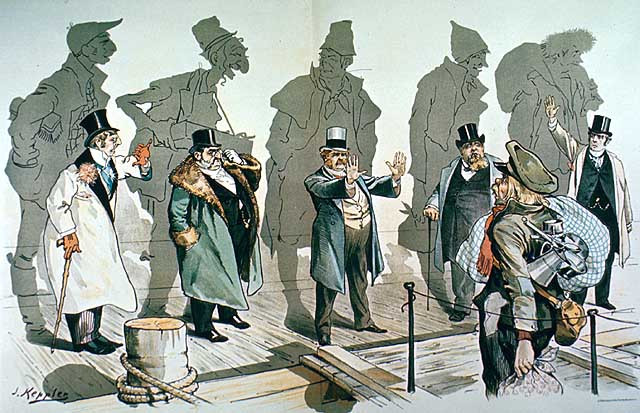
"Looking Backward" political cartoon
Reformers Tried to Help Immigrants but Also Tried to Change Them
Settlement houses grew out of the reality of immigrant poverty in cities. They were community centers in poor neighborhoods, usually run by educated middle-class women.
Hull House
Hull House in Chicago was founded in 1889 by Jane Addams and Ellen Gates Starr.
- English and citizenship classes
- kindergarten, childcare, youth programs
- job training, clubs, libraries, recreation
- help with legal, labor, and family problems
Henry Street Settlement
Lillian Wald founded Henry Street Settlement in New York. It became especially known for public-health nursing.
Jane Addams argued that poverty came from social and economic conditions, not just bad choices. That idea mattered because it pushed reformers toward labor laws, compulsory education, sanitation, playgrounds, and housing reform.
Tenements showed why reform felt urgent. They were overcrowded, poorly ventilated, dangerous in fires, and full of disease.
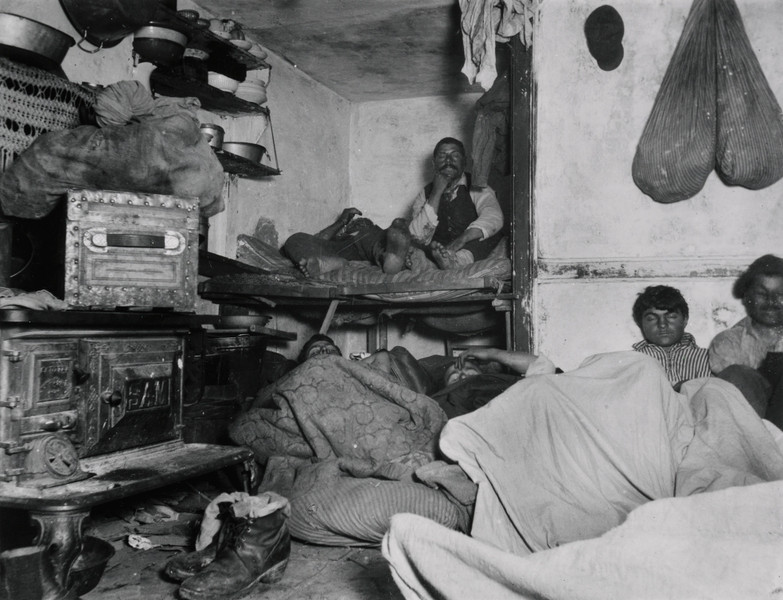
Crowded tenement interior
Jacob Riis used journalism and photography in How the Other Half Lives (1890) to expose those conditions. Images like this helped convince middle-class Americans that urban housing conditions had become a major reform issue. Still, reform often carried a paternalistic attitude. Many workers assumed middle-class Protestant values were superior.
Nativism, Social Darwinism, and Anti-Immigrant Backlash
Nativism meant defending native-born Americans against immigrants. Common complaints said immigrants lowered wages, broke strikes, supported corrupt machines, brought poverty or radicalism, and could not fit in, especially if they were Catholic or Jewish.
Two key groups:
- American Protective Association (1887) was strongly anti-Catholic.
- Immigration Restriction League (1894) wanted literacy tests.
Congress passed a literacy-test bill in 1897, but Grover Cleveland vetoed it.
Social Darwinism gave these fears an intellectual cover. Herbert Spencer used “survival of the fittest,” and William Graham Sumner argued inequality was natural. That let people treat immigrant poverty as proof of inferiority instead of the result of low wages and harsh living conditions.
Anti-Chinese prejudice was harsher and more openly racialized.
- Denis Kearney and the Workingmen’s Party of California used the slogan “The Chinese must go!”
- Rock Springs massacre (1885) showed how violent this could become.
Many Europeans were treated as undesirable but still potentially assimilable. Chinese immigrants were often labeled permanently unassimilable.
Federal Restrictions Began in the Gilded Age
The federal government began moving from mostly open immigration to selective regulation.
| Law | What it did |
|---|---|
| Page Act (1875) | restricted contract labor and those judged to come for “immoral purposes”; heavily targeted Chinese women |
| Chinese Exclusion Act (1882) | first major federal ban based on nationality; stopped Chinese labor immigration for 10 years |
| Immigration Act (1882) | head tax; excluded convicts, “lunatics,” “idiots,” and likely public charges |
| Foran Act (1885) | banned most imported contract labor |
| Geary Act (1892) | extended Chinese exclusion; required certificates of residence |
| Immigration Act (1891) | expanded exclusions and strengthened federal control |
Ellis Island opened in 1892 as a federal inspection station, and immigrants entering there passed through large federal screening spaces like the one shown below.
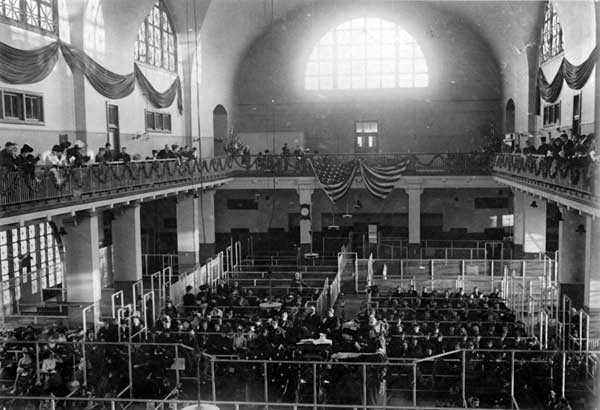
Ellis Island inspection hall
The big shift was this. Immigration was still massive, but now the federal government claimed the power to screen and exclude. The strongest restriction in this era targeted Chinese immigrants. Broad quotas on Europeans came later, in the 1920s.
Key Takeaways
Assimilation
Process by which immigrants adopt the language, customs, institutions, and identity of the receiving society
Americanization
Organized efforts by schools, reformers, employers, and officials to teach English and encourage conformity to dominant American customs and civic ideals
Cultural Adaptation (Acculturation)
Immigrants’ negotiated combination of American practices with preserved languages, religions, customs, and community identities
Ethnic Enclaves
Immigrant neighborhoods whose businesses, religious bodies, newspapers, and mutual-aid organizations preserved culture while helping newcomers find work and adjust
Settlement Houses
Community centers in poor immigrant neighborhoods that provided education, childcare, health services, recreation, and assistance while promoting adaptation
Jane Addams
Settlement-house reformer who cofounded Hull House and argued that poverty arose from changeable social and economic conditions
Hull House
Chicago settlement house founded in 1889 by Jane Addams and Ellen Gates Starr that provided education, childcare, health, and employment services
Lillian Wald
Settlement reformer who established New York’s Henry Street Settlement in 1893 and promoted public-health nursing
Tenements
Crowded, cheaply built urban apartment buildings often lacking adequate light, ventilation, plumbing, sanitation, and fire protection
Jacob Riis
Reformer and photographer whose How the Other Half Lives exposed New York tenement conditions and encouraged housing and sanitation reform
How the Other Half Lives
Jacob Riis’s 1890 book using descriptions and photographs to expose New York tenement poverty and support urban reform
Nativism
Opposition to immigrants and defense of native-born interests or culture, often based on economic, religious, racial, or political fears
Anti-Catholicism
Nativist prejudice claiming that Catholic immigrants obeyed the pope and therefore could not exercise independent democratic citizenship
Antisemitism
Prejudice portraying Jewish immigrants as permanently foreign through longstanding religious and economic stereotypes
American Protective Association
Prominent anti-Catholic nativist organization founded in 1887
Immigration Restriction League
Organization founded in 1894 that sought to restrict supposedly undesirable immigration, especially through literacy testing
Workingmen’s Party of California
Anti-Chinese labor movement led by Denis Kearney that blamed Chinese workers for low wages and unemployment and demanded their removal
Denis Kearney
Leader of the Workingmen’s Party of California who rallied anti-Chinese sentiment with the slogan “The Chinese must go!”
Rock Springs Massacre
1885 attack in Wyoming Territory in which white miners killed at least 28 Chinese miners and drove hundreds from their homes
Page Act of 1875
Early federal law barring certain contract laborers and people entering for “immoral purposes”; enforcement especially targeted Chinese women presumed to be prostitutes and restricted Chinese family formation
Chinese Exclusion Act of 1882
First major federal law barring immigration by a particular nationality and labor category; it suspended Chinese labor immigration for ten years
Geary Act of 1892
Law extending Chinese exclusion for ten years and requiring Chinese residents to carry certificates proving lawful residence
Immigration Act of 1882
Law imposing a 50-cent head tax and excluding convicts, people with specified mental conditions, and those likely to become public charges
Alien Contract Labor Law (Foran Act)
1885 law barring most employers from financing the immigration of foreign workers already bound by labor contracts
Immigration Act of 1891
Law expanding excluded categories and placing immigration enforcement more directly under federal authority
Ellis Island
Federal immigration inspection station opened in New York Harbor in 1892
Social Darwinism
Application of simplified evolutionary ideas to society, treating competition, wealth, poverty, and social hierarchy as natural outcomes of fitness
Herbert Spencer
British thinker who popularized “survival of the fittest” and argued that social competition naturally produced winners and losers
William Graham Sumner
American sociologist who defended competition, socioeconomic hierarchy, and limited government intervention through Social Darwinist reasoning
Henry Street Settlement
New York settlement established by Lillian Wald in 1893 and especially associated with public-health nursing
Notes
Assimilation
Process by which immigrants adopt the language, customs, institutions, and identity of the receiving society
Americanization
Organized efforts by schools, reformers, employers, and officials to teach English and encourage conformity to dominant American customs and civic ideals
Cultural Adaptation (Acculturation)
Immigrants’ negotiated combination of American practices with preserved languages, religions, customs, and community identities
Ethnic Enclaves
Immigrant neighborhoods whose businesses, religious bodies, newspapers, and mutual-aid organizations preserved culture while helping newcomers find work and adjust
Settlement Houses
Community centers in poor immigrant neighborhoods that provided education, childcare, health services, recreation, and assistance while promoting adaptation
Jane Addams
Settlement-house reformer who cofounded Hull House and argued that poverty arose from changeable social and economic conditions
Hull House
Chicago settlement house founded in 1889 by Jane Addams and Ellen Gates Starr that provided education, childcare, health, and employment services
Lillian Wald
Settlement reformer who established New York’s Henry Street Settlement in 1893 and promoted public-health nursing
Tenements
Crowded, cheaply built urban apartment buildings often lacking adequate light, ventilation, plumbing, sanitation, and fire protection
Jacob Riis
Reformer and photographer whose How the Other Half Lives exposed New York tenement conditions and encouraged housing and sanitation reform
How the Other Half Lives
Jacob Riis’s 1890 book using descriptions and photographs to expose New York tenement poverty and support urban reform
Nativism
Opposition to immigrants and defense of native-born interests or culture, often based on economic, religious, racial, or political fears
Anti-Catholicism
Nativist prejudice claiming that Catholic immigrants obeyed the pope and therefore could not exercise independent democratic citizenship
Antisemitism
Prejudice portraying Jewish immigrants as permanently foreign through longstanding religious and economic stereotypes
American Protective Association
Prominent anti-Catholic nativist organization founded in 1887
Immigration Restriction League
Organization founded in 1894 that sought to restrict supposedly undesirable immigration, especially through literacy testing
Workingmen’s Party of California
Anti-Chinese labor movement led by Denis Kearney that blamed Chinese workers for low wages and unemployment and demanded their removal
Denis Kearney
Leader of the Workingmen’s Party of California who rallied anti-Chinese sentiment with the slogan “The Chinese must go!”
Rock Springs Massacre
1885 attack in Wyoming Territory in which white miners killed at least 28 Chinese miners and drove hundreds from their homes
Page Act of 1875
Early federal law barring certain contract laborers and people entering for “immoral purposes”; enforcement especially targeted Chinese women presumed to be prostitutes and restricted Chinese family formation
Chinese Exclusion Act of 1882
First major federal law barring immigration by a particular nationality and labor category; it suspended Chinese labor immigration for ten years
Geary Act of 1892
Law extending Chinese exclusion for ten years and requiring Chinese residents to carry certificates proving lawful residence
Immigration Act of 1882
Law imposing a 50-cent head tax and excluding convicts, people with specified mental conditions, and those likely to become public charges
Alien Contract Labor Law (Foran Act)
1885 law barring most employers from financing the immigration of foreign workers already bound by labor contracts
Immigration Act of 1891
Law expanding excluded categories and placing immigration enforcement more directly under federal authority
Ellis Island
Federal immigration inspection station opened in New York Harbor in 1892
Social Darwinism
Application of simplified evolutionary ideas to society, treating competition, wealth, poverty, and social hierarchy as natural outcomes of fitness
Herbert Spencer
British thinker who popularized “survival of the fittest” and argued that social competition naturally produced winners and losers
William Graham Sumner
American sociologist who defended competition, socioeconomic hierarchy, and limited government intervention through Social Darwinist reasoning
Henry Street Settlement
New York settlement established by Lillian Wald in 1893 and especially associated with public-health nursing
