Topic 6.10 Notes – Development of the Middle Class
How Industrialization Grew a New Middle Class
A middle class already existed before the Civil War. Merchants, doctors, lawyers, and shopkeepers were there. What changed in the Gilded Age was scale. Big corporations made this class much larger and much more urban.
The chain you want in your head is simple:
industrialization → corporations expand → demand for salaried workers rises → middle class grows
- Large corporations like railroads, steel firms, insurance companies, and national retailers were too big for one owner to manage alone. They needed layers of employees to keep records, supervise workers, track money, and coordinate across many locations.
- That created two broad kinds of middle-class jobs:
Managers and professionals
- Corporate managers ran departments and supervised workers.
- Engineers, accountants, lawyers, doctors, teachers, and administrators brought specialized skills.
- These jobs usually required more education, training, and credentials, which helped make them higher-status.
Clerical and sales workers
- Clerks, stenographers, typists, secretaries, bookkeepers, sales clerks, and telephone operators handled the everyday paperwork and communication of the corporate economy.
- This was white-collar work, which people saw as cleaner, safer, and more respectable than factory labor, even when the pay was not especially high.
A big railroad office like the one below helps show what that new clerical world looked like in practice.
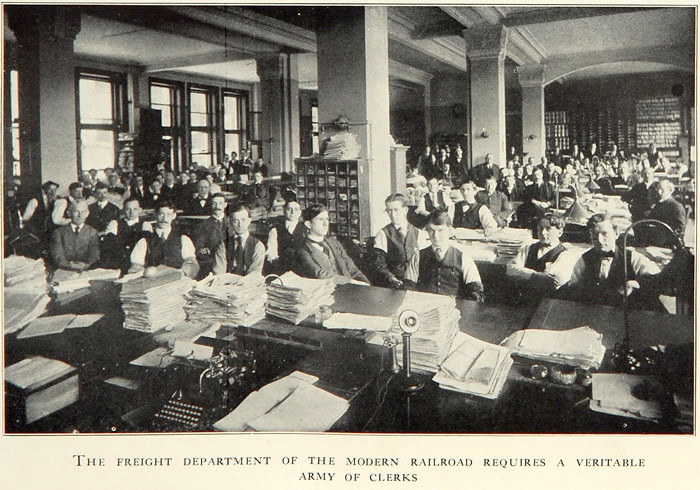
Railroad freight office clerks
Small business owners and independent professionals still mattered too. The middle class was not only office workers.
One easy test trap here. The middle class grew alongside widening inequality. Industrialization created more opportunity for some people, but it also concentrated huge wealth at the top.
Education and Access to Middle-Class Opportunity
As the economy became more corporate, schools became more tied to jobs and status.
- Public schools and high schools built literacy, numeracy, punctuality, and discipline employers wanted.
- Business colleges, normal schools, technical schools, universities, and land-grant institutions trained people for office, professional, and technical work.
- Education became a route for some people to move from manual labor or modest backgrounds into salaried work.
Women gained more access through coeducational schools and women’s colleges, especially:
- Vassar
- Wellesley
- Smith
- Bryn Mawr
Historically Black colleges also expanded opportunity for African Americans, though discrimination still blocked many professional paths.
That uneven access matters a lot. Tuition, segregation, gender barriers, racial discrimination, and the need to keep earning wages meant opportunity was real, but unequal by race, gender, and class.
Women, Consumer Culture, and Leisure
Industrialization changed women’s work and daily life, but it did not erase older gender ideas.
Women and middle-class work
- Corporate offices hired women as typists, stenographers, secretaries, bookkeepers, teachers, nurses, and telephone operators.
- These jobs offered an alternative to domestic service or factory work, especially for young unmarried white women.
- Women were usually paid less, supervised by men, and blocked from promotion. Many employers assumed women would leave work after marriage.
- The ideal of separate spheres still said men earned wages and women maintained the home.
Consumer culture
With more disposable income, middle-class families used spending to show respectability and status.
- Department stores made shopping into an experience. Know Macy’s, Marshall Field, and John Wanamaker.
- Mail-order catalogs connected rural families to national markets. Know Montgomery Ward and Sears, Roebuck and Company.
- Advertising, brand names, packaging, and electric lighting helped expand mass consumption.
A crowded bargain counter like this one captures how shopping itself became a major part of urban consumer culture.
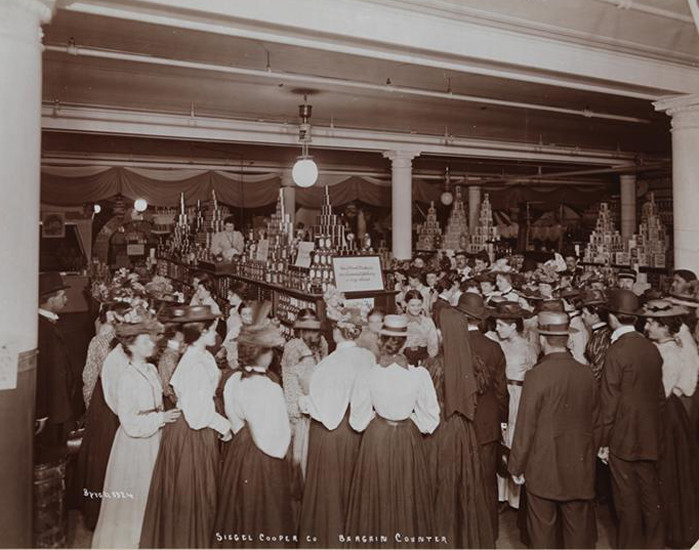
Department store bargain counter
Leisure and mass entertainment
More predictable schedules and a little more money meant more recreation.
- Professional baseball and the National League
- Vaudeville
- Circuses, theaters, concerts
- Bicycling, reading, photography
- Parks, clubs, fraternal organizations, vacation resorts
- Coney Island and early amusement parks
Access still depended on class, race, and gender, so leisure was never equally open to everyone.
The Gospel of Wealth and the Limits of Middle-Class Growth
Huge fortunes raised a big question. What should the rich do with all that wealth?
The Gospel of Wealth said the rich had a moral duty to use surplus wealth to help society.
- Andrew Carnegie gave the classic statement in his 1889 essay “Wealth.”
- He argued that the wealthy should act as trustees of their fortunes.
- He preferred philanthropy that encouraged self-improvement, not direct cash handouts.
- Carnegie funded public libraries, Carnegie Hall, universities, and research institutions.
- John D. Rockefeller also gave major support to education and medical research.
This philanthropy helped build libraries, museums, hospitals, parks, churches, and universities, especially in cities.
Keep these three ideas separate:
| Idea | Meaning |
|---|---|
| Gospel of Wealth | rich people should use private wealth for public good |
| Social Darwinism | inequality is a natural result of competition |
| Social Gospel | religious reform movement addressing poverty and labor problems |
Philanthropy could improve society and still leave inequality untouched. The same men could be praised for donations and attacked as monopolists or robber barons.
Key Takeaways
Gilded Age Middle Class
Growing urban group of salaried managers, professionals, clerical workers, and independent proprietors with more security and disposable income than industrial laborers
White-Collar Work
Salaried office, professional, clerical, or sales work associated with education, regular schedules, and middle-class status
Clerical Work
Office work such as bookkeeping, typing, stenography, correspondence, and telephone operation, performed by growing numbers of men and women, though women generally received lower pay and fewer promotions
Separate Spheres
Middle-class ideal that husbands earned wages in public life while wives maintained the home and raised children, despite many women working for pay
Consumer Culture
Culture of mass purchasing encouraged by industrial production, advertising, national markets, and middle-class disposable income and status seeking
Department Stores
Large urban retailers that gathered varied goods under one roof and used fixed prices, displays, advertising, and customer services to promote mass consumption
Mail-Order Catalogs
Catalogs used by Montgomery Ward and Sears to connect consumers outside major cities with goods from national markets
Gospel of Wealth
Belief that the wealthy should act as trustees of surplus fortunes and fund institutions for public benefit and self-improvement rather than give indiscriminate relief
Andrew Carnegie
Industrialist who articulated the Gospel of Wealth in his 1889 essay “Wealth” and funded libraries, education, research, and cultural institutions
Gilded Age Philanthropy
Private donations by wealthy industrialists to libraries, colleges, museums, hospitals, parks, research, and other educational or urban institutions
Expanded Access to Education
Growth of public schools, business and technical schools, and colleges prepared more Americans for salaried and professional work and enabled some upward mobility
Leisure Time
More free time resulting from economic security and regular schedules allowed middle-class Americans to spend more on recreation and helped expand consumer culture
Mass Entertainment
Commercial recreation such as professional baseball, vaudeville, theaters, and amusement parks, supported by disposable income, transportation, and electric lighting
Notes
Gilded Age Middle Class
Growing urban group of salaried managers, professionals, clerical workers, and independent proprietors with more security and disposable income than industrial laborers
White-Collar Work
Salaried office, professional, clerical, or sales work associated with education, regular schedules, and middle-class status
Clerical Work
Office work such as bookkeeping, typing, stenography, correspondence, and telephone operation, performed by growing numbers of men and women, though women generally received lower pay and fewer promotions
Separate Spheres
Middle-class ideal that husbands earned wages in public life while wives maintained the home and raised children, despite many women working for pay
Consumer Culture
Culture of mass purchasing encouraged by industrial production, advertising, national markets, and middle-class disposable income and status seeking
Department Stores
Large urban retailers that gathered varied goods under one roof and used fixed prices, displays, advertising, and customer services to promote mass consumption
Mail-Order Catalogs
Catalogs used by Montgomery Ward and Sears to connect consumers outside major cities with goods from national markets
Gospel of Wealth
Belief that the wealthy should act as trustees of surplus fortunes and fund institutions for public benefit and self-improvement rather than give indiscriminate relief
Andrew Carnegie
Industrialist who articulated the Gospel of Wealth in his 1889 essay “Wealth” and funded libraries, education, research, and cultural institutions
Gilded Age Philanthropy
Private donations by wealthy industrialists to libraries, colleges, museums, hospitals, parks, research, and other educational or urban institutions
Expanded Access to Education
Growth of public schools, business and technical schools, and colleges prepared more Americans for salaried and professional work and enabled some upward mobility
Leisure Time
More free time resulting from economic security and regular schedules allowed middle-class Americans to spend more on recreation and helped expand consumer culture
Mass Entertainment
Commercial recreation such as professional baseball, vaudeville, theaters, and amusement parks, supported by disposable income, transportation, and electric lighting
