Topic 8.11 Notes – The Civil Rights Movement Expands
How Civil Rights Expanded After 1960
The Black freedom struggle showed that protest could force change. Other groups borrowed its tools, including litigation, marches, sit-ins, boycotts, voter drives, civil disobedience, grassroots organizing, and appeals to the Constitution.
What changed after 1960 was the meaning of civil rights. Activists wanted more than formal legal equality. They pushed for:
- economic justice like wages, union rights, and better working conditions
- cultural recognition like ethnic studies, bilingual education, and pride in identity
- political representation in offices, schools, and local government
- sovereignty for Native nations
- reproductive freedom for women
- access for people with disabilities and language barriers
Several things made this expansion possible:
- Success in Black civil rights activism proved protest could work.
- Federal laws and court rulings gave other groups legal tools.
- Colleges became organizing centers.
- TV spread protest images nationwide.
- The New Left and counterculture encouraged people to challenge authority and old social rules.
- Postwar prosperity did not erase discrimination.
A big exam point is that shared tactics did not mean shared goals. Some movements wanted inclusion. Others wanted liberation, community control, or self-determination.
Latino, American Indian, and Asian American Activism
These movements grew out of different histories, but all challenged exclusion and demanded redress for past injustice.
Latino civil rights movements
Farmworker organizing became one of the best-known parts of Latino activism.
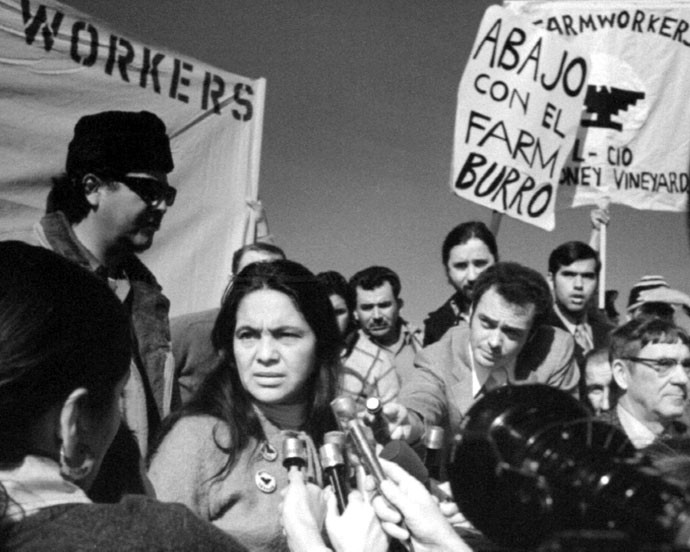
Dolores Huerta at a farmworker protest
- César Chávez, Dolores Huerta, and Larry Itliong helped lead the Delano grape strike. Filipino farmworkers started it, then Mexican American organizers from the National Farm Workers Association (founded in 1962 by Chávez and Huerta) joined. The merged union became the United Farm Workers.
- Tactics included the grape boycott, nonviolence, and the Delano-to-Sacramento march. They wanted union recognition, higher wages, and safer working conditions.
- The Chicano movement pushed cultural pride and rejected pressure to assimilate.
- 1968 East Los Angeles walkouts protested unequal schools.
- Bilingual Education Act of 1968 supported students with limited English.
- Brown Berets fought police brutality and poor schools.
- MALDEF used lawsuits to challenge discrimination.
- La Raza Unida Party sought independent political power.
- Reies López Tijerina tied land-grant activism to the Treaty of Guadalupe Hidalgo.
- In northern cities, Puerto Rican activists like the Young Lords fought over housing, poverty, schools, sanitation, health care, police brutality, and self-determination.
American Indian activism
The Alcatraz occupation became one of the most visible protests of this movement.
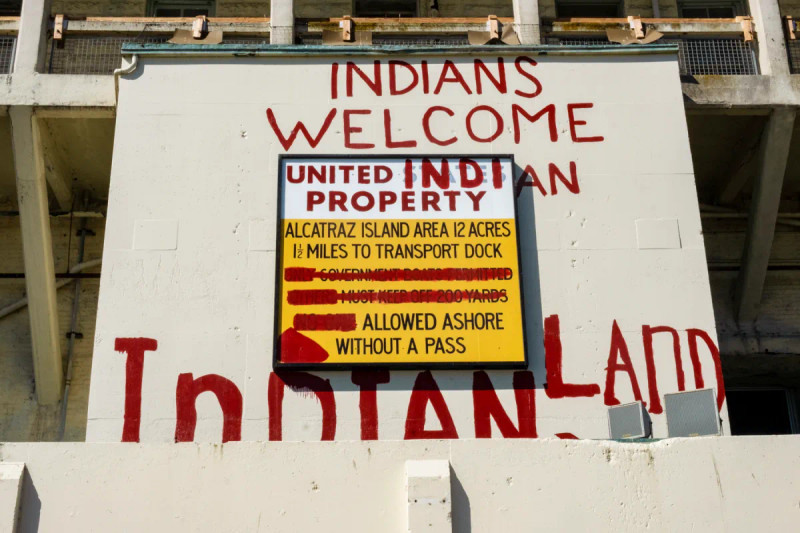
Protest signs during the Alcatraz occupation
Native activism responded to 1950s termination and relocation policies, which weakened tribes and pushed Native people into cities.
- AIM was founded in 1968.
- Major actions included the Alcatraz occupation, Trail of Broken Treaties, and Wounded Knee.
- Demands centered on treaty rights, tribal sovereignty, land, and cultural and religious preservation.
- Nixon rejected termination in 1970.
- The Indian Self-Determination and Education Assistance Act of 1975 increased tribal control over federal programs.
- The American Indian Religious Freedom Act of 1978 protected Native religious practice.
Asian American activism
- Asian American became a political identity. The Asian American Political Alliance helped popularize it.
- The Third World Liberation Front strikes at San Francisco State and UC Berkeley demanded ethnic studies.
- Filipino workers were crucial in the Delano strike.
- Lau v. Nichols said schools had to address language barriers, so “same treatment” was not always equal treatment.
- Japanese Americans organized for redress of internment, leading to the Commission on Wartime Relocation and Internment of Civilians in 1980.
Feminism and Changing Gender Roles
Second-wave feminism challenged inequality in work, education, family life, politics, and reproduction.
- Betty Friedan wrote The Feminine Mystique, which attacked the idea that women should find fulfillment only in domestic life.
- NOW, founded in 1966, pushed for legal equality.
Main legal gains:
| Law | What it did |
|---|---|
| Equal Pay Act of 1963 | banned unequal pay for equal work |
| Title VII | banned sex discrimination in employment |
| Title IX | banned sex discrimination in federally funded education |
The Equal Rights Amendment passed Congress in 1972 but failed ratification. Phyllis Schlafly led the opposition.
Reproductive rights became central:
- birth control pill
- Griswold v. Connecticut
- Roe v. Wade
- “the personal is political” meant private experiences like pregnancy, marriage, and household inequality were public power issues
Feminism was not one thing. Liberal, radical, and socialist feminists disagreed. Women of color criticized sexism in racial movements and racism and class bias in mainstream feminism.
LGBTQ+ and Disability Rights
LGBTQ+ rights movement
Before Stonewall, groups like the Mattachine Society and Daughters of Bilitis used cautious reform politics.
The Stonewall Inn uprising in 1969 changed the movement’s tone. After that, groups like the Gay Liberation Front and Gay Activists Alliance used more open, confrontational activism shaped by the New Left, Black Power, and women’s liberation.
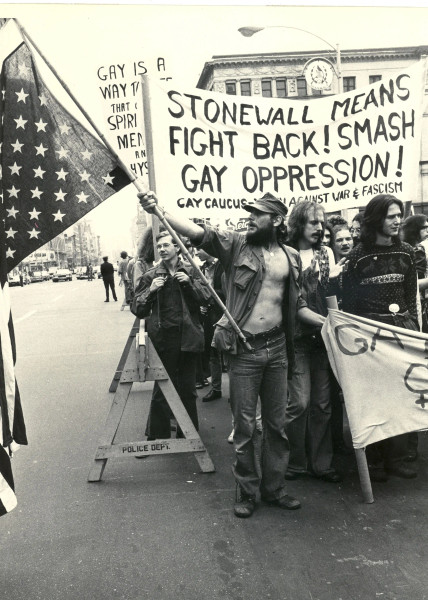
Gay liberation march after Stonewall
Important gains:
- APA removes homosexuality as mental illness in 1973
- local antidiscrimination ordinances
- Harvey Milk
- defeat of the Briggs Initiative/Proposition 6
There was backlash too, especially from Anita Bryant and repeal campaigns.
disability-rights activism
Disability activists argued that disability was not just a medical condition. Exclusion came from inaccessible buildings, schools, and public life.
- Ed Roberts helped lead the independent living movement.
- Section 504 of the Rehabilitation Act of 1973 banned discrimination in federally funded programs.
- The 1977 San Francisco federal building occupation pressured the government to enforce Section 504.
- The Education for All Handicapped Children Act of 1975 guaranteed public education for children with disabilities.
What These Movements Changed and Why It Matters
By 1980, civil rights included ethnicity, sex, sexuality, disability, language rights, tribal sovereignty, and reproductive autonomy. Activists turned personal and community struggles into public political demands.
There were limits:
- ERA failed
- farmworkers, Native communities, women, and LGBTQ+ Americans still faced inequality
- many protections were local, partial, or weakly enforced
This expansion of rights also helped trigger the conservative reaction and culture wars of the 1970s and after.
Key Takeaways
United Farm Workers (UFW)
Union formed from Mexican American and Filipino farmworker organizations; used strikes, marches, and boycotts to win recognition, higher wages, and better conditions
César Chávez
Mexican American cofounder of the UFW who promoted nonviolence, fasting, marches, and consumer boycotts to improve farmworkers’ lives
Dolores Huerta
Mexican American labor organizer who cofounded the farmworkers’ association that became the UFW and helped lead its organizing and bargaining
Larry Itliong
Filipino American labor leader whose farmworkers initiated the 1965 Delano grape strike before Chávez’s organization joined it
Chicano Movement (El Movimiento)
Mexican American movement emphasizing cultural pride, political power, educational equality, labor rights, and resistance to forced assimilation
East Los Angeles Walkouts
1968 student protests against overcrowding, unequal resources, high dropout rates, and the exclusion of Mexican American history from schools
Bilingual Education Act of 1968
Federal law providing support for educational programs serving students with limited English proficiency
Brown Berets
Chicano organization that opposed police brutality and inadequate schools and health care through protest and community programs
Mexican American Legal Defense and Educational Fund (MALDEF)
Organization founded in 1968 that used litigation to challenge discrimination in education, employment, voting, and representation
La Raza Unida Party
Mexican American political party founded in Texas in 1970 to build independent Chicano electoral power
Reies López Tijerina
Chicano leader whose New Mexico land-grant movement argued that land rights promised to Mexican residents and their descendants had been violated
Young Lords
Puerto Rican organization that promoted self-determination and organized around sanitation, health care, policing, and public services in northern cities
American Indian Movement (AIM)
Native organization founded in Minneapolis in 1968 that fought police brutality and demanded treaty rights, tribal sovereignty, and cultural survival
Occupation of Alcatraz
1969–1971 occupation by Indians of All Tribes that invoked treaty principles and made Alcatraz a symbol of intertribal activism and cultural renewal
Trail of Broken Treaties
1972 Native protest that reached Washington, D.C., and occupied the Bureau of Indian Affairs to condemn repeated federal treaty violations
Occupation of Wounded Knee
AIM and Oglala Lakota’s 71-day 1973 occupation protesting federal Indian policy and the Pine Ridge reservation government
Native American Self-Determination
Principle that Native nations should control tribal institutions, federally funded programs, land, culture, and political affairs rather than face forced assimilation
Indian Self-Determination and Education Assistance Act of 1975
Law allowing tribal governments to operate federally funded education and social-service programs previously administered by federal agencies
American Indian Religious Freedom Act of 1978
Law declaring a federal policy of protecting Native religious practices, sacred objects, and access to sacred sites, but initially providing limited enforcement
Asian American Political Alliance
Organization founded at UC Berkeley in 1968 that popularized Asian American as a political identity and encouraged coalition building
Third World Liberation Front Strikes
1968–1969 multiracial student strikes at San Francisco State and UC Berkeley demanding ethnic studies and greater minority access
Lau v. Nichols
1974 Supreme Court decision holding that schools violated federal civil rights law when language barriers denied students meaningful access to instruction
Japanese American Redress Movement
Campaign seeking investigation, apology, and compensation for World War II incarceration; Congress created an investigative commission in 1980
Second-Wave Feminism
1960s–1970s movement challenging gender inequality in employment, education, family life, politics, reproduction, and cultural expectations
Betty Friedan
Feminist author of The Feminine Mystique and cofounder of NOW who promoted women’s legal and institutional equality
The Feminine Mystique
Betty Friedan’s 1963 book describing the unspoken dissatisfaction of many middle-class suburban wives as the problem that has no name
National Organization for Women (NOW)
Feminist organization founded in 1966 to pursue employment and educational equality, reproductive freedom, and the ERA.
Equal Pay Act of 1963
Federal law prohibiting employers from paying men and women differently for substantially equal work
Title VII of the Civil Rights Act of 1964
Provision banning employment discrimination based on race, color, religion, national origin, or sex and giving feminists a basis to challenge workplace discrimination
Title IX
1972 law prohibiting sex discrimination in federally funded education, expanding equality in admissions, academics, employment, and athletics
Equal Rights Amendment (ERA)
Proposed amendment barring denial of equal rights on account of sex; it passed Congress in 1972 but fell three states short of ratification
Phyllis Schlafly
Conservative activist who led opposition to the ERA by arguing that it threatened traditional gender roles and legal protections for women
Birth Control Pill
Reliable oral contraception approved in 1960 that increased women’s control over pregnancy and family planning and contributed to changing sexual norms
Griswold v. Connecticut
1965 Supreme Court decision recognizing marital privacy and invalidating a state restriction on contraceptive use by married couples
Roe v. Wade
1973 Supreme Court decision holding that constitutional privacy protected a woman’s decision to end a pregnancy while allowing increasing regulation as pregnancy progressed
Homophile Movement
Pre-Stonewall movement, including the Mattachine Society and Daughters of Bilitis, that cautiously pursued LGBTQ+ acceptance and legal reform
Stonewall Uprising
Sustained resistance following a 1969 police raid on New York’s Stonewall Inn that became a turning point and symbol of gay liberation
Gay Liberation
Post-Stonewall movement demanding open LGBTQ+ identity and liberation from discriminatory laws, police harassment, and restrictive sexual and gender norms
American Psychiatric Association’s 1973 Decision
Removal of homosexuality from the association’s principal list of mental disorders, weakening an institutional basis for anti-gay stigma
Harvey Milk
Openly gay San Francisco supervisor elected in 1977 who mobilized opposition to the anti-gay Briggs Initiative before his 1978 assassination
Briggs Initiative (Proposition 6)
1978 California proposal permitting dismissal of gay and lesbian public-school employees and possibly their supporters; voters defeated it
Anita Bryant
Conservative activist who led a successful 1977 campaign to repeal a gay-rights ordinance in Dade County, Florida
Independent Living Movement
Disability-rights movement demanding that disabled people control their own lives and receive support for full participation in society
Ed Roberts
Disability-rights activist closely associated with the independent living movement and its demand for disabled people’s autonomy
Section 504 of the Rehabilitation Act of 1973
Provision banning disability discrimination in federally funded programs; a 25-day San Francisco occupation in 1977 helped force enforcement regulations
Education for All Handicapped Children Act of 1975
Law requiring federally funded public schools to provide children with disabilities a free appropriate public education
Delano Grape Strike
1965 farmworker strike begun by Filipino workers and joined by Chávez’s organization to demand union recognition, higher wages, and better working conditions
Nationwide Grape Boycott
UFW consumer campaign urging Americans not to buy table grapes, helping pressure major growers to sign contracts by 1970
Termination Policy
1950s federal policy ending recognition of selected tribes in an effort to dissolve the federal-tribal relationship and promote assimilation
Relocation Programs
Federal programs encouraging Native people to leave reservations for cities, where many encountered poverty, unemployment, and discrimination
Consciousness-Raising
Feminist method in which women discussed shared personal experiences to identify broader patterns of gender inequality
The Personal Is Political
Feminist principle that experiences treated as private problems often reflected broader social and political structures of male power
Liberal Feminism
Feminist approach seeking equal opportunity by removing legal and institutional barriers within existing society
Radical Feminism
Feminist approach arguing that male power was embedded in fundamental social institutions, relationships, and cultural practices
Socialist Feminism
Feminist approach connecting women’s inequality to capitalism and class relations as well as male power
Section 504 Sit-In
Twenty-five-day 1977 occupation of a San Francisco federal building that helped force the government to issue regulations enforcing disability protections
Notes
United Farm Workers (UFW)
Union formed from Mexican American and Filipino farmworker organizations; used strikes, marches, and boycotts to win recognition, higher wages, and better conditions
César Chávez
Mexican American cofounder of the UFW who promoted nonviolence, fasting, marches, and consumer boycotts to improve farmworkers’ lives
Dolores Huerta
Mexican American labor organizer who cofounded the farmworkers’ association that became the UFW and helped lead its organizing and bargaining
Larry Itliong
Filipino American labor leader whose farmworkers initiated the 1965 Delano grape strike before Chávez’s organization joined it
Chicano Movement (El Movimiento)
Mexican American movement emphasizing cultural pride, political power, educational equality, labor rights, and resistance to forced assimilation
East Los Angeles Walkouts
1968 student protests against overcrowding, unequal resources, high dropout rates, and the exclusion of Mexican American history from schools
Bilingual Education Act of 1968
Federal law providing support for educational programs serving students with limited English proficiency
Brown Berets
Chicano organization that opposed police brutality and inadequate schools and health care through protest and community programs
Mexican American Legal Defense and Educational Fund (MALDEF)
Organization founded in 1968 that used litigation to challenge discrimination in education, employment, voting, and representation
La Raza Unida Party
Mexican American political party founded in Texas in 1970 to build independent Chicano electoral power
Reies López Tijerina
Chicano leader whose New Mexico land-grant movement argued that land rights promised to Mexican residents and their descendants had been violated
Young Lords
Puerto Rican organization that promoted self-determination and organized around sanitation, health care, policing, and public services in northern cities
American Indian Movement (AIM)
Native organization founded in Minneapolis in 1968 that fought police brutality and demanded treaty rights, tribal sovereignty, and cultural survival
Occupation of Alcatraz
1969–1971 occupation by Indians of All Tribes that invoked treaty principles and made Alcatraz a symbol of intertribal activism and cultural renewal
Trail of Broken Treaties
1972 Native protest that reached Washington, D.C., and occupied the Bureau of Indian Affairs to condemn repeated federal treaty violations
Occupation of Wounded Knee
AIM and Oglala Lakota’s 71-day 1973 occupation protesting federal Indian policy and the Pine Ridge reservation government
Native American Self-Determination
Principle that Native nations should control tribal institutions, federally funded programs, land, culture, and political affairs rather than face forced assimilation
Indian Self-Determination and Education Assistance Act of 1975
Law allowing tribal governments to operate federally funded education and social-service programs previously administered by federal agencies
American Indian Religious Freedom Act of 1978
Law declaring a federal policy of protecting Native religious practices, sacred objects, and access to sacred sites, but initially providing limited enforcement
Asian American Political Alliance
Organization founded at UC Berkeley in 1968 that popularized Asian American as a political identity and encouraged coalition building
Third World Liberation Front Strikes
1968–1969 multiracial student strikes at San Francisco State and UC Berkeley demanding ethnic studies and greater minority access
Lau v. Nichols
1974 Supreme Court decision holding that schools violated federal civil rights law when language barriers denied students meaningful access to instruction
Japanese American Redress Movement
Campaign seeking investigation, apology, and compensation for World War II incarceration; Congress created an investigative commission in 1980
Second-Wave Feminism
1960s–1970s movement challenging gender inequality in employment, education, family life, politics, reproduction, and cultural expectations
Betty Friedan
Feminist author of The Feminine Mystique and cofounder of NOW who promoted women’s legal and institutional equality
The Feminine Mystique
Betty Friedan’s 1963 book describing the unspoken dissatisfaction of many middle-class suburban wives as the problem that has no name
National Organization for Women (NOW)
Feminist organization founded in 1966 to pursue employment and educational equality, reproductive freedom, and the ERA.
Equal Pay Act of 1963
Federal law prohibiting employers from paying men and women differently for substantially equal work
Title VII of the Civil Rights Act of 1964
Provision banning employment discrimination based on race, color, religion, national origin, or sex and giving feminists a basis to challenge workplace discrimination
Title IX
1972 law prohibiting sex discrimination in federally funded education, expanding equality in admissions, academics, employment, and athletics
Equal Rights Amendment (ERA)
Proposed amendment barring denial of equal rights on account of sex; it passed Congress in 1972 but fell three states short of ratification
Phyllis Schlafly
Conservative activist who led opposition to the ERA by arguing that it threatened traditional gender roles and legal protections for women
Birth Control Pill
Reliable oral contraception approved in 1960 that increased women’s control over pregnancy and family planning and contributed to changing sexual norms
Griswold v. Connecticut
1965 Supreme Court decision recognizing marital privacy and invalidating a state restriction on contraceptive use by married couples
Roe v. Wade
1973 Supreme Court decision holding that constitutional privacy protected a woman’s decision to end a pregnancy while allowing increasing regulation as pregnancy progressed
Homophile Movement
Pre-Stonewall movement, including the Mattachine Society and Daughters of Bilitis, that cautiously pursued LGBTQ+ acceptance and legal reform
Stonewall Uprising
Sustained resistance following a 1969 police raid on New York’s Stonewall Inn that became a turning point and symbol of gay liberation
Gay Liberation
Post-Stonewall movement demanding open LGBTQ+ identity and liberation from discriminatory laws, police harassment, and restrictive sexual and gender norms
American Psychiatric Association’s 1973 Decision
Removal of homosexuality from the association’s principal list of mental disorders, weakening an institutional basis for anti-gay stigma
Harvey Milk
Openly gay San Francisco supervisor elected in 1977 who mobilized opposition to the anti-gay Briggs Initiative before his 1978 assassination
Briggs Initiative (Proposition 6)
1978 California proposal permitting dismissal of gay and lesbian public-school employees and possibly their supporters; voters defeated it
Anita Bryant
Conservative activist who led a successful 1977 campaign to repeal a gay-rights ordinance in Dade County, Florida
Independent Living Movement
Disability-rights movement demanding that disabled people control their own lives and receive support for full participation in society
Ed Roberts
Disability-rights activist closely associated with the independent living movement and its demand for disabled people’s autonomy
Section 504 of the Rehabilitation Act of 1973
Provision banning disability discrimination in federally funded programs; a 25-day San Francisco occupation in 1977 helped force enforcement regulations
Education for All Handicapped Children Act of 1975
Law requiring federally funded public schools to provide children with disabilities a free appropriate public education
Delano Grape Strike
1965 farmworker strike begun by Filipino workers and joined by Chávez’s organization to demand union recognition, higher wages, and better working conditions
Nationwide Grape Boycott
UFW consumer campaign urging Americans not to buy table grapes, helping pressure major growers to sign contracts by 1970
Termination Policy
1950s federal policy ending recognition of selected tribes in an effort to dissolve the federal-tribal relationship and promote assimilation
Relocation Programs
Federal programs encouraging Native people to leave reservations for cities, where many encountered poverty, unemployment, and discrimination
Consciousness-Raising
Feminist method in which women discussed shared personal experiences to identify broader patterns of gender inequality
The Personal Is Political
Feminist principle that experiences treated as private problems often reflected broader social and political structures of male power
Liberal Feminism
Feminist approach seeking equal opportunity by removing legal and institutional barriers within existing society
Radical Feminism
Feminist approach arguing that male power was embedded in fundamental social institutions, relationships, and cultural practices
Socialist Feminism
Feminist approach connecting women’s inequality to capitalism and class relations as well as male power
Section 504 Sit-In
Twenty-five-day 1977 occupation of a San Francisco federal building that helped force the government to issue regulations enforcing disability protections
