Topic 7.5 Notes – World War I: Military and Diplomacy
Why the United States Entered World War I
World War I began in Europe in 1914 because of militarism, alliance systems, nationalism, imperial rivalry, and the assassination of Archduke Franz Ferdinand by Gavrilo Princip. One crisis in the Balkans spread fast because the great powers were already armed and tied together.
The Central Powers were Germany, Austria-Hungary, the Ottoman Empire, and Bulgaria. The Allies were Great Britain, France, Russia, later Italy, and then the United States.
Wilson declared neutrality in 1914. That did not mean the U.S. was uninvolved in the world. After the Spanish-American War, the U.S. was active overseas. The real issue was avoiding direct entry into a European war.
Many Americans liked neutrality because:
- Europe felt far away, and the U.S. had a strong antiwar tradition in European conflicts.
- The country was ethnically diverse, so people had different loyalties.
- Many saw the war as the result of old European power politics, not an American cause.
Neutrality got harder to keep because American trade and loans favored the Allies. Britain’s blockade made trade with Germany difficult and also shaped the news Americans received. Many Americans also felt more cultural sympathy for Britain and France than for Germany.
The immediate path to war
- German U-boats attacked ships and challenged neutral rights.
- The Lusitania sank in 1915, killing 128 Americans.
- The Sussex incident in 1916 led Germany to issue the Sussex Pledge, promising limits on submarine attacks.
- Germany resumed unrestricted submarine warfare on February 1, 1917.
- The Zimmermann Telegram proposed a German-Mexican alliance and promised Mexico Texas, New Mexico, and Arizona.
- The Russian Revolution removed the tsar, making the Allied side easier for Wilson to describe as democratic.
Wilson asked Congress for war on April 2, 1917, saying “the world must be made safe for democracy.” He framed the war as a defense of democracy, humanity, and neutral rights. Congress declared war on Germany on April 6, 1917, and on Austria-Hungary in December.
A couple names matter here. Theodore Roosevelt backed the preparedness movement, and Wilson’s 1916 campaign was tied to “He kept us out of war.” Also, the U.S. entered as an associated power, not a formal Allied member.
How the United States Helped the Allies Win
Once the U.S. entered, the biggest challenge was mobilization. America was not ready for a huge war in 1917.
- The Selective Service Act of 1917 created the draft.
- About 24 million men registered, 2.8 million were drafted, and 4.7 million served.
- The convoy system with naval escorts helped protect ships from submarines.
The American Expeditionary Forces
The AEF was led by General John J. Pershing, who wanted Americans to fight as an independent army when possible. That mattered because it gave the U.S. more military and political influence.
African American soldiers served in a segregated military. The 369th Infantry Regiment, the Harlem Hellfighters, fought with distinction under French command.
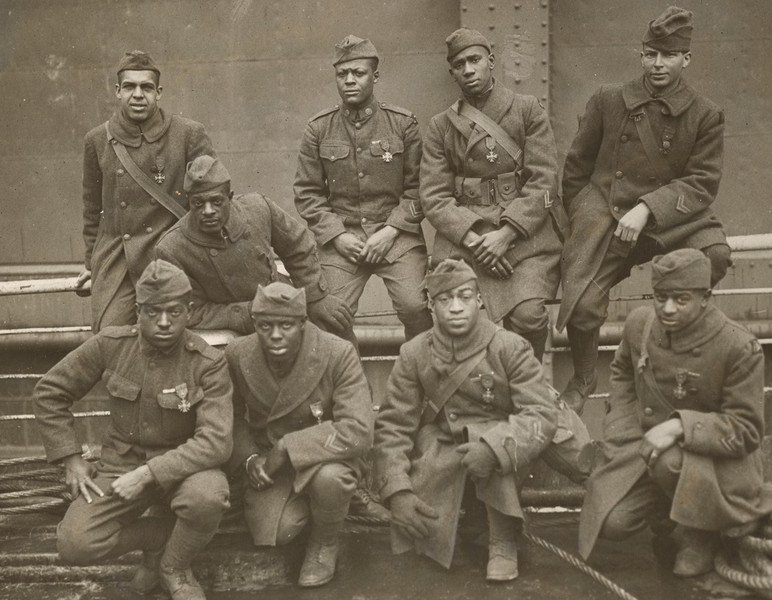
Soldiers of the 369th Infantry Regiment, the Harlem Hellfighters
Major combat in 1918
- Château-Thierry and Belleau Wood helped stop the German advance.
- Second Battle of the Marne helped turn the war toward the Allies.
- St. Mihiel Offensive was a major U.S.-led attack.
- Meuse-Argonne Offensive was the largest American operation of the war.
The best judgment for APUSH is this. The AEF fought only in the final phase, so its combat role was limited compared with years of European fighting. But U.S. troops, supplies, loans, and morale mattered a lot after Russia exited through the Treaty of Brest-Litovsk. Germany’s spring offensive failed, and the armistice came on November 11, 1918.
Wilson’s Peace Plan and the Treaty of Versailles
Wilson’s Fourteen Points aimed to build a stable peace, not just punish Germany.
Core ideas
| Idea | What it meant |
|---|---|
| Open diplomacy | no secret treaties |
| Freedom of the seas | safer global shipping |
| Lower trade barriers | more open commerce |
| Arms reduction | fewer weapons, less arms race |
| Colonial adjustment | consider fairness in imperial claims |
| Self-determination | redraw borders by nationality where possible |
| Independent Poland | restore a Polish state |
| League of Nations | collective security organization |
At the Paris Peace Conference in 1919, the Big Four were Woodrow Wilson, Georges Clemenceau, David Lloyd George, and Vittorio Orlando. Wilson wanted an idealistic peace. France wanted security and punishment. Britain wanted balance and empire. Italy wanted territory.
The Treaty of Versailles mixed those goals:
- Article 231 blamed Germany for the war.
- Germany had to pay reparations.
- Its army was limited to 100,000.
- It could have no submarines or air force.
- The Rhineland was demilitarized.
- Germany lost territory and colonies.
- The League of Nations was included in the treaty.
Why the Senate Rejected the Treaty
Ratification required a two-thirds Senate vote, and Wilson made things harder by leaving key Republicans out of the peace process after Republicans won the Senate in 1918.
Two opposition groups formed:
- Irreconcilables rejected the treaty and League outright.
- Reservationists, led by Henry Cabot Lodge, wanted changes first.
The biggest fight was over Article X of the League covenant. Supporters saw collective security. Critics feared the U.S. would get dragged into foreign conflicts and that Congress would lose its power to declare war.
Lodge Reservations tried to protect U.S. sovereignty and congressional authority. Wilson then went on a speaking tour, suffered a stroke in 1919, and refused compromise. Senate votes in 1919 and 1920 failed, so the U.S. never joined the League of Nations.
Key Takeaways
Militarism
European arms races, large standing armies, and rapid-mobilization plans that heightened tensions and helped turn the 1914 crisis into war
Alliance System
Europe’s division into rival blocs, whose commitments transformed the conflict between Austria-Hungary and Serbia into a general European war
Nationalism
Intense national rivalry and ethnic demands for independence that destabilized Europe and contributed to World War I.
Imperial Competition
European rivalry over colonies, markets, and international influence that increased tensions before World War I.
Assassination of Archduke Franz Ferdinand
Gavrilo Princip’s June 28, 1914 killing of Austria-Hungary’s heir, which triggered the diplomatic crisis that began World War I.
Central Powers vs. Allied Powers
Central Powers: Germany, Austria-Hungary, Ottoman Empire, and Bulgaria; Allies: chiefly Britain, France, Russia, Italy, and later the United States
Woodrow Wilson
President who moved the United States from neutrality to war, proposed the Fourteen Points, negotiated at Paris, and championed the League of Nations
American Neutrality
Wilson’s 1914 policy of staying out of the European war while urging Americans to remain impartial in thought and action
Neutral Rights
The claimed rights of neutral Americans and ships to travel and trade without unlawful interference or attack by belligerents
Lusitania
British passenger liner sunk by a German U-boat in 1915, killing about 1,198 people including 128 Americans and intensifying the submarine dispute
Sussex Pledge
Germany’s 1916 promise to restrict submarine attacks and protect passengers and merchant crews under specified conditions
Preparedness Movement
Campaign to strengthen the U.S. armed forces so the nation could deter attack and defend its neutral rights
Unrestricted Submarine Warfare
German policy of sinking neutral and enemy shipping without warning; its resumption in February 1917 was the immediate cause of U.S. entry
Zimmermann Telegram
German proposal that Mexico join a war against the United States in return for help recovering lost territory; its publication intensified anti-German opinion
Russian Revolution of March 1917
Overthrow of the Russian tsar, which removed an autocracy from the Allied coalition and strengthened Wilson’s democratic justification for war
Wilson’s War Message of 1917
April 2 address asking Congress for war against Germany to oppose submarine warfare and make the world safe for democracy
Associated Power
The United States’ wartime status alongside, but not formally within, the Allied alliance, preserving independent American war aims
Selective Service Act of 1917
Law requiring eligible men to register for military service, producing about 2.8 million drafted soldiers for the wartime army
Convoy System
Method of grouping merchant and troop ships under naval escort to reduce submarine losses while crossing the Atlantic
American Expeditionary Forces (AEF)
U.S. forces sent to Europe under John J. Pershing that fought mainly as an independent national army during 1918
John J. Pershing
General who commanded the AEF and generally insisted that American troops fight as a distinct national army
Harlem Hellfighters (369th Infantry Regiment)
Celebrated African American unit that fought under French command because the segregated U.S. Army restricted Black combat opportunities
Château-Thierry
June 1918 fighting in which American forces helped stop the German advance threatening Paris
Belleau Wood
June 1918 battle associated especially with the U.S. Marines that became a symbol of American combat effectiveness
Second Battle of the Marne
July–August 1918 battle in which American and Allied forces halted Germany’s final major offensive and began a sustained counterattack
St. Mihiel Offensive
September 1918 operation that reduced a German salient and was the first major offensive by an American army under American command
Meuse-Argonne Offensive
Largest U.S. operation of the war, involving about 1.2 million Americans and pressuring German defenses until the November 1918 armistice
Armistice of November 11, 1918
Agreement that stopped World War I fighting at 11:00 a.m. on November 11, 1918, before the later formal peace settlement
Fourteen Points
Wilson’s 1918 peace program calling for open diplomacy, freer trade and seas, reduced armaments, national adjustment, and a League of Nations
Self-Determination
Principle that national peoples should choose their own governments and political status, applied unevenly in the postwar settlement
Collective Security
Principle that aggression against one nation concerns all members, who cooperate to deter or respond to the aggressor
League of Nations
International organization proposed by Wilson to preserve peace through collective security; the United States never joined it
Paris Peace Conference
1919 meeting where Wilson and the other Allied leaders negotiated the postwar settlement and drafted the Treaty of Versailles
Big Four
Woodrow Wilson, Georges Clemenceau, David Lloyd George, and Vittorio Orlando, the principal leaders at the Paris Peace Conference
Treaty of Versailles
1919 peace treaty that punished Germany, redrew borders, restricted German arms, required reparations, and created the League of Nations
Article 231 (War-Guilt Clause)
Versailles provision assigning Germany and its allies responsibility for wartime loss and damage, providing a basis for reparations
Article X
League covenant provision pledging members to preserve one another’s territorial integrity and political independence against external aggression
Irreconcilables vs. Reservationists
Irreconcilables rejected the League under nearly all conditions; reservationists would accept the treaty only with protections for U.S. sovereignty and Congress
Henry Cabot Lodge
Republican Senate Foreign Relations Committee chair who led reservationist opposition and demanded limits on U.S. obligations under the League
Senate Rejection of the Treaty of Versailles
The treaty failed to win a two-thirds Senate vote, so the United States neither ratified it nor joined the League of Nations
Lodge Reservations
Proposed conditions limiting League obligations and requiring congressional approval before the United States defended another nation or entered foreign conflicts
Notes
Militarism
European arms races, large standing armies, and rapid-mobilization plans that heightened tensions and helped turn the 1914 crisis into war
Alliance System
Europe’s division into rival blocs, whose commitments transformed the conflict between Austria-Hungary and Serbia into a general European war
Nationalism
Intense national rivalry and ethnic demands for independence that destabilized Europe and contributed to World War I.
Imperial Competition
European rivalry over colonies, markets, and international influence that increased tensions before World War I.
Assassination of Archduke Franz Ferdinand
Gavrilo Princip’s June 28, 1914 killing of Austria-Hungary’s heir, which triggered the diplomatic crisis that began World War I.
Central Powers vs. Allied Powers
Central Powers: Germany, Austria-Hungary, Ottoman Empire, and Bulgaria; Allies: chiefly Britain, France, Russia, Italy, and later the United States
Woodrow Wilson
President who moved the United States from neutrality to war, proposed the Fourteen Points, negotiated at Paris, and championed the League of Nations
American Neutrality
Wilson’s 1914 policy of staying out of the European war while urging Americans to remain impartial in thought and action
Neutral Rights
The claimed rights of neutral Americans and ships to travel and trade without unlawful interference or attack by belligerents
Lusitania
British passenger liner sunk by a German U-boat in 1915, killing about 1,198 people including 128 Americans and intensifying the submarine dispute
Sussex Pledge
Germany’s 1916 promise to restrict submarine attacks and protect passengers and merchant crews under specified conditions
Preparedness Movement
Campaign to strengthen the U.S. armed forces so the nation could deter attack and defend its neutral rights
Unrestricted Submarine Warfare
German policy of sinking neutral and enemy shipping without warning; its resumption in February 1917 was the immediate cause of U.S. entry
Zimmermann Telegram
German proposal that Mexico join a war against the United States in return for help recovering lost territory; its publication intensified anti-German opinion
Russian Revolution of March 1917
Overthrow of the Russian tsar, which removed an autocracy from the Allied coalition and strengthened Wilson’s democratic justification for war
Wilson’s War Message of 1917
April 2 address asking Congress for war against Germany to oppose submarine warfare and make the world safe for democracy
Associated Power
The United States’ wartime status alongside, but not formally within, the Allied alliance, preserving independent American war aims
Selective Service Act of 1917
Law requiring eligible men to register for military service, producing about 2.8 million drafted soldiers for the wartime army
Convoy System
Method of grouping merchant and troop ships under naval escort to reduce submarine losses while crossing the Atlantic
American Expeditionary Forces (AEF)
U.S. forces sent to Europe under John J. Pershing that fought mainly as an independent national army during 1918
John J. Pershing
General who commanded the AEF and generally insisted that American troops fight as a distinct national army
Harlem Hellfighters (369th Infantry Regiment)
Celebrated African American unit that fought under French command because the segregated U.S. Army restricted Black combat opportunities
Château-Thierry
June 1918 fighting in which American forces helped stop the German advance threatening Paris
Belleau Wood
June 1918 battle associated especially with the U.S. Marines that became a symbol of American combat effectiveness
Second Battle of the Marne
July–August 1918 battle in which American and Allied forces halted Germany’s final major offensive and began a sustained counterattack
St. Mihiel Offensive
September 1918 operation that reduced a German salient and was the first major offensive by an American army under American command
Meuse-Argonne Offensive
Largest U.S. operation of the war, involving about 1.2 million Americans and pressuring German defenses until the November 1918 armistice
Armistice of November 11, 1918
Agreement that stopped World War I fighting at 11:00 a.m. on November 11, 1918, before the later formal peace settlement
Fourteen Points
Wilson’s 1918 peace program calling for open diplomacy, freer trade and seas, reduced armaments, national adjustment, and a League of Nations
Self-Determination
Principle that national peoples should choose their own governments and political status, applied unevenly in the postwar settlement
Collective Security
Principle that aggression against one nation concerns all members, who cooperate to deter or respond to the aggressor
League of Nations
International organization proposed by Wilson to preserve peace through collective security; the United States never joined it
Paris Peace Conference
1919 meeting where Wilson and the other Allied leaders negotiated the postwar settlement and drafted the Treaty of Versailles
Big Four
Woodrow Wilson, Georges Clemenceau, David Lloyd George, and Vittorio Orlando, the principal leaders at the Paris Peace Conference
Treaty of Versailles
1919 peace treaty that punished Germany, redrew borders, restricted German arms, required reparations, and created the League of Nations
Article 231 (War-Guilt Clause)
Versailles provision assigning Germany and its allies responsibility for wartime loss and damage, providing a basis for reparations
Article X
League covenant provision pledging members to preserve one another’s territorial integrity and political independence against external aggression
Irreconcilables vs. Reservationists
Irreconcilables rejected the League under nearly all conditions; reservationists would accept the treaty only with protections for U.S. sovereignty and Congress
Henry Cabot Lodge
Republican Senate Foreign Relations Committee chair who led reservationist opposition and demanded limits on U.S. obligations under the League
Senate Rejection of the Treaty of Versailles
The treaty failed to win a two-thirds Senate vote, so the United States neither ratified it nor joined the League of Nations
Lodge Reservations
Proposed conditions limiting League obligations and requiring congressional approval before the United States defended another nation or entered foreign conflicts
