Topic 2.1 Notes – Contextualizing Period 2
What Shaped Colonization in North America after 1607
European colonization did not begin from scratch in 1607. It grew out of earlier Atlantic changes that had already transformed the world.
- European maritime expansion gave states the ships, maps, and habits of long-distance empire.
- The Columbian Exchange moved crops, animals, diseases, and people across the Atlantic. Disease devastated Native populations, but Native nations still remained major political and military powers.
- Spanish conquests showed other Europeans that colonies could bring wealth, land, converts, and prestige.
- The Protestant Reformation deepened rivalry between Catholic and Protestant powers, so colonization became religious and geopolitical, not just economic.
Colonies were created for wealth, land, trade, converts, and imperial power. Monarchs often let chartered companies or proprietors do the risky work of founding them. The clearest example is the Virginia Company, which founded Jamestown in 1607, the starting point of this period.
By 1750, those rival empires claimed very different parts of North America, and the biggest pressure point sat in the interior river valleys.
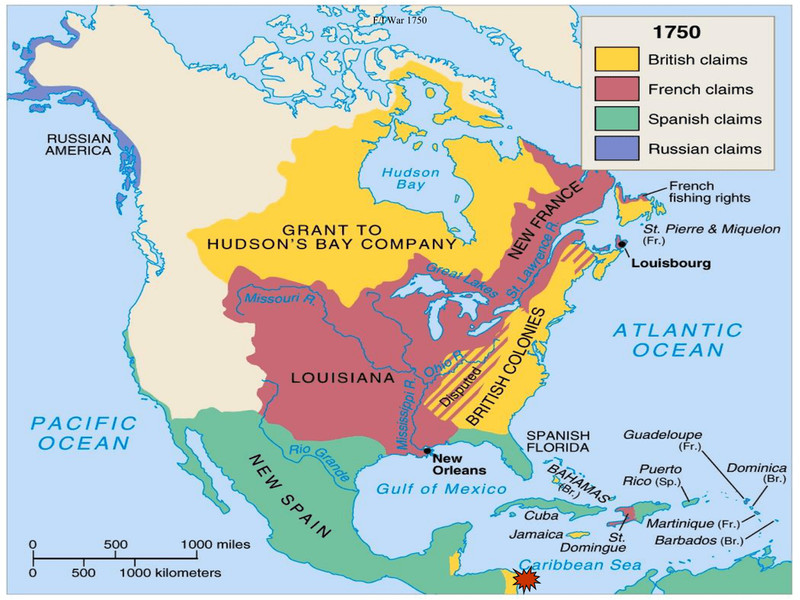
European claims in North America, c. 1750
The sentence to keep in your head is this: colonization from 1607 to 1754 developed through imperial rivalry, varied environments, and Native resistance, not through simple European expansion. The period ends when conflict in the Ohio River Valley helped trigger war in 1754.
The Four Main Colonial Models
Spain, France, the Dutch, and Britain all wanted land, labor, trade, and influence. They mixed those goals differently, which is why their colonies looked so different.
Spanish colonization
Spain aimed for imperial control, Catholic conversion, labor extraction, and territorial defense. It built missions, presidios (forts), and towns in Florida, New Mexico, Texas, and the Southwest borderlands. Spanish rule also carried encomienda traditions and a caste hierarchy based partly on ancestry.
Native resistance mattered a lot. The Pueblo Revolt of 1680, led by Popé, drove Spain out of New Mexico. Spain returned in 1692 and ruled more carefully, allowing some Pueblo practices.
French colonization
France focused on the fur trade, fishing, interior waterways, and alliances. Key regions were the St. Lawrence River, Great Lakes, and Mississippi River Valley. Quebec, founded in 1608, anchored New France.
Because there were fewer French settlers, France relied more on Native trade and diplomacy. Important relationships included alliance with the Huron-Wendat and conflict involving the Haudenosaunee, or Iroquois Confederacy.
Dutch colonization
The Dutch cared most about commerce and fur. New Netherland and New Amsterdam on Manhattan used the Hudson River to reach interior trade. The colony was diverse and business-oriented. England seized it in 1664 and renamed it New York.
British colonization
Britain sent more permanent settlers, including women and families, than France or the Dutch. British colonies drew migrants seeking land, profit, farming, religious refuge, and social mobility. That made British expansion more settler-based, which caused frequent land conflict with Native peoples. By 1754, Britain had the largest settler population in the thirteen mainland colonies.
The Regional Colonies of British North America
Geography helped shape different colonial societies.
| Region | Economy and settlement | Social and political pattern |
|---|---|---|
| New England | Small farms, fishing, lumbering, shipbuilding, trade | Puritan family migration, compact towns, congregational churches, town meetings |
| Chesapeake and North Carolina | Tobacco in Virginia, Maryland, North Carolina; dispersed river plantations | Heavy labor demand, planter elite power, House of Burgesses founded in 1619 |
| Middle colonies | Grain exports, fertile soil, ports like New York and Philadelphia | Ethnic and religious diversity, strong Quaker influence in Pennsylvania |
| Southern Atlantic colonies and British West Indies | Rice and indigo in South Carolina and Georgia; sugar in Caribbean | Plantation economies tied closely to enslaved labor and Atlantic trade |
Land, Labor, Trade, and Conflict
Colonies needed workers. Different places used family labor, wage labor, indentured servitude, Native slavery, and African slavery. Over time, plantation regions shifted from indentured servitude to racial slavery.
- A major turning point came with Virginia’s 1662 law, which made slave status hereditary through the mother.
- Chattel slavery meant enslaved people were treated as permanent, inheritable property.
- Slavery existed in every colony, even if it was much more central in the Chesapeake, Lower South, and Caribbean.
The colonies were part of an Atlantic economy shaped by mercantilism, the idea that colonies should enrich the mother country. Britain used the Navigation Acts to regulate trade, but salutary neglect meant those laws were often loosely enforced.
Native peoples were never passive. They traded, negotiated, allied, resisted, and adapted. Two conflicts show that clearly:
- Metacom’s War (King Philip’s War), 1675 to 1676 in New England
- Pueblo Revolt, 1680 in New Mexico
By 1754, struggles over land, trade routes, and the Ohio River Valley were pulling Britain, France, Spain, and Native nations toward war.
How the Colonies Became More British and More Independent
The British colonies became more connected to Britain through trade, British goods, legal traditions, and imperial identity. This process is called Anglicization.
At the same time, colonists also connected more with each other.
- Transatlantic print culture spread newspapers, pamphlets, and political arguments.
- Religious pluralism made no single church dominant across the mainland colonies.
- The First Great Awakening in the 1730s and 1740s created shared religious experiences and challenged old authority.
- Enlightenment ideas about reason and government began shaping colonial thinking.
Local government mattered too. Assemblies and town meetings gave colonists practice in self-rule, even though participation stayed mostly limited to property-holding white men.
That created the core tension of the period. Colonists became more British in culture and trade, but they also expected control over taxation and local affairs. By 1754, imperial rivalry and colonial autonomy had created the conditions for the French and Indian War.
