Topic 6.2 Notes – Westward Expansion: Economic Development
How the West Became Part of a National Market
After the Civil War, settlement sped up because opportunity and policy worked together. People moved west for land, minerals, ranching, and farming. The federal government made that movement easier through land laws, railroad aid, and communication networks.
The core idea is market integration. The West stopped being distant and isolated. Farms, mines, and ranches became tied to eastern banks, factories, railroads, and consumers.
Here’s the chain you want in your head:
- Federal support for land claims, railroads, and telegraphs
- Transportation and communication got faster and cheaper
- Migration and investment increased
- Farms, mines, ranches, and towns spread
- Output rose and western goods entered national markets
One important reminder sits underneath all of this. Land described as “open” had often been taken from American Indians. Topic 6.3 goes deeper on that conflict, but here it matters because dispossession made this economic growth possible.
Federal Policies and Infrastructure That Drove Settlement
The government did not sit back and watch. It actively pushed development westward.
Homestead Act of 1862
- Gave settlers 160 acres of public land if they lived on it and improved it.
- Drew internal migrants and immigrants planning to become citizens.
- Women heading households could file claims too.
- Limits mattered a lot. Dry land, drought, start-up costs, fraud, and abandonment meant many homesteads failed.
Other land laws
- Timber Culture Act of 1873 encouraged tree planting.
- Desert Land Act of 1877 encouraged irrigation of arid land.
- Both showed continued federal effort to turn western land into productive property, though fraud and failure were common.
Railroad subsidies and land grants
- Pacific Railway Act of 1862, expanded in 1864, gave bonds, rights of way, and huge land grants to railroad companies.
- Union Pacific built west from Omaha.
- Central Pacific built east from Sacramento.
- They met at Promontory Summit, Utah, in 1869, completing the first transcontinental railroad.
This route map is the key connection to remember: one line pushed east from Sacramento, the other pushed west from Omaha, and the tracks met in Utah.
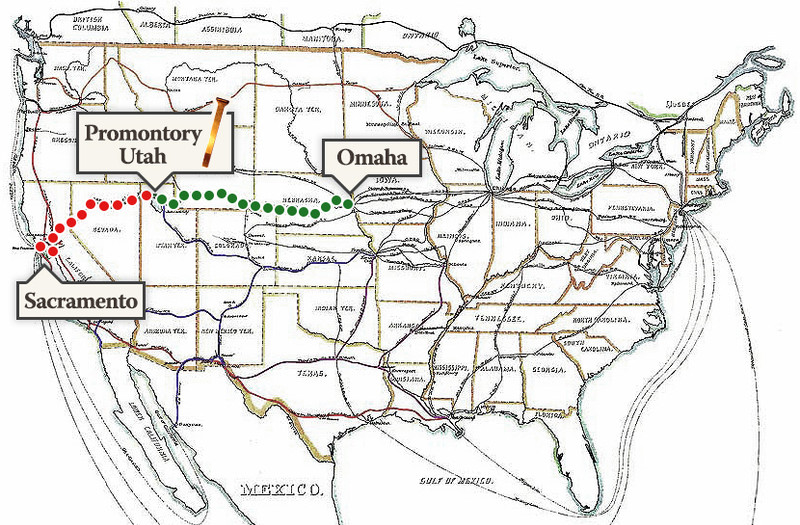
First transcontinental railroad route, completed in 1869
Telegraph and coordination
- Pacific Telegraph Act of 1860 supported a transcontinental line completed in 1861.
- Telegraph lines often followed railroads.
- In 1883, railroads created standard time zones so national schedules could work.
Big effects were easy to see. Shipping got cheaper, travel got faster, western resources reached national markets, and towns rose or fell depending on railroad routes.
The Main Engines of Western Economic Growth
Western growth came from linked sectors. Each depended on transportation, capital, and outside markets.
Mining
- Pull factors included gold, silver, copper, and lead.
- Key examples were the Comstock Lode in Nevada and strikes in Colorado, Montana, Idaho, Arizona, and the Black Hills.
- Mining towns often followed a boomtown to ghost town pattern.
- Mining shifted from lone prospectors to corporate mining because deep shafts, stamp mills, and smelters required big capital.
- Hydraulic mining boosted output but caused severe environmental damage.
Ranching and the cattle economy
The cattle business depended on long drives from Texas to Kansas rail connections, especially along the major trails shown here.
- Texas longhorns were driven north on the Chisholm Trail, Western Trail, and Goodnight-Loving Trail.
- Railhead towns like Abilene, Dodge City, and Wichita connected cattle to national markets.
- Joseph McCoy helped make Abilene a major shipping center.
- Chicago meatpacking linked western ranching to eastern consumers, especially through Armour and Swift.
- Refrigerated railcars in the 1880s made shipping dressed beef cheaper than live cattle.
- The open range declined because of barbed wire, homesteaders, overgrazing, falling prices, and the brutal winter of 1886-1887.
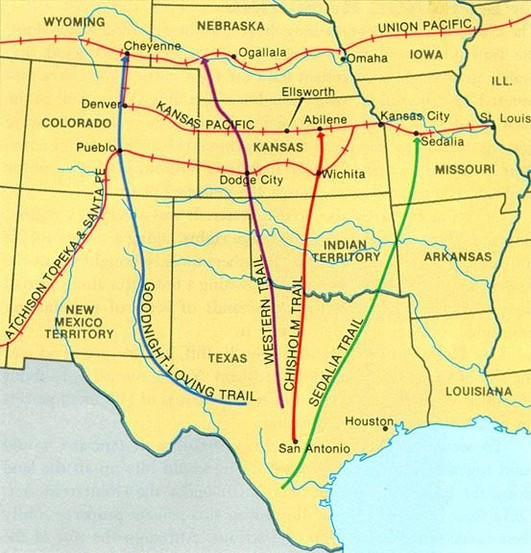
Major cattle trails and Kansas railheads
Commercial agriculture and mechanization
- New tools included steel plows, reapers, binders, threshers, seed drills, windmills, and irrigation technology.
- Joseph Glidden’s barbed wire patent in 1874 helped fence land cheaply.
- Bonanza farms in the northern Great Plains used machinery and wage labor on a huge scale.
- Mechanization raised production and lowered food prices, but bigger harvests often meant lower prices and lower profits per farmer.
Why Farmers Struggled and Organized
Commercial farming tied farmers to systems they could not control. They depended on railroads, banks, grain elevators, machinery companies, and distant commodity markets.
Problems piled up:
- Falling crop prices
- Deflation, which made debts harder to repay
- High freight rates
- Debt
- Economic downturns like the Panic of 1873 and Panic of 1893
Farmer cooperatives and protest
| Group or law | What it did |
|---|---|
| Grange founded by Oliver H. Kelley in 1867 | Built farmer cooperation and community |
| Cooperative stores and grain elevators | Cut dependence on middlemen |
| Granger laws | Tried to regulate railroads and warehouses |
| Munn v. Illinois (1877) | Upheld regulation of grain warehouses |
| Wabash v. Illinois (1886) | Limited state regulation of interstate railroads |
| Interstate Commerce Act (1887) | Created the Interstate Commerce Commission |
| Northern/Northwestern Farmers’ Alliance | Regional farmer organizing |
| Southern Farmers’ Alliance | Regional farmer organizing |
| Colored Farmers’ Alliance | Organized Black farmers shut out elsewhere |
| Subtreasury plan | Proposed federal warehouses and low-interest loans |
These groups began with cooperation and moved toward Populist politics because many farmers concluded that private markets alone would not protect them.
Effects of Western Economic Development
Western growth created new towns around mines, railroads, farms, timber, and government offices. It also made the country more regionally specialized. The West shipped grain, livestock, timber, and minerals east. The East sent capital, manufactured goods, and machinery west.
Benefits
- More food and raw materials
- Lower food prices
- Stronger national economy
- Better continental infrastructure
Costs
- Deforestation
- Overgrazing
- Hydraulic mining debris
- Drought stress
- Bison decline
- More corporate power and land speculation
- More pressure on Native lands
Key Takeaways
Homestead Act of 1862
Offered 160 acres of public land to settlers who lived on and improved it, encouraging western migration and farm ownership despite frequent hardship and fraud
Timber Culture Act of 1873
Offered additional western land to settlers who planted trees, an often unsuccessful and fraud-prone attempt to adapt homesteading to the Plains
Desert Land Act of 1877
Encouraged settlers to acquire and irrigate arid western land, though it often produced disappointing results and fraud
Railroad Subsidies and Land Grants
Federal bonds, loans, rights of way, and alternating land sections reduced construction risks and financed western railroad expansion
Pacific Railway Acts
The 1862 act and its 1864 amendments subsidized the Union Pacific and Central Pacific with loans and land to build a transcontinental railroad
First Transcontinental Railroad
Completed in 1869 when the Union Pacific and Central Pacific met at Promontory Summit, Utah, linking the Pacific Coast to the eastern rail network
Standard Time Zones
Common regional times adopted by the railroad industry in 1883 to coordinate schedules across the national rail network
Pacific Telegraph Act of 1860
Supported construction of the transcontinental telegraph, completed in 1861, which connected western communities to eastern markets and finance
Comstock Lode
Major silver deposit discovered in Nevada in 1859 that attracted migrants and investment and fueled the growth of Virginia City
Hydraulic Mining
Used pressurized water to wash away hillsides for minerals, increasing production but causing severe erosion and river debris
Open-Range System
Unfenced cattle grazing system that declined with barbed wire, expanding farms, overgrazing, falling prices, and the severe winter of 1886–1887
Long Cattle Drives
Movements of Texas cattle north to Kansas railheads, where trains carried them to eastern slaughterhouses and consumers
Chisholm Trail
Major cattle trail running north from Texas through Indian Territory to Kansas railheads
Joseph McCoy
Cattle entrepreneur who established stockyards at Abilene, Kansas, in 1867 and helped make it a major cattle-shipping town
Abilene, Kansas
Early cattle town and railhead where Texas herds were loaded onto trains for eastern markets
Refrigerated Railroad Cars
Allowed dressed beef to be shipped long distances, lowering costs and strengthening large Chicago meatpacking companies
Chicago
Major railroad, grain, and meatpacking center that connected western farms and ranches to national processing and consumer markets
Barbed Wire
Cheap fencing patented successfully in 1874 that protected crops, established property boundaries, and helped end the open range
Joseph Glidden
Patented a successful and widely used form of barbed wire in 1874
Agricultural Mechanization
Use of improved farm machinery to cultivate more acreage with less labor, greatly increasing production and helping lower food prices
Dry Farming
Semiarid farming method using deep plowing, moisture-conserving cultivation, and fallow land to cope with limited rainfall
Bonanza Farms
Large, capital-intensive Great Plains farms that used wage labor and machinery to grow crops such as wheat on thousands of acres
Commercial Agriculture
Market-oriented farming in which producers specialized in crops for distant buyers and relied on machinery, credit, and railroads
Deflation
A decline in the general price level that made fixed debts harder to repay because they had to be repaid with more valuable dollars
Agricultural Market Consolidation
Concentration of transportation, storage, processing, marketing, and credit in large businesses on which independent farmers depended
Railroad Discrimination
Practices such as rebates for large shippers and high short-haul rates that disadvantaged small farmers with few transportation alternatives
Farmer Cooperatives
Collective stores, purchasing arrangements, crop-marketing systems, elevators, and warehouses intended to reduce farmers’ dependence on middlemen
National Grange of the Patrons of Husbandry
Farm organization founded in 1867 that provided education and fellowship, organized cooperatives, and supported regulation of railroad and warehouse rates
Oliver H. Kelley
Founder of the National Grange of the Patrons of Husbandry in 1867
Granger Laws
State laws supported by the Grange to regulate railroad freight charges and grain warehouse rates
Munn v. Illinois
The 1877 Supreme Court decision upholding state regulation of private property, such as grain warehouses, when it affected the public interest
Wabash, St. Louis & Pacific Railway Co. v. Illinois
The 1886 Supreme Court decision ruling that states could not regulate railroad traffic crossing state boundaries
Interstate Commerce Act of 1887
Prohibited certain discriminatory railroad practices and created the initially weak Interstate Commerce Commission to regulate interstate railroads
Farmers’ Alliances
Regional farm organizations that promoted education and cooperatives and increasingly demanded railroad regulation, easier credit, and higher prices
Colored Farmers’ Alliance
Organization of Black farmers that pursued cooperation and economic reform separately because racial segregation limited collaboration with white alliances
Subtreasury Plan
Farm Alliance proposal for federal warehouses and low-interest crop-secured loans so farmers could delay sales until prices improved
National Market Integration
Railroads and telegraphs linked western producers and resources with eastern consumers, manufacturers, investors, and financial markets
Union Pacific Railroad
Built westward from the Missouri River region and joined the Central Pacific in Utah to complete the first transcontinental railroad
Central Pacific Railroad
Built eastward from Sacramento and joined the Union Pacific in Utah to complete the first transcontinental railroad
Placer Mining
Separated gold and other minerals from stream sediments with pans, sluices, or similar equipment
Deep-Shaft Mining
Capital-intensive extraction of underground ore using shafts, pumps, ventilation, mills, and other large-scale equipment
Boomtown
Community that grew rapidly when a mineral discovery or other economic opportunity attracted workers, merchants, and investors
Ghost Town
Former boomtown largely abandoned after its resource or economic activity became unprofitable
Transcontinental Telegraph
Communication line completed in 1861 that rapidly connected western communities with eastern markets and financial centers
Notes
Homestead Act of 1862
Offered 160 acres of public land to settlers who lived on and improved it, encouraging western migration and farm ownership despite frequent hardship and fraud
Timber Culture Act of 1873
Offered additional western land to settlers who planted trees, an often unsuccessful and fraud-prone attempt to adapt homesteading to the Plains
Desert Land Act of 1877
Encouraged settlers to acquire and irrigate arid western land, though it often produced disappointing results and fraud
Railroad Subsidies and Land Grants
Federal bonds, loans, rights of way, and alternating land sections reduced construction risks and financed western railroad expansion
Pacific Railway Acts
The 1862 act and its 1864 amendments subsidized the Union Pacific and Central Pacific with loans and land to build a transcontinental railroad
First Transcontinental Railroad
Completed in 1869 when the Union Pacific and Central Pacific met at Promontory Summit, Utah, linking the Pacific Coast to the eastern rail network
Standard Time Zones
Common regional times adopted by the railroad industry in 1883 to coordinate schedules across the national rail network
Pacific Telegraph Act of 1860
Supported construction of the transcontinental telegraph, completed in 1861, which connected western communities to eastern markets and finance
Comstock Lode
Major silver deposit discovered in Nevada in 1859 that attracted migrants and investment and fueled the growth of Virginia City
Hydraulic Mining
Used pressurized water to wash away hillsides for minerals, increasing production but causing severe erosion and river debris
Open-Range System
Unfenced cattle grazing system that declined with barbed wire, expanding farms, overgrazing, falling prices, and the severe winter of 1886–1887
Long Cattle Drives
Movements of Texas cattle north to Kansas railheads, where trains carried them to eastern slaughterhouses and consumers
Chisholm Trail
Major cattle trail running north from Texas through Indian Territory to Kansas railheads
Joseph McCoy
Cattle entrepreneur who established stockyards at Abilene, Kansas, in 1867 and helped make it a major cattle-shipping town
Abilene, Kansas
Early cattle town and railhead where Texas herds were loaded onto trains for eastern markets
Refrigerated Railroad Cars
Allowed dressed beef to be shipped long distances, lowering costs and strengthening large Chicago meatpacking companies
Chicago
Major railroad, grain, and meatpacking center that connected western farms and ranches to national processing and consumer markets
Barbed Wire
Cheap fencing patented successfully in 1874 that protected crops, established property boundaries, and helped end the open range
Joseph Glidden
Patented a successful and widely used form of barbed wire in 1874
Agricultural Mechanization
Use of improved farm machinery to cultivate more acreage with less labor, greatly increasing production and helping lower food prices
Dry Farming
Semiarid farming method using deep plowing, moisture-conserving cultivation, and fallow land to cope with limited rainfall
Bonanza Farms
Large, capital-intensive Great Plains farms that used wage labor and machinery to grow crops such as wheat on thousands of acres
Commercial Agriculture
Market-oriented farming in which producers specialized in crops for distant buyers and relied on machinery, credit, and railroads
Deflation
A decline in the general price level that made fixed debts harder to repay because they had to be repaid with more valuable dollars
Agricultural Market Consolidation
Concentration of transportation, storage, processing, marketing, and credit in large businesses on which independent farmers depended
Railroad Discrimination
Practices such as rebates for large shippers and high short-haul rates that disadvantaged small farmers with few transportation alternatives
Farmer Cooperatives
Collective stores, purchasing arrangements, crop-marketing systems, elevators, and warehouses intended to reduce farmers’ dependence on middlemen
National Grange of the Patrons of Husbandry
Farm organization founded in 1867 that provided education and fellowship, organized cooperatives, and supported regulation of railroad and warehouse rates
Oliver H. Kelley
Founder of the National Grange of the Patrons of Husbandry in 1867
Granger Laws
State laws supported by the Grange to regulate railroad freight charges and grain warehouse rates
Munn v. Illinois
The 1877 Supreme Court decision upholding state regulation of private property, such as grain warehouses, when it affected the public interest
Wabash, St. Louis & Pacific Railway Co. v. Illinois
The 1886 Supreme Court decision ruling that states could not regulate railroad traffic crossing state boundaries
Interstate Commerce Act of 1887
Prohibited certain discriminatory railroad practices and created the initially weak Interstate Commerce Commission to regulate interstate railroads
Farmers’ Alliances
Regional farm organizations that promoted education and cooperatives and increasingly demanded railroad regulation, easier credit, and higher prices
Colored Farmers’ Alliance
Organization of Black farmers that pursued cooperation and economic reform separately because racial segregation limited collaboration with white alliances
Subtreasury Plan
Farm Alliance proposal for federal warehouses and low-interest crop-secured loans so farmers could delay sales until prices improved
National Market Integration
Railroads and telegraphs linked western producers and resources with eastern consumers, manufacturers, investors, and financial markets
Union Pacific Railroad
Built westward from the Missouri River region and joined the Central Pacific in Utah to complete the first transcontinental railroad
Central Pacific Railroad
Built eastward from Sacramento and joined the Union Pacific in Utah to complete the first transcontinental railroad
Placer Mining
Separated gold and other minerals from stream sediments with pans, sluices, or similar equipment
Deep-Shaft Mining
Capital-intensive extraction of underground ore using shafts, pumps, ventilation, mills, and other large-scale equipment
Boomtown
Community that grew rapidly when a mineral discovery or other economic opportunity attracted workers, merchants, and investors
Ghost Town
Former boomtown largely abandoned after its resource or economic activity became unprofitable
Transcontinental Telegraph
Communication line completed in 1861 that rapidly connected western communities with eastern markets and financial centers
