Topic 5.1 Notes – Contextualizing Period 5
How Expansion Turned Sectional Tension into a National Crisis
Before 1844, the country was already changing fast. Transportation growth and the Market Revolution tied regions together, cotton expansion made slavery even more profitable, and the Missouri Compromise had temporarily calmed conflict by drawing the 36°30′ line. The problem was that these sections were connected and increasingly different.
Manifest Destiny meant many Americans believed the U.S. had a mission to expand across North America. That belief mixed idealism with economics, land hunger, and national security.
On a map of the United States around 1840, you can already see some of the pressure points that would define the decade ahead, especially Texas and the jointly occupied Oregon Country.
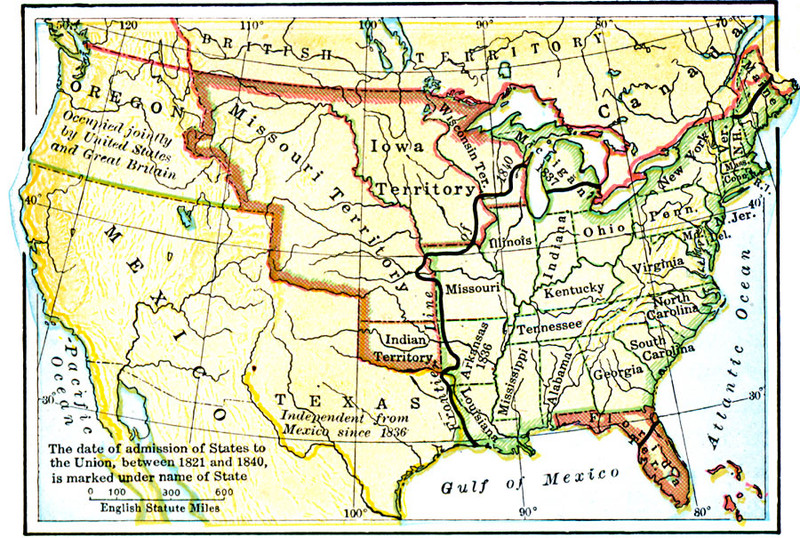
United States expansion pressures around 1840
Territorial growth came quickly:
- Annexation of Texas brought in a huge slaveholding republic and raised conflict with Mexico.
- Oregon boundary settlement with Britain added northern land without war.
- Mexican-American War ended in U.S. victory.
- Mexican Cession gave the U.S. a vast new western region.
- California gold rush pulled migrants west almost overnight and pushed California toward statehood.
Each gain raised the same questions. Would slavery spread there? Would Congress admit new free or slave states? Which section would gain power in the Senate?
The old 36°30′ Missouri line had worked only as a temporary patch. New western lands made that patch unstable.
Expansion also hit people already living in the West:
- American Indians lost land and autonomy through warfare, treaties, and white settlement.
- Mexican Americans got formal protections in the Treaty of Guadalupe Hidalgo, but many still lost land, political influence, and status.
Keep this chain in your head because it shows up everywhere on tests: expansion → slavery in the territories → sectional conflict → political breakdown → Civil War.
The Main Forces Shaping the Period
Several forces were moving at once, but slavery tied them together.
Immigration and nativism
Immigration strengthened the North’s population and labor force:
- Irish immigrants came heavily after the Great Famine and often took low-wage urban jobs.
- German immigrants came for economic, political, and religious reasons and settled in cities and the Midwest.
- Chinese migrants moved to California during and after the gold rush.
That growth triggered nativism, especially anti-Catholic fear. The American Party, or Know-Nothings, blamed immigrants for taking jobs and weakening Protestant culture.
Reform and abolition
The Second Great Awakening helped create a reform spirit that pushed people toward moral action.
Abolitionists attacked slavery directly:
- Frederick Douglass used speeches and slave narratives to expose slavery’s brutality.
- William Lloyd Garrison demanded immediate abolition.
- Antislavery societies, slave narratives, the Underground Railroad, and Harriet Tubman all spread the movement.
Women also pushed for rights at the Seneca Falls Convention, where the Declaration of Sentiments demanded greater equality.
Free labor vs slavery
Free-labor ideology said western land should be open to free white workers who could rise through their own labor. The Free-Soil view opposed slavery’s expansion because slaveholders would dominate land and politics.
Southern defenders increasingly called slavery a positive good. And when you see states’ rights in this period, connect it to slavery. That phrase was mainly being used to protect slavery.
Rights and citizenship
This period kept asking who counted as fully American. African Americans, women, American Indians, immigrants, and Mexican Americans all faced limits on rights. The country claimed liberty while denying it to many people.
From Compromise to Secession
In the 1850s, leaders kept trying to settle slavery in the territories. Each fix made things worse.
- Compromise of 1850 admitted California as free and included a harsher Fugitive Slave Law.
- Kansas-Nebraska Act let settlers decide slavery by popular sovereignty and effectively wrecked the Missouri Compromise line.
- Bleeding Kansas showed that popular sovereignty could mean actual violence.
- Dred Scott v. Sandford said Congress could not ban slavery in territories and denied citizenship to African Americans.
These fights raised the biggest constitutional questions of the era:
- Could Congress limit slavery in territories?
- Did popular sovereignty work?
- Were enslaved people constitutionally protected property?
The party system cracked under that pressure:
- Whigs fell apart.
- Democrats split sectionally.
- Republicans formed from former Whigs, Free-Soilers, and antislavery Democrats.
In 1860, Abraham Lincoln won without Southern electoral support. Southern leaders saw that as proof they were losing national power. South Carolina seceded first, other Southern states followed, and they formed the Confederate States of America.
Civil War, Reconstruction, and What Period 5 Settled
The Union had major advantages in population, industry, railroads, money, and Lincoln’s leadership. The Emancipation Proclamation changed the war’s purpose by making slavery’s destruction part of Union victory and weakening the Confederacy. Nearly 180,000 Black soldiers served in the Union cause, like the Union troops shown here. The Gettysburg Address reframed the war as a fight for national purpose and democratic ideals.
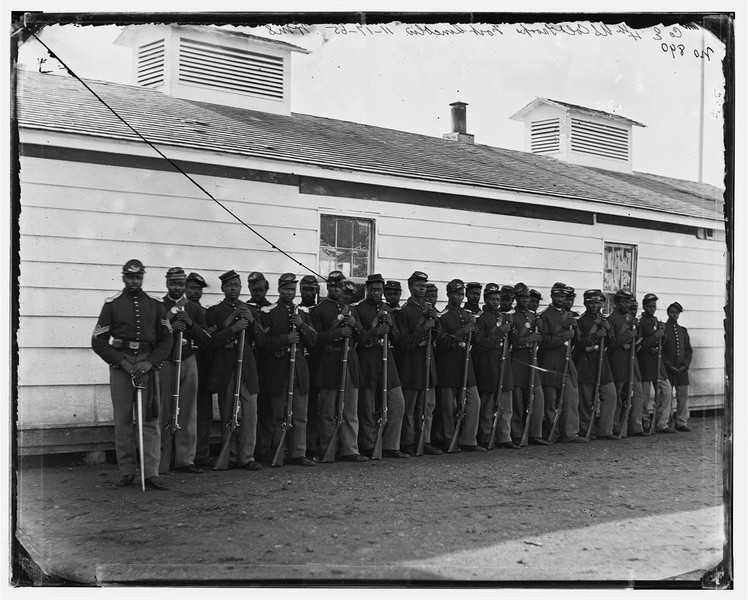
Black Union soldiers during the Civil War
Reconstruction then rewrote the Constitution:
- 13th Amendment abolished slavery.
- 14th Amendment established birthright citizenship, due process, and equal protection.
- 15th Amendment protected voting rights regardless of race.
Those were huge changes, but Reconstruction had sharp limits. Sharecropping, debt, and the crop-lien system trapped many Black families in poverty. Black Codes, white resistance, and Ku Klux Klan violence attacked Black freedom. Northern commitment faded, and troop withdrawal in 1877 ended Reconstruction.
