Topic 5.6 Notes – Failure of Compromise
Why Compromise Over Slavery in the Territories Failed
The core issue was bigger than any one territory. Every new state could shift the balance in Congress, so slavery in the West meant political power in Washington and the future of the Union.
Earlier deals had only postponed the fight:
- Missouri Compromise drew the 36°30′ line and tried a geographic compromise.
- Compromise of 1850 used popular sovereignty in some western lands and delayed a final answer.
This map is a good reminder of what that earlier geographic compromise looked like before the 1850s blew it apart.
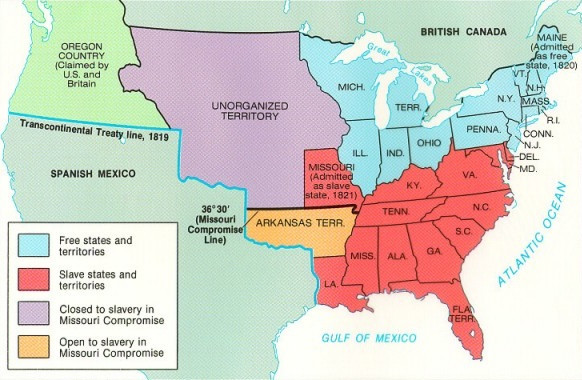
Missouri Compromise map
The 1850s showed four failed ways of solving the issue:
- Geographic compromise failed when old boundaries no longer held.
- Popular sovereignty failed because both sides rushed in to control the vote.
- Judicial settlement failed because the Supreme Court’s answer satisfied the South and enraged the North.
- National party mediation failed because parties stopped bridging sections and became sectional themselves.
What made this spiral so dangerous was mistrust. Each side thought the other was using the federal government to force its system on the whole nation.
The chain you need to know
- Kansas-Nebraska Act repealed the Missouri Compromise line.
- Bleeding Kansas showed popular sovereignty turning into fraud and violence.
- Sectional violence hardened attitudes.
- Dred Scott wiped out faith in congressional compromise.
- Party realignment created sectional politics.
- Democratic splits made compromise even less possible.
The Kansas-Nebraska Act and Bleeding Kansas
In 1854, Stephen A. Douglas sponsored the Kansas-Nebraska Act. It organized Kansas and Nebraska and said settlers would decide slavery through popular sovereignty.
That sounded democratic, but it also repealed the Missouri Compromise restriction north of 36°30′.
- Northerners were outraged because they saw this as betrayal of a long-standing bargain, feared slavery spreading into land once closed to it, and talked about a Slave Power conspiracy.
- Southerners supported it because they argued slaveholders had equal rights in the territories and enslaved people were protected property.
How Kansas fell apart
Popular sovereignty assumed a fair local vote. Kansas got the opposite.
- New England Emigrant Aid Company sent antislavery settlers.
- Border ruffians from Missouri crossed over to vote illegally.
- Fraud in the 1855 elections created a proslavery legislature at Shawnee Mission.
- Antislavery settlers rejected it and formed a rival government at Topeka.
Bleeding Kansas
- Sack of Lawrence involved proslavery forces attacking an antislavery town.
- John Brown’s Pottawatomie Creek killings were a violent antislavery retaliation.
- Raids, murders, and destruction followed on both sides.
The big point is simple. Popular sovereignty produced rival governments, fraud, and violence instead of a settlement.
Violence and Court Decisions Deepened Sectional Conflict
Kansas violence spilled into national politics.
The caning of Charles Sumner
After Charles Sumner gave his “The Crime Against Kansas” speech, Preston Brooks caned him on the Senate floor in 1856.
- Many Northerners saw slaveholding brutality.
- Many Southerners praised Brooks for defending Southern honor.
Political cartoons like this one helped turn the attack into a national symbol of sectional hatred.
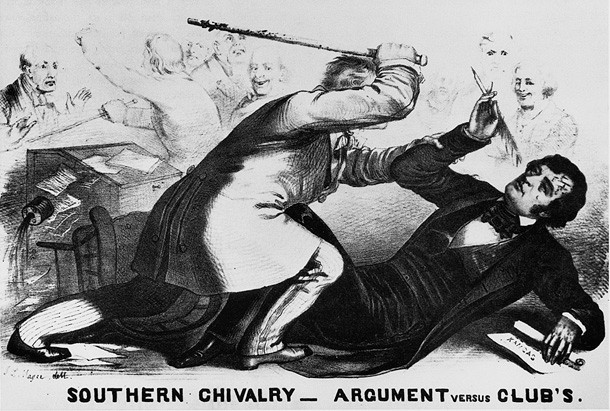
“Southern Chivalry” cartoon on the Sumner caning
Dred Scott v. Sandford
In 1857, Chief Justice Roger B. Taney ruled that:
- African Americans were not U.S. citizens as he interpreted the Constitution.
- Dred Scott had no standing to sue in federal court.
- Congress could not ban slavery in the territories.
- The Missouri Compromise was unconstitutional.
His logic used Fifth Amendment property-rights reasoning. To the South, this was a constitutional victory. To the North, it looked like proof the federal government served slaveholders.
This mattered enormously because if Congress could not restrict slavery, the main Republican position was under direct attack.
Party Realignment and the Final Breakdown of National Politics
The old party system had helped hold the Union together because both major parties had Northern and Southern wings. In the 1850s, that structure broke.
- The Whig Party collapsed over slavery.
- The American Party or Know-Nothings grew through anti-immigrant, anti-Catholic nativism, but it also split sectionally.
- The Republican Party formed in 1854 from former Northern Whigs, Free-Soilers, antislavery Democrats, and some ex-Know-Nothings. It opposed the extension of slavery and backed free-soil ideology, meaning western land should go to free labor.
Election of 1856
| Candidate | Party | Significance |
|---|---|---|
| James Buchanan | Democrat | Won presidency |
| John C. Frémont | Republican | Strong Northern support showed a sectional party could compete |
| Millard Fillmore | American Party | Showed nativism still mattered, but less than slavery |
Lecompton Constitution and Democratic division
The Lecompton Constitution in 1857 was a proslavery constitution for Kansas. Buchanan supported it. Douglas opposed it because it violated fair popular sovereignty. Kansas later rejected it. That split Democrats at the exact moment national compromise needed them united.
Lincoln, Douglas, and John Brown
In the Lincoln-Douglas debates, Lincoln opposed expansion of slavery and used the House Divided idea. Douglas answered Dred Scott with the Freeport Doctrine, saying territories could exclude slavery by refusing to protect it legally. That helped him in Illinois but alienated Southern Democrats.
In 1859, John Brown’s raid on Harpers Ferry tried to seize a federal arsenal and spark a slave uprising. He was captured by U.S. Marines led by Robert E. Lee and executed. Some Northerners praised him as a martyr. Southerners saw the raid as proof antislavery politics threatened their lives and property.
Key Takeaways
Popular Sovereignty
Policy allowing territorial settlers to decide slavery; in practice it produced fraud, rival governments, and violence rather than an accepted result
Missouri Compromise
1820 settlement prohibiting slavery in the Louisiana Purchase north of 36°30′ except Missouri; the Kansas–Nebraska Act repealed its restriction
Kansas–Nebraska Act
1854 law organizing Kansas and Nebraska under popular sovereignty, repealing the Missouri Compromise restriction and provoking a sectional crisis
Stephen A. Douglas
Illinois Democrat who sponsored the Kansas–Nebraska Act, defended popular sovereignty and the Freeport Doctrine, and opposed the Lecompton Constitution
Slave Power Conspiracy
Northern belief that slaveholders and their allies were using the federal government to extend and protect slavery
Border Ruffians
Proslavery Missourians who crossed into Kansas, cast illegal ballots, and intimidated antislavery settlers during territorial elections
Bleeding Kansas
Mid-1850s armed conflict in Kansas in which proslavery and antislavery forces used fraud and violence while competing to control the territory
Sack of Lawrence
May 1856 proslavery attack on the antislavery town of Lawrence, Kansas, destroying newspaper offices and other property
Pottawatomie Killings
John Brown and his followers’ retaliatory killing of five proslavery men near Pottawatomie Creek during Bleeding Kansas
John Brown
Radical abolitionist who led the Pottawatomie killings and later raided Harpers Ferry in hopes of starting an enslaved uprising
Caning of Charles Sumner
1856 assault in which Representative Preston Brooks beat Senator Charles Sumner after Sumner’s antislavery “Crime Against Kansas” speech
Second Party System
National competition between Democrats and Whigs whose cross-sectional coalitions collapsed in the 1850s under pressure from slavery and nativism
Whig Party
National party that disintegrated in the 1850s as Northern antislavery Whigs and Southern Whigs could no longer cooperate over slavery’s expansion
Nativism
Hostility toward immigrants, especially Catholic Irish and Germans, that disrupted party loyalties but ultimately could not displace the slavery issue
American Party (Know-Nothing Party)
Nativist party hostile to Catholic immigration that briefly attracted former Whigs before dividing along sectional lines over slavery
Republican Party
Northern-based party formed in 1854 from antislavery Whigs, Free-Soilers, antislavery Democrats, and others opposed to slavery’s territorial expansion
Free-Soil Ideology
Belief that western territories should exclude slavery and remain open to free labor, independent farmers, and economic advancement
Democratic Party
The last major party with substantial support in both sections, increasingly divided over whether settlers could exclude slavery from federal territories
Election of 1856
James Buchanan defeated Republican John C. Frémont and Know-Nothing Millard Fillmore, while Frémont’s Northern strength revealed a powerful sectional realignment
Lecompton Constitution
Fraud-tainted proslavery Kansas constitution backed by Buchanan but opposed by Douglas; Congress rejected it and Kansas voters overwhelmingly defeated it
James Buchanan
Democratic president elected in 1856 who supported admitting Kansas under the proslavery Lecompton Constitution, splitting his party and discrediting his administration
Dred Scott v. Sandford
1857 ruling that Dred Scott lacked federal citizenship and that Congress could not prohibit slavery in the territories, making the Missouri Compromise unconstitutional
Roger B. Taney
Chief justice whose Dred Scott opinion held that people descended from enslaved Africans were not U.S. citizens and that Congress could not prohibit slavery in federal territories
Lincoln–Douglas Debates
1858 Illinois Senate debates in which Lincoln opposed slavery’s expansion and Douglas defended popular sovereignty despite the Dred Scott ruling
Abraham Lincoln
Republican who argued that slavery was wrong and should not expand, challenged Douglas in 1858, and emerged as a prominent national party leader
House Divided Speech
Lincoln’s warning that the nation could not remain permanently divided between slavery and freedom and would eventually become all one or the other
Freeport Doctrine
Douglas’s claim that territories could effectively exclude slavery by refusing to enact the local laws and police protections it required
John Brown’s Raid on Harpers Ferry
Brown’s failed 1859 seizure of the federal arsenal at Harpers Ferry to arm enslaved people and spark an uprising; after his execution, some Northerners portrayed him as a martyr, intensifying Southern fears
Notes
Popular Sovereignty
Policy allowing territorial settlers to decide slavery; in practice it produced fraud, rival governments, and violence rather than an accepted result
Missouri Compromise
1820 settlement prohibiting slavery in the Louisiana Purchase north of 36°30′ except Missouri; the Kansas–Nebraska Act repealed its restriction
Kansas–Nebraska Act
1854 law organizing Kansas and Nebraska under popular sovereignty, repealing the Missouri Compromise restriction and provoking a sectional crisis
Stephen A. Douglas
Illinois Democrat who sponsored the Kansas–Nebraska Act, defended popular sovereignty and the Freeport Doctrine, and opposed the Lecompton Constitution
Slave Power Conspiracy
Northern belief that slaveholders and their allies were using the federal government to extend and protect slavery
Border Ruffians
Proslavery Missourians who crossed into Kansas, cast illegal ballots, and intimidated antislavery settlers during territorial elections
Bleeding Kansas
Mid-1850s armed conflict in Kansas in which proslavery and antislavery forces used fraud and violence while competing to control the territory
Sack of Lawrence
May 1856 proslavery attack on the antislavery town of Lawrence, Kansas, destroying newspaper offices and other property
Pottawatomie Killings
John Brown and his followers’ retaliatory killing of five proslavery men near Pottawatomie Creek during Bleeding Kansas
John Brown
Radical abolitionist who led the Pottawatomie killings and later raided Harpers Ferry in hopes of starting an enslaved uprising
Caning of Charles Sumner
1856 assault in which Representative Preston Brooks beat Senator Charles Sumner after Sumner’s antislavery “Crime Against Kansas” speech
Second Party System
National competition between Democrats and Whigs whose cross-sectional coalitions collapsed in the 1850s under pressure from slavery and nativism
Whig Party
National party that disintegrated in the 1850s as Northern antislavery Whigs and Southern Whigs could no longer cooperate over slavery’s expansion
Nativism
Hostility toward immigrants, especially Catholic Irish and Germans, that disrupted party loyalties but ultimately could not displace the slavery issue
American Party (Know-Nothing Party)
Nativist party hostile to Catholic immigration that briefly attracted former Whigs before dividing along sectional lines over slavery
Republican Party
Northern-based party formed in 1854 from antislavery Whigs, Free-Soilers, antislavery Democrats, and others opposed to slavery’s territorial expansion
Free-Soil Ideology
Belief that western territories should exclude slavery and remain open to free labor, independent farmers, and economic advancement
Democratic Party
The last major party with substantial support in both sections, increasingly divided over whether settlers could exclude slavery from federal territories
Election of 1856
James Buchanan defeated Republican John C. Frémont and Know-Nothing Millard Fillmore, while Frémont’s Northern strength revealed a powerful sectional realignment
Lecompton Constitution
Fraud-tainted proslavery Kansas constitution backed by Buchanan but opposed by Douglas; Congress rejected it and Kansas voters overwhelmingly defeated it
James Buchanan
Democratic president elected in 1856 who supported admitting Kansas under the proslavery Lecompton Constitution, splitting his party and discrediting his administration
Dred Scott v. Sandford
1857 ruling that Dred Scott lacked federal citizenship and that Congress could not prohibit slavery in the territories, making the Missouri Compromise unconstitutional
Roger B. Taney
Chief justice whose Dred Scott opinion held that people descended from enslaved Africans were not U.S. citizens and that Congress could not prohibit slavery in federal territories
Lincoln–Douglas Debates
1858 Illinois Senate debates in which Lincoln opposed slavery’s expansion and Douglas defended popular sovereignty despite the Dred Scott ruling
Abraham Lincoln
Republican who argued that slavery was wrong and should not expand, challenged Douglas in 1858, and emerged as a prominent national party leader
House Divided Speech
Lincoln’s warning that the nation could not remain permanently divided between slavery and freedom and would eventually become all one or the other
Freeport Doctrine
Douglas’s claim that territories could effectively exclude slavery by refusing to enact the local laws and police protections it required
John Brown’s Raid on Harpers Ferry
Brown’s failed 1859 seizure of the federal arsenal at Harpers Ferry to arm enslaved people and spark an uprising; after his execution, some Northerners portrayed him as a martyr, intensifying Southern fears
