Topic 5.10 Notes – Reconstruction
What Reconstruction Changed
Emancipation destroyed slavery during the war, but it did not answer what rights freedpeople would have or how the South would be rebuilt. Reconstruction was the effort from 1865 to 1877 to restore the former Confederate states, define freedom, and settle who controlled reunion.
The core questions all connect:
- Readmission meant deciding the terms for former Confederate states to return.
- Freedpeople’s rights meant deciding whether freedom included voting, land, family control, education, and legal equality.
- Federal vs. state power meant deciding whether states could still define rights mostly on their own.
- Congress vs. president meant deciding who would run Reconstruction policy.
The biggest changes to lock in:
- 13th Amendment permanently ended slavery.
- Secession was effectively settled. States could not leave the Union.
- Citizenship became more national, especially through the 14th Amendment.
- The federal government took a bigger role in protecting rights.
- The South saw a brief biracial democracy, with Black voting and officeholding.
The tension you need to remember is simple. Reconstruction changed the Constitution a lot, but daily life and economic power changed far less.
Competing Plans for Reconstruction
The first fight was over how harsh or lenient reunion should be.
Lincoln’s Ten Percent Plan
Lincoln’s Proclamation of Amnesty and Reconstruction in 1863 offered a quick path back. If 10 percent of a state’s 1860 voters swore loyalty and accepted emancipation, they could rebuild a state government. Lincoln wanted fast restoration, but this plan gave no broad protection for Black suffrage or long-term rights.
Wade-Davis Bill
Congress thought Lincoln was too lenient. The Wade-Davis Bill required a majority to take an ironclad oath saying they had never supported the Confederacy. Lincoln pocket-vetoed it. That clash previewed the larger Congress-versus-president struggle.
Johnson’s Presidential Reconstruction
Andrew Johnson kept reunion easy. Southern states had to repeal secession, repudiate Confederate debt, and ratify the 13th Amendment. He handed out pardons widely, did not require Black voting rights, and let former Confederates return to office, including Alexander Stephens.
Black Codes
Southern governments then passed Black Codes to control freedpeople through labor contracts, vagrancy laws, apprenticeship laws, and limits on movement, property, testimony, and arms. Mississippi’s Black Code is the standard example. These laws convinced many northerners that Johnson’s plan had failed, which is exactly the argument this cartoon makes about violence and white southern resistance under Johnson’s approach.
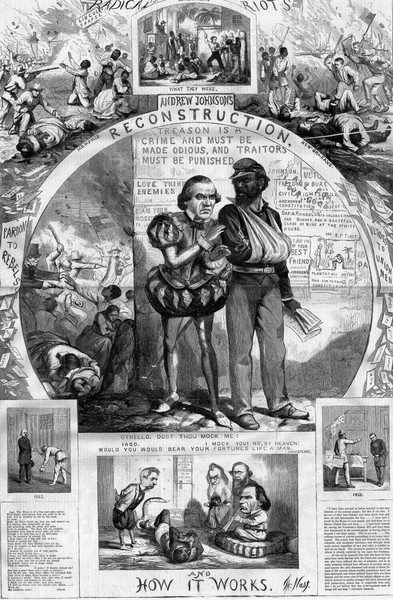
Thomas Nast cartoon attacking Johnson’s Reconstruction
How the Federal Government Tried to Protect Freedom
Freedpeople defined freedom in concrete ways. They wanted legal marriages, control of family life, independent churches, schools, land, and political participation.
Freedmen’s Bureau
The Freedmen’s Bureau was created in 1865 as the Bureau of Refugees, Freedmen, and Abandoned Lands and led by Oliver O. Howard. It gave food, medical care, legal help, marriage legalization, labor contract supervision, and school support. It helped found schools and HBCUs, including Howard University. Its limits mattered too. It was understaffed, uneven, and could not deliver lasting land reform. The promise of “forty acres and a mule” came from Sherman’s Special Field Order No. 15, but Johnson returned much land to former Confederates.
Civil Rights Act of 1866
This law declared birthright citizenship and basic civil rights. It directly overturned Dred Scott v. Sandford. Johnson vetoed it, and Congress overrode him. That showed Congress was taking control.
Reconstruction Amendments
| Amendment | What it did |
|---|---|
| 13th | Abolished slavery except as punishment for crime |
| 14th | Birthright citizenship, due process, equal protection, penalties for denying male suffrage, barred some ex-Confederates from office |
| 15th | Banned denial of voting rights based on race, color, or previous condition of servitude |
The women’s rights movement grew stronger but split here. Elizabeth Cady Stanton and Susan B. Anthony formed the National Woman Suffrage Association. Lucy Stone and Henry Blackwell formed the American Woman Suffrage Association.
Congressional Reconstruction in Action
Congressional Republicans ranged from moderates to Radicals like Thaddeus Stevens and Charles Sumner. They wanted stronger federal protection.
The Reconstruction Acts of 1867 divided the former Confederacy except Tennessee into five military districts. States had to register Black male voters, hold conventions, write new constitutions, ratify the 14th Amendment, and win congressional approval.
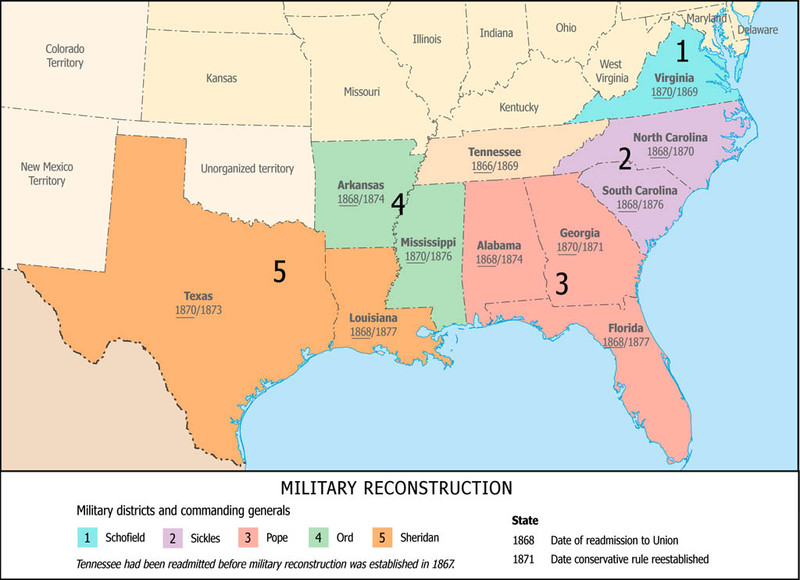
Military Reconstruction districts, 1867
Johnson fought back and was impeached in 1868 over Edwin Stanton and the Tenure of Office Act. The House impeached him, but the Senate acquitted him by one vote. Congress still dominated Reconstruction.
Republican governments in the South rested on a coalition of:
- Freedmen
- Scalawags who were white southern Republicans
- Carpetbaggers who were northern migrants
African Americans voted, served on juries, and held office. Named examples you should know together:
- Hiram Revels: first Black U.S. senator
- Blanche K. Bruce: first Black senator to serve a full term
- Robert Smalls: formerly enslaved war hero turned congressman
Their governments built public schools, rebuilt infrastructure, expanded public services, pushed fairer taxes, and protected civil rights. This was the South’s first real experiment in interracial democracy.
Resistance, Enforcement, and Why Reconstruction Was Limited
White southern resistance aimed to destroy Black political power and Republican rule.
Major examples:
- Memphis Riot 1866
- New Orleans Riot 1866
- Ku Klux Klan, founded in 1866
Congress answered with the Enforcement Acts of 1870 and 1871, including the Ku Klux Klan Act. These made voter intimidation and civil-rights violations federal crimes. President Grant used force in places like South Carolina.
This worked for a while, but Reconstruction had weak foundations:
- no broad land redistribution
- continued economic dependence
- persistent white violence
- weakening northern commitment
The final judgment is the one APUSH loves. Reconstruction won huge legal and constitutional gains, but many stayed only partly secure because enforcement and northern resolve did not last.
Key Takeaways
Reconstruction
The 1865–1877 process of restoring the former Confederate states, rebuilding the South, and defining freedom and citizenship after slavery
Abraham Lincoln
President who favored rapid, lenient reunion through the Ten Percent Plan and showed limited late support for Black male suffrage
Ten Percent Plan / Proclamation of Amnesty and Reconstruction
Lincoln’s plan allowing a state government to form when 10 percent of its 1860 voters swore loyalty and accepted emancipation
Wade–Davis Bill
Congressional plan requiring a majority of white men to swear they had never voluntarily supported the Confederacy; Lincoln pocket-vetoed it
Special Field Order No. 15 / “Forty Acres and a Mule”
Sherman’s wartime order reserving some coastal land for freed families, inspiring an expectation of land reform that never became a general guarantee
Freedmen’s Bureau
Federal agency that provided relief, schools, legal assistance, and labor supervision to freedpeople and some poor whites after the war
Andrew Johnson
Lincoln’s successor, a racist southern Unionist who favored rapid restoration of white-controlled governments and opposed Black political equality
Presidential Reconstruction
Johnson’s lenient restoration program requiring loyalty, rejection of secession and Confederate debt, and ratification of the Thirteenth Amendment but not Black suffrage
Black Codes
Southern laws that restricted freedpeople’s movement, employment, legal rights, and autonomy to preserve white control and a dependent labor force
Moderate Republicans vs. Radical Republicans
Moderates initially sought basic civil equality and orderly readmission; Radicals demanded stronger federal protection, Black male suffrage, and deeper southern reform
Thaddeus Stevens
Leading House Radical Republican who advocated strong federal Reconstruction, Black rights, and redistribution of some former Confederate land
Charles Sumner
Leading Senate Radical Republican who supported strong federal protection and political equality for African Americans
Civil Rights Act of 1866
Law declaring U.S.-born people citizens regardless of race and protecting contracts, property, lawsuits, and testimony; enacted over Johnson’s veto
Reconstruction Amendments
The Thirteenth, Fourteenth, and Fifteenth Amendments, which abolished slavery, established national citizenship and equal protection, and prohibited racial discrimination in voting
Thirteenth Amendment
1865 amendment abolishing slavery and involuntary servitude nationwide except as punishment for a crime after conviction
Fourteenth Amendment
1868 amendment establishing birthright citizenship and barring states from abridging citizens’ privileges or immunities or denying due process or equal protection
Fifteenth Amendment
1870 amendment prohibiting denial of voting rights because of race, color, or previous servitude, protecting Black male but not women’s suffrage
National Woman Suffrage Association
Organization founded in 1869 by Stanton and Anthony to seek a federal women’s suffrage amendment and a broad women’s rights program
American Woman Suffrage Association
Organization founded in 1869 by Stone and Blackwell that supported the Fifteenth Amendment and pursued women’s suffrage mainly state by state
Congressional Reconstruction
Republican-led Reconstruction tying readmission to federal protection of civil rights, Black male political participation, and ratification of the Fourteenth Amendment
Reconstruction Acts / Military Reconstruction
1867 laws dividing ten former Confederate states into five military districts and requiring biracial voting, new constitutions, and Fourteenth Amendment ratification
Tenure of Office Act
1867 law requiring Senate consent to remove certain confirmed officials, used against Johnson after he tried to dismiss Edwin Stanton
Andrew Johnson’s Impeachment
The House impeached Johnson in 1868 mainly over the Tenure of Office Act, but the Senate acquitted him by one vote and did not remove him
Scalawags
Pejorative name for white southern Republicans who supported Reconstruction and the region’s biracial Republican governments
Carpetbaggers
Pejorative name for northerners who moved South after the war as officials, teachers, missionaries, veterans, workers, or investors
Biracial Republican Governments
Reconstruction-era southern governments that protected Black male voting, expanded public services, rebuilt infrastructure, and established public-school systems
Ku Klux Klan
White supremacist terrorist organization founded in 1866 that used violence to suppress Black voting and destroy the southern Republican coalition
Enforcement Acts
1870–1871 laws making interference with voting and civil rights a federal offense and authorizing federal supervision and prosecution
Ku Klux Klan Act of 1871
Enforcement law allowing the president to use federal force and, in limited cases, suspend habeas corpus against organized racial terrorism
Ulysses S. Grant
President who used the Enforcement and Ku Klux Klan Acts to suppress Klan terrorism temporarily, especially in South Carolina
Elizabeth Cady Stanton
Women’s rights leader who opposed the Fifteenth Amendment without women’s suffrage and helped found the National Woman Suffrage Association
Susan B. Anthony
Women’s rights leader who opposed the Fifteenth Amendment without women’s suffrage and helped found the National Woman Suffrage Association
Lucy Stone
Suffrage leader who supported the Fifteenth Amendment while continuing to seek women’s enfranchisement, chiefly through state campaigns
Henry Blackwell
Suffrage leader who supported the Fifteenth Amendment and helped organize the state-focused American Woman Suffrage Association
Joint Committee on Reconstruction
Congressional committee created to investigate conditions in the South and recommend a congressional Reconstruction policy
Notes
Reconstruction
The 1865–1877 process of restoring the former Confederate states, rebuilding the South, and defining freedom and citizenship after slavery
Abraham Lincoln
President who favored rapid, lenient reunion through the Ten Percent Plan and showed limited late support for Black male suffrage
Ten Percent Plan / Proclamation of Amnesty and Reconstruction
Lincoln’s plan allowing a state government to form when 10 percent of its 1860 voters swore loyalty and accepted emancipation
Wade–Davis Bill
Congressional plan requiring a majority of white men to swear they had never voluntarily supported the Confederacy; Lincoln pocket-vetoed it
Special Field Order No. 15 / “Forty Acres and a Mule”
Sherman’s wartime order reserving some coastal land for freed families, inspiring an expectation of land reform that never became a general guarantee
Freedmen’s Bureau
Federal agency that provided relief, schools, legal assistance, and labor supervision to freedpeople and some poor whites after the war
Andrew Johnson
Lincoln’s successor, a racist southern Unionist who favored rapid restoration of white-controlled governments and opposed Black political equality
Presidential Reconstruction
Johnson’s lenient restoration program requiring loyalty, rejection of secession and Confederate debt, and ratification of the Thirteenth Amendment but not Black suffrage
Black Codes
Southern laws that restricted freedpeople’s movement, employment, legal rights, and autonomy to preserve white control and a dependent labor force
Moderate Republicans vs. Radical Republicans
Moderates initially sought basic civil equality and orderly readmission; Radicals demanded stronger federal protection, Black male suffrage, and deeper southern reform
Thaddeus Stevens
Leading House Radical Republican who advocated strong federal Reconstruction, Black rights, and redistribution of some former Confederate land
Charles Sumner
Leading Senate Radical Republican who supported strong federal protection and political equality for African Americans
Civil Rights Act of 1866
Law declaring U.S.-born people citizens regardless of race and protecting contracts, property, lawsuits, and testimony; enacted over Johnson’s veto
Reconstruction Amendments
The Thirteenth, Fourteenth, and Fifteenth Amendments, which abolished slavery, established national citizenship and equal protection, and prohibited racial discrimination in voting
Thirteenth Amendment
1865 amendment abolishing slavery and involuntary servitude nationwide except as punishment for a crime after conviction
Fourteenth Amendment
1868 amendment establishing birthright citizenship and barring states from abridging citizens’ privileges or immunities or denying due process or equal protection
Fifteenth Amendment
1870 amendment prohibiting denial of voting rights because of race, color, or previous servitude, protecting Black male but not women’s suffrage
National Woman Suffrage Association
Organization founded in 1869 by Stanton and Anthony to seek a federal women’s suffrage amendment and a broad women’s rights program
American Woman Suffrage Association
Organization founded in 1869 by Stone and Blackwell that supported the Fifteenth Amendment and pursued women’s suffrage mainly state by state
Congressional Reconstruction
Republican-led Reconstruction tying readmission to federal protection of civil rights, Black male political participation, and ratification of the Fourteenth Amendment
Reconstruction Acts / Military Reconstruction
1867 laws dividing ten former Confederate states into five military districts and requiring biracial voting, new constitutions, and Fourteenth Amendment ratification
Tenure of Office Act
1867 law requiring Senate consent to remove certain confirmed officials, used against Johnson after he tried to dismiss Edwin Stanton
Andrew Johnson’s Impeachment
The House impeached Johnson in 1868 mainly over the Tenure of Office Act, but the Senate acquitted him by one vote and did not remove him
Scalawags
Pejorative name for white southern Republicans who supported Reconstruction and the region’s biracial Republican governments
Carpetbaggers
Pejorative name for northerners who moved South after the war as officials, teachers, missionaries, veterans, workers, or investors
Biracial Republican Governments
Reconstruction-era southern governments that protected Black male voting, expanded public services, rebuilt infrastructure, and established public-school systems
Ku Klux Klan
White supremacist terrorist organization founded in 1866 that used violence to suppress Black voting and destroy the southern Republican coalition
Enforcement Acts
1870–1871 laws making interference with voting and civil rights a federal offense and authorizing federal supervision and prosecution
Ku Klux Klan Act of 1871
Enforcement law allowing the president to use federal force and, in limited cases, suspend habeas corpus against organized racial terrorism
Ulysses S. Grant
President who used the Enforcement and Ku Klux Klan Acts to suppress Klan terrorism temporarily, especially in South Carolina
Elizabeth Cady Stanton
Women’s rights leader who opposed the Fifteenth Amendment without women’s suffrage and helped found the National Woman Suffrage Association
Susan B. Anthony
Women’s rights leader who opposed the Fifteenth Amendment without women’s suffrage and helped found the National Woman Suffrage Association
Lucy Stone
Suffrage leader who supported the Fifteenth Amendment while continuing to seek women’s enfranchisement, chiefly through state campaigns
Henry Blackwell
Suffrage leader who supported the Fifteenth Amendment and helped organize the state-focused American Woman Suffrage Association
Joint Committee on Reconstruction
Congressional committee created to investigate conditions in the South and recommend a congressional Reconstruction policy
