Topic 8.2 Notes – The Cold War from 1945 to 1980
What Containment Was
The Cold War was a struggle between two superpowers that usually avoided direct full-scale war with each other. Instead, they fought through alliances, aid, propaganda, nuclear buildup, crises, and proxy wars.
The wartime alliance fell apart fast after Yalta and Potsdam. The U.S. and USSR had different systems, distrusted each other, and wanted different kinds of postwar security in Europe. The Soviets wanted a buffer zone in Eastern Europe. Americans saw Soviet control there as expansion.
- Containment meant stopping communism from spreading into new places.
- It did not mean overthrowing communist governments that already existed. That would be rollback.
- George F. Kennan gave the main theory for containment in the Long Telegram and the 1947 “X” article. He argued the USSR would keep pushing, but would back down if firmly resisted.
- Winston Churchill’s Iron Curtain speech captured the new division of Europe.
Big exam point: the continuity is containment. The change is the methods.
How the United States Built the Noncommunist World Order
Early containment used diplomacy, aid, and institutions together. In Europe, that effort took shape across the divided map of the early Cold War.
United Nations
The United Nations was founded in 1945, and the U.S. joined it, unlike after World War I. Its Security Council veto meant the UN often stalled when superpowers disagreed. Still, it mattered in Korea, where the U.S. acted with UN backing.
Bretton Woods and open markets
The U.S. also tried to build a stable capitalist world economy.
| Institution | Purpose |
|---|---|
| IMF | currency stability |
| World Bank | reconstruction and development |
| GATT | lower trade barriers |
These helped create stronger noncommunist economies, which U.S. leaders thought would make communism less appealing.
Truman Doctrine and Marshall Plan
- Truman Doctrine in 1947 gave aid to Greece and Turkey and promised support for “free peoples” resisting subjugation. This was a public claim that the U.S. now had global responsibilities.
- Marshall Plan or European Recovery Program gave about $13 billion to Western Europe from 1948 to 1952. It rebuilt economies, reduced communist appeal, and tied Western Europe closer to the U.S.
Germany and alliances
- Berlin Blockade led to the Berlin Airlift in 1948-1949.
- In 1949, Germany split into West Germany and East Germany.
- NATO formed in 1949 as the first permanent peacetime U.S. alliance in Europe.
- The Soviet answer was the Warsaw Pact in 1955.
How Containment Became Militarized
By 1950, containment became more military and more global.
- In 1949, Mao Zedong created the People’s Republic of China. Chiang Kai-shek and the Nationalists fled to Taiwan. Many Americans saw this as communism spreading.
- NSC-68 in 1950 called for a huge military buildup.
Korean War
When North Korea under Kim Il Sung invaded South Korea in 1950, the U.S. intervened under UN authority.
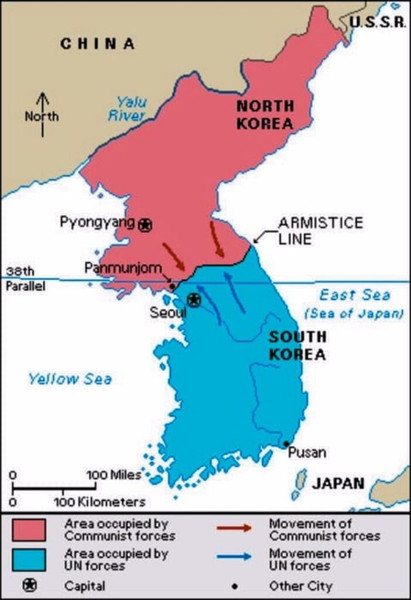
Korean War map
- North Korea pushed south.
- MacArthur’s Inchon landing turned the war around.
- UN forces crossed the 38th parallel.
- China intervened and pushed them back.
- Truman fired Douglas MacArthur for challenging limited-war policy.
- The 1953 armistice left Korea divided near the 38th parallel.
This was the first big shooting war of containment. It showed the U.S. would use force, but also avoid expanding into World War III.
Nuclear strategy
- Soviet atomic bomb in 1949 ended the U.S. monopoly.
- Hydrogen bombs followed, U.S. in 1952 and USSR in 1953.
- Eisenhower’s New Look relied on nuclear weapons.
- Massive retaliation and brinkmanship, linked to John Foster Dulles, threatened huge response to aggression.
- MAD or mutually assured destruction meant both sides could destroy each other, so deterrence rested on fear of total war.
- Sputnik in 1957 and the U-2 incident with Francis Gary Powers in 1960 showed rivalry intensifying.
Crises, Détente, and the Changing Methods of Containment
Kennedy kept containment but changed strategy to flexible response, which gave the U.S. more options than immediate nuclear escalation.
- Berlin Wall in 1961 became the clearest symbol of Cold War division.
- Bay of Pigs in 1961 embarrassed the U.S. and strengthened Fidel Castro.
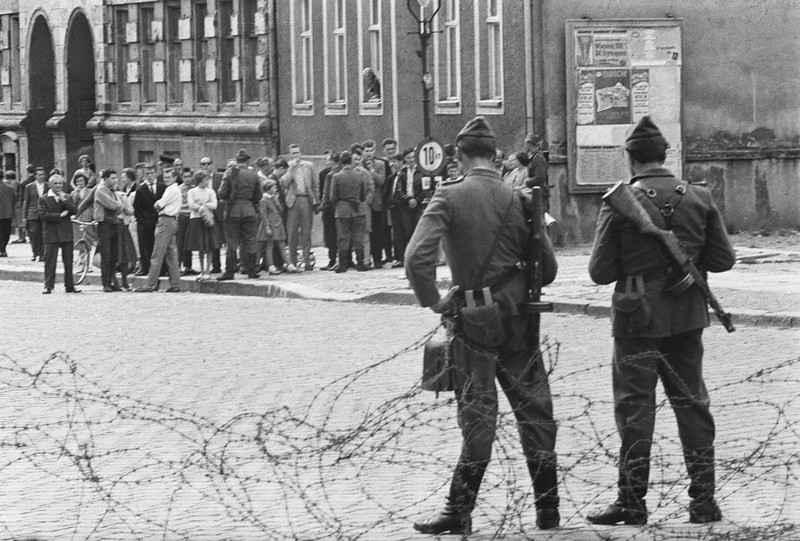
Berlin Wall, 1961
In its earliest form, the barrier was just barbed wire and armed guards, like the scene here. The Cuban Missile Crisis in 1962 then brought the world closest to nuclear war. U-2 photos showed Soviet missiles in Cuba. Kennedy imposed a naval quarantine. The final deal removed Soviet missiles from Cuba, included a U.S. promise not to invade Cuba, and secretly removed U.S. Jupiter missiles from Turkey. Afterward came the hotline and the Limited Nuclear Test Ban Treaty.
Détente
In the 1970s, détente meant reduced tension, not friendship.
- Nixon and Henry Kissinger used realpolitik
- Nixon opened relations with China in 1972 and used the Sino-Soviet split
- SALT I and the ABM Treaty in 1972 tried to manage the arms race
- Helsinki Accords in 1975 recognized borders and included human-rights language
Breakdown by 1979-1980
Carter stressed human rights and signed SALT II, but the Soviet invasion of Afghanistan shattered détente. Carter answered with grain restrictions, a Moscow Olympics boycott, support for Afghan resistance, higher defense spending, and the Carter Doctrine.
What Changed and What Stayed the Same from 1945 to 1980
Stayed the same
- Containment remained the core goal from Truman through Carter.
- The U.S. stayed deeply involved in world affairs instead of returning to isolationism.
- Alliances, aid, open markets, and nuclear deterrence kept mattering.
Changed
- Policy moved from economic and diplomatic tools toward heavier military commitments.
- The focus spread from Europe to Asia and beyond.
- Strategy shifted from U.S. atomic monopoly to arms race, MAD, and arms control.
- Presidents used different methods. Truman built the system, Eisenhower leaned on nukes, Kennedy used flexible response, Nixon pursued détente, and Carter ended in renewed tension.
Key Takeaways
Cold War
Post-1945 U.S.–Soviet ideological and geopolitical rivalry fought through alliances, arms races, pressure, and proxy wars rather than sustained direct war
Yalta Conference
February 1945 Allied meeting that arranged Germany’s occupation and discussed the United Nations and elections in liberated Europe
Potsdam Conference
July–August 1945 Allied meeting where disputes over Germany and Eastern Europe revealed worsening U.S.–Soviet relations
Eastern Bloc
Soviet-dominated communist states of Eastern Europe that were politically and economically aligned with Moscow
Iron Curtain
Churchill’s phrase for the political and ideological division between Soviet-dominated Eastern Europe and the Western democracies
Winston Churchill
Former British prime minister whose 1946 Fulton speech declared that an iron curtain had descended across Europe
George F. Kennan
American diplomat who developed containment as sustained political and economic pressure against cautious Soviet expansion
Collective Security
System in which nations cooperate and treat aggression against one member as a concern or attack against all
United Nations
International organization founded in 1945 for diplomacy and collective security, with vetoes for five permanent Security Council members
Bretton Woods Agreements
Postwar agreements establishing the IMF and World Bank to promote monetary stability, reconstruction, and an open global economy
International Monetary Fund (IMF)
Bretton Woods institution created to promote currency stability and international monetary cooperation
World Bank
Bretton Woods institution created to finance postwar reconstruction and economic development
General Agreement on Tariffs and Trade (GATT)
1947 international agreement that encouraged reductions in tariffs and other trade barriers
Harry S. Truman
President who publicly established containment, backed European reconstruction and NATO, and committed U.S. forces in Korea
Truman Doctrine
1947 policy pledging aid to free peoples resisting armed minorities or outside pressure, first applied to Greece and Turkey
George C. Marshall
Secretary of state who proposed the large-scale American program for rebuilding Europe after World War II.
Marshall Plan
1948–1952 U.S. aid program that helped restore Western Europe, reduced communist appeal, and tied recipients more closely to the United States
North Atlantic Treaty Organization (NATO)
1949 U.S.-led alliance declaring that an armed attack on one member would be treated as an attack on all
Warsaw Pact
Soviet-led military alliance formed with Eastern European communist states in 1955 in response to NATO and West German membership
Mao Zedong
Chinese communist leader who defeated Chiang Kai-shek’s Nationalists and established the People’s Republic of China in 1949
Chinese Communist Revolution
Mao’s 1949 victory on the mainland, which drove Chiang’s Nationalists to Taiwan and intensified American fears of communist expansion
NSC-68
1950 policy document portraying a global Soviet drive for domination and recommending major military expansion and defense spending
Korean War
1950–1953 limited war in which U.S.-led UN forces preserved South Korea after a North Korean invasion but failed to reunify Korea
Douglas MacArthur
UN commander in Korea whom Truman removed after he publicly pressed to expand the limited war into China
Limited War
A conflict fought with restricted goals and methods to avoid escalation into a wider or nuclear war, as in Korea
Nuclear Arms Race
U.S.–Soviet competition to build larger, more survivable nuclear arsenals and improved bomber, missile, and submarine delivery systems
Nuclear Deterrence
Preventing attack by maintaining the credible ability to inflict unacceptable nuclear destruction in retaliation
Dwight D. Eisenhower
President whose New Look policy relied heavily on nuclear deterrence to contain communism at lower conventional cost
New Look
Eisenhower defense policy emphasizing nuclear weapons and deterrence rather than permanently maintaining Korean War–sized conventional forces
John Foster Dulles
Eisenhower’s secretary of state who promoted massive retaliation and brinkmanship as methods of containing communism
Massive Retaliation
Doctrine of deterring aggression by threatening an overwhelming, potentially nuclear response at places and with means of U.S. choosing
Brinkmanship
Willingness to approach the edge of war, including nuclear war, to pressure an adversary into retreating
Mutually Assured Destruction (MAD)
Condition in which each superpower had a survivable nuclear arsenal capable of devastating retaliation after a first strike
Sputnik
First artificial satellite, launched by the Soviet Union in 1957, that intensified U.S. fears about Soviet missile capabilities
U-2 Incident
1960 Soviet downing of Francis Gary Powers’s American spy plane, exposing U.S. surveillance and disrupting a planned summit
Flexible Response
Kennedy strategy expanding conventional and special forces so the United States could answer aggression without immediately using nuclear weapons
Berlin Wall
Barrier built by East Germany in 1961 to stop escapes through Berlin, becoming the leading symbol of divided Europe
John F. Kennedy
President who adopted flexible response and confronted Cold War crises at Berlin, the Bay of Pigs, and Cuba
Fidel Castro
Cuban revolutionary who overthrew Batista in 1959 and aligned Cuba with the Soviet Union after conflict with the United States
Bay of Pigs Invasion
Failed 1961 landing by CIA-trained Cuban exiles that strengthened Castro and pushed Cuba toward greater Soviet protection
Nikita Khrushchev
Soviet leader who backed the Berlin Wall and placed nuclear missiles in Cuba before negotiating their removal with Kennedy
Cuban Missile Crisis
Thirteen-day 1962 confrontation ended by Soviet missile removal, a U.S. no-invasion pledge, and secret removal of U.S. missiles from Turkey
Limited Nuclear Test Ban Treaty
1963 U.S.–Soviet agreement prohibiting nuclear tests in the atmosphere, outer space, and underwater
Détente
Deliberate relaxation of Cold War tensions through diplomacy and arms control without ending ideological competition or containment
Richard Nixon
President who pursued détente, opened relations with communist China, and negotiated SALT I and the ABM Treaty
Henry Kissinger
Nixon’s national security adviser and secretary of state who promoted realpolitik, triangular diplomacy, and détente
Realpolitik
Foreign policy based on practical strategic interests and balances of power rather than rigid ideological judgments
Sino-Soviet Split
Ideological and strategic rivalry between communist China and the Soviet Union that disproved the idea of a unified communist bloc
Nixon’s Opening to China
Nixon’s 1972 visit began improved U.S.–Chinese relations and gave the United States leverage against the Soviet Union
Triangular Diplomacy
Using separate relationships among the United States, China, and Soviet Union to gain leverage and preserve a favorable balance of power
Anti-Ballistic Missile Treaty
1972 treaty limiting missile-defense systems to preserve mutual vulnerability and discourage a nuclear first strike
Helsinki Accords
1975 agreements accepting European boundaries, encouraging cooperation, and establishing human-rights commitments later used by Eastern-bloc dissidents
Jimmy Carter
President who emphasized human rights, signed SALT II, and returned to confrontation after the Soviet invasion of Afghanistan
SALT II
1979 U.S.–Soviet agreement setting further limits on strategic delivery systems, signed but never ratified by the Senate
Soviet Invasion of Afghanistan
1979 Soviet intervention to support Afghanistan’s communist government that prompted U.S. sanctions, rearmament, and support for Afghan resistance
Carter Doctrine
1980 declaration that the United States would use force if necessary to prevent an outside power from controlling the Persian Gulf
Containment
U.S. policy of preventing further expansion of communist power and Soviet influence through economic, diplomatic, and military measures
Rollback
Policy of attempting to remove communist governments already in power rather than merely preventing further expansion
Long Telegram
Kennan’s 1946 analysis arguing that the Soviet Union was hostile but cautious and could be contained through firm, sustained pressure
“X” Article
Kennan’s 1947 public article arguing that sustained resistance at strategically important points could contain Soviet expansion
Berlin Blockade
Soviet cutoff of land and water access to West Berlin in 1948–1949 intended to pressure the Western powers to abandon the city
Berlin Airlift
U.S. and British operation that supplied West Berlin by air until the Soviet Union ended its 1948–1949 blockade
Joseph Stalin
Soviet leader who sought a protective Eastern European buffer and established Soviet-aligned communist governments there after World War II.
Chiang Kai-shek
Leader of China’s Nationalists who lost the mainland to Mao’s communists in 1949 and retreated to Taiwan
SALT I
1972 agreement temporarily limiting certain U.S. and Soviet strategic missile launchers without substantially reducing their arsenals
Notes
Cold War
Post-1945 U.S.–Soviet ideological and geopolitical rivalry fought through alliances, arms races, pressure, and proxy wars rather than sustained direct war
Yalta Conference
February 1945 Allied meeting that arranged Germany’s occupation and discussed the United Nations and elections in liberated Europe
Potsdam Conference
July–August 1945 Allied meeting where disputes over Germany and Eastern Europe revealed worsening U.S.–Soviet relations
Eastern Bloc
Soviet-dominated communist states of Eastern Europe that were politically and economically aligned with Moscow
Iron Curtain
Churchill’s phrase for the political and ideological division between Soviet-dominated Eastern Europe and the Western democracies
Winston Churchill
Former British prime minister whose 1946 Fulton speech declared that an iron curtain had descended across Europe
George F. Kennan
American diplomat who developed containment as sustained political and economic pressure against cautious Soviet expansion
Collective Security
System in which nations cooperate and treat aggression against one member as a concern or attack against all
United Nations
International organization founded in 1945 for diplomacy and collective security, with vetoes for five permanent Security Council members
Bretton Woods Agreements
Postwar agreements establishing the IMF and World Bank to promote monetary stability, reconstruction, and an open global economy
International Monetary Fund (IMF)
Bretton Woods institution created to promote currency stability and international monetary cooperation
World Bank
Bretton Woods institution created to finance postwar reconstruction and economic development
General Agreement on Tariffs and Trade (GATT)
1947 international agreement that encouraged reductions in tariffs and other trade barriers
Harry S. Truman
President who publicly established containment, backed European reconstruction and NATO, and committed U.S. forces in Korea
Truman Doctrine
1947 policy pledging aid to free peoples resisting armed minorities or outside pressure, first applied to Greece and Turkey
George C. Marshall
Secretary of state who proposed the large-scale American program for rebuilding Europe after World War II.
Marshall Plan
1948–1952 U.S. aid program that helped restore Western Europe, reduced communist appeal, and tied recipients more closely to the United States
North Atlantic Treaty Organization (NATO)
1949 U.S.-led alliance declaring that an armed attack on one member would be treated as an attack on all
Warsaw Pact
Soviet-led military alliance formed with Eastern European communist states in 1955 in response to NATO and West German membership
Mao Zedong
Chinese communist leader who defeated Chiang Kai-shek’s Nationalists and established the People’s Republic of China in 1949
Chinese Communist Revolution
Mao’s 1949 victory on the mainland, which drove Chiang’s Nationalists to Taiwan and intensified American fears of communist expansion
NSC-68
1950 policy document portraying a global Soviet drive for domination and recommending major military expansion and defense spending
Korean War
1950–1953 limited war in which U.S.-led UN forces preserved South Korea after a North Korean invasion but failed to reunify Korea
Douglas MacArthur
UN commander in Korea whom Truman removed after he publicly pressed to expand the limited war into China
Limited War
A conflict fought with restricted goals and methods to avoid escalation into a wider or nuclear war, as in Korea
Nuclear Arms Race
U.S.–Soviet competition to build larger, more survivable nuclear arsenals and improved bomber, missile, and submarine delivery systems
Nuclear Deterrence
Preventing attack by maintaining the credible ability to inflict unacceptable nuclear destruction in retaliation
Dwight D. Eisenhower
President whose New Look policy relied heavily on nuclear deterrence to contain communism at lower conventional cost
New Look
Eisenhower defense policy emphasizing nuclear weapons and deterrence rather than permanently maintaining Korean War–sized conventional forces
John Foster Dulles
Eisenhower’s secretary of state who promoted massive retaliation and brinkmanship as methods of containing communism
Massive Retaliation
Doctrine of deterring aggression by threatening an overwhelming, potentially nuclear response at places and with means of U.S. choosing
Brinkmanship
Willingness to approach the edge of war, including nuclear war, to pressure an adversary into retreating
Mutually Assured Destruction (MAD)
Condition in which each superpower had a survivable nuclear arsenal capable of devastating retaliation after a first strike
Sputnik
First artificial satellite, launched by the Soviet Union in 1957, that intensified U.S. fears about Soviet missile capabilities
U-2 Incident
1960 Soviet downing of Francis Gary Powers’s American spy plane, exposing U.S. surveillance and disrupting a planned summit
Flexible Response
Kennedy strategy expanding conventional and special forces so the United States could answer aggression without immediately using nuclear weapons
Berlin Wall
Barrier built by East Germany in 1961 to stop escapes through Berlin, becoming the leading symbol of divided Europe
John F. Kennedy
President who adopted flexible response and confronted Cold War crises at Berlin, the Bay of Pigs, and Cuba
Fidel Castro
Cuban revolutionary who overthrew Batista in 1959 and aligned Cuba with the Soviet Union after conflict with the United States
Bay of Pigs Invasion
Failed 1961 landing by CIA-trained Cuban exiles that strengthened Castro and pushed Cuba toward greater Soviet protection
Nikita Khrushchev
Soviet leader who backed the Berlin Wall and placed nuclear missiles in Cuba before negotiating their removal with Kennedy
Cuban Missile Crisis
Thirteen-day 1962 confrontation ended by Soviet missile removal, a U.S. no-invasion pledge, and secret removal of U.S. missiles from Turkey
Limited Nuclear Test Ban Treaty
1963 U.S.–Soviet agreement prohibiting nuclear tests in the atmosphere, outer space, and underwater
Détente
Deliberate relaxation of Cold War tensions through diplomacy and arms control without ending ideological competition or containment
Richard Nixon
President who pursued détente, opened relations with communist China, and negotiated SALT I and the ABM Treaty
Henry Kissinger
Nixon’s national security adviser and secretary of state who promoted realpolitik, triangular diplomacy, and détente
Realpolitik
Foreign policy based on practical strategic interests and balances of power rather than rigid ideological judgments
Sino-Soviet Split
Ideological and strategic rivalry between communist China and the Soviet Union that disproved the idea of a unified communist bloc
Nixon’s Opening to China
Nixon’s 1972 visit began improved U.S.–Chinese relations and gave the United States leverage against the Soviet Union
Triangular Diplomacy
Using separate relationships among the United States, China, and Soviet Union to gain leverage and preserve a favorable balance of power
Anti-Ballistic Missile Treaty
1972 treaty limiting missile-defense systems to preserve mutual vulnerability and discourage a nuclear first strike
Helsinki Accords
1975 agreements accepting European boundaries, encouraging cooperation, and establishing human-rights commitments later used by Eastern-bloc dissidents
Jimmy Carter
President who emphasized human rights, signed SALT II, and returned to confrontation after the Soviet invasion of Afghanistan
SALT II
1979 U.S.–Soviet agreement setting further limits on strategic delivery systems, signed but never ratified by the Senate
Soviet Invasion of Afghanistan
1979 Soviet intervention to support Afghanistan’s communist government that prompted U.S. sanctions, rearmament, and support for Afghan resistance
Carter Doctrine
1980 declaration that the United States would use force if necessary to prevent an outside power from controlling the Persian Gulf
Containment
U.S. policy of preventing further expansion of communist power and Soviet influence through economic, diplomatic, and military measures
Rollback
Policy of attempting to remove communist governments already in power rather than merely preventing further expansion
Long Telegram
Kennan’s 1946 analysis arguing that the Soviet Union was hostile but cautious and could be contained through firm, sustained pressure
“X” Article
Kennan’s 1947 public article arguing that sustained resistance at strategically important points could contain Soviet expansion
Berlin Blockade
Soviet cutoff of land and water access to West Berlin in 1948–1949 intended to pressure the Western powers to abandon the city
Berlin Airlift
U.S. and British operation that supplied West Berlin by air until the Soviet Union ended its 1948–1949 blockade
Joseph Stalin
Soviet leader who sought a protective Eastern European buffer and established Soviet-aligned communist governments there after World War II.
Chiang Kai-shek
Leader of China’s Nationalists who lost the mainland to Mao’s communists in 1949 and retreated to Taiwan
SALT I
1972 agreement temporarily limiting certain U.S. and Soviet strategic missile launchers without substantially reducing their arsenals
