Topic 8.15 Notes – Continuity and Change in Period 8
How Period 8 Reshaped National Identity
National identity means the shared ideas Americans have about freedom, citizenship, government, prosperity, culture, and the U.S. role in the world.
In 1945, that identity already included:
- capitalism and consumer success as part of the American Dream
- constitutional government and anti-radical politics
- strong anti-communism
- clear racial inequality and limited citizenship in practice
By 1980, the country looked different:
- the U.S. saw itself as a permanent world leader
- citizenship was more legally inclusive
- Americans expected more federal action
- culture was more pluralistic and openly argued over
The key continuity is huge. The U.S. still stayed a capitalist consumer society with persistent inequality and ongoing arguments over liberty vs. order, federal power vs. local control, and ideals vs. reality.
The Four Big Changes by 1980
These four changes make a strong essay structure because they cover most of the evidence.
Permanent global leadership
World War II did not end with the U.S. stepping back. It moved into lasting superpower status built around containment and military readiness.
- United Nations helped organize postwar diplomacy.
- Bretton Woods system, including the International Monetary Fund and World Bank, helped build a free-market global economy.
- Truman Doctrine, Marshall Plan, and NATO turned anti-communism into long-term policy.
- Korean War, Cuban Missile Crisis, Vietnam War, and later détente showed that Cold War foreign policy became permanent.
That global rivalry was not limited to Europe. By the 1970s, Cold War alignments stretched across much of the world, which helps explain why U.S. foreign policy stayed so active for decades.
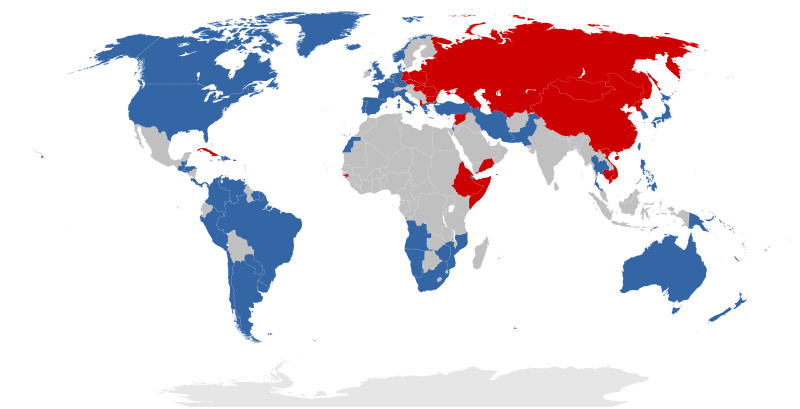
Cold War alignments in the mid-1970s
Eisenhower’s military-industrial complex warning matters because it shows Americans feared permanent military spending and defense influence at home.
More inclusive legal citizenship
The federal government became much more active in protecting rights.
- Truman desegregates armed forces
- Brown v. Board of Education
- Civil Rights Act of 1964
- Voting Rights Act of 1965
Other groups pushed citizenship wider:
- César Chávez, Dolores Huerta, and the United Farm Workers
- American Indian Movement and Wounded Knee
- NOW, Title IX, Equal Rights Amendment, Roe v. Wade
- Stonewall uprising
- Immigration and Nationality Act of 1965 opened immigration beyond old quota systems
Expanded federal responsibility
New Deal liberalism grew into a government expected to fight poverty, protect rights, and regulate health and the environment.
- Great Society
- War on Poverty
- Medicare
- Medicaid
- EPA
- Clean Air Act
- Clean Water Act
A more divided and pluralistic culture
The old image of one shared middle-class culture weakened.
- Beat movement criticized conformity
- counterculture rejected mainstream values
- New Left challenged institutions and war
- antiwar movement grew during Vietnam
- Tet Offensive damaged trust in official claims
- Kent State showed how deep the conflict had become
- Earth Day reflected new environmental values
What Stayed the Same or Changed More Slowly
Legal equality moved faster than real life did.
- redlining, unequal schools, job discrimination, police conflict, and wealth gaps kept inequality alive
- prosperity grew, but unevenly by race, class, and region
- the suburban ideal stayed powerful through the GI Bill, Levittown, the baby boom, television, highways, and consumerism
- many Americans still valued traditional family roles, patriotism, religion, and anti-communism
- the American Dream still centered on capitalism and mass consumption
That suburban ideal was visible in places like Levittown, where rows of similar houses reflected the mass-produced, family-centered vision of postwar life.
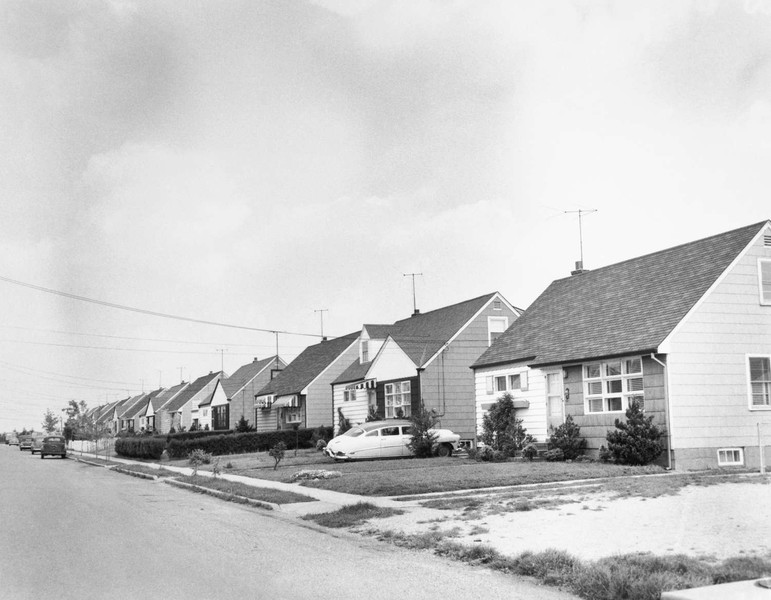
Levittown-style postwar suburb
Why National Identity Became More Contested
Cold War fear brought loyalty programs, HUAC, McCarthyism, and the Second Red Scare. Americans kept arguing over civil liberties versus security. Vietnam revived that fight through the Gulf of Tonkin Resolution, Pentagon Papers, and War Powers Resolution.
By the 1970s, confidence fell hard because of Vietnam, Watergate, Nixon’s resignation, stagflation, deindustrialization, the 1973 oil embargo, and the 1979 Iranian hostage crisis.
That atmosphere helped a conservative resurgence grow:
- Barry Goldwater
- Ronald Reagan
- Sun Belt growth
- Moral Majority
Conservatism reacted to change, but it did not bring back 1945. It operated in a country already changed by civil rights, suburbia, the Great Society, and rights movements.
Best Continuity and Change Argument for the Exam
The strongest claim is that Period 8 substantially reshaped national identity, especially in foreign policy, federal power, and legal citizenship. The best qualification is that transformation stayed incomplete because inequality, consumer capitalism, and old political conflicts endured.
