Topic 7.1 Notes – Contextualizing Period 7
How the United States Became a Modern Industrial Nation and a World Power
Period 7 starts with foundations built earlier. Gilded Age railroads connected national markets, big business concentrated wealth, western expansion completed continental growth, and the failure of Reconstruction left Jim Crow and disfranchisement in place. That matters because this period did not begin from scratch. It accelerated trends already underway.
The main story is one connected process. Industrial growth gave the U.S. the steel, money, ships, and factories to project power abroad. Foreign expansion and war then strengthened industry, federal power, and migration at home. On tests, the best framing is this tension: growth expanded opportunity, but it also brought instability, inequality, and fights over government’s role.
The Big Changes Reshaping American Life
Industrialization changed the scale of the economy. Huge firms like Carnegie Steel, Standard Oil, and U.S. Steel dominated production and distribution. Trusts and monopolistic combinations could control prices, markets, and labor more easily than small businesses could.
- National markets grew through railroads, finance, and mass production.
- Mass production and the assembly line lowered costs and increased output.
- That same industrial power later supported a modern navy, wartime production, and global influence.
By the early 20th century, factory work was increasingly organized around standardized production, as in automobile plants turning out cars on an assembly line.
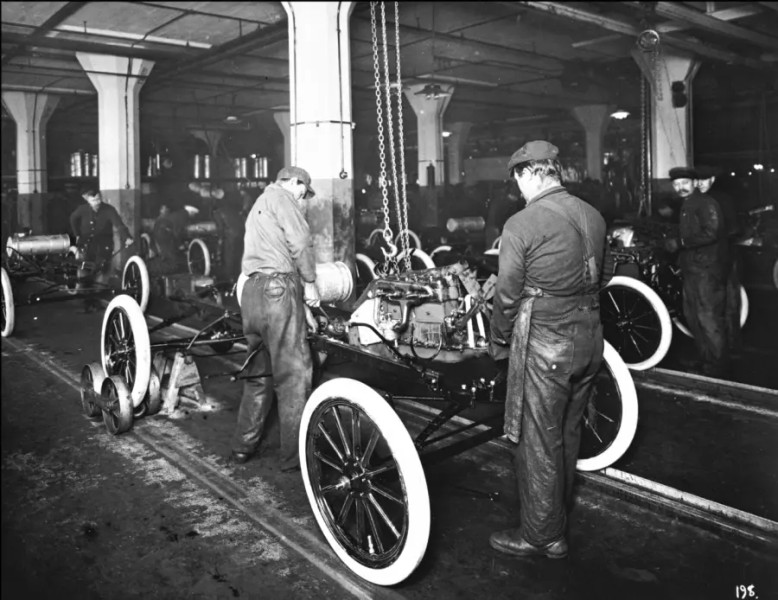
Ford Model T assembly line
Cities grew because factories, offices, and transportation networks pulled people in. By the 1920 census, the U.S. was majority urban for the first time. Consumer culture expanded through automobiles, electrification, installment buying, advertising, chain stores, radio, and motion pictures. Henry Ford’s Model T made car ownership possible for many middle-class families.
Mass culture spread national tastes, but it also created conflict over values.
- Harlem Renaissance brought Black literature, art, and music into national culture.
- Jazz symbolized new freedom and modern urban life.
- Flappers challenged older ideas about women’s behavior and sexuality.
- The Scopes Trial showed the clash between fundamentalism and modernism.
Migration drove a lot of this change.
| Movement | What changed |
|---|---|
| New Immigrants | People from southern and eastern Europe reshaped cities and labor |
| Asian migration under exclusion | Continued despite barriers shaped by the Chinese Exclusion legacy |
| Great Migration | African Americans moved to Chicago, Detroit, and New York for jobs and escape from Jim Crow |
| Mexican labor migration | Workers moved into Southwest agriculture and industry |
| Wartime migration | Millions moved to industrial centers and the West Coast during war |
Nativism pushed back hard. The Immigration Act of 1924 sharply restricted immigration, especially from southern and eastern Europe.
Reform and Government Expansion
As industrial capitalism created corruption, unsafe work, poverty, and machine politics, Americans demanded reform. The first big wave was Progressivism.
- Leaders like Theodore Roosevelt and Woodrow Wilson supported more active government.
- Jane Addams and settlement houses helped the urban poor.
- Muckrakers exposed abuses in business and politics.
- The Triangle Shirtwaist Factory fire showed the human cost of weak labor protections.
- The Clayton Antitrust Act targeted unfair business practices.
- The Federal Reserve Act created a more modern banking system.
- The 16th, 17th, 18th, and 19th Amendments added an income tax, direct election of senators, Prohibition, and women’s suffrage.
Progressives wanted regulation and democracy, but many still accepted segregation, nativism, and coercive social control.
The second wave came with the Great Depression. The 1929 crash was the trigger, but the deeper causes included weak banks, overproduction, unequal wealth, farm distress, and global debt and trade problems.
Franklin D. Roosevelt’s New Deal aimed at relief, recovery, and reform.
- CCC and WPA created jobs
- AAA aided farmers
- FDIC protected bank deposits
- SEC regulated the stock market
- Wagner Act supported labor unions
- Social Security Act created old-age pensions and unemployment support
The New Deal created a limited welfare state and redefined modern liberalism around federal responsibility for economic security. It did not fully end the Depression. WWII mobilization did.
Expansion, War, and Debates Over America’s Role in the World
Industrial strength pushed the U.S. outward. Motives included markets, naval strategy, imperial rivalry, missionary ideas, Social Darwinism, and the closing frontier.
- Alfred Thayer Mahan argued great nations needed a strong navy.
- The Spanish-American War marked a turning point.
- The U.S. annexed Hawaii and gained Puerto Rico, Guam, and the Philippines.
- The Panama Canal increased strategic and commercial power.
- The Anti-Imperialist League argued empire betrayed self-government.
The map highlights the spread of U.S. overseas acquisitions and strategic footholds around the Pacific and Caribbean.
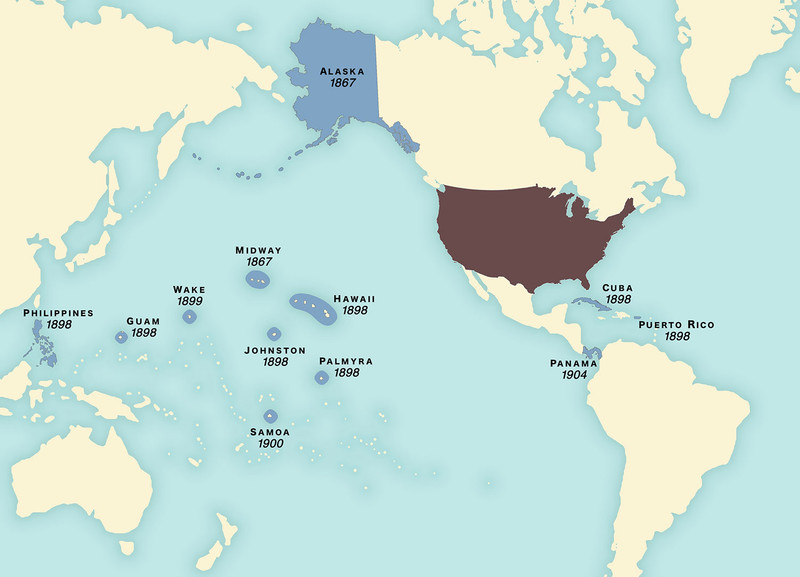
U.S. overseas expansion, 1867 to 1904
In World War I, the U.S. stayed neutral at first, then entered in 1917. Wartime mobilization expanded federal power and also repression.
- Woodrow Wilson proposed the Fourteen Points and the League of Nations
- The Treaty of Versailles ended the war
- The Espionage Act, Sedition Act, and Schenck v. United States limited dissent
- The First Red Scare fed anti-radical and anti-immigrant fears
Rejecting the League did not mean total isolationism. The U.S. still stayed active internationally.
World War II finished the transformation. Pearl Harbor brought full entry, and U.S. industry became the arsenal of democracy.
- Rosie the Riveter symbolized women’s war work
- A. Philip Randolph pressured FDR on discrimination
- The Double V campaign linked victory abroad to equality at home
- Executive Order 8802 banned discrimination in defense industries
- Japanese American incarceration led to Korematsu v. United States
- Hiroshima and Nagasaki helped end the war in the Pacific
By 1945, the U.S. had unmatched production, military reach, and major influence over the postwar order, including the United Nations.
What to Connect on an SAQ or LEQ
Most essays in this topic work when you link the pieces instead of treating them separately.
- Industrialization led to urbanization, migration, consumer culture, reform, and military capacity.
- The instability of capitalism led to Progressivism, the New Deal, and a larger federal government.
- War accelerated migration, production, civil-liberties conflicts, and federal power.
- The recurring debate never disappeared. Americans kept arguing over how much government they wanted at home and how much intervention they wanted abroad.
- Strong contextualization explains events as part of the U.S. rising into an industrial and global power.
