Topic 9.3 Notes – The End of the Cold War
How the Cold War Ended
The Cold War did not end with a peace treaty or a U.S. battlefield victory. It ended when communist rule collapsed across Eastern Europe in 1989, Germany reunified in 1990, and the Soviet Union dissolved in 1991.
Before that, the U.S. had followed containment, and the 1970s brought détente, a temporary easing of tension. That mood broke after the Soviet invasion of Afghanistan in 1979, which pushed the superpowers back into sharper conflict.
The main causes worked together:
- Reagan’s pressure raised military and ideological pressure on the USSR.
- Soviet economic weakness made the arms race and global commitments harder to sustain.
- Gorbachev’s reforms loosened communist control.
- Democratic and nationalist movements challenged Soviet rule in Eastern Europe and inside the USSR.
- Soviet refusal to use force let those challenges succeed.
That’s the key interpretation you want to keep straight. Reagan mattered, but “Reagan alone won the Cold War” is too simple for APUSH.
Reagan’s Pressure Campaign Against Communism
Reagan rejected détente. He believed the U.S. should confront Soviet power, then negotiate from strength.
Ideological offensive
Reagan treated the Cold War as a moral fight, not just a strategic one.
- “Evil empire” speech in 1983 framed the USSR as illegitimate and oppressive.
- Brandenburg Gate speech in 1987 included “Mr. Gorbachev, tear down this wall.”
- This rhetoric aimed to undercut communist legitimacy, rally Western allies, and encourage resistance behind the Iron Curtain.
That message was especially visible at Berlin, where Reagan spoke with the Brandenburg Gate and the divided city behind him.
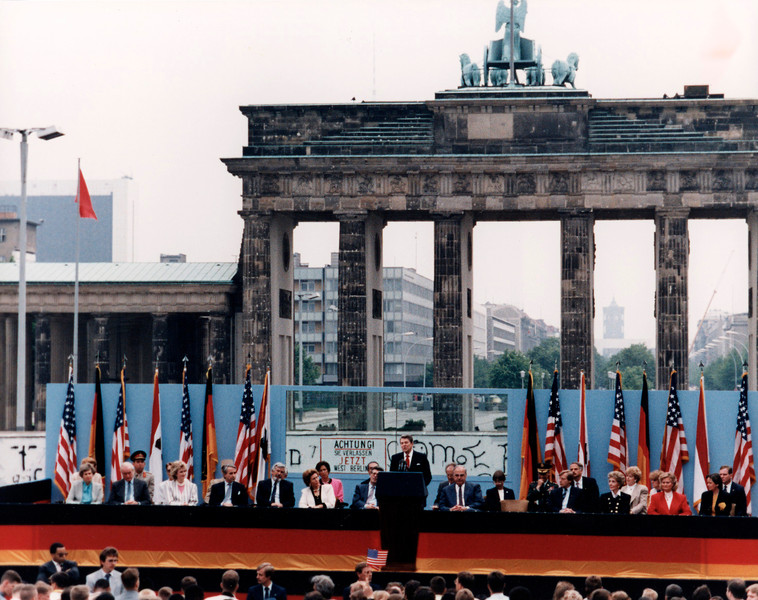
Reagan at the Brandenburg Gate, 1987
Military buildup
Reagan increased spending on both nuclear and conventional weapons.
- B-1 bomber
- MX missile
- 600-ship navy
- Pershing II and ground-launched cruise missiles placed in Western Europe to counter Soviet SS-20s
- Strategic Defense Initiative (SDI) or “Star Wars”
SDI mattered because it challenged mutual assured destruction, the idea that neither side attacks because both would be destroyed. It scared Soviet leaders with the possibility of a new arms race they could not afford. Still, SDI alone did not bankrupt the USSR.
Reagan Doctrine and limited interventions
Reagan also backed anticommunist forces abroad:
- Afghanistan: aid to the mujahideen fighting Soviet occupation
- Nicaragua: support for the Contras against the Sandinistas; Congress passed the Boland Amendments, and secret funding produced the Iran-Contra scandal
- El Salvador: aid to an anti-leftist government despite human rights abuses
- Grenada invasion in 1983
- Libya bombing in 1986
- Lebanon peacekeeping mission, followed by the 1983 Beirut barracks bombing
Why the Soviet Bloc Collapsed
Pressure from outside hit a system that was already weak inside.
Soviet internal weaknesses
- Centrally planned economy struggled with shortages, low productivity, weak innovation, and farm problems.
- Heavy military spending and support for allies drained resources.
- Afghanistan became a costly, demoralizing war.
Gorbachev’s reforms
- Glasnost meant openness. Less censorship meant more criticism of the regime.
- Perestroika meant restructuring. It introduced limited market reforms and decentralization.
Gorbachev wanted to save communism, but the reforms weakened Party control instead. He also improved relations with the West and stopped enforcing the Brezhnev Doctrine by force.
Revolutions of 1989 and Soviet breakup
- Poland: Solidarity, Round Table Talks, partly free elections
- Hungary: reforms and opening the border with Austria
- East Germany: protests, refugee crisis, fall of the Berlin Wall on November 9, 1989
- Czechoslovakia: Velvet Revolution, Václav Havel
- Romania: violent overthrow of Nicolae Ceaușescu
Inside the USSR, nationalist movements grew in Estonia, Latvia, Lithuania, Ukraine, Georgia, and Armenia. After the failed August 1991 coup, Boris Yeltsin gained power. In December 1991, Russia, Ukraine, and Belarus declared the USSR over and formed the Commonwealth of Independent States. Gorbachev resigned, and 15 independent states emerged.
Diplomacy, Reunification, and the New World After 1991
Pressure and diplomacy came together in summit meetings:
| Meeting | What mattered |
|---|---|
| Geneva 1985 | Reagan and Gorbachev began a working relationship |
| Reykjavík 1986 | nearly reached huge arms cuts |
| Washington 1987 | INF Treaty signed |
| Moscow 1988 | showed easing tensions |
The INF Treaty eliminated an entire class of missiles and used on-site inspections. START I followed in 1991 under George H. W. Bush.
German reunification needed agreement from the U.S., USSR, Britain, and France. Bush backed it, and Germany reunited in 1990 while staying in NATO.
After 1991, the U.S. became the sole superpower in a unipolar world. Relations with Russia changed, but worries remained about former Soviet nuclear weapons. NATO survived and expanded in 1999 to Poland, Hungary, and the Czech Republic.
New interventions showed that the Cold War was over, but arguments over U.S. power were not:
- Persian Gulf War / Operation Desert Storm against Saddam Hussein after Iraq invaded Kuwait
- Somalia
- Bosnia and the Dayton Accords
- Kosovo
These raised lasting debates over world leadership vs. “world’s policeman,” unilateral action vs. multilateralism, and national interest vs. humanitarian intervention.
Key Takeaways
End of the Cold War
The 1989–1991 collapse of Eastern European communism, reunification of Germany, and dissolution of the Soviet Union, ending the bipolar world order
Ronald Reagan
President who pressured the Soviet Union through anticommunist rhetoric, military expansion, overseas intervention, and later arms-control diplomacy with Gorbachev
Evil Empire Speech
Reagan's 1983 speech portraying the Soviet Union as morally illegitimate and rejecting moral equivalence between the superpowers
Tear Down This Wall Speech
Reagan's 1987 Brandenburg Gate speech challenging Gorbachev to remove the Berlin Wall and end Europe's political division
Reagan's Military Buildup
Major expansion of nuclear and conventional forces, including new missiles, the B-1 bomber, and a larger navy, intended to pressure the USSR and strengthen U.S. bargaining power
Strategic Defense Initiative (SDI or Star Wars)
Reagan's proposed missile-defense system using advanced and space-based technology to intercept incoming nuclear weapons
Reagan Doctrine
Policy of aiding anticommunist governments and insurgents seeking to weaken or overthrow Soviet-backed regimes
Soviet–Afghan War
Costly 1979–1989 Soviet occupation opposed by U.S.-supported mujahideen, which strained Soviet finances and morale before withdrawal
Contras
U.S.-supported armed opponents of Nicaragua's leftist Sandinista government and major beneficiaries of the Reagan Doctrine
Boland Amendments
Congressional restrictions on U.S. assistance to the Nicaraguan Contras that administration officials secretly attempted to evade
Iran-Contra Scandal
Scandal revealed in 1986 involving secret arms sales to Iran and the diversion of proceeds to the Contras despite congressional restrictions
Reagan's Limited Military Interventions
Direct uses of force including the 1983 Grenada invasion, 1986 bombing of Libya, and Lebanon peacekeeping mission that ended after the Beirut barracks bombing
Soviet Economic Stagnation
Long-term inefficiency, weak productivity, shortages, and heavy military costs that left the Soviet economy unable to sustain its commitments
Mikhail Gorbachev
Soviet leader who introduced glasnost and perestroika, negotiated with Reagan, and refused to use force to preserve Eastern European communist regimes
Glasnost
Gorbachev's policy of openness that reduced censorship and allowed criticism of officials, historical abuses, and Communist Party rule
Perestroika
Gorbachev's restructuring policy introducing limited market mechanisms and decentralization without creating a stable replacement for the command economy
Brezhnev Doctrine
Earlier Soviet claim of authority to intervene militarily to preserve communist rule, a policy Gorbachev effectively abandoned in Eastern Europe
Reagan–Gorbachev Diplomacy
Summit diplomacy from Geneva through Reykjavík, Washington, and Moscow that reduced tensions and produced major nuclear arms agreements
Intermediate-Range Nuclear Forces Treaty (INF Treaty)
1987 U.S.-Soviet treaty eliminating an entire class of ground-launched missiles and establishing on-site inspections
Strategic Arms Reduction Treaty (START I)
1991 U.S.-Soviet agreement requiring major reductions in both countries' strategic nuclear arsenals
Revolutions of 1989
Rapid overthrow of communist governments across Eastern Europe, generally without Soviet military intervention
Solidarity
Independent Polish trade union that won the 1989 partly free elections and helped form the Soviet bloc's first noncommunist-led government
Fall of the Berlin Wall
Opening of East German border crossings on November 9, 1989, symbolizing the collapse of communist authority and Europe's division
Velvet Revolution
Largely peaceful 1989 revolution that ended communist rule in Czechoslovakia and brought dissident Václav Havel to the presidency
German Reunification
October 3, 1990, unification in which East Germany joined West Germany, with the reunified nation remaining in NATO.
Dissolution of the Soviet Union
December 1991 breakup of the USSR into fifteen independent states after reform, nationalism, economic crisis, and the failed August coup
August 1991 Soviet Coup Attempt
Failed effort by communist hard-liners to remove Gorbachev and reverse reform, which instead weakened the Communist Party and accelerated Soviet dissolution
Boris Yeltsin
President of the Russian republic whose visible resistance to the August 1991 coup increased his power and hastened the Soviet Union's collapse
Commonwealth of Independent States (CIS)
Loose association created by Russia, Ukraine, and Belarus in December 1991 as they agreed that the Soviet Union would cease to exist
George H. W. Bush
President who cautiously managed the Cold War's end, supported German reunification, negotiated arms reductions, and led the Persian Gulf War coalition
Unipolar World
Post-Soviet international system in which the United States remained the world's only superpower
Peace Dividend
Hope that reduced Cold War defense needs would allow military resources to be redirected toward domestic priorities
Saddam Hussein
Iraqi dictator whose 1990 invasion and annexation of Kuwait triggered the U.S.-led Persian Gulf War
Persian Gulf War (Operation Desert Storm)
1991 U.S.-led, UN-authorized coalition war that expelled Saddam Hussein's Iraqi forces from Kuwait without occupying Baghdad
New World Order
George H. W. Bush's vision of U.S. leadership through international institutions and multinational coalitions to resist aggression
Humanitarian Intervention
Use of military or peacekeeping forces to address famine, civil war, ethnic violence, or mass suffering rather than a direct attack on the United States
Somalia Intervention
1992–1994 humanitarian intervention that expanded into efforts to stabilize Somalia before 18 U.S. deaths in Mogadishu weakened public support and prompted withdrawal
Bill Clinton
President who expanded the Somalia mission and used U.S. and NATO power in Bosnia and Kosovo for stability and humanitarian purposes
Kosovo Intervention
1999 NATO air campaign against Yugoslav and Serbian forces, defended as humanitarian protection but conducted without explicit UN Security Council authorization
Ethnic Cleansing
Forced removal of an ethnic population from a territory, as occurred during the wars in the former Yugoslavia
NATO Enlargement
Post-Cold War expansion of NATO, including Poland, Hungary, and the Czech Republic in 1999, which strengthened Central European ties to the West but angered Russia
Multilateralism
Approach favoring U.S. action through alliances, the United Nations, or broad international coalitions whenever possible
World's Policeman Debate
Dispute over whether the sole superpower should actively confront aggression and humanitarian crises or avoid costly, open-ended foreign commitments
Mujahideen
Varied groups that fought the Soviet occupation of Afghanistan with U.S. aid generally routed through Pakistan
Bosnian War
Post-Yugoslav conflict involving ethnic nationalism and ethnic cleansing that ended in 1995 after NATO air strikes and U.S.-supported diplomacy
Dayton Accords
1995 peace agreement negotiated with U.S. assistance that ended the Bosnian War
Notes
End of the Cold War
The 1989–1991 collapse of Eastern European communism, reunification of Germany, and dissolution of the Soviet Union, ending the bipolar world order
Ronald Reagan
President who pressured the Soviet Union through anticommunist rhetoric, military expansion, overseas intervention, and later arms-control diplomacy with Gorbachev
Evil Empire Speech
Reagan's 1983 speech portraying the Soviet Union as morally illegitimate and rejecting moral equivalence between the superpowers
Tear Down This Wall Speech
Reagan's 1987 Brandenburg Gate speech challenging Gorbachev to remove the Berlin Wall and end Europe's political division
Reagan's Military Buildup
Major expansion of nuclear and conventional forces, including new missiles, the B-1 bomber, and a larger navy, intended to pressure the USSR and strengthen U.S. bargaining power
Strategic Defense Initiative (SDI or Star Wars)
Reagan's proposed missile-defense system using advanced and space-based technology to intercept incoming nuclear weapons
Reagan Doctrine
Policy of aiding anticommunist governments and insurgents seeking to weaken or overthrow Soviet-backed regimes
Soviet–Afghan War
Costly 1979–1989 Soviet occupation opposed by U.S.-supported mujahideen, which strained Soviet finances and morale before withdrawal
Contras
U.S.-supported armed opponents of Nicaragua's leftist Sandinista government and major beneficiaries of the Reagan Doctrine
Boland Amendments
Congressional restrictions on U.S. assistance to the Nicaraguan Contras that administration officials secretly attempted to evade
Iran-Contra Scandal
Scandal revealed in 1986 involving secret arms sales to Iran and the diversion of proceeds to the Contras despite congressional restrictions
Reagan's Limited Military Interventions
Direct uses of force including the 1983 Grenada invasion, 1986 bombing of Libya, and Lebanon peacekeeping mission that ended after the Beirut barracks bombing
Soviet Economic Stagnation
Long-term inefficiency, weak productivity, shortages, and heavy military costs that left the Soviet economy unable to sustain its commitments
Mikhail Gorbachev
Soviet leader who introduced glasnost and perestroika, negotiated with Reagan, and refused to use force to preserve Eastern European communist regimes
Glasnost
Gorbachev's policy of openness that reduced censorship and allowed criticism of officials, historical abuses, and Communist Party rule
Perestroika
Gorbachev's restructuring policy introducing limited market mechanisms and decentralization without creating a stable replacement for the command economy
Brezhnev Doctrine
Earlier Soviet claim of authority to intervene militarily to preserve communist rule, a policy Gorbachev effectively abandoned in Eastern Europe
Reagan–Gorbachev Diplomacy
Summit diplomacy from Geneva through Reykjavík, Washington, and Moscow that reduced tensions and produced major nuclear arms agreements
Intermediate-Range Nuclear Forces Treaty (INF Treaty)
1987 U.S.-Soviet treaty eliminating an entire class of ground-launched missiles and establishing on-site inspections
Strategic Arms Reduction Treaty (START I)
1991 U.S.-Soviet agreement requiring major reductions in both countries' strategic nuclear arsenals
Revolutions of 1989
Rapid overthrow of communist governments across Eastern Europe, generally without Soviet military intervention
Solidarity
Independent Polish trade union that won the 1989 partly free elections and helped form the Soviet bloc's first noncommunist-led government
Fall of the Berlin Wall
Opening of East German border crossings on November 9, 1989, symbolizing the collapse of communist authority and Europe's division
Velvet Revolution
Largely peaceful 1989 revolution that ended communist rule in Czechoslovakia and brought dissident Václav Havel to the presidency
German Reunification
October 3, 1990, unification in which East Germany joined West Germany, with the reunified nation remaining in NATO.
Dissolution of the Soviet Union
December 1991 breakup of the USSR into fifteen independent states after reform, nationalism, economic crisis, and the failed August coup
August 1991 Soviet Coup Attempt
Failed effort by communist hard-liners to remove Gorbachev and reverse reform, which instead weakened the Communist Party and accelerated Soviet dissolution
Boris Yeltsin
President of the Russian republic whose visible resistance to the August 1991 coup increased his power and hastened the Soviet Union's collapse
Commonwealth of Independent States (CIS)
Loose association created by Russia, Ukraine, and Belarus in December 1991 as they agreed that the Soviet Union would cease to exist
George H. W. Bush
President who cautiously managed the Cold War's end, supported German reunification, negotiated arms reductions, and led the Persian Gulf War coalition
Unipolar World
Post-Soviet international system in which the United States remained the world's only superpower
Peace Dividend
Hope that reduced Cold War defense needs would allow military resources to be redirected toward domestic priorities
Saddam Hussein
Iraqi dictator whose 1990 invasion and annexation of Kuwait triggered the U.S.-led Persian Gulf War
Persian Gulf War (Operation Desert Storm)
1991 U.S.-led, UN-authorized coalition war that expelled Saddam Hussein's Iraqi forces from Kuwait without occupying Baghdad
New World Order
George H. W. Bush's vision of U.S. leadership through international institutions and multinational coalitions to resist aggression
Humanitarian Intervention
Use of military or peacekeeping forces to address famine, civil war, ethnic violence, or mass suffering rather than a direct attack on the United States
Somalia Intervention
1992–1994 humanitarian intervention that expanded into efforts to stabilize Somalia before 18 U.S. deaths in Mogadishu weakened public support and prompted withdrawal
Bill Clinton
President who expanded the Somalia mission and used U.S. and NATO power in Bosnia and Kosovo for stability and humanitarian purposes
Kosovo Intervention
1999 NATO air campaign against Yugoslav and Serbian forces, defended as humanitarian protection but conducted without explicit UN Security Council authorization
Ethnic Cleansing
Forced removal of an ethnic population from a territory, as occurred during the wars in the former Yugoslavia
NATO Enlargement
Post-Cold War expansion of NATO, including Poland, Hungary, and the Czech Republic in 1999, which strengthened Central European ties to the West but angered Russia
Multilateralism
Approach favoring U.S. action through alliances, the United Nations, or broad international coalitions whenever possible
World's Policeman Debate
Dispute over whether the sole superpower should actively confront aggression and humanitarian crises or avoid costly, open-ended foreign commitments
Mujahideen
Varied groups that fought the Soviet occupation of Afghanistan with U.S. aid generally routed through Pakistan
Bosnian War
Post-Yugoslav conflict involving ethnic nationalism and ethnic cleansing that ended in 1995 after NATO air strikes and U.S.-supported diplomacy
Dayton Accords
1995 peace agreement negotiated with U.S. assistance that ended the Bosnian War
