Topic 3.1 Notes – Contextualizing Period 3
How the British Colonies Became Ready to Resist Empire
Before 1754, the colonies were used to running many of their own affairs. Britain had Navigation Acts, but salutary neglect meant loose enforcement, so colonial assemblies handled taxes and local laws.
- Colonists still saw themselves as British subjects. They believed they had the rights of Englishmen, but also expected their own assemblies to control internal affairs.
- Political participation was wider than in Britain for white male property owners, because landownership was more common. It was still limited by property, race, gender, and status.
- John Locke mattered because he argued people have natural rights and government rests on consent of the governed. That gave colonists a language for resistance.
- Republicanism taught people to fear concentrated power and corruption. That becomes huge once Parliament starts tightening control.
- The First Great Awakening made ordinary people more willing to question authority, including elites.
- Slavery was already central, especially in the Chesapeake and Lower South.
- Regional patterns were already clear
- New England and Middle Colonies had commerce and mixed farming
- Southern colonies relied more on plantations and enslaved labor
- Population growth and westward migration increased pressure on Indigenous land even before independence.
A map of North America on the eve of the French and Indian War helps tie those regional patterns to geography. Focus on the British colonies hugging the Atlantic coast, with French claims stretching through the interior and Spanish Florida to the south.
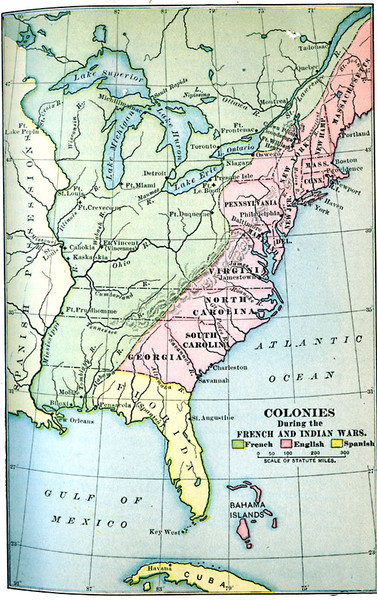
North American claims during the French and Indian War era
North America Was a Contested Continent
In 1754, North America was not “British America.” It was a struggle among empires and Native nations.
- Britain controlled the Atlantic seaboard colonies.
- France controlled Canada and the Mississippi Valley.
- Spain controlled Florida and lands to the south and west.
- American Indian nations controlled much of the interior and acted as major diplomatic and military powers.
A map of imperial claims around 1750 helps show why conflict was so likely, especially in the Ohio River Valley.
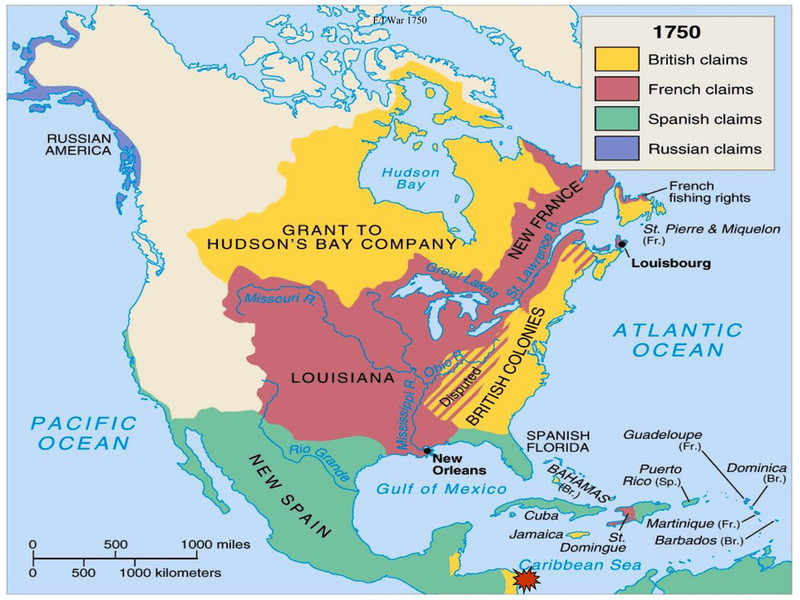
European claims in North America, c. 1750
Native groups and regions
- Haudenosaunee Iroquois Confederacy: powerful alliance in the Northeast
- Ohio Valley peoples: at the center of imperial conflict
- Great Lakes peoples: key to trade and alliance networks
- Southeastern nations: strong regional powers
- Mississippi Valley peoples: tied into river trade and diplomacy
Britain’s settlers wanted permanent western farms. France relied more on trade and Native alliances. That difference made the Ohio River Valley explosive and helped trigger the French and Indian War, the North American part of the Seven Years’ War. Britain won in 1763, but victory brought debt, defense costs, and a reason to tighten imperial control.
How Imperial Reform Turned into Revolution
After 1763, Britain tried to reorganize its empire. Colonists saw that as a threat to the autonomy they were used to.
- Proclamation of 1763 restricted settlement west of the Appalachians, angering settlers and land speculators.
- Stamp Act taxed printed materials and became a constitutional crisis.
- Stricter trade regulation meant Britain was now enforcing imperial rules much more seriously.
- Britain defended this with virtual representation. Colonists answered with no taxation without representation.
Colonists built resistance from several ideas at once: rights of Englishmen, colonial self-government, Locke’s natural rights, and republican fear of arbitrary power.
Resistance networks
- Stamp Act Congress showed intercolonial cooperation.
- Committees of correspondence spread news and arguments.
- Nonimportation agreements and boycotts used economics as protest.
- Crowd action and pamphlets spread resistance into everyday politics.
- Women made boycotts work through household purchasing and homespun production.
- Benjamin Franklin is a good example of someone who first tried to defend colonial rights within the empire.
Escalation came fast: Boston Tea Party → Coercive/Intolerable Acts → Lexington and Concord.
Then the goal changed from protest to independence.
- Thomas Paine’s Common Sense attacked monarchy and made independence sound practical.
- The Declaration of Independence used equality, natural rights, and the right to alter or abolish government.
Patriot victory depended on George Washington, militias, French military and financial support, and Britain’s difficulty fighting far from home.
Revolution, Republican Government, and the New Nation
The Revolution spread ideals of republicanism, civic virtue, liberty, and representative self-government. It did not create full equality.
- Some Northern states began gradual emancipation.
- Slavery stayed entrenched and expanded in the South and West.
- Republican motherhood gave women a larger educational role, not political equality.
- Most states kept property limits on political participation.
New governments appeared quickly.
- State constitutions and declarations of rights tried to protect liberty.
- The Articles of Confederation created a weak national government.
- Its biggest weaknesses were no direct power to tax and weak power over commerce.
- Its biggest success was the Northwest Ordinance of 1787.
The Articles’ weakness became obvious in Shays’ Rebellion, which pushed leaders toward the Constitution.
- The Constitutional Convention created a stronger federal system with federalism, separation of powers, and checks and balances.
- Major compromises
- Great Compromise
- Three-Fifths Compromise
- slave trade protected until 1808
- fugitive slave clause
This structure matters for APUSH because the Constitution divided power among three branches and gave each branch ways to limit the others.
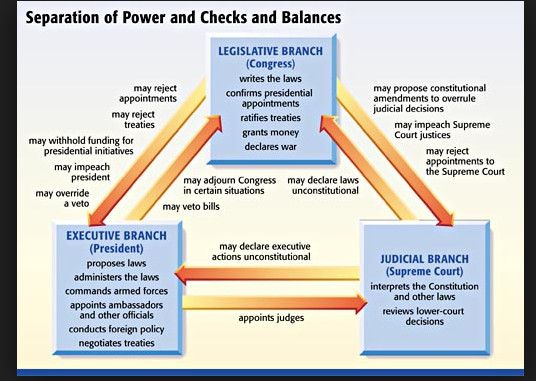
Separation of powers and checks and balances
Ratification
| Side | Leaders | Main view |
|---|---|---|
| Federalists | Alexander Hamilton, James Madison, John Jay | Stronger central government; defended in the Federalist Papers |
| Anti-Federalists | no single trio to memorize | Feared centralized power; demanded liberty protections |
The Bill of Rights was ratified in 1791.
National Identity Grew While Conflict Continued
A national identity grew out of shared resistance, the Revolution, the Declaration, the Constitution, and new institutions. Newspapers, public celebrations, histories, and classical republican imagery helped people imagine themselves as Americans.
The first party system showed that nation-building also created division.
- Federalists backed stronger national power, commerce, and Hamilton’s financial program.
- Democratic-Republicans favored agrarianism, states’ rights, and tighter limits on federal power.
- Big flashpoints were the French Revolution, neutrality, the Alien and Sedition Acts, and Washington’s Farewell Address.
Independence did not remove foreign threats.
- Britain kept forts in the Northwest Territory and influence with Native nations.
- Spain controlled the lower Mississippi and New Orleans.
- U.S. goals were border defense, neutral trade, western settlement, and avoiding entangling alliances.
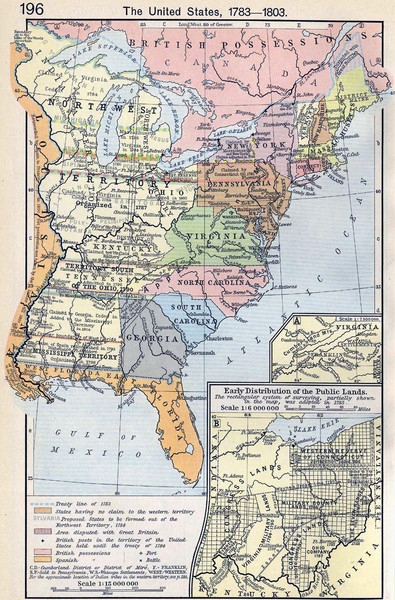
The United States, 1783-1803
This map helps you see the pressure points in the early republic, especially the British presence around the Great Lakes and the Spanish control of the Mississippi borderlands.
Westward migration kept driving conflict. The U.S. made treaties with Native nations even as settlers pushed onto their land. Frontier regions mixed cultures through trade and intermarriage, but also through violence and dispossession. In California, Spanish missions used coerced Native labor and pushed conversion.
By 1800, the U.S. had a stronger government and a clearer identity, but slavery, Native sovereignty, regional differences, and the balance between state and national power were still unresolved.
