Topic 8.4 Notes – Economy After 1945
What Drove Postwar Economic Growth
The United States came out of World War II in a rare position. Its factories, cities, and transportation systems were still standing, unlike much of Europe and Asia. Wartime production had already ended Depression unemployment and expanded industry, science, and technology.
Four causes worked together, not separately:
- Private sector expansion converted wartime factories into producers of cars, televisions, refrigerators, and washing machines.
- Federal policy and spending kept demand strong through benefits, housing support, defense contracts, and research.
- Baby boom families needed houses, schools, appliances, and later college and jobs.
- Technological development raised productivity and opened new regions to growth.
This produced rising wages, consumer spending, homeownership, and a larger middle class. The key qualification is that prosperity was broad, not universal.
The Four Main Causes of Growth
Expanding private sector
Businesses shifted from tanks and planes to consumer durables. Mass production lowered prices, advertising pushed demand, and installment buying plus consumer credit let families buy expensive goods over time.
Big purchases created a chain reaction. A car boosted steel, rubber, petroleum, glass, insurance, and road construction. A house boosted lumber, furniture, appliances, construction, and retail. Large corporations grew, and so did service and white-collar work.
Federal spending and policy
The postwar economy was a mixed economy. Private business led production, but government supported stability and demand. Truman’s Fair Deal and Eisenhower’s Modern Republicanism both accepted that the federal government should help maintain prosperity.
Examples students forget to connect:
- Social Security expansion
- minimum wage increases
- housing assistance
- defense contracts
- scientific research
G.I. Bill
The clearest example was the Servicemen’s Readjustment Act of 1944, usually called the G.I. Bill.
- Paid for college and vocational training
- Guaranteed home, farm, and business loans
- Provided unemployment pay for veterans
That meant more college students, more skilled workers, more homeowners, and more construction.
Baby boom
From 1946 to 1964, about 76 million babies were born. Returning veterans, early marriage, economic confidence, and suburban housing all fed this boom. The fertility rate rose sharply after World War II and stayed elevated through the late 1950s, which is the pattern shown here.
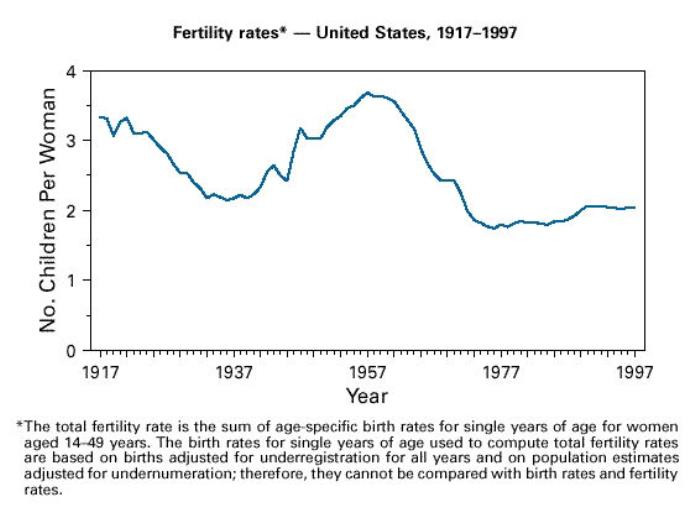
U.S. fertility rates, 1917-1997
The boom increased demand first for homes and baby products, then for schools, colleges, and jobs.
Technological development
Cold War research pushed aviation, electronics, nuclear technology, synthetic materials, and early computers. Federal military contracts linked universities, government, and private industry.
Two effects matter a lot:
- Air conditioning helped the South and West grow.
- Agricultural mechanization reduced farm jobs and pushed people toward metropolitan areas.
How Growth Changed Where Americans Lived
Suburbanization
Middle-class families moved from cities and rural areas to suburbs because of housing shortages, the baby boom, rising incomes, FHA and VA mortgages, cars, highways, and mass-produced homes.
Levittown is the standard example. William Levitt used assembly-line building methods to make affordable suburban homes.
Suburbs increased demand for cars, shopping centers, appliances, and local services. They also drained tax money and people from many cities through white flight and decentralization.
The Interstate Highway System
The Federal-Aid Highway Act of 1956 created a huge highway network. It supported commuting, trucking, tourism, suburban growth, and national markets. It also cut through and damaged some urban neighborhoods.
Migration to the Sun Belt
The South and West grew fast after 1945. California, Texas, Florida, and Arizona became major examples.
Pull factors included:
- defense spending and military bases
- aerospace, oil, electronics, construction, tourism
- lower taxes and weaker unions
- cheap land
- warm climate
- air conditioning
This drew veterans, young families, retirees, skilled workers, and many African Americans in the Second Great Migration. Population growth gave the Sun Belt more House seats and Electoral College votes.
Who Benefited and Who Was Left Out
Postwar affluence reached many Americans, but not all. Unions like the UAW and steel unions won higher wages, pensions, and health insurance for many workers. The Taft-Hartley Act of 1947 limited union power and encouraged right-to-work laws.
Racial inequality was built into prosperity:
- Black veterans were often blocked from full G.I. Bill access by segregated colleges, local control, and discriminatory banks.
- FHA/VA lending, redlining, restrictive covenants, and developer exclusion limited minority homeownership.
- Shelley v. Kraemer (1948) stopped court enforcement of restrictive covenants, but discrimination continued.
- Levittown originally excluded Black buyers.
Women were pushed toward domestic ideals, but many kept working, often in lower-paid jobs.
The Cause-and-Effect Chain to Lock In
Postwar growth came from interaction:
- G.I. Bill led to college and mortgages.
- College led to skilled jobs, mortgages led to homeownership.
- Homebuilding led to construction and consumer spending.
- Highways + cars + suburbs led to commuting, shopping centers, and decentralization.
- Defense spending + air conditioning + jobs led to Sun Belt growth.
Key Takeaways
Postwar Economic Boom
Late-1940s–1960s expansion driven by a growing private sector, federal spending, pent-up demand, the baby boom, and new technology
Pent-Up Demand
Postwar surge in consumer spending after wartime rationing and shortages delayed purchases while workers accumulated savings
Mixed Economy
Economy in which private firms direct most production while government supports demand through benefits, infrastructure, research, regulation, and contracts
Harry Truman
President whose Fair Deal sought to extend New Deal liberalism through expanded benefits, housing aid, health insurance, and civil rights measures
Fair Deal
Truman program proposing expanded Social Security, a higher minimum wage, housing aid, national health insurance, and civil rights; Congress enacted only parts
Dwight D. Eisenhower
President who practiced Modern Republicanism, preserved major New Deal programs, and supported defense, research, and interstate highway spending
Modern Republicanism
Eisenhower's moderate policy of fiscal restraint and private enterprise combined with acceptance of New Deal programs and major federal investments
John F. Kennedy
President whose New Frontier proposed federal action in education, cities, science, welfare, and economic growth
New Frontier
Kennedy program connecting economic growth with federal investment in education, cities, science, and social welfare, though most proposals initially failed
Servicemen's Readjustment Act of 1944 / G.I. Bill
Provided veterans education aid, unemployment payments, and guaranteed low-interest loans, expanding the middle class, homeownership, and skilled employment
Mass-Consumption Economy
Postwar economy sustained by rising wages, savings, credit, advertising, and widespread purchases of homes, automobiles, appliances, and other consumer goods
Taft–Hartley Act of 1947
Restricted unions by banning closed shops, permitting right-to-work laws, limiting union tactics, and allowing federal delays of strikes threatening national health or safety
Right-to-Work Laws
State laws permitted by Taft–Hartley that prohibit requiring workers to join or financially support a union as a condition of employment
Baby Boom
Sharp, prolonged rise in births from 1946 through 1964 that increased demand for housing, goods, schools, services, colleges, and later jobs
Military-Industrial Complex
Relationship among the armed forces, federal government, and defense industries sustained by military contracts and research spending
Air Conditioning
Technology that made homes and workplaces practical in hot climates, removing an obstacle to population and business growth in the Sun Belt
Agricultural Mechanization
Use of machinery and rising farm productivity that reduced demand for farm labor and encouraged migration to metropolitan employment
Suburbanization
Large-scale postwar movement of mainly middle-class families to communities outside central cities, encouraged by mortgages, cars, highways, incomes, and mass-produced housing
Federal Housing Administration (FHA)
Federal agency whose mortgage insurance reduced lender risk and helped expand long-term home financing, while discriminatory practices reinforced segregation
Levittown
Mass-produced Long Island suburb begun in 1947 that offered standardized, affordable homes to many veterans while initially excluding Black buyers
William Levitt
Developer whose firm built Levittown using standardized designs, specialized tasks, and large-scale purchasing to reduce housing costs
Racially Restrictive Covenants
Housing agreements barring property sales to specified racial groups, used to exclude Black families from many neighborhoods and suburbs
Shelley v. Kraemer
1948 Supreme Court decision ruling that courts could not enforce racially restrictive housing covenants, though informal housing discrimination continued
Redlining
Practice of labeling often-Black neighborhoods risky for mortgage lending, denying investment while favorable financing supported predominantly white suburbs
White Flight
Movement of white residents from racially changing central cities to suburbs, encouraged by discriminatory housing, segregated schools, highways, and federal mortgages
Federal-Aid Highway Act of 1956 / Interstate Highway System
Authorized about 41,000 miles of interstate highways, stimulating private industries, trucking, commuting, suburbanization, and metropolitan decentralization
Sun Belt
Rapidly growing South and West, where jobs, federal spending, affordable land, highways, and air conditioning attracted migrants and increased regional economic and political power
Second Great Migration
Continued movement of African Americans from the rural South to urban areas in the North and West during and after World War II.
Mass Affluence
Broad postwar rise in income, homeownership, and consumption that enlarged the middle class but did not eliminate poverty or racial inequality
Expansion of Higher Education
Rapid growth in college access, aided especially by the G.I. Bill, that increased skilled employment, social mobility, and middle-class migration
Notes
Postwar Economic Boom
Late-1940s–1960s expansion driven by a growing private sector, federal spending, pent-up demand, the baby boom, and new technology
Pent-Up Demand
Postwar surge in consumer spending after wartime rationing and shortages delayed purchases while workers accumulated savings
Mixed Economy
Economy in which private firms direct most production while government supports demand through benefits, infrastructure, research, regulation, and contracts
Harry Truman
President whose Fair Deal sought to extend New Deal liberalism through expanded benefits, housing aid, health insurance, and civil rights measures
Fair Deal
Truman program proposing expanded Social Security, a higher minimum wage, housing aid, national health insurance, and civil rights; Congress enacted only parts
Dwight D. Eisenhower
President who practiced Modern Republicanism, preserved major New Deal programs, and supported defense, research, and interstate highway spending
Modern Republicanism
Eisenhower's moderate policy of fiscal restraint and private enterprise combined with acceptance of New Deal programs and major federal investments
John F. Kennedy
President whose New Frontier proposed federal action in education, cities, science, welfare, and economic growth
New Frontier
Kennedy program connecting economic growth with federal investment in education, cities, science, and social welfare, though most proposals initially failed
Servicemen's Readjustment Act of 1944 / G.I. Bill
Provided veterans education aid, unemployment payments, and guaranteed low-interest loans, expanding the middle class, homeownership, and skilled employment
Mass-Consumption Economy
Postwar economy sustained by rising wages, savings, credit, advertising, and widespread purchases of homes, automobiles, appliances, and other consumer goods
Taft–Hartley Act of 1947
Restricted unions by banning closed shops, permitting right-to-work laws, limiting union tactics, and allowing federal delays of strikes threatening national health or safety
Right-to-Work Laws
State laws permitted by Taft–Hartley that prohibit requiring workers to join or financially support a union as a condition of employment
Baby Boom
Sharp, prolonged rise in births from 1946 through 1964 that increased demand for housing, goods, schools, services, colleges, and later jobs
Military-Industrial Complex
Relationship among the armed forces, federal government, and defense industries sustained by military contracts and research spending
Air Conditioning
Technology that made homes and workplaces practical in hot climates, removing an obstacle to population and business growth in the Sun Belt
Agricultural Mechanization
Use of machinery and rising farm productivity that reduced demand for farm labor and encouraged migration to metropolitan employment
Suburbanization
Large-scale postwar movement of mainly middle-class families to communities outside central cities, encouraged by mortgages, cars, highways, incomes, and mass-produced housing
Federal Housing Administration (FHA)
Federal agency whose mortgage insurance reduced lender risk and helped expand long-term home financing, while discriminatory practices reinforced segregation
Levittown
Mass-produced Long Island suburb begun in 1947 that offered standardized, affordable homes to many veterans while initially excluding Black buyers
William Levitt
Developer whose firm built Levittown using standardized designs, specialized tasks, and large-scale purchasing to reduce housing costs
Racially Restrictive Covenants
Housing agreements barring property sales to specified racial groups, used to exclude Black families from many neighborhoods and suburbs
Shelley v. Kraemer
1948 Supreme Court decision ruling that courts could not enforce racially restrictive housing covenants, though informal housing discrimination continued
Redlining
Practice of labeling often-Black neighborhoods risky for mortgage lending, denying investment while favorable financing supported predominantly white suburbs
White Flight
Movement of white residents from racially changing central cities to suburbs, encouraged by discriminatory housing, segregated schools, highways, and federal mortgages
Federal-Aid Highway Act of 1956 / Interstate Highway System
Authorized about 41,000 miles of interstate highways, stimulating private industries, trucking, commuting, suburbanization, and metropolitan decentralization
Sun Belt
Rapidly growing South and West, where jobs, federal spending, affordable land, highways, and air conditioning attracted migrants and increased regional economic and political power
Second Great Migration
Continued movement of African Americans from the rural South to urban areas in the North and West during and after World War II.
Mass Affluence
Broad postwar rise in income, homeownership, and consumption that enlarged the middle class but did not eliminate poverty or racial inequality
Expansion of Higher Education
Rapid growth in college access, aided especially by the G.I. Bill, that increased skilled employment, social mobility, and middle-class migration
