Topic 3.12 Notes – Movement in the Early Republic
How Movement Reshaped the Early Republic
This topic is one long cause-and-effect chain. People moved, they entered lands already claimed by others, competition grew, violence and treaties followed, and that opened the door to even more movement.
- Migration came in three major forms:
- European immigration
- westward movement by settlers
- forced migration of enslaved Africans and African Americans
- Free migrants were pulled by land, economic opportunity, religious toleration, and social mobility.
- Key groups to know:
- Scots-Irish entered through Pennsylvania, then moved down the Shenandoah Valley and along the Great Wagon Road into the backcountry.
- Germans settled heavily in Pennsylvania, then spread into Maryland, Virginia, and the Carolinas.
- Smaller groups included Dutch, Swiss, French, plus refugees from the French Revolution and Haitian Revolution.
The land they moved into was never empty. Native nations lived there, European empires claimed it, and speculators and state governments wanted it too. The frontier was a shifting zone of contact and conflict, not open space waiting for settlement.
Frontier culture kept older colonial patterns alive:
- mixed subsistence farming and market activity
- ethnic diversity
- weak formal government
- strong local autonomy
- distrust of eastern elites
Westward Expansion and Conflict over Land
Before independence and after it, the pattern stayed the same. Settlers crossed boundaries, Native peoples resisted, and governments tried to catch up.
Pontiac’s Rebellion and the Proclamation of 1763 gave the earlier version of that pattern. Britain tried to limit settlement west of the Appalachians, and colonists often ignored it.
After the Revolution, migration spread into Kentucky, Tennessee, western Pennsylvania, western New York, and the Ohio Valley. In the Old Northwest, American expansion pushed into a region still controlled by Native nations.
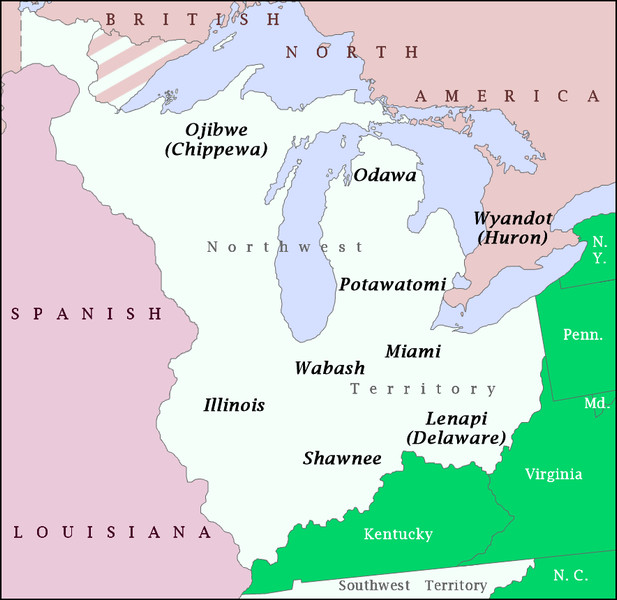
Native nations in the Old Northwest, c. 1792
Major routes mattered because geography shaped movement:
- Wilderness Road through the Cumberland Gap
- Ohio River
- Tennessee River
- Cumberland River
- Mississippi River
Northwest Ordinance of 1787
The new national government encouraged settlement by creating an orderly process for western growth.
- territories could become states, not colonies
- it protected private property
- it encouraged public education
- it banned slavery in the Northwest Territory
Even with federal policy, land claims were messy. Settlers, squatters, speculators, land companies, states, federal officials, and Native nations could all claim the same ground. This map captures the key idea your teacher wants you to remember: U.S. claims stretched much farther than actual U.S. control.
Native Resistance and Shifting Alliances
Native nations were making strategic choices, not all reacting the same way. Their goal was to protect sovereignty, land, trade, and resources.
During the American Revolution, many Native groups sided with Britain because settler expansion looked like the bigger threat.
Haudenosaunee Confederacy
- Oneida and Tuscarora generally supported the Americans
- Mohawk, Seneca, and Cayuga often supported Britain
- Onondaga largely tried to stay neutral
The Treaty of Paris of 1783 gave the U.S. land to the Mississippi River, but Native nations had not been consulted and rejected the idea that Britain could hand over their land.
Native strategies included treaty negotiation, trade with Britain, Spain, and the U.S., playing rivals against each other, relocation, intertribal confederacies, and internal debate over accommodation versus resistance.
Northwest Indian War
- Settlers entered lands north of the Ohio River.
- Shawnee, Miami, Delaware, and others formed the Western Confederacy.
- Britain kept forts near the Great Lakes and aided resistance.
- Little Turtle helped defeat Arthur St. Clair in 1791.
- Anthony Wayne won at Fallen Timbers in 1794.
- Treaty of Greenville in 1795 ceded much of Ohio.
- Jay’s Treaty led Britain to evacuate western posts in 1796.
Southern borderlands
- Dragging Canoe led Cherokee resistance among the Chickamauga Cherokee.
- Alexander McGillivray used Creek diplomacy to balance powers.
- Spain, from Florida and Louisiana, used alliances to slow U.S. expansion.
- The Treaty of New York in 1790 tried to set Creek-U.S. boundaries.
How Migration Changed Slavery and Regional Attitudes
Movement also changed where slavery grew and where opposition to it grew.
Westward and southward expansion spread slavery into Georgia, Kentucky, Tennessee, and the Mississippi borderlands. The turning point was Eli Whitney’s cotton gin in 1793. It made short-staple cotton profitable, so planters wanted more land and more enslaved labor.
- Textile demand rose.
- Cotton gin increased profitability.
- Cotton spread inland.
- Plantation expansion raised demand for enslaved labor.
- Native dispossession and forced migration expanded with it.
At the same time, antislavery ideas spread in the North and parts of the Upper South.
- Pennsylvania gradual abolition law of 1780
- Massachusetts court decisions in the early 1780s
- Virginia manumission law of 1782
- Northwest Ordinance ban on slavery
- New York gradual emancipation law of 1799
- Quaker antislavery activism and Black petitions using Revolutionary ideals
By 1800, a regional pattern had emerged:
| Region | Attitude by 1800 |
|---|---|
| North | moving gradually toward abolition |
| Upper South | mixed and uncertain |
| Deep South | increasingly committed to slavery |
Key Takeaways
Scots-Irish
Descendants of Scottish Protestants from northern Ireland who migrated through Pennsylvania and the Shenandoah Valley into the southern and western backcountry
German-Speaking Migrants
Migrants who formed substantial Pennsylvania communities and carried German-language churches, schools, newspapers, and farming traditions into Maryland, Virginia, and the Carolinas
Frontier Cultures
Cultures in shifting zones of settlement marked by ethnic diversity, local autonomy, mixed subsistence and market economies, and distrust of distant eastern governments
Land Speculation
Purchase of large western tracts in expectation that migration would raise land values, often creating disputes with settlers, governments, and Native nations
Northwest Territory
U.S.-claimed land north of the Ohio River where settlement, Native resistance, federal territorial policy, and the prohibition of slavery shaped western expansion
Northwest Ordinance of 1787
Created a process for western territories to become equal states, encouraged education, protected property, and prohibited slavery in the Northwest Territory
Native Sovereignty
The claim that Native nations governed their own peoples and lands and that territory could be transferred only through legitimate treaties
Haudenosaunee (Iroquois Confederacy)
Native confederacy divided during the Revolution, with the Oneida and Tuscarora generally supporting the Americans and many Mohawk, Seneca, and Cayuga supporting Britain
Treaty of Paris of 1783
Recognized U.S. independence and assigned it lands to the Mississippi, although Native nations rejected Britain's authority to transfer their territory
Western Confederacy
Loose alliance of Shawnee, Miami, Delaware, and other Native peoples formed to resist U.S. settlement north of the Ohio River
Northwest Indian War
Conflict in which the Western Confederacy resisted U.S. settlement north of the Ohio until American victory and the Treaty of Greenville opened more land
Little Turtle
Miami chief who helped lead the Western Confederacy to major victories over U.S. forces, including St. Clair's defeat in 1791
Arthur St. Clair
U.S. commander whose army was destroyed by Little Turtle and other Native leaders in 1791, exposing federal weakness in the West
St. Clair's Defeat
The Western Confederacy's destruction of Arthur St. Clair's army in 1791, one of the worst U.S. defeats by Native forces
Anthony Wayne
U.S. general who organized a better-trained army and defeated the Western Confederacy at Fallen Timbers in 1794
Battle of Fallen Timbers
Anthony Wayne's 1794 victory over the Western Confederacy, after which nearby British forces refused refuge to retreating Native warriors
Treaty of Greenville
1795 treaty in which Native representatives ceded much of present-day Ohio to the United States, opening it to increased settlement
Jay's Treaty
1794 agreement that arranged Britain's evacuation of western posts, weakening British support for Native resistance and strengthening U.S. control of the Old Northwest
Dragging Canoe
Cherokee leader who rejected land cessions and led resistance from communities often called the Chickamauga Cherokee
Alexander McGillivray
Creek leader who balanced relations with Spain and the United States to defend Creek land and autonomy
Treaty of New York
1790 agreement intended to establish peace and a boundary between the Creek Nation and the United States, though land disputes continued
Forced Migration of Enslaved People
The involuntary Atlantic transport and internal movement of enslaved Africans through sales, inheritance, and slaveholding migration into southern and western lands
Eli Whitney
Inventor who developed the cotton gin in 1793, making short-staple cotton far more profitable and accelerating slavery's expansion
Cotton Gin
Machine that rapidly removed seeds from short-staple cotton, increasing cotton profitability and demand for plantation land and enslaved labor
Quaker Antislavery Activism
Religious organizing against slavery that joined Revolutionary ideals and Black activism in encouraging northern abolition
Gradual Abolition
Northern policy that placed slavery on a path toward extinction, often freeing future generations rather than immediately emancipating everyone enslaved
Pennsylvania Gradual Abolition Law of 1780
First state gradual abolition law, changing the status of children born after its passage rather than immediately freeing all enslaved people
Massachusetts Abolition
Early-1780s court decisions effectively ended slavery by ruling it incompatible with the state constitution's declaration of equality
Manumission
The individual freeing of an enslaved person by a slaveholder, made easier in Virginia in 1782 but insufficient to displace slavery
Wilderness Road
Migration route through the Cumberland Gap that connected the eastern states with Kentucky and encouraged westward settlement
Notes
Scots-Irish
Descendants of Scottish Protestants from northern Ireland who migrated through Pennsylvania and the Shenandoah Valley into the southern and western backcountry
German-Speaking Migrants
Migrants who formed substantial Pennsylvania communities and carried German-language churches, schools, newspapers, and farming traditions into Maryland, Virginia, and the Carolinas
Frontier Cultures
Cultures in shifting zones of settlement marked by ethnic diversity, local autonomy, mixed subsistence and market economies, and distrust of distant eastern governments
Land Speculation
Purchase of large western tracts in expectation that migration would raise land values, often creating disputes with settlers, governments, and Native nations
Northwest Territory
U.S.-claimed land north of the Ohio River where settlement, Native resistance, federal territorial policy, and the prohibition of slavery shaped western expansion
Northwest Ordinance of 1787
Created a process for western territories to become equal states, encouraged education, protected property, and prohibited slavery in the Northwest Territory
Native Sovereignty
The claim that Native nations governed their own peoples and lands and that territory could be transferred only through legitimate treaties
Haudenosaunee (Iroquois Confederacy)
Native confederacy divided during the Revolution, with the Oneida and Tuscarora generally supporting the Americans and many Mohawk, Seneca, and Cayuga supporting Britain
Treaty of Paris of 1783
Recognized U.S. independence and assigned it lands to the Mississippi, although Native nations rejected Britain's authority to transfer their territory
Western Confederacy
Loose alliance of Shawnee, Miami, Delaware, and other Native peoples formed to resist U.S. settlement north of the Ohio River
Northwest Indian War
Conflict in which the Western Confederacy resisted U.S. settlement north of the Ohio until American victory and the Treaty of Greenville opened more land
Little Turtle
Miami chief who helped lead the Western Confederacy to major victories over U.S. forces, including St. Clair's defeat in 1791
Arthur St. Clair
U.S. commander whose army was destroyed by Little Turtle and other Native leaders in 1791, exposing federal weakness in the West
St. Clair's Defeat
The Western Confederacy's destruction of Arthur St. Clair's army in 1791, one of the worst U.S. defeats by Native forces
Anthony Wayne
U.S. general who organized a better-trained army and defeated the Western Confederacy at Fallen Timbers in 1794
Battle of Fallen Timbers
Anthony Wayne's 1794 victory over the Western Confederacy, after which nearby British forces refused refuge to retreating Native warriors
Treaty of Greenville
1795 treaty in which Native representatives ceded much of present-day Ohio to the United States, opening it to increased settlement
Jay's Treaty
1794 agreement that arranged Britain's evacuation of western posts, weakening British support for Native resistance and strengthening U.S. control of the Old Northwest
Dragging Canoe
Cherokee leader who rejected land cessions and led resistance from communities often called the Chickamauga Cherokee
Alexander McGillivray
Creek leader who balanced relations with Spain and the United States to defend Creek land and autonomy
Treaty of New York
1790 agreement intended to establish peace and a boundary between the Creek Nation and the United States, though land disputes continued
Forced Migration of Enslaved People
The involuntary Atlantic transport and internal movement of enslaved Africans through sales, inheritance, and slaveholding migration into southern and western lands
Eli Whitney
Inventor who developed the cotton gin in 1793, making short-staple cotton far more profitable and accelerating slavery's expansion
Cotton Gin
Machine that rapidly removed seeds from short-staple cotton, increasing cotton profitability and demand for plantation land and enslaved labor
Quaker Antislavery Activism
Religious organizing against slavery that joined Revolutionary ideals and Black activism in encouraging northern abolition
Gradual Abolition
Northern policy that placed slavery on a path toward extinction, often freeing future generations rather than immediately emancipating everyone enslaved
Pennsylvania Gradual Abolition Law of 1780
First state gradual abolition law, changing the status of children born after its passage rather than immediately freeing all enslaved people
Massachusetts Abolition
Early-1780s court decisions effectively ended slavery by ruling it incompatible with the state constitution's declaration of equality
Manumission
The individual freeing of an enslaved person by a slaveholder, made easier in Virginia in 1782 but insufficient to displace slavery
Wilderness Road
Migration route through the Cumberland Gap that connected the eastern states with Kentucky and encouraged westward settlement
