Topic 6.11 Notes – Reform in the Gilded Age
How Gilded Age Reform Responded to Industrial Capitalism
After the Civil War, industrial capitalism meant big corporations, mechanized production, railroads, and national markets. That made goods cheaper and fortunes larger, but it also made inequality impossible to ignore.
Reformers reacted to:
- Concentrated wealth in the hands of industrialists and financiers
- Labor conflict such as strikes over wages and conditions
- Unsafe work in factories, mines, and railroads
- Urban poverty in crowded immigrant neighborhoods
- Farm debt and dependence on railroads, banks, and middlemen
- Financial panics that could wipe out jobs and savings fast
Under all of this sat one huge debate. Should capitalism be cleaned up, regulated, reorganized cooperatively, or replaced entirely?
Common targets of criticism included laissez-faire government, Social Darwinism that treated inequality as natural, monopoly power, speculation, and unearned wealth.
Gospel of Wealth and Social Gospel
- Gospel of Wealth tied to Andrew Carnegie said the rich could keep their fortunes, but they had a duty to give back through philanthropy.
- Social Gospel said poverty came from sinful social structures, so society had to reform housing, labor conditions, and institutions.
Most reform still happened through churches, clubs, charities, cooperatives, and local organizations, not a federal welfare state. That matters because Gilded Age reform set up Progressivism later. It built the ideas, leaders, and organizations first.
Competing Economic Alternatives to Laissez-Faire
People did not agree on one alternative. They offered several.
Agrarian reform and the producer ideal
Farmers saw themselves as producers of real wealth and believed they should benefit from their labor. Instead, falling crop prices, railroad rates, grain elevator fees, debt, and dependence on banks hurt them badly.
Groups and ideas:
- The Grange and Farmers’ Alliances organized farmers
- They pushed cooperative purchasing and marketing
- They wanted railroad regulation, a bigger money supply, and crop storage and credit help
This is a common test point. Agrarian reform usually tried to protect small property owners, not abolish private property.
Henry George and the single-tax movement
In Progress and Poverty (1879), Henry George argued that poverty lasted because landowners captured rising land values they did not create. His answer was a single tax on unimproved land value. He still supported markets and private ownership of what labor produced, so this was not socialism.
Edward Bellamy and utopian nationalism
In Looking Backward (1888), Edward Bellamy imagined a cooperative national economy organized for public benefit. It inspired Nationalist Clubs. The key idea was that industrial efficiency did not have to mean corporate capitalism.
Socialism and radical critiques
- Socialism blamed private ownership of the means of production for exploitation and favored collective or public ownership.
- Eugene V. Debs moved toward socialism after the Pullman Strike.
- Anarchists rejected both capitalism and coercive government.
- The Haymarket affair let opponents paint radical reform as violent.
The Social Gospel and Cultural Criticism
The Social Gospel applied Christian ethics to industrial society. Washington Gladden and Walter Rauschenbusch argued that poverty and inequality were social sins, not just personal failures.
That led to support for:
- missions and charities
- housing and sanitation reform
- education
- better working conditions
- sympathy for labor
- settlement work
Writers and photographers helped expose the gap between glitter and reality:
- Mark Twain and Charles Dudley Warner, The Gilded Age (1873)
- Stephen Crane, Maggie: A Girl of the Streets (1893)
- Jacob Riis, How the Other Half Lives (1890)
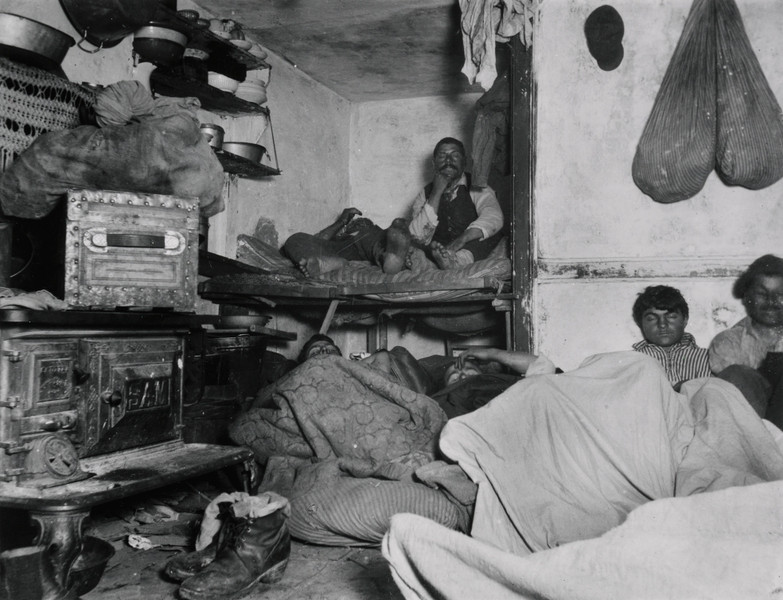
How the Other Half Lives photograph
Riis’s photos, like this crowded interior, are strong evidence of harsh urban conditions, but remember the sourcing move. He chose images to push reform and viewed immigrants from a middle-class reform perspective.
Women’s Reform and the Expansion of Public Life
Women entered reform through college, clubs, churches, and the idea of social housekeeping. They argued that protecting homes meant fixing public problems too.
Clubs, settlement houses, and civic reform
Colleges such as Vassar, Smith, Wellesley, and Bryn Mawr, plus coed western and midwestern state universities, opened new opportunities.
Women’s organizations built leadership skills:
- General Federation of Women’s Clubs (1890)
- Hull House founded in 1889 by Jane Addams and Ellen Gates Starr
Their reforms included education, public health, libraries, sanitation, child welfare, and immigrant aid. This work empowered women, but it could also be paternalistic toward immigrants and the poor.
Temperance and suffrage
- Woman’s Christian Temperance Union founded in 1874
- Frances Willard’s “Do Everything” program linked temperance to suffrage, labor reform, prison reform, and public health
- The “home protection” ballot said women needed the vote to protect families
- Suffrage groups included NWSA, AWSA, and after 1890 NAWSA
- Minor v. Happersett (1875) said citizenship did not automatically include voting rights
- Western wins came in Wyoming, Colorado, Utah, and Idaho
Black women’s reform
- National Association of Colored Women founded in 1896
- Mary Church Terrell led with the motto “Lifting as We Climb”
- Ida B. Wells fought lynching through journalism and speaking
Black women linked gender equality with racial justice, which is why “women’s reform” was never one united movement.
Key Takeaways
Agrarian Reform
Farmers’ response to debt, falling crop prices, and concentrated economic power through cooperatives; some also sought railroad regulation, easier credit, and a larger money supply
Producer Ideal
Belief that productive workers and farmers should receive the benefits of their labor and retain economic independence
Henry George
Author of Progress and Poverty who blamed inequality on private capture of rising land values and proposed a single tax on land
Single-Tax Movement
Henry George’s proposal to tax unimproved land value, discourage speculation, and recover socially created wealth without taxing labor or improvements
Edward Bellamy
Utopian author whose Looking Backward envisioned a peaceful transition to a nationally coordinated cooperative economy
Looking Backward
Edward Bellamy’s 1888 novel depicting a future cooperative commonwealth that replaced competition and private profit with national economic coordination
Socialism
Ideology holding that capitalism’s inequality arose from private ownership of major productive property and advocating collective, cooperative, or public ownership
Anarchism
Radical ideology rejecting both capitalism and coercive government in favor of decentralized voluntary cooperation
Eugene V. Debs
Labor leader whose Pullman Strike experience and imprisonment helped turn him toward socialism and a broader critique of capitalism
Social Gospel
Protestant movement applying Christian ethics to poverty and inequality and calling for institutional reform rather than charity or individual conversion alone
Washington Gladden
Early Social Gospel minister who defended labor organization and argued in Applied Christianity that economic relations were subject to Christian moral judgment
Walter Rauschenbusch
Minister among New York’s working class who became the leading Social Gospel theologian and carried its ideas into the Progressive Era
Realism
Literary and artistic movement that rejected idealization and portrayed ordinary people and social conditions more accurately
Naturalism
Form of realism emphasizing how environment, heredity, and economic forces constrained individual choice
The Gilded Age
Mark Twain and Charles Dudley Warner’s 1873 novel whose title suggested that a thin surface of prosperity concealed corruption and social disorder
Jacob Riis
Journalist and photographer who used investigation and tenement images in How the Other Half Lives to build support for urban housing reform
How the Other Half Lives
Jacob Riis’s 1890 investigation using writing and photographs to expose overcrowded and unsanitary New York tenements
Separate Spheres
Ideology assigning men to politics and paid public life while assigning women to domestic life and moral responsibility for the home
Voluntary Associations
Private clubs, churches, charities, and reform organizations through which women and others excluded from formal politics gained public influence
Social Housekeeping
Argument that women’s domestic duty to protect families justified public action on sanitation, education, housing, child welfare, and workplace safety
General Federation of Women’s Clubs
National organization founded in 1890 that linked women’s clubs and promoted libraries, schools, public health, conservation, and local reform
Settlement House Movement
Reform movement in which educated residents provided services, studied urban conditions, and advocated for immigrant and working-class neighborhoods
Hull House
Chicago settlement house founded in 1889 by Jane Addams and Ellen Gates Starr that provided services and supported social investigation and reform
Jane Addams
College-educated reformer who co-founded Hull House and turned settlement work into sustained social service, investigation, and advocacy
Temperance
Movement to reduce or prohibit alcohol because reformers linked drinking to poverty, violence, lost wages, crime, and workplace accidents
Woman’s Christian Temperance Union
Large women’s organization founded in 1874 that campaigned against alcohol and, under Frances Willard, expanded into suffrage and other reforms
Frances Willard
WCTU president from 1879 to 1898 who promoted the broad “Do Everything” program and the home-protection argument for women’s suffrage
Do Everything
Frances Willard’s WCTU program linking temperance with suffrage, labor reform, prison reform, public health, and protection of women and children
Home-Protection Ballot
Argument that women needed voting rights to protect their homes from alcohol and the laws and businesses supporting it
Women’s Suffrage Movement
Campaign for women’s voting rights using arguments based on citizenship, representation, self-protection, and women’s supposed moral influence
National Woman Suffrage Association vs. American Woman Suffrage Association
The NWSA pursued a federal amendment and broad women’s rights, while the AWSA emphasized state campaigns and supported the Fifteenth Amendment
Elizabeth Cady Stanton
Women’s rights leader who, with Susan B. Anthony, led the NWSA and pursued a federal suffrage amendment and a broad equality program
Susan B. Anthony
Suffrage leader who worked with Elizabeth Cady Stanton in the NWSA and campaigned for a federal women’s voting-rights amendment
National American Woman Suffrage Association
Organization formed in 1890 by the reunion of the NWSA and AWSA to coordinate the campaign for women’s voting rights
Minor v. Happersett
1875 Supreme Court decision ruling that citizenship did not itself guarantee women voting rights, encouraging state campaigns and a specific federal amendment
National Association of Colored Women
Black women’s organization founded in 1896 that combined community service, racial advancement, women’s leadership, and opposition to discrimination
Mary Church Terrell
First president of the National Association of Colored Women, whose “Lifting as We Climb” ideal joined community advancement with opposition to racism
Ida B. Wells
Journalist and activist who used evidence and speaking tours to expose lynching as racial terror rather than punishment for Black criminality
Grange
Agrarian organization that promoted cooperative purchasing and marketing to reduce farmers’ dependence on private middlemen
Farmers’ Alliances
Agrarian organizations that used cooperative purchasing and marketing to help farmers resist debt and dependence on railroads, merchants, and other middlemen
Progress and Poverty
Henry George’s 1879 book arguing that landowners captured socially created land values and advocating a single tax on unimproved land
Utopianism
Reform vision that imagined industrial society reorganized around cooperation and equality rather than competition and private profit
Women’s Higher Education
Expanded college access that gave women skills, professional opportunities, and networks for entering public life and leading reform
Notes
Agrarian Reform
Farmers’ response to debt, falling crop prices, and concentrated economic power through cooperatives; some also sought railroad regulation, easier credit, and a larger money supply
Producer Ideal
Belief that productive workers and farmers should receive the benefits of their labor and retain economic independence
Henry George
Author of Progress and Poverty who blamed inequality on private capture of rising land values and proposed a single tax on land
Single-Tax Movement
Henry George’s proposal to tax unimproved land value, discourage speculation, and recover socially created wealth without taxing labor or improvements
Edward Bellamy
Utopian author whose Looking Backward envisioned a peaceful transition to a nationally coordinated cooperative economy
Looking Backward
Edward Bellamy’s 1888 novel depicting a future cooperative commonwealth that replaced competition and private profit with national economic coordination
Socialism
Ideology holding that capitalism’s inequality arose from private ownership of major productive property and advocating collective, cooperative, or public ownership
Anarchism
Radical ideology rejecting both capitalism and coercive government in favor of decentralized voluntary cooperation
Eugene V. Debs
Labor leader whose Pullman Strike experience and imprisonment helped turn him toward socialism and a broader critique of capitalism
Social Gospel
Protestant movement applying Christian ethics to poverty and inequality and calling for institutional reform rather than charity or individual conversion alone
Washington Gladden
Early Social Gospel minister who defended labor organization and argued in Applied Christianity that economic relations were subject to Christian moral judgment
Walter Rauschenbusch
Minister among New York’s working class who became the leading Social Gospel theologian and carried its ideas into the Progressive Era
Realism
Literary and artistic movement that rejected idealization and portrayed ordinary people and social conditions more accurately
Naturalism
Form of realism emphasizing how environment, heredity, and economic forces constrained individual choice
The Gilded Age
Mark Twain and Charles Dudley Warner’s 1873 novel whose title suggested that a thin surface of prosperity concealed corruption and social disorder
Jacob Riis
Journalist and photographer who used investigation and tenement images in How the Other Half Lives to build support for urban housing reform
How the Other Half Lives
Jacob Riis’s 1890 investigation using writing and photographs to expose overcrowded and unsanitary New York tenements
Separate Spheres
Ideology assigning men to politics and paid public life while assigning women to domestic life and moral responsibility for the home
Voluntary Associations
Private clubs, churches, charities, and reform organizations through which women and others excluded from formal politics gained public influence
Social Housekeeping
Argument that women’s domestic duty to protect families justified public action on sanitation, education, housing, child welfare, and workplace safety
General Federation of Women’s Clubs
National organization founded in 1890 that linked women’s clubs and promoted libraries, schools, public health, conservation, and local reform
Settlement House Movement
Reform movement in which educated residents provided services, studied urban conditions, and advocated for immigrant and working-class neighborhoods
Hull House
Chicago settlement house founded in 1889 by Jane Addams and Ellen Gates Starr that provided services and supported social investigation and reform
Jane Addams
College-educated reformer who co-founded Hull House and turned settlement work into sustained social service, investigation, and advocacy
Temperance
Movement to reduce or prohibit alcohol because reformers linked drinking to poverty, violence, lost wages, crime, and workplace accidents
Woman’s Christian Temperance Union
Large women’s organization founded in 1874 that campaigned against alcohol and, under Frances Willard, expanded into suffrage and other reforms
Frances Willard
WCTU president from 1879 to 1898 who promoted the broad “Do Everything” program and the home-protection argument for women’s suffrage
Do Everything
Frances Willard’s WCTU program linking temperance with suffrage, labor reform, prison reform, public health, and protection of women and children
Home-Protection Ballot
Argument that women needed voting rights to protect their homes from alcohol and the laws and businesses supporting it
Women’s Suffrage Movement
Campaign for women’s voting rights using arguments based on citizenship, representation, self-protection, and women’s supposed moral influence
National Woman Suffrage Association vs. American Woman Suffrage Association
The NWSA pursued a federal amendment and broad women’s rights, while the AWSA emphasized state campaigns and supported the Fifteenth Amendment
Elizabeth Cady Stanton
Women’s rights leader who, with Susan B. Anthony, led the NWSA and pursued a federal suffrage amendment and a broad equality program
Susan B. Anthony
Suffrage leader who worked with Elizabeth Cady Stanton in the NWSA and campaigned for a federal women’s voting-rights amendment
National American Woman Suffrage Association
Organization formed in 1890 by the reunion of the NWSA and AWSA to coordinate the campaign for women’s voting rights
Minor v. Happersett
1875 Supreme Court decision ruling that citizenship did not itself guarantee women voting rights, encouraging state campaigns and a specific federal amendment
National Association of Colored Women
Black women’s organization founded in 1896 that combined community service, racial advancement, women’s leadership, and opposition to discrimination
Mary Church Terrell
First president of the National Association of Colored Women, whose “Lifting as We Climb” ideal joined community advancement with opposition to racism
Ida B. Wells
Journalist and activist who used evidence and speaking tours to expose lynching as racial terror rather than punishment for Black criminality
Grange
Agrarian organization that promoted cooperative purchasing and marketing to reduce farmers’ dependence on private middlemen
Farmers’ Alliances
Agrarian organizations that used cooperative purchasing and marketing to help farmers resist debt and dependence on railroads, merchants, and other middlemen
Progress and Poverty
Henry George’s 1879 book arguing that landowners captured socially created land values and advocating a single tax on unimproved land
Utopianism
Reform vision that imagined industrial society reorganized around cooperation and equality rather than competition and private profit
Women’s Higher Education
Expanded college access that gave women skills, professional opportunities, and networks for entering public life and leading reform
