Topic 3.13 Notes – Continuity and Change in Period 3
How the American Revolution Changed Society Unevenly
Independence came out of rising conflict after the French and Indian War. Britain won a huge empire, then tried to control it more tightly through the Proclamation of 1763, Sugar Act, Stamp Act, Townshend Acts, and Tea Act. Colonists saw these as attacks on self-government. Fighting at Lexington and Concord, Paine’s Common Sense, and the Declaration of Independence pushed resistance into a full independence movement.
This map helps you see the imperial backdrop. After 1763, Britain controlled much more of eastern North America and also tried to limit colonial settlement west of the Appalachians through the Proclamation of 1763.
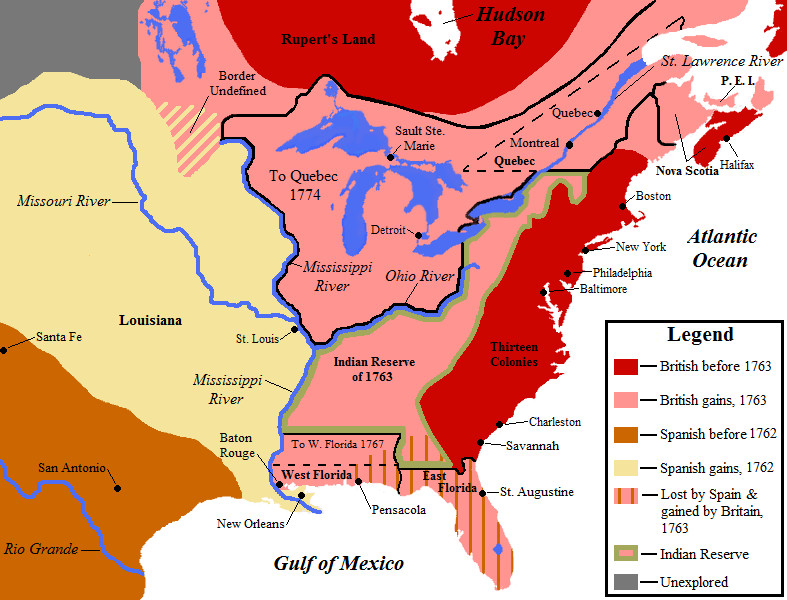
North America after the French and Indian War
The biggest change was political. Sovereignty moved from king and Parliament to the people of a new republic. The key ideas were popular sovereignty, republicanism, and natural rights.
The core continuity is just as important. Revolutionary ideals expanded debate about liberty more than they created actual equality. That’s the thesis you want in your head: major political and constitutional change, but limited and uneven social change. Change was strongest in government and national identity. Continuity was strongest in race, gender, class hierarchy, and western expansion.
What Changed in Government and Politics
The Revolution replaced monarchy with republicanism. Power was supposed to come from citizens, not heredity.
State governments
New state constitutions usually gave weak governors and strong legislatures because Americans feared concentrated power. Many also included rights protections for speech, religion, press, assembly, and due process.
The Articles of Confederation
The Articles created the first national government. They kept the union together and helped win peace in the Treaty of Paris 1783. Their other major success was western land policy.
The best example is the Northwest Ordinance of 1787:
- set a process for territories to become states
- promised equal statehood
- supported public education
- banned slavery in the Northwest Territory
Its weaknesses mattered a lot:
- no direct power to tax
- weak control over commerce
- no executive
- no national judiciary
The Constitution
The Constitution built a stronger federal system with federalism, separation of powers, checks and balances, and a bicameral legislature.
Key compromises:
- Great Compromise gave proportional representation in the House and equal representation in the Senate
- Three-Fifths Compromise, fugitive slave clause, and slave trade protection until 1808 protected slavery inside the new system
Federalists backed ratification. Anti-Federalists feared centralized power. Hamilton, Madison, and Jay argued for the Constitution in the Federalist Papers. The Bill of Rights was added in 1791.
Putting it into practice
Washington set major precedents through his cabinet, the two-term precedent, and support for the Judiciary Act. The Whiskey Rebellion showed the new government could enforce federal law. The Alien and Sedition Acts and the Kentucky and Virginia Resolutions showed the continuing fight over liberty versus order. Out of those debates came the first party system, Federalists vs. Democratic-Republicans.
What Changed and Stayed the Same in Society
Political life opened up for more white men, and people showed less respect for old aristocratic elites. Still, property qualifications remained common, and wealthy white men still dominated officeholding. The Senate and Electoral College reflected fear of direct democracy.
Women
Women supported the Revolution through boycotts, homespun production, fundraising, camp support, and managing farms and businesses. Abigail Adams captured the gap between ideals and reality when she urged John Adams to “remember the ladies.”
Republican motherhood gave women a larger role in raising virtuous citizens and increased support for women’s education. But coverture still limited married women’s legal identity, and women generally could not vote or hold office. One exception was property-owning women in early New Jersey.
Religion and culture
The Revolution weakened established churches and expanded religious liberty. Two anchors to know are the Virginia Statute for Religious Freedom and the First Amendment.
A new national culture also grew:
- neoclassical imagery linked the U.S. to Rome and Greece
- George Washington became a national symbol
- Noah Webster promoted American language and identity
Slavery, Native Peoples, and the Limits of Revolutionary Equality
Revolutionary language inspired antislavery petitions, manumission, and gradual emancipation in the North. Know Pennsylvania’s gradual abolition act of 1780. Free Black communities grew, and enslaved people sought freedom through military service, escape, and petitions.
But slavery stayed central in the South. The Constitution protected slaveholders, and Eli Whitney’s cotton gin in 1793 helped expand slavery southward and westward.
For American Indians, continuity was harsh. Settler pressure on Native land continued. The change was that the United States replaced Britain as the main expansionist power. The Treaty of Paris handed over land claims without Native consent. Native nations resisted through diplomacy, war, alliances, and confederation. After the Battle of Fallen Timbers in 1794, the Treaty of Greenville in 1795 opened much of Ohio to U.S. settlement.
Another western example is Spanish missions in California, where Native labor was coerced and cultures mixed under Spanish control.
National Identity, Foreign Relations, and Global Impact
The Revolution helped create a new American identity through the Declaration, shared war memory, and national institutions. Even so, strong regional differences remained. New England leaned commercial, the mid-Atlantic stayed diverse, the South rested on plantation slavery, and the West focused on land and frontier issues.
Foreign problems did not disappear with independence:
- Britain kept frontier posts
- Spain controlled Florida, Louisiana, and New Orleans
- Jay’s Treaty dealt with Britain
- Pinckney’s Treaty won access to the Mississippi
- Washington’s Proclamation of Neutrality and Farewell Address pushed the U.S. away from deep European entanglements
Revolutionary ideals also spread outward. They influenced the French Revolution, the Haitian Revolution, and later Latin American independence movements. The final judgment is the one APUSH loves: independence transformed political authority and constitutional government, but many inequalities and conflicts persisted or intensified depending on the group.
