Topic 5.8 Notes – Military Conflict in the Civil War
Why the Union Won the Civil War
The Union won through a combination of strengths, not one magic reason. Northern population, industry, railroads, food, and ships gave it the capacity for a long war. What mattered is that the Union eventually matched those resources with better leadership, a coordinated strategy, key victories, naval pressure, emancipation, and destruction of Southern infrastructure.
A common mistake is thinking early Confederate success proved the South was stronger. It showed something narrower. Southern advantages worked best in a short war, especially on defense and under strong generals like Lee and Jackson. The North had more potential, but it still had to organize that potential into victory.
The Starting Balance of Strengths and Weaknesses
At the start, each side had real advantages.
- Union advantages included about 22 million people against about 9 million in the Confederacy, including about 3.5 million enslaved people. The North also had more factories, banks, food production, merchant shipping, railroads, and the U.S. Navy.
- That meant the Union could equip huge armies, replace losses more easily, and keep fighting longer.
- Confederate advantages included fighting on home ground, needing only to survive rather than conquer the North, high motivation to defend local communities and slavery, and talented officers like Robert E. Lee and Thomas “Stonewall” Jackson.
- Southern leaders also hoped Northern casualties and war weariness would push the North to compromise.
Geography shaped everything, especially the mix of Union, Confederate, and border states at the start of the war.
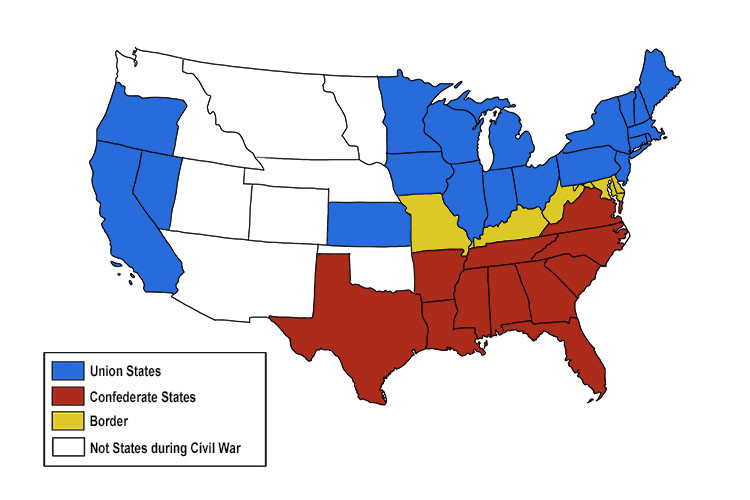
Union, Confederate, and border states at the start of the Civil War
- Fort Sumter began the war in April 1861.
- The border states were Delaware, Maryland, Kentucky, and Missouri.
- Maryland mattered because it protected Washington, D.C.
- Kentucky and Missouri mattered because they helped control the Mississippi Valley.
- The Union goal was to defeat Confederate armies and restore federal authority.
- The Confederate goal was to outlast the Union and win independence.
- First Bull Run showed this would be a long war, not a quick rebellion.
How Strategy and Leadership Shifted the War to the Union
Once the war dragged on, strategy and leadership mattered more and more.
- Anaconda Plan under Winfield Scott aimed to blockade Southern ports, seize the Mississippi River, and squeeze the Confederacy over time.
- Early Union leadership was shaky. George B. McClellan trained troops well but moved too cautiously. His Peninsula Campaign failed to take Richmond.
- The western theater showed Northern strength more clearly. Fort Henry, Fort Donelson, Shiloh, and David Farragut’s capture of New Orleans opened the South to attack.
- Antietam in 1862 stopped Lee’s invasion of the North. It was not a crushing tactical victory, but it was a strategic Union success.
- Gettysburg in July 1863 ended Lee’s second invasion. Pickett’s Charge failed, and the battle became the Confederacy’s “high-water mark.”
- Vicksburg, also in July 1863, gave the Union control of the Mississippi and split the Confederacy.
- In 1864, Grant coordinated simultaneous offensives. His campaigns included the Wilderness, Spotsylvania, Cold Harbor, and the siege of Petersburg.
- Sherman captured Atlanta in 1864, lifting Northern morale and helping Lincoln beat McClellan in the election.
How the War Became a Total Mobilization Struggle
This war pulled in whole societies, not just armies.
- Both sides began with volunteers, then moved to conscription.
- The Confederacy passed the first national draft in 1862. Exemptions for some slaveholders caused resentment.
- The Union draft came in 1863. Substitution and commutation made it look like wealthier men could avoid service.
The home front was full of strain.
- In the North, Peace Democrats, called Copperheads, wanted negotiation.
- The New York City Draft Riots of 1863 mixed anti-draft anger with brutal racist violence against African Americans.
- In the South, inflation, shortages, taxation, impressment, and desertion weakened support.
- The Richmond Bread Riot of 1863 showed civilian desperation.
- Unionist resistance in Appalachia led to West Virginia joining the Union in 1863.
Women kept both societies functioning. They ran farms and businesses and worked as nurses and relief workers. The United States Sanitary Commission helped support Union soldiers. Disease killed more soldiers than battle wounds.
Why the Confederacy Could Not Keep Fighting
Confederate hopes for foreign help collapsed. Cotton diplomacy failed because Britain and France found cotton in Egypt and India, Britain depended on Northern grain, and slavery made open support harder. After Antietam and the Emancipation Proclamation, intervention became even less likely.
Emancipation also changed the military balance. Enslaved people fled to Union lines, weakening Southern labor. Nearly 180,000 African American men served in the Union Army and about 20,000 in the Navy.
By late war, Union strategy became hard war. That meant attacking the South’s ability to keep armies in the field.
- Sherman’s March to the Sea destroyed railroads, crops, mills, and supply lines.
- Philip Sheridan wrecked resources in the Shenandoah Valley.
- Attrition favored the Union because the North could replace men and supplies better.
The end came fast in 1865. Petersburg and Richmond fell, and Lee surrendered to Grant at Appomattox Court House on April 9, 1865. This scene shows that final surrender meeting. The Union had kept pressure on until Confederate armies, morale, diplomacy, and infrastructure all collapsed together.
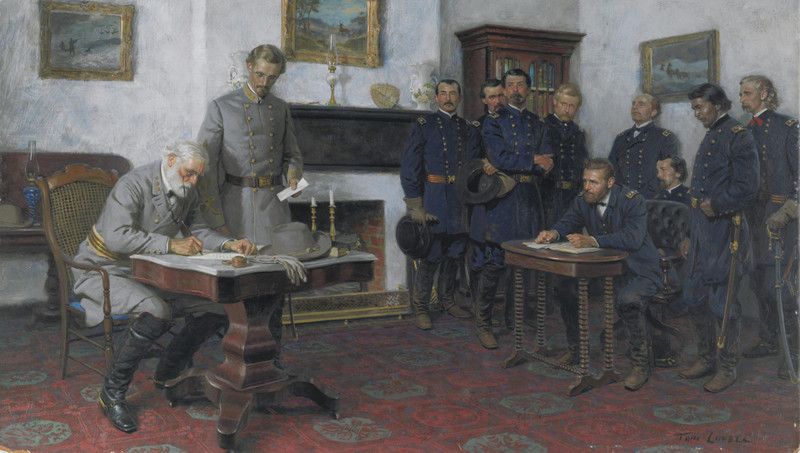
Lee surrenders to Grant at Appomattox Court House, 1865
Key Takeaways
Civil War
1861–1865 war in which the Union defeated the seceded Confederacy and restored federal authority
Fort Sumter
Federal fort attacked by Confederate forces on April 12, 1861, beginning the Civil War and prompting Lincoln’s call for troops
Border States
Delaware, Maryland, Kentucky, and Missouri—slave states that remained in the Union and provided vital people, resources, routes, and strategic geography
Union And Confederate War Aims
The Union had to defeat Southern armies and restore federal authority; the Confederacy needed only to survive until the North abandoned reunification
First Battle Of Bull Run (First Manassas)
July 1861 Confederate victory that disproved expectations of a short war and led both sides to raise larger armies
Union And Confederate Advantages
The Union had greater population, industry, finance, railroads, food, and naval power; the Confederacy had defensive geography, motivation, territory, and strong early commanders
Anaconda Plan
Union strategy to blockade Southern ports, control the Mississippi River, and steadily pressure Confederate armies and strategic centers
Winfield Scott
Union general associated with the Anaconda Plan for blockading and gradually constricting the Confederacy
Union Blockade
Naval effort that increasingly restricted Southern cotton exports and imports of weapons and manufactured supplies
Cotton Diplomacy
Failed Confederate strategy of using European dependence on Southern cotton to obtain recognition, supplies, or intervention from Britain and France
Civil War Conscription
The Confederacy adopted the first national draft in 1862 and the Union followed in 1863, with exemptions and substitution provisions provoking class resentment
New York City Draft Riots
July 1863 uprising combining opposition to the Union draft with class resentment, economic anxiety, and racist violence against African Americans
Peace Democrats (Copperheads)
Northern Democrats who opposed continued warfare and favored negotiating with the Confederacy
Richmond Bread Riot
1863 protest in which women facing severe food shortages looted Richmond stores, revealing Confederate home-front distress
African American Military Service
Nearly 180,000 Black men served in the Union Army and about 20,000 in the Navy, adding manpower while weakening slavery and the Confederate economy
Emancipation Proclamation
Wartime measure that encouraged enslaved people to flee, authorized Black military service, weakened Confederate labor, and discouraged European intervention
Robert E. Lee
Commander of the Army of Northern Virginia whose aggressive leadership produced early successes but costly losses and failed invasions of the North
Thomas “Stonewall” Jackson
Confederate general noted for rapid movement and tactical daring during the South’s early eastern victories
George B. McClellan
Union general who trained the Army of the Potomac well but repeatedly overestimated Confederate strength and hesitated to pursue decisive victory
Ulysses S. Grant
Aggressive Union commander who won key western victories and, from 1864, coordinated all Union armies in sustained pressure against the Confederacy
Fort Henry And Fort Donelson
Tennessee forts captured by Grant in February 1862, opening river routes into the Confederate interior
Battle Of Shiloh
Costly April 1862 battle in Tennessee that revealed the war’s growing scale and the Union’s ability to absorb heavy losses
David Farragut
Union naval commander who captured New Orleans in April 1862, depriving the Confederacy of its largest city and a major Mississippi port
Capture Of New Orleans
April 1862 Union naval victory that seized the Confederacy’s largest city and an important port near the Mississippi’s mouth
Battle Of Antietam
September 17, 1862 battle that ended Lee’s Maryland invasion and enabled Lincoln to announce emancipation from a position of strength
Battle Of Gettysburg
July 1–3, 1863 Union victory in Pennsylvania that ended Lee’s major northern invasion and forced the Confederacy increasingly onto the defensive
Vicksburg Campaign
Grant’s maneuver and siege campaign ending July 4, 1863, which gave the Union the Mississippi River and divided the Confederacy
Attrition
Wearing down an enemy by inflicting losses and consuming resources faster than they can be replaced, a struggle that favored the better-supplied Union
Overland Campaign
Grant’s costly 1864 Virginia campaign that maintained continuous pressure on Lee and drove the fighting toward Petersburg
Siege Of Petersburg
Prolonged Union operation against the railroad center supplying Richmond that pinned Lee’s army and subjected it to unsustainable attrition
William Tecumseh Sherman
Union general who captured Atlanta and conducted hard-war campaigns through Georgia and the Carolinas against Confederate infrastructure and resources
Atlanta Campaign
Sherman’s 1864 advance that captured a major Confederate railroad and industrial center, revived Northern morale, and aided Lincoln’s reelection
Election Of 1864
Lincoln defeated McClellan after the fall of Atlanta revived Northern morale, ensuring continuation of the war until Confederate defeat
Abraham Lincoln
Union president who sustained the war effort, replaced ineffective commanders, appointed Grant, and won reelection after Atlanta’s capture
Hard War (Scorched-Earth Warfare)
Late Union strategy destroying railroads, farms, factories, and supplies that sustained Confederate armies, without officially authorizing indiscriminate killing of civilians
Sherman’s March To The Sea
November–December 1864 march from Atlanta to Savannah that destroyed Confederate transportation, supplies, economic resources, and morale
Philip Sheridan
Union general whose hard-war campaign devastated the Shenandoah Valley’s agricultural resources and ability to supply Confederate armies
Rifled Muskets And Minié Balls
Accurate long-range firearms and conical bullets that increased infantry firepower and made attacks against entrenched defenders especially costly
Civil War Railroads
Railroads rapidly transported troops and supplies, making tracks, bridges, and junctions crucial military objectives and targets
Civil War Telegraph
Technology that allowed political and military leaders to communicate across long distances and coordinate operations more rapidly
Ironclad Warships
Armored steam-powered vessels that demonstrated the growing obsolescence of wooden warships during the Civil War
Battle Of Hampton Roads (USS Monitor And CSS Virginia)
Inconclusive March 1862 clash between ironclads that demonstrated the future of armored naval warfare
Appomattox Court House
Site where Lee surrendered to Grant on April 9, 1865, under generous terms that effectively ended major Confederate resistance
Peninsula Campaign
McClellan’s 1862 advance toward Richmond that was driven back during the Seven Days Battles, leaving the Confederate capital uncaptured
Total War
Warfare mobilizing entire societies and attacking resources that sustain armies; Union hard war moved toward it but did not authorize unrestricted attacks on civilians
Notes
Civil War
1861–1865 war in which the Union defeated the seceded Confederacy and restored federal authority
Fort Sumter
Federal fort attacked by Confederate forces on April 12, 1861, beginning the Civil War and prompting Lincoln’s call for troops
Border States
Delaware, Maryland, Kentucky, and Missouri—slave states that remained in the Union and provided vital people, resources, routes, and strategic geography
Union And Confederate War Aims
The Union had to defeat Southern armies and restore federal authority; the Confederacy needed only to survive until the North abandoned reunification
First Battle Of Bull Run (First Manassas)
July 1861 Confederate victory that disproved expectations of a short war and led both sides to raise larger armies
Union And Confederate Advantages
The Union had greater population, industry, finance, railroads, food, and naval power; the Confederacy had defensive geography, motivation, territory, and strong early commanders
Anaconda Plan
Union strategy to blockade Southern ports, control the Mississippi River, and steadily pressure Confederate armies and strategic centers
Winfield Scott
Union general associated with the Anaconda Plan for blockading and gradually constricting the Confederacy
Union Blockade
Naval effort that increasingly restricted Southern cotton exports and imports of weapons and manufactured supplies
Cotton Diplomacy
Failed Confederate strategy of using European dependence on Southern cotton to obtain recognition, supplies, or intervention from Britain and France
Civil War Conscription
The Confederacy adopted the first national draft in 1862 and the Union followed in 1863, with exemptions and substitution provisions provoking class resentment
New York City Draft Riots
July 1863 uprising combining opposition to the Union draft with class resentment, economic anxiety, and racist violence against African Americans
Peace Democrats (Copperheads)
Northern Democrats who opposed continued warfare and favored negotiating with the Confederacy
Richmond Bread Riot
1863 protest in which women facing severe food shortages looted Richmond stores, revealing Confederate home-front distress
African American Military Service
Nearly 180,000 Black men served in the Union Army and about 20,000 in the Navy, adding manpower while weakening slavery and the Confederate economy
Emancipation Proclamation
Wartime measure that encouraged enslaved people to flee, authorized Black military service, weakened Confederate labor, and discouraged European intervention
Robert E. Lee
Commander of the Army of Northern Virginia whose aggressive leadership produced early successes but costly losses and failed invasions of the North
Thomas “Stonewall” Jackson
Confederate general noted for rapid movement and tactical daring during the South’s early eastern victories
George B. McClellan
Union general who trained the Army of the Potomac well but repeatedly overestimated Confederate strength and hesitated to pursue decisive victory
Ulysses S. Grant
Aggressive Union commander who won key western victories and, from 1864, coordinated all Union armies in sustained pressure against the Confederacy
Fort Henry And Fort Donelson
Tennessee forts captured by Grant in February 1862, opening river routes into the Confederate interior
Battle Of Shiloh
Costly April 1862 battle in Tennessee that revealed the war’s growing scale and the Union’s ability to absorb heavy losses
David Farragut
Union naval commander who captured New Orleans in April 1862, depriving the Confederacy of its largest city and a major Mississippi port
Capture Of New Orleans
April 1862 Union naval victory that seized the Confederacy’s largest city and an important port near the Mississippi’s mouth
Battle Of Antietam
September 17, 1862 battle that ended Lee’s Maryland invasion and enabled Lincoln to announce emancipation from a position of strength
Battle Of Gettysburg
July 1–3, 1863 Union victory in Pennsylvania that ended Lee’s major northern invasion and forced the Confederacy increasingly onto the defensive
Vicksburg Campaign
Grant’s maneuver and siege campaign ending July 4, 1863, which gave the Union the Mississippi River and divided the Confederacy
Attrition
Wearing down an enemy by inflicting losses and consuming resources faster than they can be replaced, a struggle that favored the better-supplied Union
Overland Campaign
Grant’s costly 1864 Virginia campaign that maintained continuous pressure on Lee and drove the fighting toward Petersburg
Siege Of Petersburg
Prolonged Union operation against the railroad center supplying Richmond that pinned Lee’s army and subjected it to unsustainable attrition
William Tecumseh Sherman
Union general who captured Atlanta and conducted hard-war campaigns through Georgia and the Carolinas against Confederate infrastructure and resources
Atlanta Campaign
Sherman’s 1864 advance that captured a major Confederate railroad and industrial center, revived Northern morale, and aided Lincoln’s reelection
Election Of 1864
Lincoln defeated McClellan after the fall of Atlanta revived Northern morale, ensuring continuation of the war until Confederate defeat
Abraham Lincoln
Union president who sustained the war effort, replaced ineffective commanders, appointed Grant, and won reelection after Atlanta’s capture
Hard War (Scorched-Earth Warfare)
Late Union strategy destroying railroads, farms, factories, and supplies that sustained Confederate armies, without officially authorizing indiscriminate killing of civilians
Sherman’s March To The Sea
November–December 1864 march from Atlanta to Savannah that destroyed Confederate transportation, supplies, economic resources, and morale
Philip Sheridan
Union general whose hard-war campaign devastated the Shenandoah Valley’s agricultural resources and ability to supply Confederate armies
Rifled Muskets And Minié Balls
Accurate long-range firearms and conical bullets that increased infantry firepower and made attacks against entrenched defenders especially costly
Civil War Railroads
Railroads rapidly transported troops and supplies, making tracks, bridges, and junctions crucial military objectives and targets
Civil War Telegraph
Technology that allowed political and military leaders to communicate across long distances and coordinate operations more rapidly
Ironclad Warships
Armored steam-powered vessels that demonstrated the growing obsolescence of wooden warships during the Civil War
Battle Of Hampton Roads (USS Monitor And CSS Virginia)
Inconclusive March 1862 clash between ironclads that demonstrated the future of armored naval warfare
Appomattox Court House
Site where Lee surrendered to Grant on April 9, 1865, under generous terms that effectively ended major Confederate resistance
Peninsula Campaign
McClellan’s 1862 advance toward Richmond that was driven back during the Seven Days Battles, leaving the Confederate capital uncaptured
Total War
Warfare mobilizing entire societies and attacking resources that sustain armies; Union hard war moved toward it but did not authorize unrestricted attacks on civilians
