Topic 4.1 Notes – Contextualizing Period 4
How the Republic Changed from 1800 to 1848
In 1800, the U.S. still felt unfinished. The Constitution had created a stronger federal government, but people still argued over how much power that government should have. The country depended heavily on slavery, faced pressure from European empires, and kept expanding onto American Indian land.
The election of 1800 mattered because it was the first peaceful transfer of power between rival parties. Jefferson called it a revolution, and in one sense it was. It proved parties could compete without destroying the republic.
By 1848, the country had changed fast. The map below helps you track that growth from the original United States through the Louisiana Purchase, Texas annexation, Oregon settlement, and the land ceded by Mexico. Every new piece of land reopened the same question. Would slavery expand there?
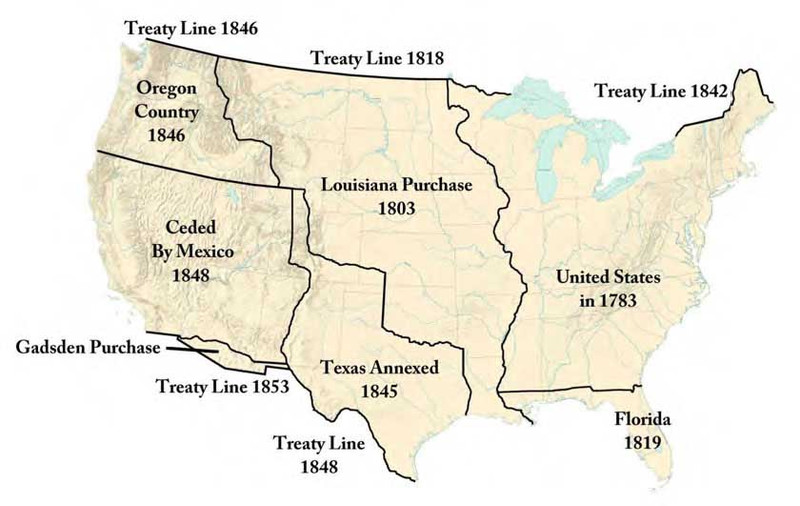
U.S. territorial growth, 1783 to 1848
The pattern for this whole period is the one teachers love to test. Democratization, economic growth, expansion, and reform all moved forward together, but unevenly. White men gained political power. Others often lost power or stayed excluded.
Politics Became More Democratic for White Men
Voting opened up far beyond property-owning white men. Western states often entered with broader suffrage, older states dropped property requirements, parties wanted more voters, and older social hierarchies weakened.
That did not mean democracy for everyone.
- Women could not vote.
- Free African American men often lost voting rights or faced restrictions, even as white men gained them.
- Enslaved people had no political rights.
- American Indians were treated as outside the political community.
Party systems
Politics became mass politics.
| System | Parties | What to know |
|---|---|---|
| First Party System | Federalists vs. Democratic-Republicans | Fought over federal power, the economy, and foreign policy |
| Era of Good Feelings | Federalists faded | One-party moment after War of 1812, but conflict did not disappear |
| Second Party System | Democrats vs. Whigs | Democrats backed Jackson and anti-elite rhetoric; Whigs backed Henry Clay and a stronger federal role in development |
Campaigning changed too. You get rallies, conventions, partisan newspapers, slogans, and organized voter turnout. Politics became louder, more popular, and more emotional.
Two constitutional anchors matter here:
- Marbury v. Madison established judicial review, giving the Supreme Court power to strike down unconstitutional laws.
- The Louisiana Purchase showed Jefferson using broad federal power even though he had claimed to favor strict construction.
Expansion, Foreign Policy, and Sectional Conflict
The U.S. wanted land, security, and trade, and those goals drove foreign policy.
- Louisiana Purchase (1803) doubled U.S. territory and secured the Mississippi River and New Orleans.
- Lewis and Clark expedition (1804-1806) mapped the land, collected scientific information, and strengthened U.S. claims.
- War of 1812 grew out of impressment, limits on neutral trade, and British support for American Indian resistance. The Treaty of Ghent ended the war. The war boosted nationalism, weakened the Federalists, and hurt Native resistance in the Old Northwest and South.
- Monroe Doctrine (1823) warned Europe against further colonization or intervention in the Americas. It showed rising U.S. ambition in the Western Hemisphere.
Expansion also meant American Indian dispossession. White settlement depended on coercive treaties, warfare, removal, and loss of Native sovereignty.
The slavery issue kept following expansion west.
Missouri Compromise
- Missouri entered as a slave state
- Maine entered as a free state
- Slavery banned north of 36°30′ in the rest of the Louisiana Purchase territory
This map helps you see the basic deal and why it mattered politically. It drew a line between free and slave expansion, but that line was only a temporary fix.
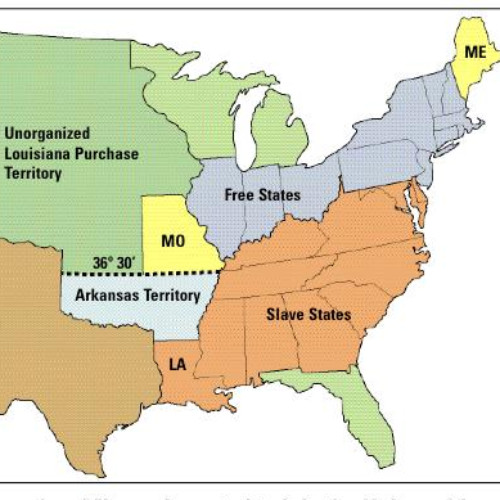
Missouri Compromise map
The Market Revolution Remade Work, Regions, and Reform
The market revolution was the shift from local or semi-subsistence production to a national commercial economy. People produced more for sale, less just for their own households.
Transportation and communication made that possible:
- Roads, canals, steamboats, railroads moved goods and people faster and cheaper.
- The Erie Canal linked the Great Lakes to the Hudson River and tied the Midwest to the Northeast.
- Samuel Morse’s telegraph sped up long-distance communication.
Manufacturing changed too.
- Factories, textile mills, steam power, and interchangeable parts increased production.
- Eli Whitney’s cotton gin made short-staple cotton highly profitable and drove cotton expansion.
Regional specialization
- Northeast built manufacturing, finance, and commerce
- Midwest focused on commercial farming
- South centered on cotton and slavery
This is a favorite APUSH pattern. The country became more connected and more sectional at the same time.
Social effects
- Wage labor grew, and many artisans lost control over production.
- A larger middle class grew, but so did a laboring poor.
- The Panics of 1819 and 1837 showed how unstable the new economy could be.
- The Lowell mills put young women into wage labor in textile factories.
- Separate spheres and the cult of domesticity framed middle-class women as moral guardians of the home.
- Irish and German immigrants built ethnic communities and also faced nativism.
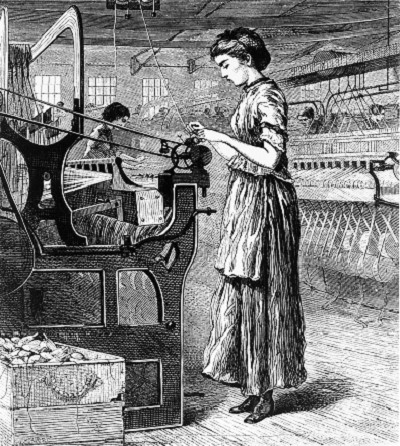
Lowell textile mill worker
Images like this one capture the kind of factory labor that expanded during the market revolution, especially for young women in textile mills.
Cotton South
The Deep South expanded through plantations and slavery. After the international slave trade ended in 1808, the domestic slave trade forcibly moved enslaved people south and west.
Enslaved people resisted in many ways:
- preserving families and religion
- slowing work
- escape
- rebellion
Know Gabriel’s Rebellion and Nat Turner’s Rebellion.
Religion, culture, and reform
The Second Great Awakening stressed conversion, moral choice, and human perfectibility. That energy fed voluntary reform movements such as temperance, public education, prison and asylum reform, abolition, utopian communities, and women’s rights.
The Seneca Falls Convention (1848) made women’s equality and suffrage explicit demands.
A national culture also grew. Emerson and Thoreau shaped transcendentalism, part of American Romanticism. At the same time, African American, immigrant, regional, and Native cultures stayed distinct.
